


The 3-Line Summary
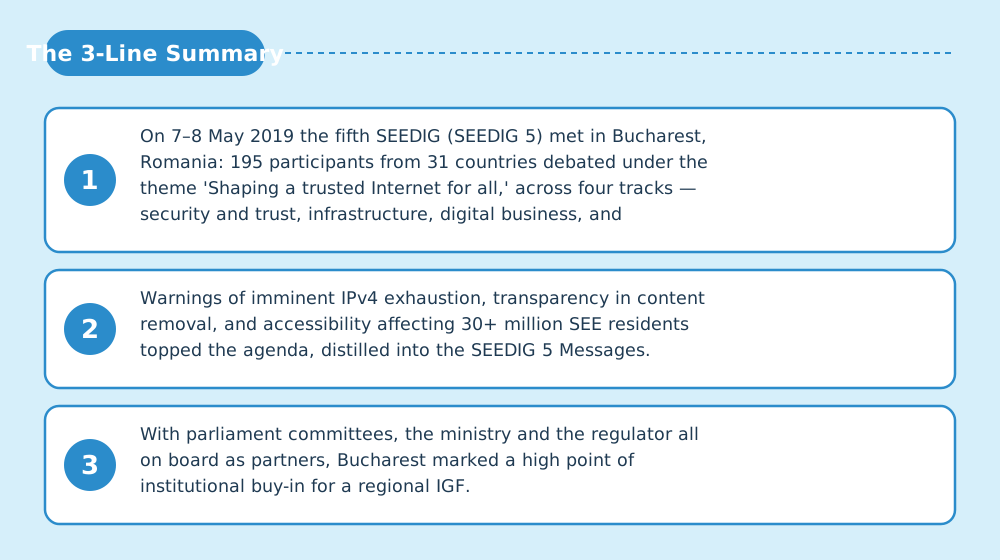
- On 7–8 May 2019 the fifth SEEDIG (SEEDIG 5) met in Bucharest, Romania: 195 participants from 31 countries debated under the theme 'Shaping a trusted Internet for all,' across four tracks — security and trust, infrastructure, digital business, and accessibility and skills.
- Warnings of imminent IPv4 exhaustion, transparency in content removal, and accessibility affecting 30+ million SEE residents topped the agenda, distilled into the SEEDIG 5 Messages.
- With parliament committees, the ministry and the regulator all on board as partners, Bucharest marked a high point of institutional buy-in for a regional IGF.
Welcome — this is the Japan IGF Support Organization. This in-depth report on SEEDIG 2019 in Bucharest draws on official outputs, session records and on-site reporting. In a hurry? The three lines above and the diagrams carry the gist.
Conference at a Glance (from official records)
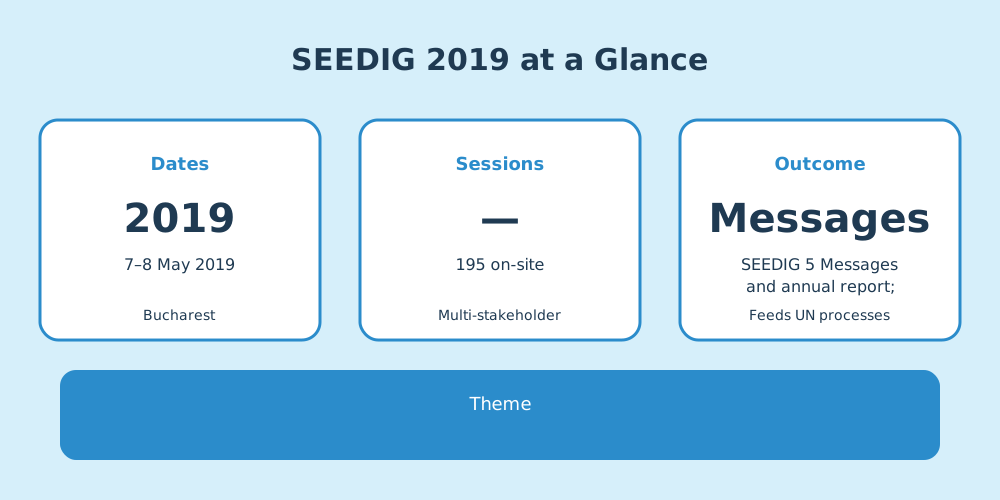
| Item | Detail |
|---|---|
| Dates | 7–8 May 2019 (Pre-events (including the Youth School) on 6 May; main meeting on 7–8 May. Branded 'SEEDIG 5') |
| Venue | Bucharest, Romania |
| Theme | Shaping a trusted Internet for all |
| Participants | 195 (195 participants from 31 countries; 90% from the SEE+ region, 45% women, 22% youth) |
| Host | Institutional partners included the Romanian Senate and Chamber of Deputies committees on communications, the Ministry of Communications and Information Society, and ANCOM; supported by the Council of Europe, European Commission, ICANN, Internet Society and RIPE NCC |
| Outcome | SEEDIG 5 Messages and annual report; third edition of the Youth School |
(See the source list at the end of this article.)
Discussion Digest — from the Session Records
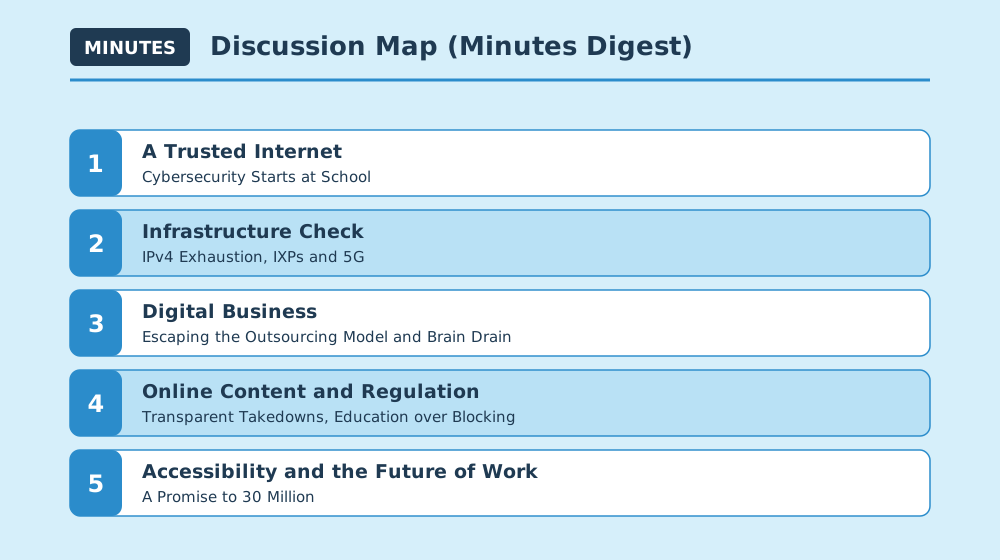
Key exchanges extracted from session records and transcripts.
1. A Trusted Internet — Cybersecurity Starts at School
Sessions: Track 1, 'Security and trust' (7–8 May)
- A secure cyberspace and stronger protection of users' rights were framed as preconditions for digital transformation, with cybersecurity to be integrated into school curricula from early stages [2]
- Because cyber threats ignore borders, the Messages called for regional cross-border cooperation and modernised legal frameworks and criminal-justice cooperation against cybercrime [2]
- Building trust means combining regulatory and self-regulatory mechanisms, clarifying actors' responsibilities, and developing human-centric technologies — notably AI — reflecting regional values [2]
2. Infrastructure Check — IPv4 Exhaustion, IXPs and 5G
Sessions: Track 2, 'Infrastructure and technologies for digital innovation,' with Hisham Ibrahim (RIPE NCC) and IXP figures from Romania and Serbia (Eric Băleanu, Dušan Stojičević)
"Allocations from returned IPv4 addresses are likely to run out by February 2020"
— Hisham Ibrahim (RIPE NCC) [2][3]
- With 'IPv4 addresses running out,' IPv6 deployment was called urgent, while IXPs and peering that keep traffic local were shown to cut latency and costs [2][3]
- On 5G, regional cooperation accelerates rollout; regulators were urged to improve spectrum access, streamline authorisation and try innovative award procedures [2][3]
- Mikhail Anisimov of the .ru registry walked through how regulation touches the Internet's technical foundations — DNS, BGP and certification authorities [2][3]
3. Digital Business — Escaping the Outsourcing Model and Brain Drain
Sessions: Track 3, 'Digital businesses: trends, challenges and regulations'
- The region's ICT industry leans heavily on outsourcing models, raising sustainability concerns [2][3]
- Common obstacles named: brain drain, bureaucracy, political instability, financing gaps and restrictive data-flow policies [2][3]
- Platform consolidation requires regulatory examination balancing connectivity benefits against competitiveness, with cross-sector regional cooperation prescribed for ecosystem building [2][3]
4. Online Content and Regulation — Transparent Takedowns, Education over Blocking
Sessions: Online content sessions and the opening, with Cătălin Drulă (Romanian Parliament ICT Committee), Maria-Manuela Catrina (Ministry of Communications), Eduard Lovin (ANCOM) and Chengetai Masango (UN IGF Secretariat)
"Regulatory challenges require non-discrimination, accountability, transparency and safety"
— Cătălin Drulă (Romanian Parliament Committee on ICT) [2][3]
- Platform content-removal systems lack transparency and adequate remedy procedures for users [2][3]
- Education and critical thinking were judged more effective against misinformation than blocking, while illegal-content removal needs clear procedures aligned with democratic principles [2][3]
- Responsibility is shared among users, companies and governments; ANCOM's Eduard Lovin announced plans to complete 5G spectrum allocation by 2020 [2][3]
5. Accessibility and the Future of Work — A Promise to 30 Million
Sessions: Track 4, 'Digital technologies: enhancing accessibility and skills'; at the third Youth School, 17 youth fellows debated Chief Ethics Officers at major tech companies
- Accessibility affects more than 30 million SEE residents — a quality-of-life and human-rights imperative — and persons with disabilities must take part in design, testing and evaluation [2][3]
- Public procurement should be leveraged to drive market adoption of accessibility standards, and universities should teach accessibility as a foundational ICT competency [2][3]
- On the future of work: education must build adaptability for multiple simultaneous careers, and governments need protective frameworks for gig-economy workers [2][3]
Three-Minute Short Talk — Your Questions Answered
Q. So what did the meeting decide?
A. SEEDIG doesn't decide — but its takeaways became the SEEDIG 5 Messages, delivered to governments and the UN IGF. Notably, Romania's parliament committees, ministry and regulator all signed on as partners.
Q. What was the most urgent topic?
A. IPv4 exhaustion. A RIPE NCC speaker warned the remaining addresses would likely run out by February 2020 — and the RIPE region indeed exhausted its IPv4 pool in November 2019, underscoring the IPv6 imperative.
Q. Why should I care?
A. Every theme travels: IPv6 migration, transparent content takedowns, and gig-worker protection are the same debates now running through platform regulation worldwide.
What Is SEEDIG? (for first-time readers)
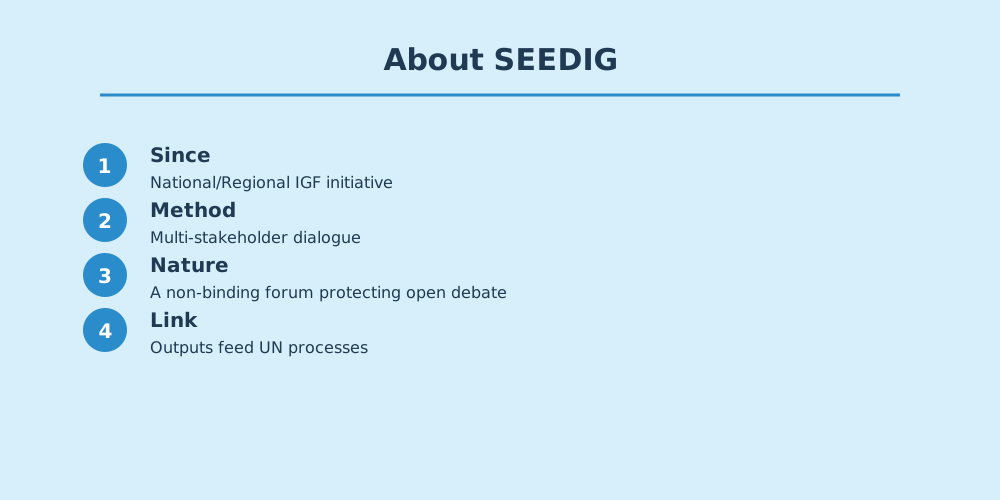
SEEDIG is a National or Regional IGF Initiative (NRI), aligning local internet governance discussion with global IGF principles.
Why It Matters to You
What was discussed here becomes the baseline for national digital policy, platform rules and AI regulation worldwide within a few years. The principles confirmed at the 2019 meeting are the foundation of the "next rules" for the phones, social platforms and AI services you use every day.
Sources & References
- SEEDIG 5 — SEEDIG(公式) (accessed 2026-07-11)
- Messages from SEEDIG 5 — SEEDIG(公式) (accessed 2026-07-11)
- SEEDIG 2019 Liveblog — RIPE Labs, Gergana Petrova (accessed 2026-07-11)
- South Eastern European Dialogue on Internet Governance — Wikipedia(英語版) (accessed 2026-07-11)
Quotes are translated or condensed from the records listed above. Bracketed numbers [n] refer to the source list.
Related links
- IGF official (NRI list): https://www.intgovforum.org/en/content/national-and-regional-igf-initiatives
- Japan IGF: https://japanigf.jp/
- Yuki Nakazawa's blog: https://nkzw.jp/category/igf/
Revision History
Rev. 1 — published 2 May 2019, 15:00 (Article published)
Rev. 2 — updated 11 July 2026, 02:14 (Fully revised into the in-depth edition: added the 3-line summary, minutes digest, short talk, source list and diagrams (all quotes verified against the listed sources))
— 中澤祐樹

