

The 3-Line Summary
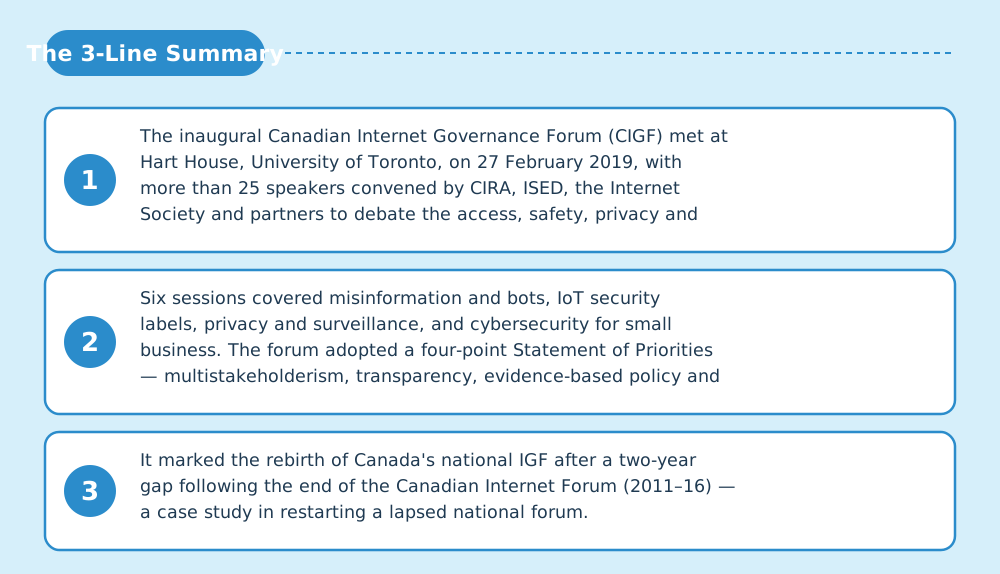
- The inaugural Canadian Internet Governance Forum (CIGF) met at Hart House, University of Toronto, on 27 February 2019, with more than 25 speakers convened by CIRA, ISED, the Internet Society and partners to debate the access, safety, privacy and security of Canada's internet.
- Six sessions covered misinformation and bots, IoT security labels, privacy and surveillance, and cybersecurity for small business. The forum adopted a four-point Statement of Priorities — multistakeholderism, transparency, evidence-based policy and user education — delivered to IGF 2019 in Berlin.
- It marked the rebirth of Canada's national IGF after a two-year gap following the end of the Canadian Internet Forum (2011–16) — a case study in restarting a lapsed national forum.
Welcome — this is the Japan IGF Support Organization. This in-depth report on Canadian Internet Governance Forum 2019 draws on official outputs, session records and on-site reporting. In a hurry? The three lines above and the diagrams carry the gist.
📍 The venue was Hart House at the University of Toronto (7 Hart House Cir.), per CIRA's media advisory of 26 February 2019 and dig.watch; the 'Ottawa, Canada' in the official site footer is the secretariat's address, not the event location
Conference at a Glance (from official records)
| Item | Detail |
|---|---|
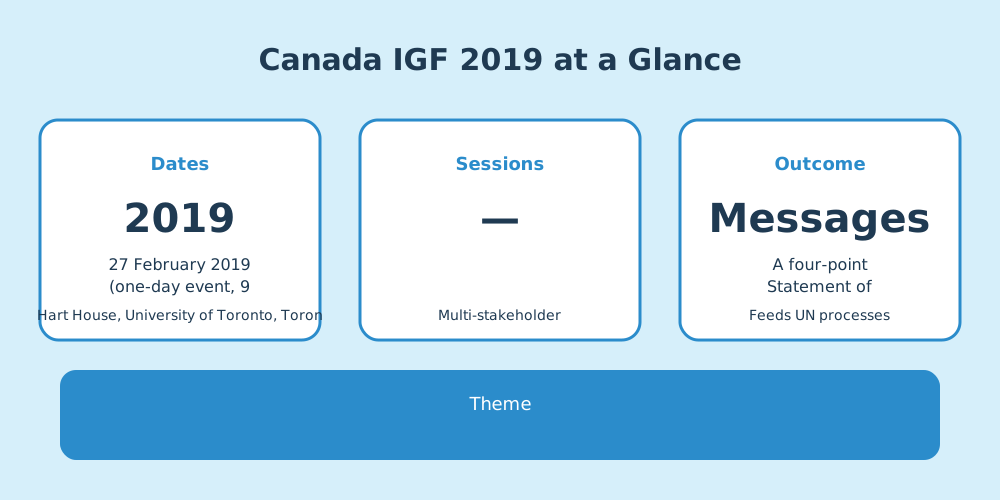
| Official name | Canadian Internet Governance Forum 2019 |
| Dates | 27 February 2019 (one-day event, 9 a.m.–4:30 p.m.) |
| Venue | Hart House, University of Toronto, Toronto, Canada |
| Theme | Regional governance themes |
| Host | Multistakeholder steering committee chaired by Nancy Carter (CANARIE); a collaboration of CIRA, ISED, CANARIE, the Internet Society, Youth IGF Canada and CIPPIC, with secretariat support from CIRA |
| Outcome | A four-point Statement of Priorities, fed into NRI agenda-setting at IGF 2019 in Berlin |
(See the source list at the end of this article.)
Discussion Digest — from the Session Records
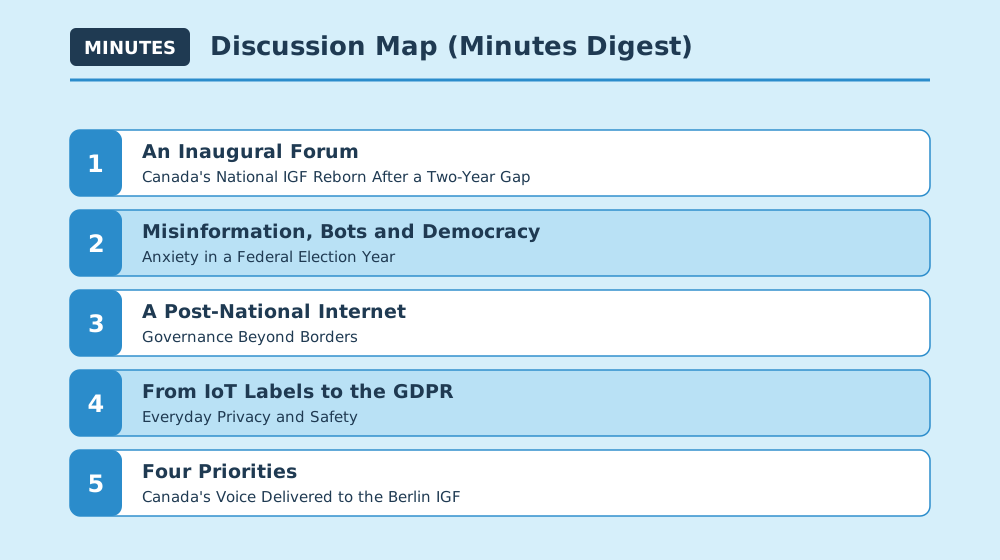
Key exchanges extracted from session records and transcripts.
1. An Inaugural Forum — Canada's National IGF Reborn After a Two-Year Gap
Sessions: Welcoming address by Byron Holland, President & CEO of CIRA
- CIRA, ISED, CANARIE, the Internet Society, Youth IGF Canada and CIPPIC joined in what the official report calls an unprecedented level of collaboration to relaunch Canada's national IGF as the inaugural CIGF [1][2][4]
- Opening the forum, CIRA CEO Byron Holland urged that solutions to internet problems must also weigh their impact on freedom and free speech, and asked how to bring the next three billion people online [1][2][4]
- CIRA research from December 2018 found 80% of Canadians see universal access to high-speed internet as critical to economic growth, while six in ten admitted having been taken in by fake news [1][2][4]
2. Misinformation, Bots and Democracy — Anxiety in a Federal Election Year
Sessions: Panel 'Misinformation, Bots, and Democracy' (Kevin Chan of Facebook Canada, Anatoliy Gruzd, David Skok and others)
- With 94% of Canadian internet users holding at least one social media account, exposure to disinformation campaigns was described as enormous [1]
- Facebook said it had grown its integrity workforce from 10,000 to 30,000 people and removed roughly 1.5 billion fake accounts in Q2–Q3 2018 [1]
- Panellists stressed that domestic actors pose a risk equal to or higher than foreign ones, and that the challenge is countering fake news without censoring legitimate speech [1]
3. A Post-National Internet — Governance Beyond Borders
Sessions: Opening keynote by Tucows CEO Elliot Noss and the panel 'Canada's Role in the Future of Internet Governance'
"hellz yeah, you have the right to be concerned and you should be"
— Konstantinos Komaitis (Internet Society) [1][4]
- In his keynote, Tucows CEO Elliot Noss argued the internet is a post-nation, transnational technology that should stay that way, and that problems of global magnitude cannot be solved by national remedies [1][4]
- The closing panel mapped four competing internet models — Silicon Valley (open, self-regulated), Washington D.C. (commercially driven), European (heavily regulated) and China (authoritarian, closed) — and warned of fragmentation from extraterritorial regulation [1][4]
- A third-party account by the Internet Governance Project praised the forum for its rational, optimistic tone, in contrast with the cyber-doomsday narratives at recent UN IGFs [1][4]
4. From IoT Labels to the GDPR — Everyday Privacy and Safety
Sessions: Panels 'Considerations for Effective Internet of Things Labels' and 'Privacy and Surveillance in the Internet Age'
- Speakers called for IoT security and privacy labels certified by trusted third parties and internationally interoperable — for a market of Canada's size, international standardisation or equivalency is the minimum requirement [1]
- Comparing the GDPR with Canada's PIPEDA, panellists found the guidelines similar but the heavy European fines fundamentally different, arguing Canada may need its own approach rather than importing the GDPR [1]
- Plain-language consent processes and the right to revoke consent at any time were recurring demands [1]
5. Four Priorities — Canada's Voice Delivered to the Berlin IGF
Sessions: Outcome document: Statement of Priorities
- The forum adopted four priorities: maintain and promote the multistakeholder approach; increase government and business transparency to build public trust; ensure thoughtful, evidence-based and proportionate solutions; and educate users on how to participate [1][5]
- As a National-Regional Initiative, the outcome document fed into agenda-setting for IGF 2019 in Berlin that November [1][5]
- In its debrief the steering committee planned to hold the 2020 event outside Ontario — a plan overtaken by the pandemic, which forced the 2020 edition online [1][5]
Three-Minute Short Talk — Your Questions Answered
Q. So what did the forum actually decide?
A. It doesn't legislate — it's Canada's UN-recognised national forum where government, business and civil society talk as equals. Its four-point Statement of Priorities was delivered to the global IGF in Berlin that November.
Q. Why was 2019 the 'first' one?
A. Canada previously had the CIRA-run Canadian Internet Forum (2011–2016), which ended in 2016. After a two-year gap, the community relaunched a national IGF under a new structure — the CIGF — in 2019.
Q. Why should I care?
A. The agenda — misinformation, IoT security labels, how far to follow the GDPR — mirrors debates in most democracies, and the CIGF is a useful case study in rebuilding a lapsed national IGF.
What Is Canada IGF? (for first-time readers)
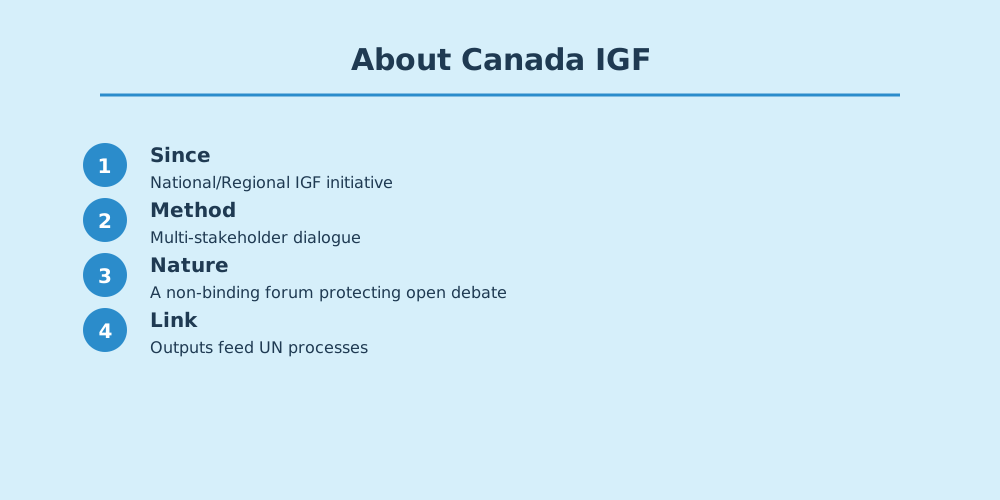
Canada IGF is a National or Regional IGF Initiative (NRI), aligning local internet governance discussion with global IGF principles.
Why It Matters to You
What was discussed here becomes the baseline for national digital policy, platform rules and AI regulation worldwide within a few years. The principles confirmed at the 2019 meeting are the foundation of the "next rules" for the phones, social platforms and AI services you use every day.
Sources & References
- Canadian Internet Governance Forum 2019 (official report) — Canadian IGF (accessed 2026-07-11)
- Media advisory: Internet leaders gather in Toronto tomorrow — CIRA(Internet Archive保存版) (accessed 2026-07-11)
- Canadian Internet Governance Forum 2019 — DiploFoundation (accessed 2026-07-11)
- A Post-national Canada for a Post-national Internet — Internet Governance Project(ジョージア工科大学) (accessed 2026-07-11)
- Canada IGF(NRI記録) — UN IGF Secretariat (accessed 2026-07-11)
Quotes are translated or condensed from the records listed above. Bracketed numbers [n] refer to the source list.
Related links
- IGF official (NRI list): https://www.intgovforum.org/en/content/national-and-regional-igf-initiatives
- Japan IGF: https://japanigf.jp/
- Yuki Nakazawa's blog: https://nkzw.jp/category/igf/
Revision History
Rev. 1 — published 23 July 2019, 11:00 (Article published)
Rev. 2 — updated 16 July 2026, 20:09 (Fully revised into the in-depth edition: added the 3-line summary, minutes digest, short talk, source list and diagrams (all quotes verified against the listed sources))
— 中澤祐樹