

The 3-Line Summary
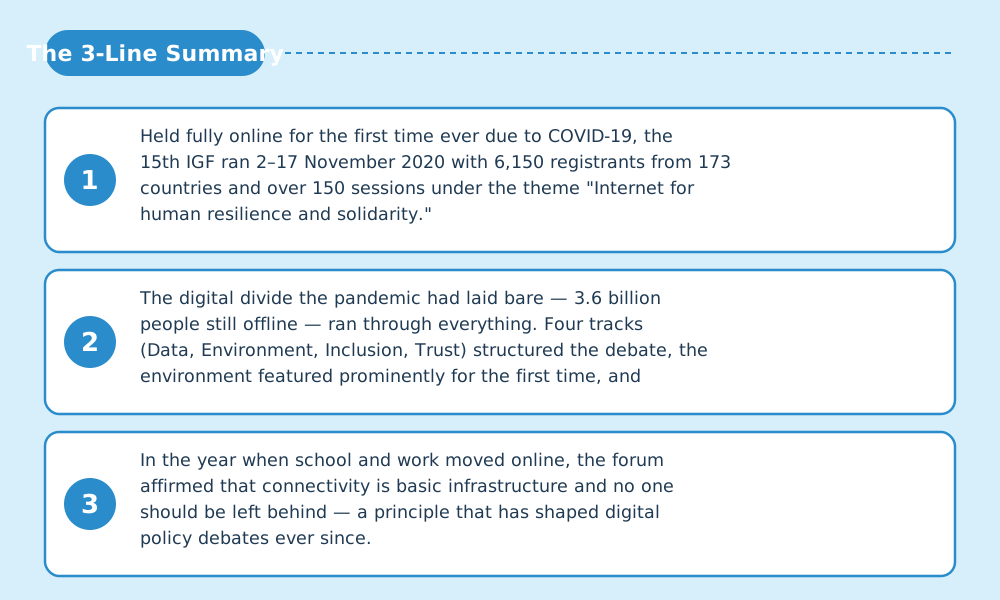
- Held fully online for the first time ever due to COVID-19, the 15th IGF ran 2–17 November 2020 with 6,150 registrants from 173 countries and over 150 sessions under the theme "Internet for human resilience and solidarity."
- The digital divide the pandemic had laid bare — 3.6 billion people still offline — ran through everything. Four tracks (Data, Environment, Inclusion, Trust) structured the debate, the environment featured prominently for the first time, and Secretary-General Guterres pressed for delivery of his Roadmap for Digital Cooperation and a stronger IGF.
- In the year when school and work moved online, the forum affirmed that connectivity is basic infrastructure and no one should be left behind — a principle that has shaped digital policy debates ever since.
Welcome — this is the Japan IGF Support Organization. This in-depth report on Global IGF 2020 in Virtual draws on official outputs, session records and on-site reporting. In a hurry? The three lines above and the diagrams carry the gist.
📍 The 15th IGF and the first ever held fully online. Originally planned for Katowice, Poland; the pandemic moved it online, and Poland instead hosted the 16th IGF in Katowice in 2021
Conference at a Glance (from official records)
| Item | Detail |
|---|---|
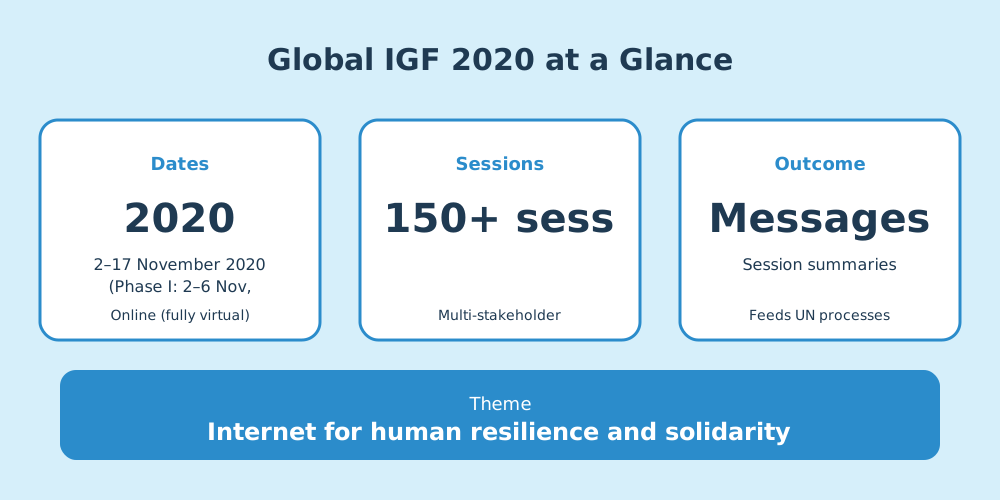
| Dates | 2–17 November 2020 (Phase I: 2–6 Nov, Phase II: 9–17 Nov) |
| Venue | Online (fully virtual) |
| Theme | Internet for human resilience and solidarity |
| Registrants | 6,150 |
| Participation | 15,000+ live viewers of high-level sessions on UN Web TV; 50% of session organisers and 47% of participants were women; 59% were first-time IGF attendees |
| Countries | 173 |
| Sessions | 150+ sessions |
| Host | United Nations (hosted online by the UN) |
| Outcome | Session summaries, transcripts, videos and voluntary commitments published; Poland confirmed at the closing as host of the 16th IGF (Katowice, 2021) |
| Milestone | 15th meeting; the first fully virtual IGF, held amid COVID-19 in the UN's 75th anniversary year |
(See the source list at the end of this article.)
Discussion Digest — from the Session Records
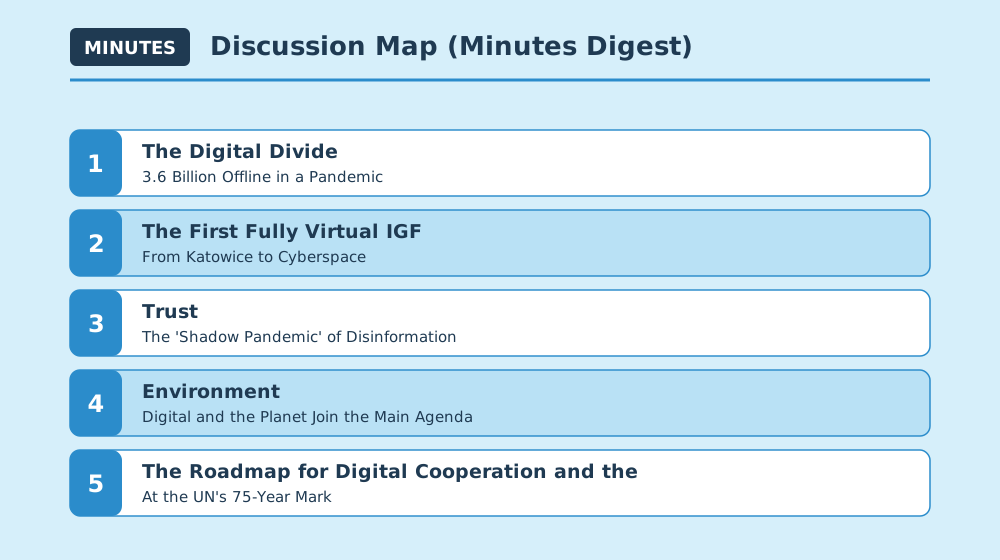
Key exchanges extracted from session records and transcripts.
1. The Digital Divide — 3.6 Billion Offline in a Pandemic
Sessions: Opening Session "Internet Governance in the Age of Uncertainty" (9 November) and the High-Level Leaders Track
"The SDG target of achieving universal connectivity by 2020 has not been met. In fact, 3.6 billion people continue to lack access to the internet"
— Volkan Bozkır (President of the UN General Assembly) [2][4]
"In the least developed countries, only 19 per cent of individuals were online in 2019. We are leaving a large majority behind"
— Liu Zhenmin (UN Under-Secretary-General for Economic and Social Affairs) [2][4]
"Those without access to digital technology – almost half the world – are denied opportunities to study, communicate, trade, shop, work and participate in much of modern life"
— António Guterres (UN Secretary-General) [2][4]
- With school, work and healthcare moving online, speakers stressed how the pandemic widened the gap for those left unconnected [2][4]
- Gender gaps, affordability and digital literacy were framed as barriers to 'meaningful access' beyond mere connectivity [2][4]
2. The First Fully Virtual IGF — From Katowice to Cyberspace
Sessions: The meeting as a whole (new two-phase format)
- Planned for Katowice, Poland, the meeting moved fully online — as the Polish hosts put it, 'We were supposed to meet in Katowice, now we will meet on the Internet' [1][6]
- 6,150 registrants from 173 countries, 59% of them first-timers — the travel-free format visibly widened participation [1][6]
- A new two-phase format (pre-events and introductory sessions, then the main meeting) tested what an online-native IGF could look like [1][6]
3. Trust — The 'Shadow Pandemic' of Disinformation
Sessions: Trust-track sessions and the closing video message (17 November)
"The shadow pandemic of disinformation about COVID-19 has put health and lives at risk"
— António Guterres (UN Secretary-General) [3][4][5]
- With cyber-attacks rising during the pandemic, online safety and security anchored the Trust track [3][4][5]
- Content moderation, DNS abuse and children's rights and online safety were debated across sessions [3][4][5]
4. Environment — Digital and the Planet Join the Main Agenda
Sessions: Environment-track sessions
- For the first time, climate and environmental issues were given headline status as one of the four thematic tracks [3][5]
- Participants called for deploying digital technology for planetary wellbeing, weighing digitalisation's footprint against its potential [3][5]
5. The Roadmap for Digital Cooperation and the IGF's Future — At the UN's 75-Year Mark
Sessions: Closing Session "Internet Governance in the Age of Uncertainty" (17 November)
"We need an Internet Governance Forum that is responsive, relevant and impactful"
— António Guterres (UN Secretary-General) [3][4]
- Delivering the Secretary-General's June 2020 Roadmap for Digital Cooperation — to connect, respect and protect all people online — was framed, in the UN's 75th anniversary year, as the IGF's new mission [3][4]
- The debate fed the push to make the IGF more outcome-oriented (the 'IGF+' agenda), and the closing confirmed Katowice, Poland as host of the 2021 meeting [3][4]
Three-Minute Short Talk — Your Questions Answered
Q. So what did the conference actually decide?
A. The IGF doesn't 'decide' — it's the UN's forum where governments, companies and civil society talk as equals. In 2020 it went fully virtual for the first time, drawing 6,150 registrants from 173 countries, and its discussions fed into the UN's Roadmap for Digital Cooperation.
Q. What was the biggest issue?
A. The digital divide. While the connected world moved school and work online, 3.6 billion people remained offline. As Secretary-General Guterres put it, almost half the world is denied participation in much of modern life — and that reality ran through every session.
Q. Why should I care?
A. Remote school, remote work and COVID disinformation were everyone's daily life in 2020. The principle affirmed here — that connectivity is basic infrastructure, like water or electricity — has shaped digital policy debates around the world since.
What Is Global IGF? (for first-time readers)
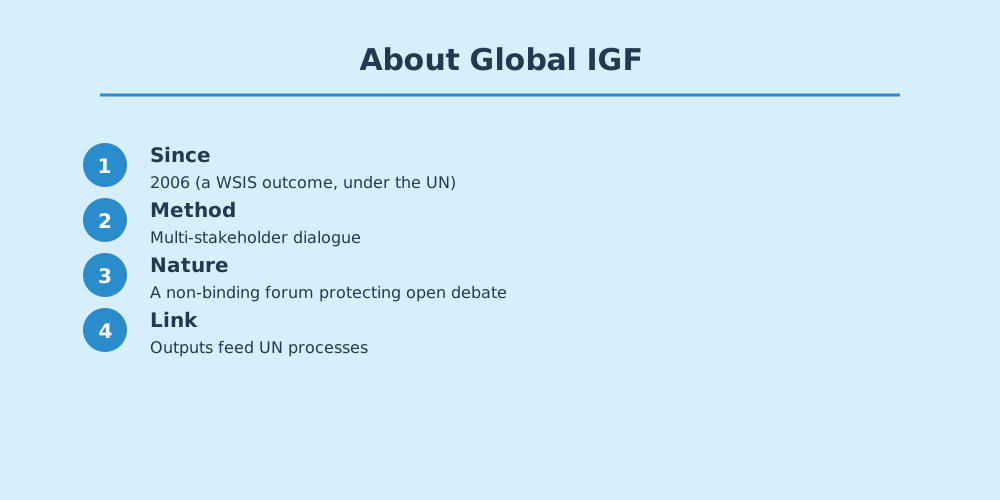
Global IGF has met annually under UN auspices since 2006 — the one global conference where governments, business, civil society, the technical community and youth debate internet governance as equals (the multistakeholder model).
Why It Matters to You
What was discussed here becomes the baseline for national digital policy, platform rules and AI regulation worldwide within a few years. The principles confirmed at the 2020 meeting are the foundation of the "next rules" for the phones, social platforms and AI services you use every day.
Sources & References
- IGF 2020: Virtually together for an Internet for human resilience and solidarity — UN IGF Secretariat (accessed 2026-07-10)
- Internet Governance Forum calls for bridging digital divides, harnessing the Internet to support human resilience and build solidarity amid COVID-19 — UN DESA (accessed 2026-07-10)
- Inclusive and meaningful access to Internet key for strong COVID-19 recovery, IGF concludes with calls for global unity to bridge digital divides — UN DESA (accessed 2026-07-10)
- Secretary-General's video message to the closing of the 15th Annual Internet Governance Forum: Internet Governance in the Age of Uncertainty — UN Secretary-General (accessed 2026-07-10)
- Internet Governance Forum (IGF) 2020 — session reports — DiploFoundation (accessed 2026-07-10)
- Virtual Internet Governance Forum 2020 – on the Internet, about the Internet — gov.pl (accessed 2026-07-10)
Quotes are translated or condensed from the records listed above. Bracketed numbers [n] refer to the source list.
Related links
- IGF official (NRI list): https://www.intgovforum.org/en/content/national-and-regional-igf-initiatives
- Japan IGF: https://japanigf.jp/
- Yuki Nakazawa's blog: https://nkzw.jp/category/igf/
Revision History
Rev. 1 — published 9 November 2020, 22:00 (Article published)
Rev. 2 — updated 10 July 2026, 14:28 (Fully revised into the in-depth edition: added the 3-line summary, minutes digest, short talk, source list and diagrams (all quotes verified against the listed sources))
— 中澤祐樹

