


The 3-Line Summary
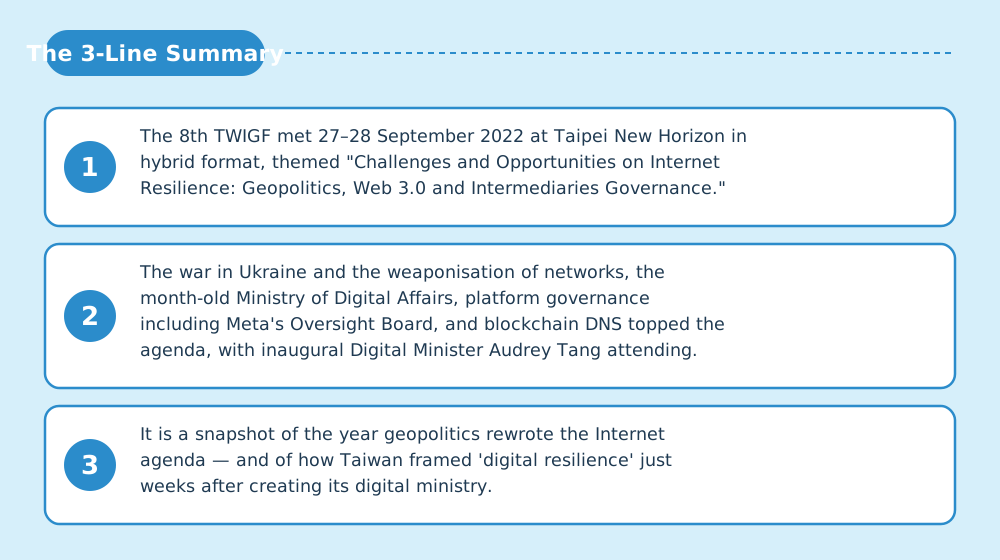
- The 8th TWIGF met 27–28 September 2022 at Taipei New Horizon in hybrid format, themed "Challenges and Opportunities on Internet Resilience: Geopolitics, Web 3.0 and Intermediaries Governance."
- The war in Ukraine and the weaponisation of networks, the month-old Ministry of Digital Affairs, platform governance including Meta's Oversight Board, and blockchain DNS topped the agenda, with inaugural Digital Minister Audrey Tang attending.
- It is a snapshot of the year geopolitics rewrote the Internet agenda — and of how Taiwan framed 'digital resilience' just weeks after creating its digital ministry.
Welcome — this is the Japan IGF Support Organization. This in-depth report on TWIGF 2022 (Taiwan Internet Governance Forum) draws on official outputs, session records and on-site reporting. In a hurry? The three lines above and the diagrams carry the gist.
📍 Hybrid format combining the Taipei New Horizon venue with live streaming
Conference at a Glance (from official records)
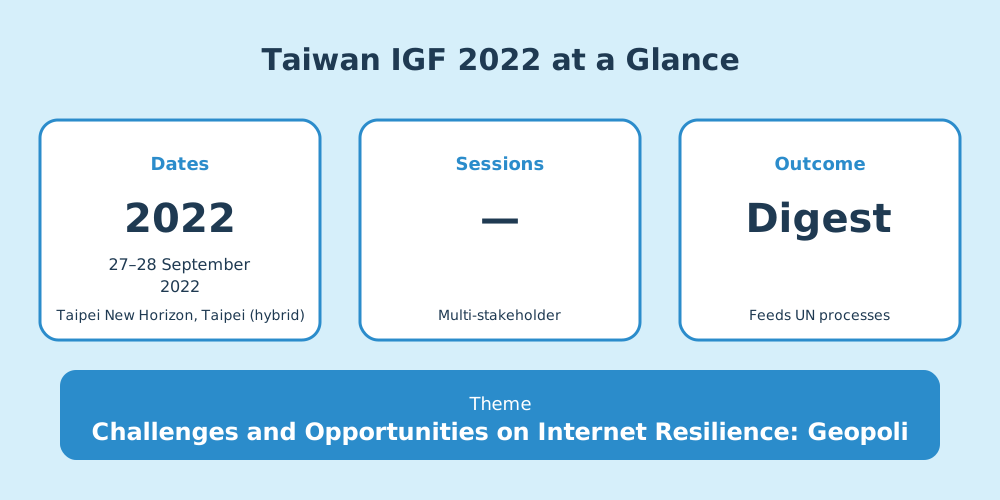
| Item | Detail |
|---|---|
| Official name | TWIGF 2022 (Taiwan Internet Governance Forum) |
| Edition | 8th annual meeting |
| Dates | 27–28 September 2022 |
| Venue | Taipei New Horizon, Taipei (hybrid) |
| Theme | Challenges and Opportunities on Internet Resilience: Geopolitics, Web 3.0 and Intermediaries Governance |
| Host | Taiwan Internet Governance Forum (TWIGF), in cooperation with TWNIC |
(See the source list at the end of this article.)
Discussion Digest — from the Session Records
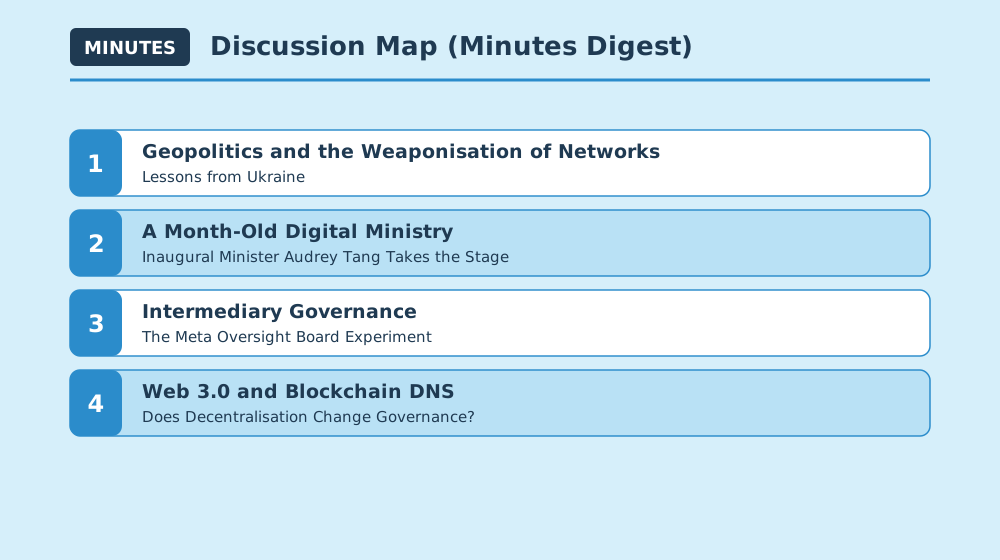
Key exchanges extracted from session records and transcripts.
1. Geopolitics and the Weaponisation of Networks — Lessons from Ukraine
Sessions: Opening ceremony and geopolitics sessions (27 September)
"In the Russia-Ukraine war we have seen how critical the Internet is — and how vulnerable it is (translated from Chinese)"
— Lo Ping-cheng (Minister without Portfolio, Executive Yuan) [2][3]
- Lo warned that malicious cyberattacks and floods of disinformation are weaponising inherently neutral network technologies and social media [2][3]
- Taiwan had just weathered waves of cyberattacks and disinformation around the August 2022 Pelosi visit, making resilience an immediate concern rather than an abstraction [2][3]
- NCC Chairman Chen Yaw-shyang also attended, adding the regulator's perspective [2][3]
2. A Month-Old Digital Ministry — Inaugural Minister Audrey Tang Takes the Stage
Sessions: Opening ceremony (27 September)
"This TWIGF's theme fully reflects the core concerns of today's Internet community (translated from Chinese)"
— Audrey Tang (Minister of Digital Affairs) [2][3]
- As first head of the Ministry of Digital Affairs — launched just a month earlier on 27 August 2022 — Tang discussed the Internet's future alongside TWIGF chair Kuo-Wei Wu and TWNIC CEO Kenny Huang [2][3]
- Tang noted the meeting's breadth across infrastructure, human rights, privacy, data protection, the economy and digital transformation [2][3]
- Kenny Huang argued that countering online threats requires public-sphere responses and co-governance across sectors [2][3]
3. Intermediary Governance — The Meta Oversight Board Experiment
Sessions: Intermediary governance sessions
- Sessions examined Meta's Oversight Board, noting it had received more than one million appeals while issuing 28 decisions [3]
- Intermediary governance — who enforces rules between platforms and states, including cross-border corporate data transfers — formed one of the meeting's three thematic pillars [3]
4. Web 3.0 and Blockchain DNS — Does Decentralisation Change Governance?
Sessions: Panel #3 "Blockchain Domain Names under Global Internet Governance" and related sessions
- Moderated by Henry Tsai — also a presiding judge at the Shilin District Court — Panel #3 explored how blockchain domains issued outside the established DNS regime challenge governance [3][5]
- Speakers cited over US$7 billion in blockchain-related attack and fraud losses, weighing Web 3.0's promise against its risks [3][5]
Three-Minute Short Talk — Your Questions Answered
Q. What was the headline issue at TWIGF 2022?
A. The weaponisation of the Internet exposed by the war in Ukraine. Executive Yuan minister Lo Ping-cheng opened by warning that cyberattacks and disinformation are turning neutral technology into weapons.
Q. In what capacity did Audrey Tang appear?
A. As the inaugural Minister of Digital Affairs — the ministry had launched only a month earlier. It was the new ministry's first TWIGF, signalling that the government owned the 'resilience' agenda.
Q. Why does it matter elsewhere?
A. Taiwan's new digital ministry invites comparison with digital agencies worldwide, and its intermediary-governance debate mirrors platform-regulation fights in the EU, Japan and beyond.
What Is Taiwan IGF? (for first-time readers)
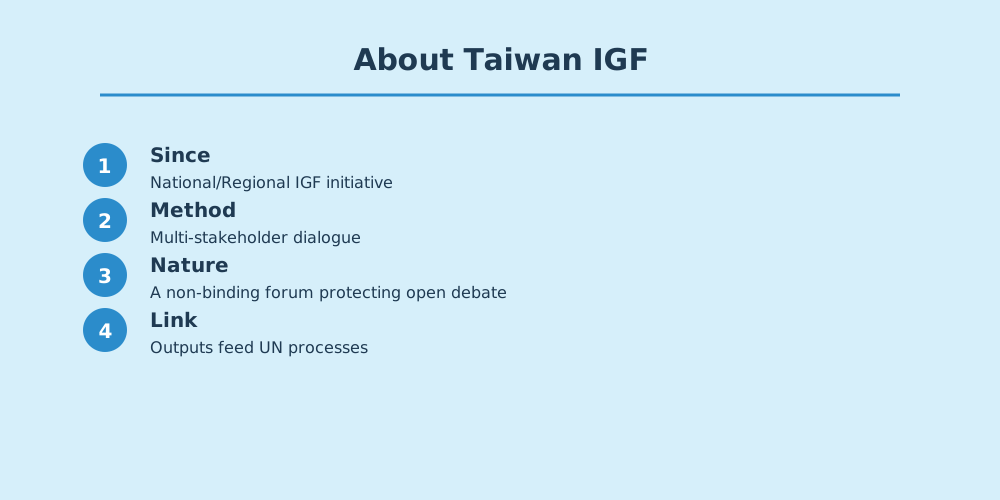
Taiwan IGF is a National or Regional IGF Initiative (NRI), aligning local internet governance discussion with global IGF principles.
Why It Matters to You
What was discussed here becomes the baseline for national digital policy, platform rules and AI regulation worldwide within a few years. The principles confirmed at the 2022 meeting are the foundation of the "next rules" for the phones, social platforms and AI services you use every day.
Sources & References
- TWIGF 2022(公式ページ) — TWIGF (accessed 2026-07-11)
- 第8屆TWIGF 臺灣網路治理論壇年會登場 — DIGITIMES (accessed 2026-07-11)
- 第8屆TWIGF 臺灣網路治理論壇與數位部唐鳳探討台灣網路韌性發展 — Information Security (accessed 2026-07-11)
- 【 TWIGF論壇-網路韌性的挑戰與契機:地緣政治、WEB 3.0 與中介者治理】2022年大會,即將盛大登場 — TWNIC Blog(財團法人台灣網路資訊中心) (accessed 2026-07-11)
- 【TWIGF 2022 臺灣網路治理論壇】Panel#3 全球網路治理下的區塊鏈域名(登壇報告) — 国立陽明交通大学科技法律学院 (accessed 2026-07-11)
Quotes are translated or condensed from the records listed above. Bracketed numbers [n] refer to the source list.
Related links
- IGF official (NRI list): https://www.intgovforum.org/en/content/national-and-regional-igf-initiatives
- Japan IGF: https://japanigf.jp/
- Yuki Nakazawa's blog: https://nkzw.jp/category/igf/
Revision History
Rev. 1 — published 24 July 2022, 15:00 (Article published)
Rev. 2 — updated 16 July 2026, 20:09 (Fully revised into the in-depth edition: added the 3-line summary, minutes digest, short talk, source list and diagrams (all quotes verified against the listed sources))
— 中澤祐樹

