


The 3-Line Summary
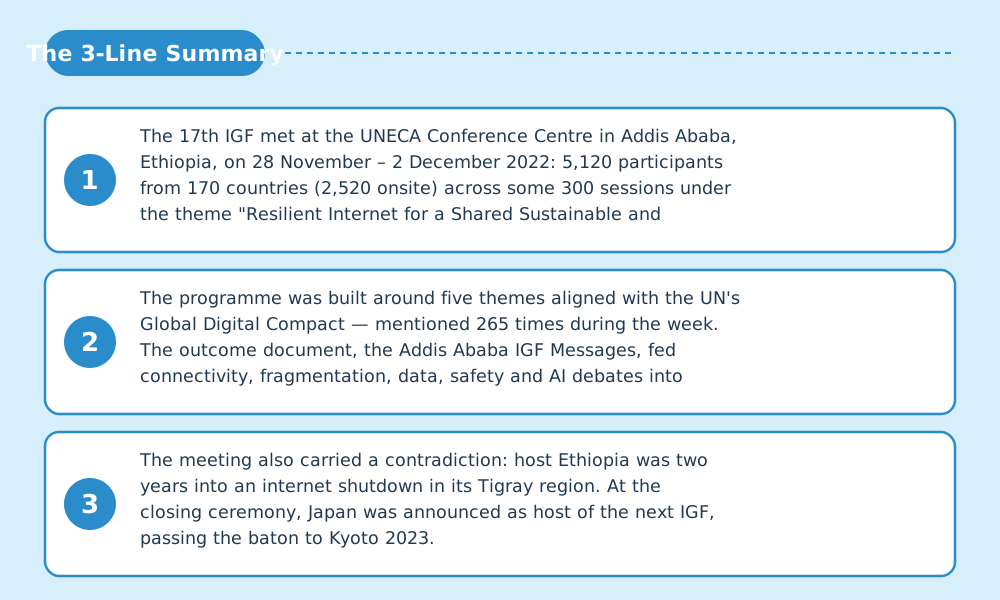
- The 17th IGF met at the UNECA Conference Centre in Addis Ababa, Ethiopia, on 28 November – 2 December 2022: 5,120 participants from 170 countries (2,520 onsite) across some 300 sessions under the theme "Resilient Internet for a Shared Sustainable and Common Future."
- The programme was built around five themes aligned with the UN's Global Digital Compact — mentioned 265 times during the week. The outcome document, the Addis Ababa IGF Messages, fed connectivity, fragmentation, data, safety and AI debates into the 2024 GDC process.
- The meeting also carried a contradiction: host Ethiopia was two years into an internet shutdown in its Tigray region. At the closing ceremony, Japan was announced as host of the next IGF, passing the baton to Kyoto 2023.
Welcome — this is the Japan IGF Support Organization. This in-depth report on Global IGF 2022 in Addis Ababa draws on official outputs, session records and on-site reporting. In a hurry? The three lines above and the diagrams carry the gist.
Conference at a Glance (from official records)
| Item | Detail |
|---|---|
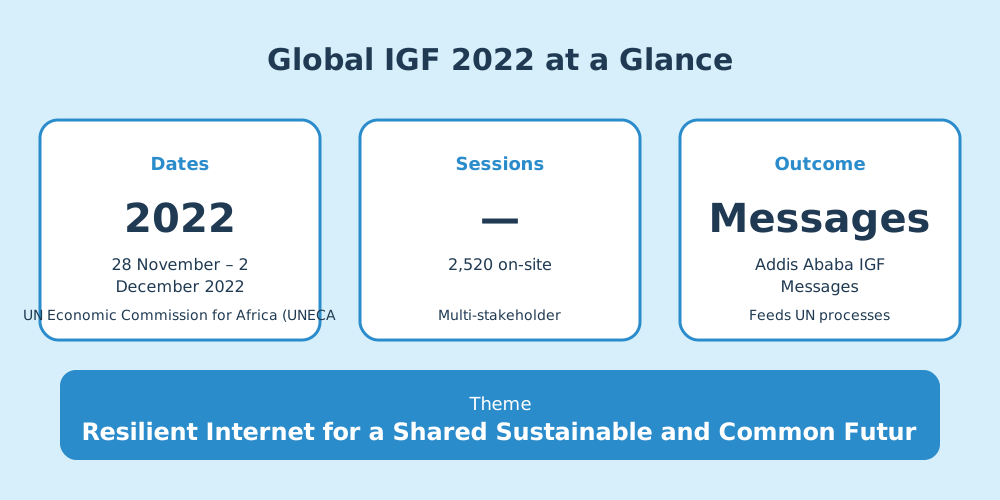
| Dates | 28 November – 2 December 2022 |
| Venue | UN Economic Commission for Africa (UNECA) Conference Centre, Addis Ababa, Ethiopia |
| Theme | Resilient Internet for a Shared Sustainable and Common Future |
| Participants | 5,120 |
| On-site participants | 2,520 |
| Countries | 170 |
| Host | Government of Ethiopia and the United Nations |
| Outcome | Addis Ababa IGF Messages |
| Milestone | First IGF in Africa since Nairobi 2011; the 17th annual meeting |
(See the source list at the end of this article.)
Discussion Digest — from the Session Records
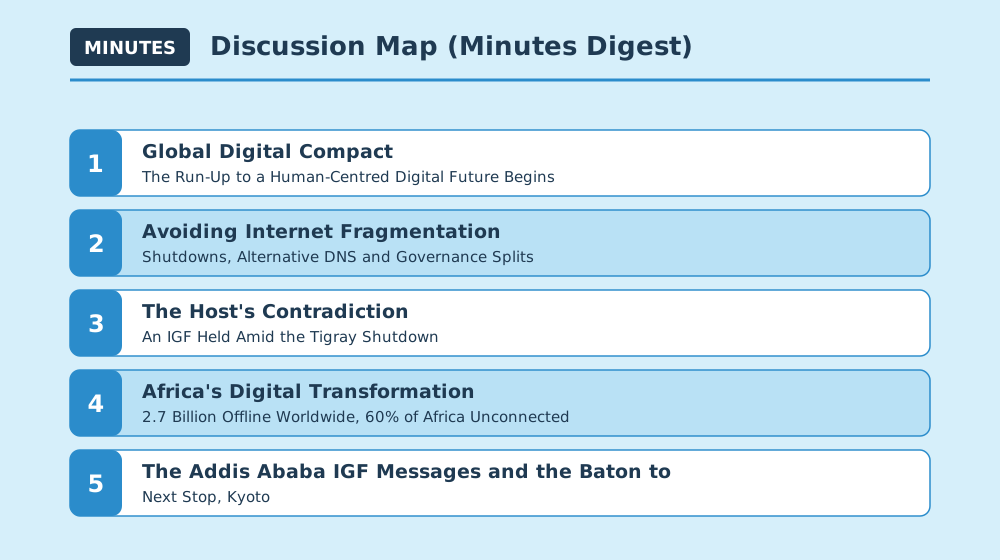
Key exchanges extracted from session records and transcripts.
1. Global Digital Compact — The Run-Up to a Human-Centred Digital Future Begins
Sessions: Opening Ceremony (29 November) and the meeting as a whole (five themes aligned with the GDC)
"The safe, secure human-centred digital space begins with the protection of free speech, freedom of expression and the right to online autonomy and privacy"
— António Guterres (UN Secretary-General) [1][4][7]
- For the first time the IGF's five themes (connecting all people and human rights, avoiding fragmentation, data and privacy, safety and accountability, advanced technologies including AI) were designed around the GDC's focus areas — and the GDC was mentioned 265 times during the sessions [1][4][7]
- A visible increase in diplomats and government officials signalled that digital policy had become core business for national diplomacies [1][4][7]
- The debates were framed as key input into the Global Digital Compact to be adopted at the UN Summit of the Future in 2024 [1][4][7]
2. Avoiding Internet Fragmentation — Shutdowns, Alternative DNS and Governance Splits
Sessions: Policy Network on Internet Fragmentation (PNIF) session and related fragmentation sessions
- The PNIF presented a three-layer framework: user-experience fragmentation (intentional disruptions such as internet shutdowns), technical fragmentation (alternative DNS and other measures harming interoperability), and fragmentation of governance coordination among standards bodies [3][4]
- dig.watch's wrap-up argued that "the red line which will make or break the internet is adherence to the use of the same core protocols, in particular, the TCP/IP"; cyber aspects of conflicts such as the Ukraine war were only sporadically raised [3][4]
- Concrete cases where fragmentation is already under way were reported, such as browsers blocking government-issued encryption certificates in Kazakhstan and Russia [3][4]
3. The Host's Contradiction — An IGF Held Amid the Tigray Shutdown
Sessions: Pre-event press coverage and civil-society campaigning (#KeepItOn)
"The IGF and UN's position on shutdowns everywhere has been consistent; they are incompatible with human rights"
— Chengetai Masango (IGF Secretariat) [8]
- Host Ethiopia was two years into an internet shutdown in its Tigray region, imposed when the military campaign began in November 2020 — drawing international criticism of holding a UN internet meeting in a shutdown country [8]
- The #KeepItOn coalition of 280+ organisations in 105 countries and Access Now campaigned to end what they called a "weaponised" shutdown that cut off families and impeded humanitarian aid [8]
- A June 2022 UN report had noted that shutdowns often coincide with armed operations and can conceal human rights violations [8]
4. Africa's Digital Transformation — 2.7 Billion Offline Worldwide, 60% of Africa Unconnected
Sessions: Opening ceremony, high-level track and Africa-focused sessions
"The internet's contribution to social development is immense, the democratization of knowledge and communication, access to entrepreneurship skills and new employment opportunities, health care access and education are a few noteworthy ones"
— Abiy Ahmed (Prime Minister of Ethiopia) [5][7][4]
"Harmonizing regulations to remove barriers to connectivity both within African nations and across the continent is crucial"
— Antonio Pedro (Acting Executive Secretary, UN Economic Commission for Africa) [5][7][4]
- Opening remarks reported 2.7 billion people offline worldwide, with Africa the least connected region at 60% of its population offline (versus 89% connected in Europe) [5][7][4]
- While about 70% of Africa's population is within mobile-internet coverage, fewer than 25% actually use it, largely due to high costs [5][7][4]
- An African Parliamentary Network on Internet Governance was launched, strengthening the engagement of developing-country parliaments [5][7][4]
5. The Addis Ababa IGF Messages and the Baton to Japan — Next Stop, Kyoto
Sessions: Closing Ceremony (2 December)
"This is what is unique about the IGF. It is a vibrant participatory space, multi-stakeholder platform and multilateral process, involving inputs from over 170 countries"
— Li Junhua (UN Under-Secretary-General for Economic and Social Affairs) [1][6]
- The Addis Ababa IGF Messages, synthesising the points raised across roughly 300 sessions, were finalised in January 2023 after a public consultation [1][6]
- The closing ceremony announced Japan as host of the 18th IGF in 2023 — later confirmed for Kyoto — making Addis Ababa the run-up event for Japan's internet governance community [1][6]
- Speakers stressed that the IGF is a year-long cyclic process, not a standalone annual meeting, and called on stakeholders to disseminate the Messages to decision-makers [1][6]
Three-Minute Short Talk — Your Questions Answered
Q. So what did the conference actually decide?
A. The IGF doesn't 'decide' — it's the UN's forum where governments, companies and civil society talk as equals. But the discussions were distilled into the Addis Ababa IGF Messages, a key input into the Global Digital Compact the UN adopted in 2024.
Q. What was the most contentious topic?
A. The venue itself. Host Ethiopia had kept its Tigray region offline for two years while hosting a conference on the future of the internet. Rights groups worldwide protested, and even the IGF Secretariat stated that shutdowns are incompatible with human rights.
Q. Why should I care?
A. This is where the Global Digital Compact debate — the UN's attempt at shared rules for the digital world — really started, and where the fight against a fragmenting 'splinternet' took centre stage. Both now shape national digital policy everywhere. It also handed the baton to IGF 2023 in Kyoto, Japan.
What Is Global IGF? (for first-time readers)
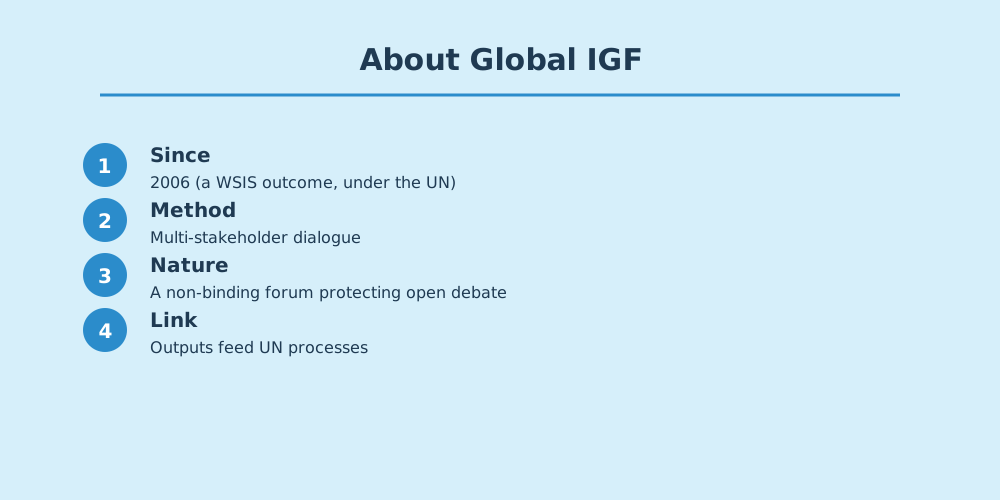
Global IGF has met annually under UN auspices since 2006 — the one global conference where governments, business, civil society, the technical community and youth debate internet governance as equals (the multistakeholder model).
Why It Matters to You
What was discussed here becomes the baseline for national digital policy, platform rules and AI regulation worldwide within a few years. The principles confirmed at the 2022 meeting are the foundation of the "next rules" for the phones, social platforms and AI services you use every day.
Sources & References
- IGF 2022 Outputs(Addis Ababa IGF Messages ほか) — UN IGF Secretariat (accessed 2026-07-10)
- IGF 2022 Participation & Programme Statistics — UN IGF Secretariat (accessed 2026-07-10)
- Internet Governance Forum 2022 — event page & session reports — DiploFoundation (accessed 2026-07-10)
- IGF 2022 Summary Report — DiploFoundation (accessed 2026-07-10)
- Opening Remarks at Opening Session of 17th IGF — UN DESA (accessed 2026-07-10)
- Closing Ceremony at IGF 2022 — UN DESA (accessed 2026-07-10)
- Investing in resilient internet will enhance inclusive, sustainable growth in Africa — UNECA (accessed 2026-07-10)
- Ethiopia hosts UN internet meeting after cutting off Tigray — via DC News Now (accessed 2026-07-10)
Quotes are translated or condensed from the records listed above. Bracketed numbers [n] refer to the source list.
Related links
- IGF official (NRI list): https://www.intgovforum.org/en/content/national-and-regional-igf-initiatives
- Japan IGF: https://japanigf.jp/
- Yuki Nakazawa's blog: https://nkzw.jp/category/igf/
Revision History
Rev. 1 — published 28 November 2022, 15:00 (Article published)
Rev. 2 — updated 10 July 2026, 14:28 (Fully revised into the in-depth edition: added the 3-line summary, minutes digest, short talk, source list and diagrams (all quotes verified against the listed sources))
— 中澤祐樹

