

The 3-Line Summary
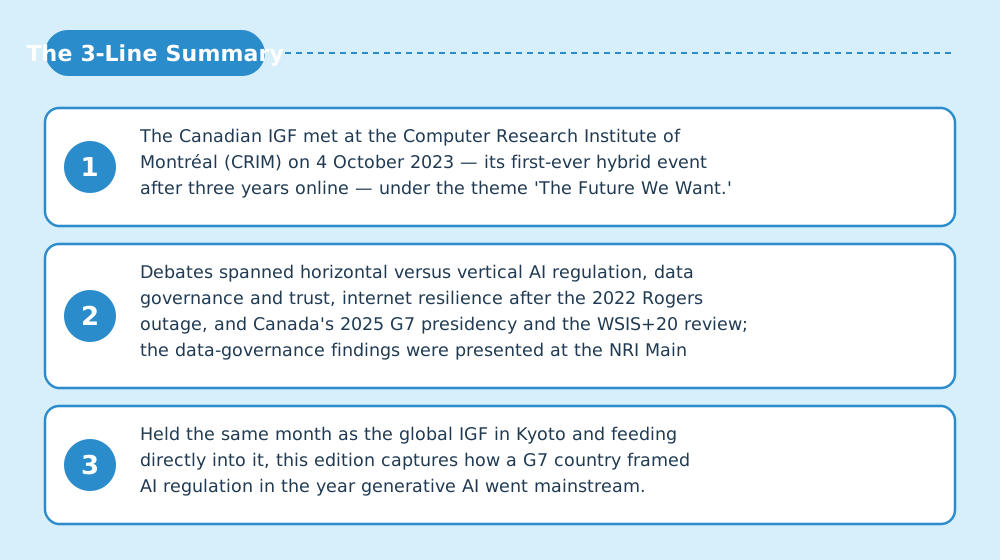
- The Canadian IGF met at the Computer Research Institute of Montréal (CRIM) on 4 October 2023 — its first-ever hybrid event after three years online — under the theme 'The Future We Want.'
- Debates spanned horizontal versus vertical AI regulation, data governance and trust, internet resilience after the 2022 Rogers outage, and Canada's 2025 G7 presidency and the WSIS+20 review; the data-governance findings were presented at the NRI Main Session of IGF 2023 in Kyoto.
- Held the same month as the global IGF in Kyoto and feeding directly into it, this edition captures how a G7 country framed AI regulation in the year generative AI went mainstream.
Welcome — this is the Japan IGF Support Organization. This in-depth report on Canadian Internet Governance Forum 2023: The Future We Want draws on official outputs, session records and on-site reporting. In a hurry? The three lines above and the diagrams carry the gist.
Conference at a Glance (from official records)
| Item | Detail |
|---|---|
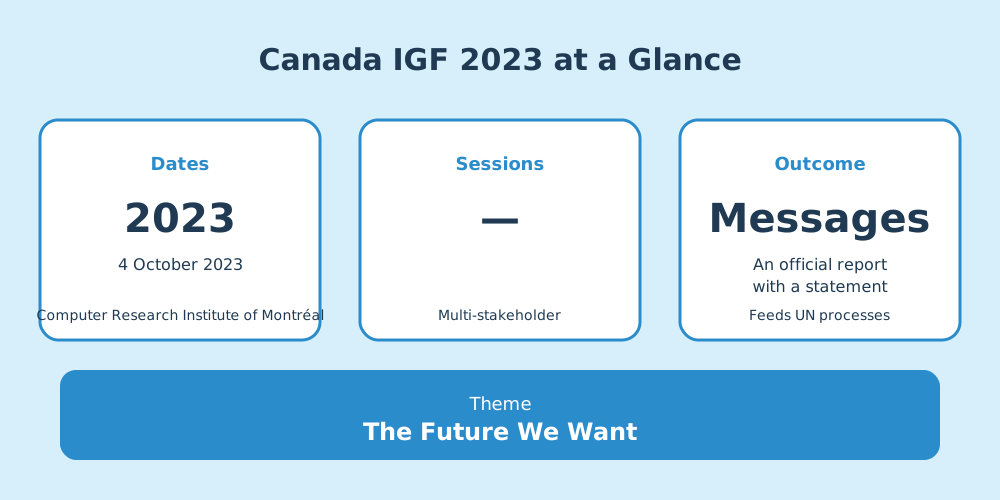
| Official name | Canadian Internet Governance Forum 2023: The Future We Want |
| Dates | 4 October 2023 |
| Venue | Computer Research Institute of Montréal (CRIM), Montreal, Quebec |
| Theme | The Future We Want |
| Format | Hybrid — the CIGF's first-ever hybrid event after three years of virtual events |
| Keynote | Keynotes by Tripti Sinha (Chair, ICANN Board) and Jacques Latour (Chief Technology and Security Officer, CIRA) |
| Host | CIGF multi-stakeholder All-Hands Committee, chaired by Georgia Evans (CIRA) |
| Outcome | An official report with a statement of priorities; the data-governance session's findings were presented at the NRI Main Session of IGF 2023 in Kyoto |
(See the source list at the end of this article.)
Discussion Digest — from the Session Records
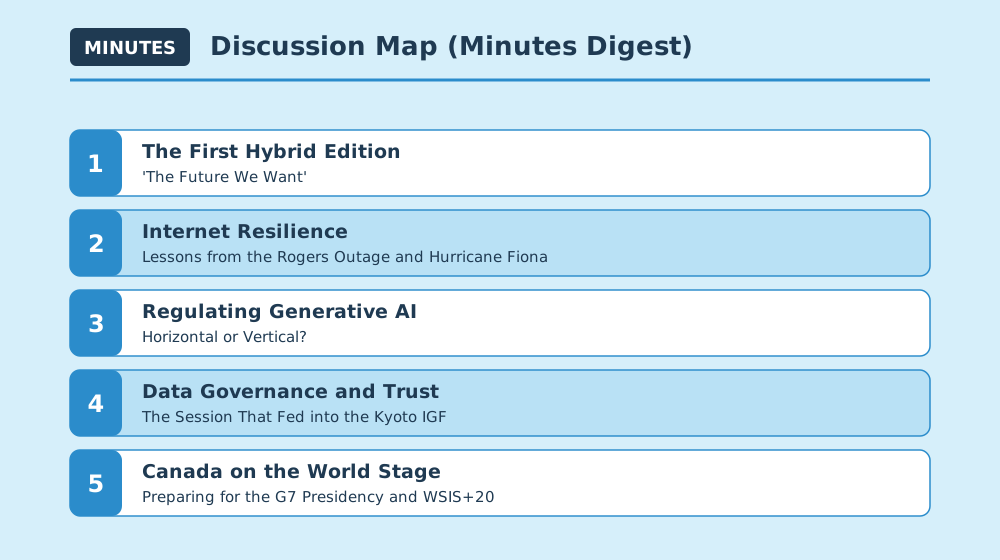
Key exchanges extracted from session records and transcripts.
1. The First Hybrid Edition — 'The Future We Want'
Sessions: The forum overall (4 October 2023 at CRIM; opening by Georgia Evans, first keynote by ICANN Board Chair Tripti Sinha)
- After three years of virtual events, the first hybrid edition recorded unanimous agreement that the future we want is inclusive, democratic and aligned with the global public interest, while preserving the internet's security, resilience and interoperability [1][3]
- It convened amid upheaval in Canadian internet policy: new telecom and broadcasting policy directions, freshly passed online streaming and online news laws, and anticipated online harms legislation [1][3]
- Working together as a community, the report concluded, is the only way to ensure the internet remains a powerful tool for good [1][3]
2. Internet Resilience — Lessons from the Rogers Outage and Hurricane Fiona
Sessions: Second keynote by Jacques Latour, CIRA Chief Technology and Security Officer (11:05–11:35 a.m.)
- The keynote presented the government's Telecommunications Reliability Agenda — born of the 2022 nationwide Rogers outage and Hurricane Fiona — and recommendations from CFDIR, the public-private Canadian Forum for Digital Infrastructure Resilience [1]
- Latour, co-chair of both CFDIR report processes, mapped where Canada stands and where it needs to go to keep Canadians online when they need the internet most [1]
- Guidelines for evaluating internet resilience for end users, businesses and ISPs were among the deliverables discussed [1]
3. Regulating Generative AI — Horizontal or Vertical?
Sessions: Panel 'The pros and cons of regulating AI' and breakout 'The ethics of AI: Hype versus reality' (Fenwick McKelvey of Concordia, Marc-Etienne Ouimette of AWS, Beth Coleman of the University of Toronto, Parteek Sibal of UNESCO and others)
- Panellists contrasted horizontal approaches regulating AI's inputs, processes and outputs across use cases (EU, Canada, China) with vertical, sector-by-sector approaches (US, UK), debating the pros and cons of each [1][2]
- Canada's Artificial Intelligence and Data Act (AIDA, housed in Bill C-27) was characterised as horizontal and impact-based, with implementation requiring a major build-up of government capacity [1][2]
- AI literacy for all ages was ranked a top priority, to counter chatbot 'hallucinations' feeding misinformation and persistent myths such as AI replacing humans in the workforce [1][2]
4. Data Governance and Trust — The Session That Fed into the Kyoto IGF
Sessions: Panel 'Data governance for a trusted global internet' (Sonia Carreno of IAB Canada, Cristiano Therrien of Open North, Michael Lenczner of Ajah; moderated by Charles Morgan of McCarthy Tétrault)
- The session's high-level findings were slated for presentation at the NRI Main Session of the global IGF 2023 in Kyoto, Japan [1][2]
- With Quebec's Law 25 and federal Bill C-27 advancing in parallel, panellists highlighted the heavy compliance burden created by fragmented rules across Canadian and international jurisdictions [1][2]
- Earning citizens' trust, they argued, requires transparency, clear communication and meaningful individual control at the core of privacy law — treating Canadians as citizens with rights, not merely consumers, with the decolonisation of data also raised [1][2]
5. Canada on the World Stage — Preparing for the G7 Presidency and WSIS+20
Sessions: Breakouts 'The 2025 Canadian presidency of the G7' (introduced by Cindy Temorshuizen, the Prime Minister's Personal Representative for the G7; moderated by CIGI President Paul Samson; with Brenda McPhail and others) and 'Towards WSIS +20'
- For its 2025 G7 presidency, Canada was urged to move beyond an economic lens and push a digital-policy agenda centred on human rights and countering digital authoritarianism [1][2]
- Canada chaired the Freedom Online Coalition in 2022 and launched the Ottawa Agenda; with Freedom House reporting a thirteenth straight year of declining online freedom and generative AI supercharging censorship and disinformation, panellists called for building on that record [1][2]
- With three governance models competing — US-rooted multistakeholderism, China-Russia cyber-sovereignty and the EU's rights-centred approach — the WSIS+20 review in 2025 was framed as a consequential inflection point for decades to come [1][2]
Three-Minute Short Talk — Your Questions Answered
Q. What did it decide?
A. A shared vision — an inclusive, democratic internet aligned with the global public interest — plus priorities across communications policy, data governance, AI regulation and global strategy, with the data-governance findings presented at the IGF 2023 NRI session in Kyoto.
Q. Why Montreal?
A. After three years online, this was the CIGF's first-ever hybrid event, hosted at the Computer Research Institute of Montréal (CRIM).
Q. Why should I care?
A. It fed directly into the global IGF in Kyoto that same month, and its horizontal-versus-vertical framing of AI regulation remains one of the clearest guides to how governments split on governing AI.
What Is Canada IGF? (for first-time readers)
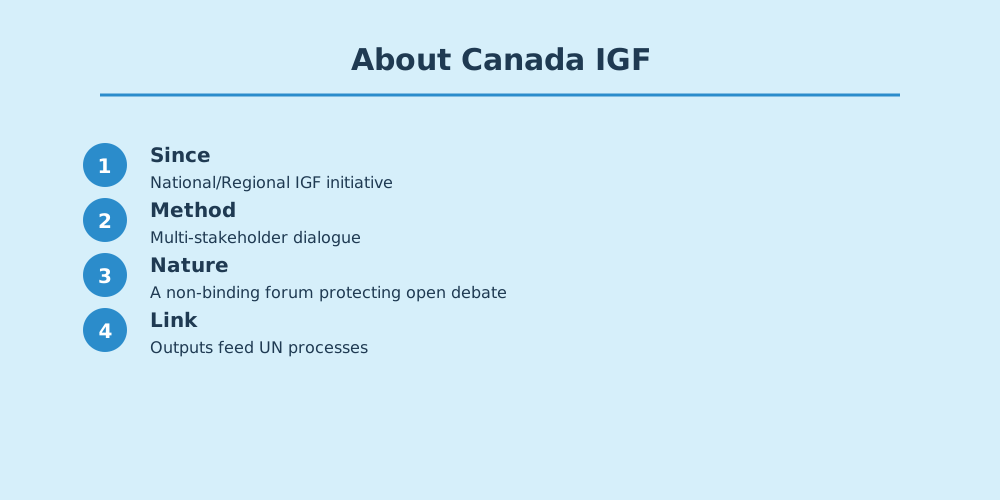
Canada IGF is a National or Regional IGF Initiative (NRI), aligning local internet governance discussion with global IGF principles.
Why It Matters to You
What was discussed here becomes the baseline for national digital policy, platform rules and AI regulation worldwide within a few years. The principles confirmed at the 2023 meeting are the foundation of the "next rules" for the phones, social platforms and AI services you use every day.
Sources & References
- Canadian IGF 2023: The Future We Want (official report) — Canadian IGF (accessed 2026-07-11)
- 2023 Canadian Internet Governance Forum (CIGF) — IGF提出版レポート — UN IGF Secretariat (accessed 2026-07-11)
- Canadian IGF — Past Events(初ハイブリッド開催の説明) — Canadian IGF (accessed 2026-07-11)
- Canadian Internet Governance Forum — CIRA (accessed 2026-07-11)
- Canada IGF(NRI記録) — UN IGF Secretariat (accessed 2026-07-11)
Quotes are translated or condensed from the records listed above. Bracketed numbers [n] refer to the source list.
Related links
- IGF official (NRI list): https://www.intgovforum.org/en/content/national-and-regional-igf-initiatives
- Japan IGF: https://japanigf.jp/
- Yuki Nakazawa's blog: https://nkzw.jp/category/igf/
Revision History
Rev. 1 — published 24 July 2023, 10:00 (Article published)
Rev. 2 — updated 16 July 2026, 20:09 (Fully revised into the in-depth edition: added the 3-line summary, minutes digest, short talk, source list and diagrams (all quotes verified against the listed sources))
— 中澤祐樹