


The 3-Line Summary
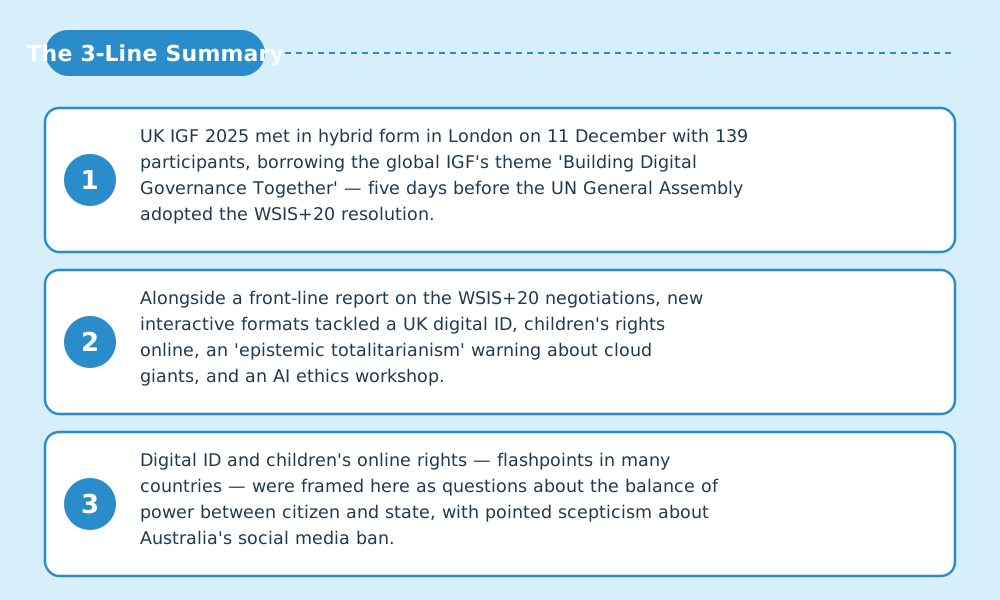
- UK IGF 2025 met in hybrid form in London on 11 December with 139 participants, borrowing the global IGF's theme 'Building Digital Governance Together' — five days before the UN General Assembly adopted the WSIS+20 resolution.
- Alongside a front-line report on the WSIS+20 negotiations, new interactive formats tackled a UK digital ID, children's rights online, an 'epistemic totalitarianism' warning about cloud giants, and an AI ethics workshop.
- Digital ID and children's online rights — flashpoints in many countries — were framed here as questions about the balance of power between citizen and state, with pointed scepticism about Australia's social media ban.
Welcome — this is the Japan IGF Support Organization. This in-depth report on UK IGF 2025 draws on official outputs, session records and on-site reporting. In a hurry? The three lines above and the diagrams carry the gist.
Conference at a Glance (from official records)
| Item | Detail |
|---|---|
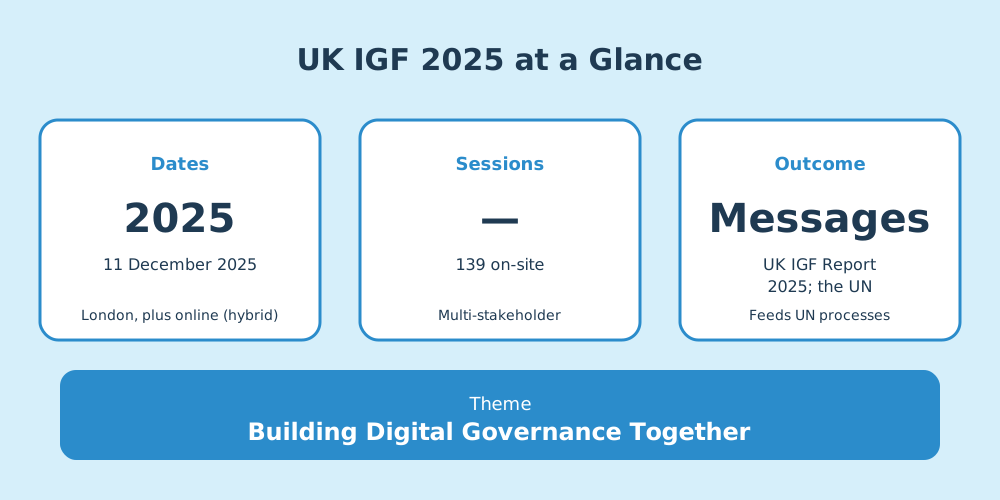
| Official name | UK IGF 2025 |
| Dates | 11 December 2025 |
| Venue | London, plus online (hybrid) |
| Theme | Building Digital Governance Together (The same theme as the global IGF in Lillestrøm, Norway (June 2025), which the event explicitly followed) |
| Participants | 139 (139 representatives from government, civil society, industry, the technical community and academia; just over a third first-time registrants; the programme was shaped by a public Call for Issues and added new interactive formats — a workshop and a lightning talk) |
| Host | UK IGF Steering Committee (secretariat: Nominet); sponsored in 2025 by Nominet and Verisign |
| Outcome | UK IGF Report 2025; the UN General Assembly adopted the WSIS+20 resolution five days after the event, on 16 December 2025, as recorded in the report |
(See the source list at the end of this article.)
Discussion Digest — from the Session Records
Key exchanges extracted from session records and transcripts.
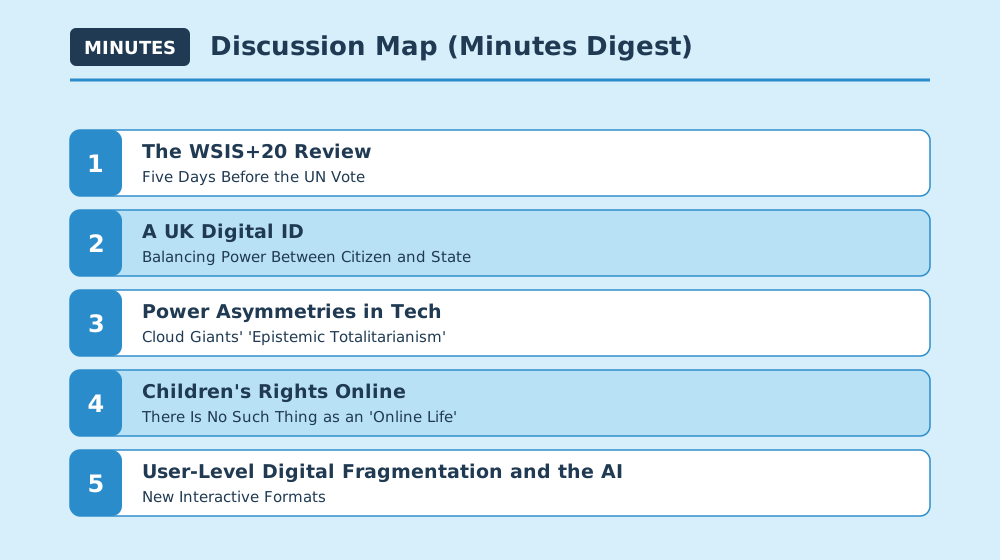
1. The WSIS+20 Review — Five Days Before the UN Vote
Sessions: Panel 'The WSIS+20 Review: A Multistakeholder Conversation' (13:45–14:25, chaired by Nick Wenban-Smith, with David Souter, Paul Blaker and Ellie McDonald)
- David Souter reported different priorities across geographical blocs and the difficulty of consensus in polarised global politics; many governments wanted closer GDC–WSIS alignment while some questioned the GDC's legitimacy — the UN resolution was adopted on 16 December, five days after the event [1][3]
- Paul Blaker (DSIT) said the UK negotiated with a positive agenda focused on environmental impacts, diversity and inclusion, human rights and connecting unserved communities, stressing a globally inclusive multistakeholder model, with IGF funding and financing for development next on the agenda [1][3]
- Ellie McDonald (Global Partners Digital) described the Global Digital Rights Coalition for WSIS formed to protect the WSIS framework and renew the IGF mandate; all agreed innovations like the Informal Multistakeholder Sounding Board and satellite consultations should carry into future UN processes [1][3]
2. A UK Digital ID — Balancing Power Between Citizen and State
Sessions: Panel 'A UK Digital ID — how can we ensure a balance of power between the citizen and the state?' (14:30–15:30, chaired by Wendy Grossman)
- Chair Wendy Grossman noted the UK's long history of proposing ID systems, each sold as the remedy for the pressing social concern of its time — and reframed the question from whether to have digital ID to what makes a good or bad identity system [1][3]
- David Birch argued modern digital ID infrastructure could improve public services, reduce fraud and simplify life, but should verify specific entitlements rather than personal identity [1][3]
- Professor Mirca Madianou (Goldsmiths) warned current biometric systems misidentify and exclude marginalised groups at high error rates and must be designed for dignity, equality and recognition; Karla Prudencio (Privacy International) stressed data protection law, human rights assessments and technical audits [1][3]
3. Power Asymmetries in Tech — Cloud Giants' 'Epistemic Totalitarianism'
Sessions: Lightning talk 'Power Asymmetries in Tech' (13:25–13:40, Dr Cecilia Rikap, UCL)
"Large companies are exercising 'epistemic totalitarianism' by determining the trajectory of AI development (her coined term as quoted in the report)."
— Dr Cecilia Rikap (UCL Institute for Innovation and Public Purpose) [1][3]
- Cloud giants subsume AI start-ups into networks of control beyond ownership, even steering which technologies start-ups focus on developing [1][3]
- The cloud is more than infrastructure: it is a powerful ecosystem where digital tech is developed, produced, deployed and consumed — and organisations are growing dependent on it [1][3]
- She proposed reimagining digital sovereignty through public, democratically governed technological ecosystems to counter dependency on big tech and recalibrate the balance of power [1][3]
4. Children's Rights Online — There Is No Such Thing as an 'Online Life'
Sessions: Panel 'How do we protect children's rights online in 2025?' (15:50–16:45, chaired by Mark Russell)
- Mark Russell (CEO, The Children's Society): there is no such thing as an 'online life' for young people — it's just their life, with interactions, experiences and relationships happening both online and offline [1][3]
- Professor Sonia Livingstone (LSE) argued safety often overrides children's other human rights — expression, assembly, privacy — because adults typically represent children on their behalf; Dr Kim Ringmar-Sylwander added children's perceptions differ greatly from adults' and they should be consulted on decisions affecting them [1][3]
- Jen Persson (Defend Digital Me) criticised how aspects of children's experiences are 'cherry-picked' to suit the direction of political travel, making an accurate, complete picture hard to establish [1][3]
5. User-Level Digital Fragmentation and the AI Ethics Workshop — New Interactive Formats
Sessions: Panel 'Digital Fragmentation from a User Perspective' (09:35–10:30, chaired by Izaan Khan) + workshop 'Ethics of AI' (10:50–12:30, led by Sal Mohammed and Stacie Chan)
- Sheetal Kumar stressed protecting diverse online experiences to safeguard users' rights, agency and control, cautioning that blunt actions like Australia's selective platform ban risk unintended consequences; Alice Taylor argued education — including through gaming — beats age-based bans for keeping young people safe [1][3][4]
- Rachel Coldicutt urged the UK to face the inherently monopolistic nature of internet infrastructure and build pluralistic, resilient and equitable systems rather than relying on narrow inclusion metrics [1][3][4]
- The AI ethics workshop surfaced demands for transparency (watermarking, disclosure, humans in the loop), granular consent and effective opt-outs, clearer definitions of 'public' data, and urgent AI literacy for children and adults alike [1][3][4]
Three-Minute Short Talk — Your Questions Answered
Q. What was the timing?
A. Just five days before the UN General Assembly adopted the WSIS+20 resolution deciding the IGF's future — with UK negotiators and NGOs reporting live from the final days of talks.
Q. What was most contested?
A. The UK digital ID proposal. Convenience and fraud-reduction arguments met warnings that biometric systems fail minorities at high error rates and that citizen-state power balance is at stake — plus sharp criticism of Australia's social media ban as a blunt tool.
Q. Why should I care?
A. Digital ID and children's online-age rules are live debates in most democracies. The forum's framings — education over bans, and safety crowding out children's other rights — travel well beyond the UK.
What Is UK IGF? (for first-time readers)
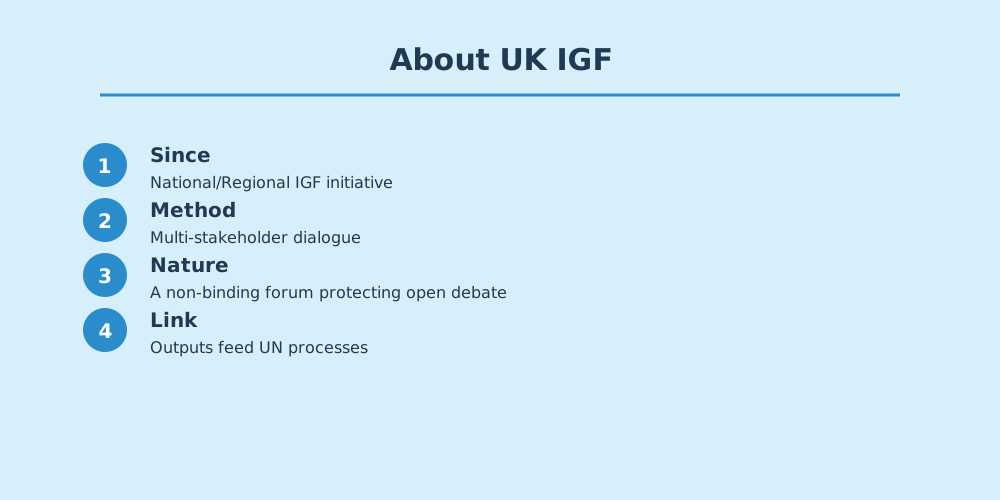
UK IGF is a National or Regional IGF Initiative (NRI), aligning local internet governance discussion with global IGF principles.
Why It Matters to You
What was discussed here becomes the baseline for national digital policy, platform rules and AI regulation worldwide within a few years. The principles confirmed at the 2025 meeting are the foundation of the "next rules" for the phones, social platforms and AI services you use every day.
Sources & References
- UK Internet Governance Forum Report 2025 (PDF) — UK IGF(事務局: Nominet) (accessed 2026-07-11)
- UK IGF 2025(公式イベントページ) — UK IGF (accessed 2026-07-11)
- 2025 Agenda — UK IGF (accessed 2026-07-11)
- UK IGF 2025 Speakers — UK IGF (accessed 2026-07-11)
Quotes are translated or condensed from the records listed above. Bracketed numbers [n] refer to the source list.
Related links
- IGF official (NRI list): https://www.intgovforum.org/en/content/national-and-regional-igf-initiatives
- Japan IGF: https://japanigf.jp/
- Yuki Nakazawa's blog: https://nkzw.jp/category/igf/
Revision History
Rev. 1 — published 16 June 2025, 09:00 (Article published)
Rev. 2 — updated 16 July 2026, 20:09 (Fully revised into the in-depth edition: added the 3-line summary, minutes digest, short talk, source list and diagrams (all quotes verified against the listed sources))
— 中澤祐樹

