

This essay applies the framework of Information Economics — most prominently associated with Carl Shapiro & Hal Varian — to analyze the Climate IGF 2024 Baku conference from a management perspective. Target audience: executives, MBA students, management researchers, consultants, and policy analysts.
Executive Summary
Shapiro & Varian's Information Rules theorized the basic rules of information goods and network economies (lock-in, switching costs, network effects, complements). Climate IGF's regulatory debates apply these economic principles.
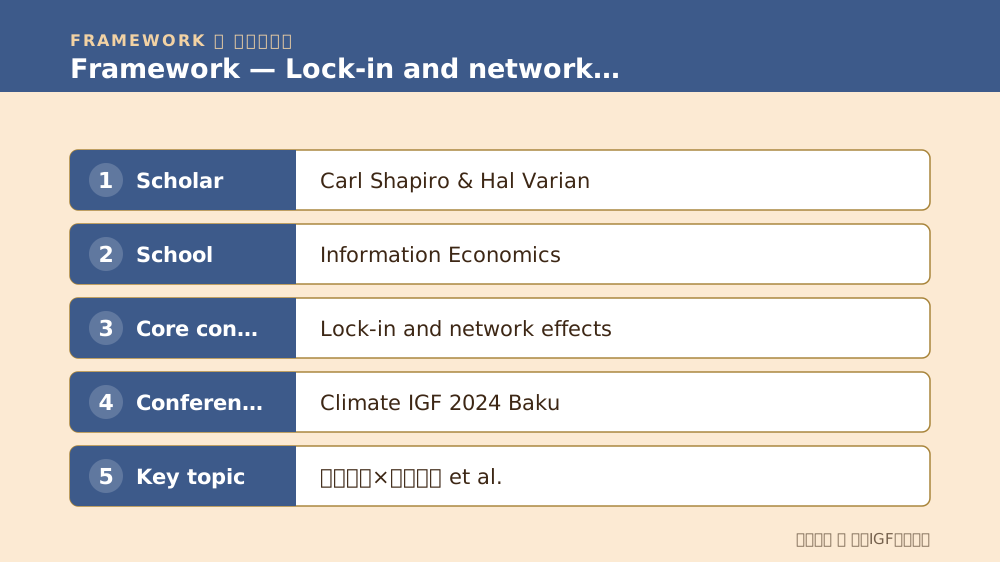
For firms operating in Azerbaijan and adjacent 気候変動×デジタル, データセンター環境負荷, グリーンICT domains, this essay maps how to incorporate the conference debate into strategic decision-making through the lens of Lock-in and network effects.
Economics of platform monopoly
気候変動×デジタル in Azerbaijan's market requires competition-economics-based design. Regulation that ignores information-economy principles often produces unintended consequences.
The theoretical framework of Carl Shapiro & Hal Varian provides a lens to read the 2024 debate not as mere "industry trends" but as a precursor of structural change. The fact that this is a global-level discussion has direct strategic implications for the geographic scope of the target market.
Switching costs
For practical application, we map the applicability of Lock-in and network effects to each topic at the conference.
1. Application to "気候変動×デジタル"
The discussion on "気候変動×デジタル" can be located, in Carl Shapiro & Hal Varian's framework, as a primary strategic variable.
Concrete managerial implications include:
- Implications for Azerbaijan's market: early identification of regulatory trends and preemptive business-model adjustment
- Impact on competitive advantage: monitoring competitors' moves and reviewing one's differentiation strategy
- Investment decisions: allocation of R&D investment and reconfiguration of the portfolio
2. Application to "データセンター環境負荷"
The discussion on "データセンター環境負荷" can be located, in Carl Shapiro & Hal Varian's framework, as an important constraint.
Concrete managerial implications include:
- Implications for Azerbaijan's market: early identification of regulatory trends and preemptive business-model adjustment
- Impact on competitive advantage: monitoring competitors' moves and reviewing one's differentiation strategy
- Investment decisions: allocation of R&D investment and reconfiguration of the portfolio
3. Application to "グリーンICT"
The discussion on "グリーンICT" can be located, in Carl Shapiro & Hal Varian's framework, as an auxiliary topic.
Concrete managerial implications include:
- Implications for Azerbaijan's market: early identification of regulatory trends and preemptive business-model adjustment
- Impact on competitive advantage: monitoring competitors' moves and reviewing one's differentiation strategy
- Investment decisions: allocation of R&D investment and reconfiguration of the portfolio
4. Application to "国連連携"
The discussion on "国連連携" can be located, in Carl Shapiro & Hal Varian's framework, as an auxiliary topic.
Concrete managerial implications include:
- Implications for Azerbaijan's market: early identification of regulatory trends and preemptive business-model adjustment
- Impact on competitive advantage: monitoring competitors' moves and reviewing one's differentiation strategy
- Investment decisions: allocation of R&D investment and reconfiguration of the portfolio
5. Application to "WSIS成果"
The discussion on "WSIS成果" can be located, in Carl Shapiro & Hal Varian's framework, as an auxiliary topic.
Concrete managerial implications include:
- Implications for Azerbaijan's market: early identification of regulatory trends and preemptive business-model adjustment
- Impact on competitive advantage: monitoring competitors' moves and reviewing one's differentiation strategy
- Investment decisions: allocation of R&D investment and reconfiguration of the portfolio
Strategic Actions for Firms Operating in Azerbaijan
We translate the management analysis above into concrete actions for firms operating in Azerbaijan.
Short-term (within 6 months)
- Intelligence gathering: closely read the Climate IGF 2024 minutes and reports; share with the corporate strategy function
- Stakeholder mapping: identify relevant regulators, industry associations, and civil society organizations
- Risk assessment: quantify potential impacts of the regulatory directions under discussion
Medium-term (1–3 years)
- Capability building: close the capability gaps identified through the Lock-in and network effects framework
- Alliance strategy: cultivate relationships with the international IGF community
- Regulatory dialogue: shift from reactive compliance to proactive agenda-setting
Long-term (3–10 years)
- Business model reconstruction: structural transformation informed by Carl Shapiro & Hal Varian's framework
- Contribution to international standard-setting: sustained participation in venues like Climate IGF
- Norm formation from Azerbaijan: accumulation of soft power through distinctive contributions to international debate
ROI Analysis Perspective
In Carl Shapiro & Hal Varian's framework, ROI of investment in Climate IGF participation is evaluated not as a single-year financial metric but as multi-year option value. This aligns with the "real options" approach to decision-making under uncertainty.
| Dimension | Short-term ROI | Long-term option value |
|---|---|---|
| Direct financial | Limited | Medium–Large |
| Network capital | Medium | Large |
| Brand / legitimacy | Medium | Large |
| Policy intelligence | Large | Medium–Large |
| Talent development | Medium | Large |
Conclusion: A Question to Executives
Reading Climate IGF 2024 through the auxiliary line of Carl Shapiro & Hal Varian's framework, the conference emerges not as a mere international gathering but as a site of contemporary implementation of Lock-in and network effects. Executives in Azerbaijan face a strategic choice: passive observer or active participant.
This essay argues that the latter choice is indispensable for building long-term competitive advantage. Carl Shapiro & Hal Varian's theoretical insight provides the intellectual foundation for that strategic choice.
Primary Sources
- IGF Secretariat. Annual Reports of Climate IGF.
- Climate IGF 2024 Baku Conference Materials.
- Japan IGF Support Organization. https://japanigf.jp/
- Nakazawa Yuki Blog. https://nkzw.jp/category/igf/
Secondary Sources (Management)
- Works of Carl Shapiro & Hal Varian (representative texts of Information Economics)
*This piece belongs to the academic essays (management series). Strategic proposals are illustrative applications of general analytical frameworks; specific business judgments require individual due diligence.*
更新履歴
第1稿投稿 2026年6月14日 12時18分(記事コンテンツアップ)
— 中澤祐樹

