

The 3-Line Summary
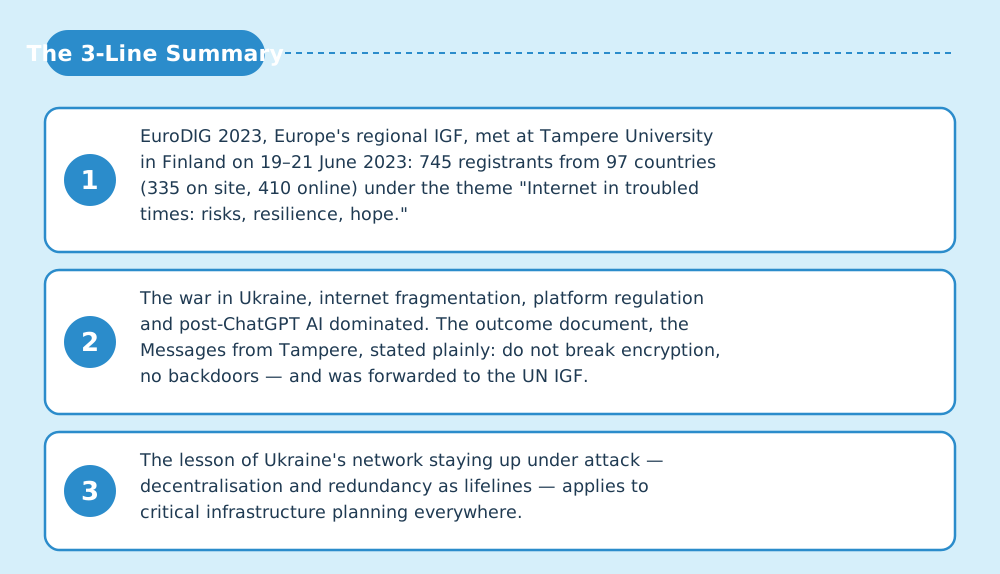
- EuroDIG 2023, Europe's regional IGF, met at Tampere University in Finland on 19–21 June 2023: 745 registrants from 97 countries (335 on site, 410 online) under the theme "Internet in troubled times: risks, resilience, hope."
- The war in Ukraine, internet fragmentation, platform regulation and post-ChatGPT AI dominated. The outcome document, the Messages from Tampere, stated plainly: do not break encryption, no backdoors — and was forwarded to the UN IGF.
- The lesson of Ukraine's network staying up under attack — decentralisation and redundancy as lifelines — applies to critical infrastructure planning everywhere.
Welcome — this is the Japan IGF Support Organization. This in-depth report on EuroDIG 2023 in Tampere draws on official outputs, session records and on-site reporting. In a hurry? The three lines above and the diagrams carry the gist.
Conference at a Glance (from official records)
| Item | Detail |
|---|---|
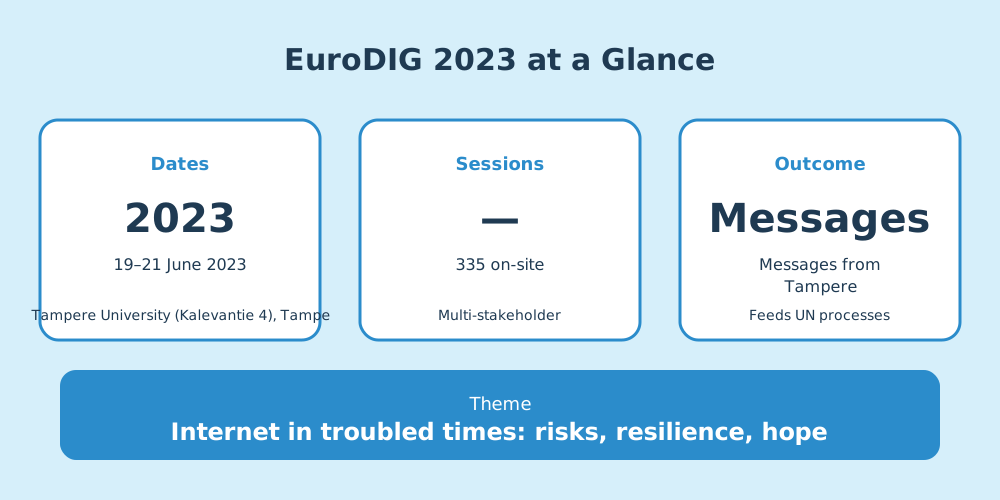
| Dates | 19–21 June 2023 |
| Venue | Tampere University (Kalevantie 4), Tampere, Finland |
| Theme | Internet in troubled times: risks, resilience, hope |
| On-site participants | 335 |
| Registrations | 745 |
| Online participants | 410 |
| Countries | 97 |
| Host | Tampere University, in cooperation with the City of Tampere, Traficom, ISOC Finland Chapter, Finland's Ministry for Foreign Affairs, Ministry of Transport and Communications, and Yle |
| Outcome | Messages from Tampere |
(See the source list at the end of this article.)
Discussion Digest — from the Session Records
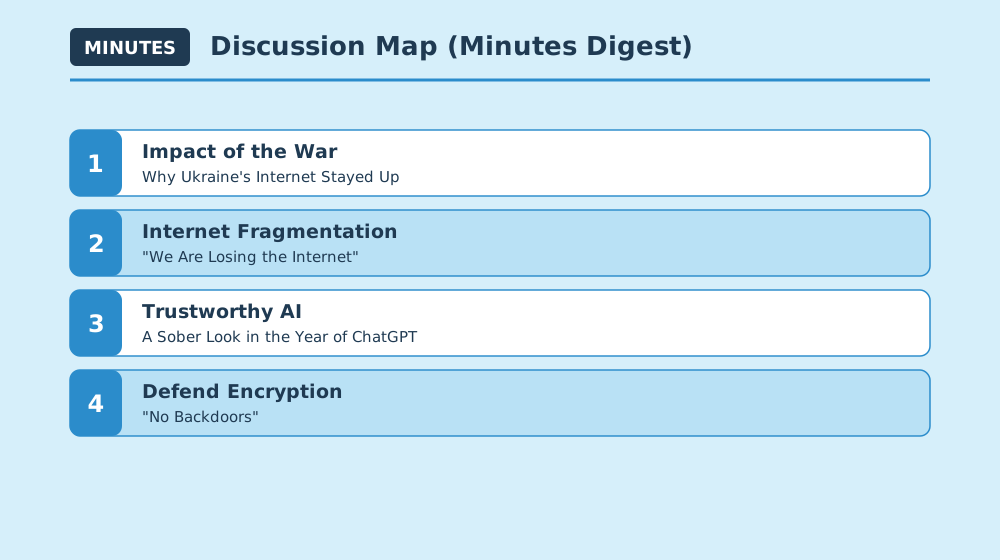
Key exchanges extracted from session records and transcripts.
1. Impact of the War — Why Ukraine's Internet Stayed Up
Sessions: Main Topic sessions on the Impact of the War
- Ukraine showed remarkable resilience against both infrastructure attacks and disinformation; a distributed system with sufficient redundancy proved a vital component of the open internet [3][4]
- At the same time, gaps remain in the uptake of key internet security standards and best practices [3][4]
- Political interference — calls to revoke ccTLDs or address space — was flagged as a threat to the global internet itself [3][4]
2. Internet Fragmentation — "We Are Losing the Internet"
Sessions: Main Topic sessions on Internet Fragmentation
"We are losing the Internet, and we need to face that reality before we can confront it"
— Andrew Sullivan (Internet Society) [1][4]
"A more state-driven approach can lead to fragmentation of the Internet"
— Pearse O'Donohue (European Commission, DG CNECT) [1][4]
- Preserving the integrity of the technical layer is critical; government regulation, intentional or not, risks fragmenting the open internet [1][4]
- The UN Global Digital Compact was framed as a tool to prevent fragmentation, with calls for closer dialogue between governments and the technical community [1][4]
3. Trustworthy AI — A Sober Look in the Year of ChatGPT
Sessions: Workshop on trustworthy AI and large language models
"Large Language Models like ChatGPT4 have a revolutionary potential for customer services, translation, and human-machine communication, but they do not produce knowledge"
— Francesco Vecchi (session rapporteur) [1]
- In the first year of the generative-AI boom, the forum drew a careful line between potential and limits [1]
- A companion workshop treated digital literacy as a civic skill, underscoring the role of education [1]
4. Defend Encryption — "No Backdoors"
Sessions: Security sessions and the Messages from Tampere
- The Messages state: do not break encryption and no backdoors — instead support vulnerability disclosure and patching processes [1]
- All stakeholders regulating or developing the internet were urged to conduct impact assessments covering security, privacy and the risk of fragmentation [1]
- States and the EU were called on to systematically engage the technical community throughout the policy-making cycle [1]
Three-Minute Short Talk — Your Questions Answered
Q. What is EuroDIG in the first place?
A. It's Europe's regional IGF, held in a different European city every year since 2008. It doesn't make binding decisions, but it distils its discussions into 'Messages' delivered to the UN IGF and policymakers. In 2023 the stage was Tampere University.
Q. What was the most striking discussion?
A. The analysis of why Ukraine's internet stayed up under attack: a decentralised structure with no single point of failure did the work. Meanwhile, political demands to revoke domains and IP addresses were flagged as a threat to the foundations of the global net.
Q. Why should I care?
A. The 'do not break encryption, no backdoors' message goes to the heart of debates in every democracy about privacy versus investigative powers, and the resilience lessons apply to any country that depends on connectivity in a crisis.
What Is EuroDIG? (for first-time readers)
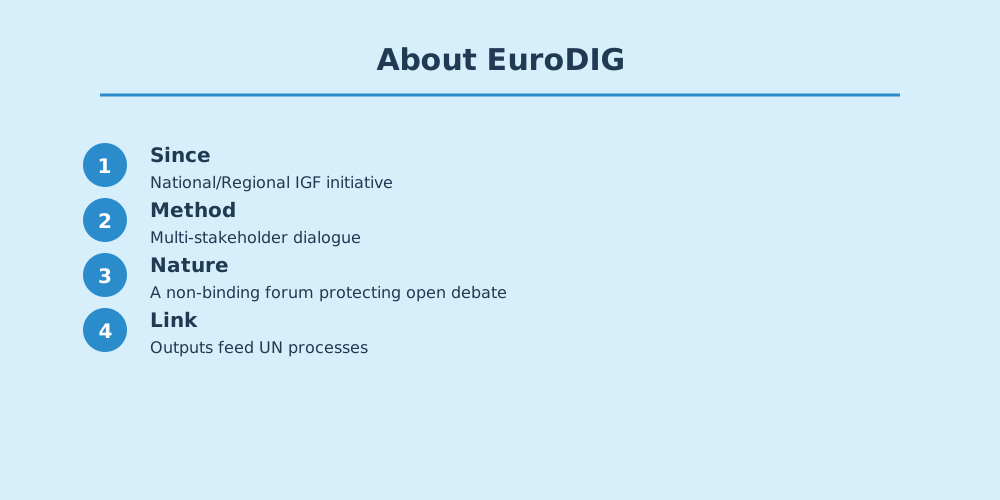
EuroDIG is a National or Regional IGF Initiative (NRI), aligning local internet governance discussion with global IGF principles.
Why It Matters to You
What was discussed here becomes the baseline for national digital policy, platform rules and AI regulation worldwide within a few years. The principles confirmed at the 2023 meeting are the foundation of the "next rules" for the phones, social platforms and AI services you use every day.
Sources & References
- Messages from Tampere — eurodig.org (accessed 2026-07-10)
- EuroDIG 2023 — eurodigwiki.org (accessed 2026-07-10)
- EuroDIG 2023 — DiploFoundation (accessed 2026-07-10)
- EuroDIG 2023 Live Blog — RIPE NCC, Gergana Petrova (accessed 2026-07-10)
- EuroDIG News 26/2023(開催報告・参加統計) — eurodig.org (accessed 2026-07-10)
- EuroDIG conference 19-21 June 2023 in Tampere — tuni.fi (accessed 2026-07-10)
Quotes are translated or condensed from the records listed above. Bracketed numbers [n] refer to the source list.
Related links
- IGF official (NRI list): https://www.intgovforum.org/en/content/national-and-regional-igf-initiatives
- Japan IGF: https://japanigf.jp/
- Yuki Nakazawa's blog: https://nkzw.jp/category/igf/
Revision History
Rev. 1 — published 19 June 2023, 15:00 (Article published)
Rev. 2 — updated 10 July 2026, 14:28 (Fully revised into the in-depth edition: added the 3-line summary, minutes digest, short talk, source list and diagrams (all quotes verified against the listed sources))
— 中澤祐樹

