


The 3-Line Summary
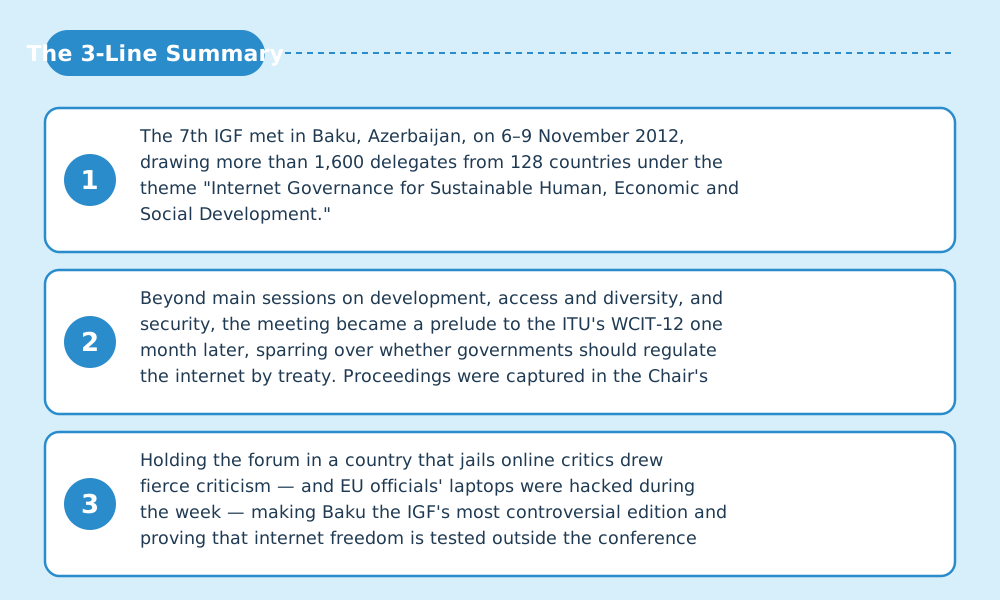
- The 7th IGF met in Baku, Azerbaijan, on 6–9 November 2012, drawing more than 1,600 delegates from 128 countries under the theme "Internet Governance for Sustainable Human, Economic and Social Development."
- Beyond main sessions on development, access and diversity, and security, the meeting became a prelude to the ITU's WCIT-12 one month later, sparring over whether governments should regulate the internet by treaty. Proceedings were captured in the Chair's Summary.
- Holding the forum in a country that jails online critics drew fierce criticism — and EU officials' laptops were hacked during the week — making Baku the IGF's most controversial edition and proving that internet freedom is tested outside the conference hall.
Welcome — this is the Japan IGF Support Organization. This in-depth report on Global IGF 2012 in Baku draws on official outputs, session records and on-site reporting. In a hurry? The three lines above and the diagrams carry the gist.
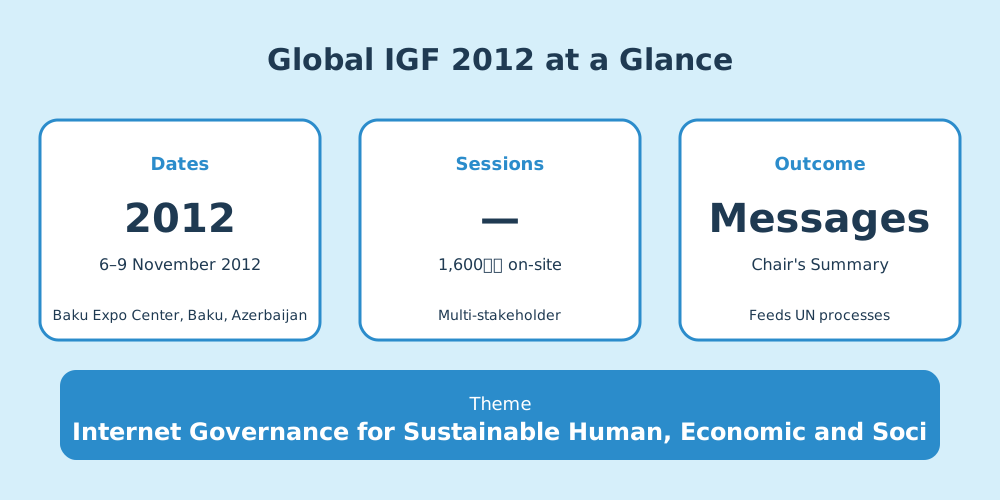
Conference at a Glance (from official records)
| Item | Detail |
|---|---|
| Edition | 7th IGF meeting |
| Dates | 6–9 November 2012 |
| Venue | Baku Expo Center, Baku, Azerbaijan |
| Theme | Internet Governance for Sustainable Human, Economic and Social Development |
| Participants | More than 1,600 delegates from 128 countries |
| Main sessions | 5 |
| Remote hubs | 52 |
| Remote panellists | 49 |
| Host | Government of Azerbaijan (Ministry of Communications and Information Technologies) and the United Nations |
| Outcome | Chair's Summary |
(See the source list at the end of this article.)
Discussion Digest — from the Session Records
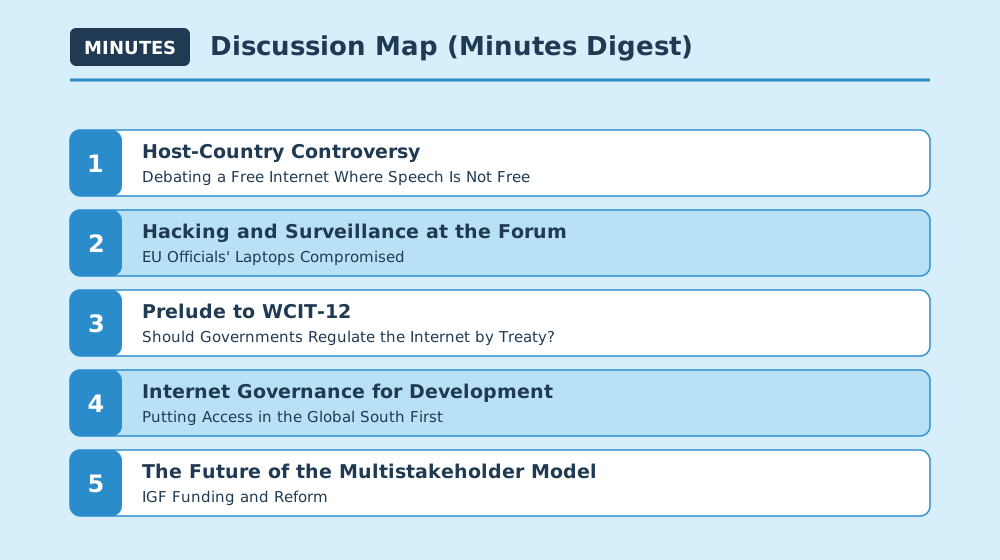
Key exchanges extracted from session records and transcripts.
1. Host-Country Controversy — Debating a Free Internet Where Speech Is Not Free
Sessions: Press conferences and side events during the forum (7 November and beyond, outside the official programme)
"It is not a democracy, but an imitation"
— Neelie Kroes (Vice-President, European Commission) [5][6][8]
"Holding the event in an authoritarian country created a unique platform to discuss issues that would otherwise not be permitted"
— Emin Milli (Azerbaijani blogger) [5][6][8]
"The government and organisers did the best they could to prevent us from distributing the report"
— Emin Huseynov (freedom of expression advocate) [5][6][8]
- Rights groups and the European Commission attacked the choice of a host that jails online critics; at a 7 November press conference Vice-President Kroes called for the release of Azerbaijanis imprisoned over their online activity [5][6][8]
- The IGF Secretariat blocked the local Expression Online coalition from distributing reports on free expression in Azerbaijan on the premises, and a booth was denied after ministry intervention — the venue itself became a free-speech battleground [5][6][8]
- President Aliyev skipped the opening ceremony for the Bakutel telecom fair, his welcome message read out by ICT Minister Ali Abbasov; after the forum, Azerbaijan re-criminalised online defamation and stepped up pressure on activists [5][6][8]
2. Hacking and Surveillance at the Forum — EU Officials' Laptops Compromised
Sessions: Incidents during the forum week (outside official sessions)
"A free internet is of little use to a people who are not free"
— Sarah Kendzior (anthropologist, writing for Al Jazeera) [6][7]
- Laptops of two EU officials travelling with Commission Vice-President Kroes were compromised at their Baku hotel, prompting forensic analysis of the machines [6][7]
- Activists reported being questioned at registration about planned protests, and independent media were told they were not legitimate press; some delegates behaved on the assumption their conversations were monitored [6][7]
- The week's lesson: in a surveillance state, connectivity also makes users accessible to the state — internet access and personal freedom are not the same thing [6][7]
3. Prelude to WCIT-12 — Should Governments Regulate the Internet by Treaty?
Sessions: Main Session "Managing Critical Internet Resources" and the Opening Ceremony
- With the ITU's WCIT-12 in Dubai one month away, proposals to revise the International Telecommunication Regulations (last updated in 1988) took centre stage; panellists noted WCIT would not be multistakeholder — only governments speak and vote — and warned it should not hand governments internationally sanctioned rationales to tightly regulate the internet [2][4]
- Speakers argued telecom-mindset regulation contradicts the internet's fundamental operating mechanisms; ETNO's "sender pays" proposal was criticised as likely to isolate developing countries from overseas content [2][4]
- ITU Secretary-General Hamadoun Touré assured the opening ceremony that the ITU did not want to control the internet and reaffirmed its commitment to the multistakeholder model [2][4]
4. Internet Governance for Development — Putting Access in the Global South First
Sessions: Main Sessions "Internet Governance for Development (IG4D)" and "Access and Diversity"
- With "development" in the overarching theme, connectivity, access and diversity in developing countries headlined the agenda, and deeper engagement from African and other developing countries was noted [2][3]
- The difficulty of producing local content in developing countries was debated, with pricing and business models — and building demand — seen as keys to expanding access [2][3]
- Remote participation doubled active engagement: 49 experts joined panels remotely and 52 hubs worldwide followed proceedings; civil society was the largest stakeholder group, with markedly higher participation by women and youth [2][3]
5. The Future of the Multistakeholder Model — IGF Funding and Reform
Sessions: Main Session "Taking Stock and the Way Forward" and the Closing Ceremony
- Civil society called strongly for the IGF to remain a forum that promotes human rights and fundamental freedoms online — people should enjoy the same freedoms online as offline [2][4]
- At the closing ceremony APNIC's Paul Wilson voiced concern about IGF funding and stressed keeping the IGF part of a broader, bottom-up multistakeholder system [2][4]
- Participants urged the IGF to take a more proactive role in defining "Enhanced Cooperation," the governance question pending since the WSIS process [2][4]
Three-Minute Short Talk — Your Questions Answered
Q. So what did the conference actually decide?
A. The IGF doesn't vote on anything — it's the UN's forum where governments, companies and civil society talk as equals. Baku drew over 1,600 people from 128 countries, and the discussions, from developing-country access to internet regulation, were published as the Chair's Summary.
Q. What was the most contentious topic?
A. The venue itself. Debating a 'free internet' in a country that jails online critics drew fierce criticism — an EU commissioner called Azerbaijan 'not a democracy, but an imitation,' local groups were blocked from handing out reports, and EU officials' laptops were hacked.
Q. Why should I care?
A. One month later, the ITU's WCIT-12 treaty conference fought over how far governments could regulate the internet. Baku's warnings against binding the internet with intergovernmental treaties were the opening skirmish in a battle that helped keep the internet you use today open.
What Is Global IGF? (for first-time readers)
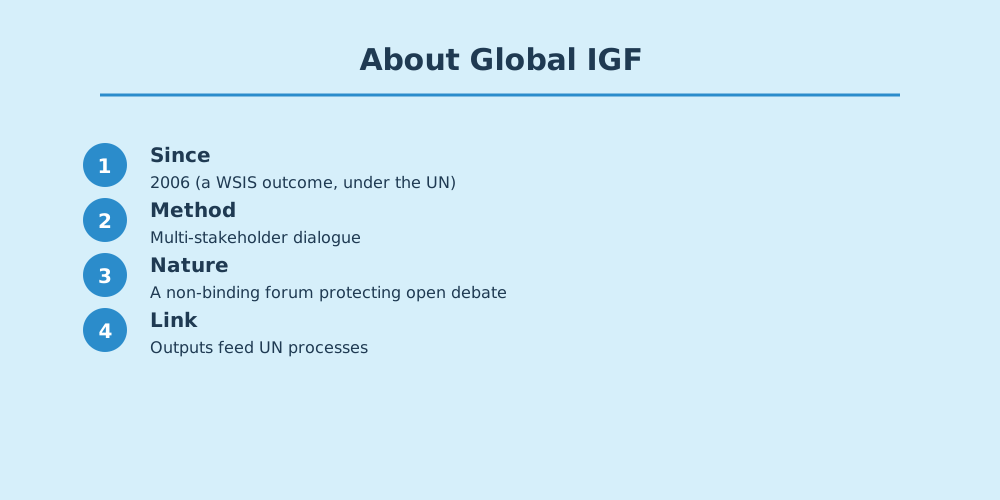
Global IGF has met annually under UN auspices since 2006 — the one global conference where governments, business, civil society, the technical community and youth debate internet governance as equals (the multistakeholder model).
Why It Matters to You
What was discussed here becomes the baseline for national digital policy, platform rules and AI regulation worldwide within a few years. The principles confirmed at the 2012 meeting are the foundation of the "next rules" for the phones, social platforms and AI services you use every day.
Sources & References
- IGF 2012 — UN IGF Secretariat (accessed 2026-07-10)
- Seventh Meeting of the Internet Governance Forum (IGF) — Chair's Summary (PDF) — WGIGアーカイブ / wgig.org (accessed 2026-07-10)
- Internet Governance Forum — IGF VII, Baku 2012 — en (accessed 2026-07-10)
- RIPE NCC Report on IGF 2012 — RIPE NCC (accessed 2026-07-10)
- Azerbaijan: After the 2012 IGF, freedom of expression more vulnerable — APC (accessed 2026-07-10)
- Censorship, hacking and harassment: the Azerbaijan IGF experience — The Foreign Policy Centre (accessed 2026-07-10)
- An internet conference in a surveillance state — Al Jazeera(Sarah Kendzior 寄稿) (accessed 2026-07-10)
- Azerbaijan: How to Measure Free Speech on the Internet? — Eurasianet (accessed 2026-07-10)
Quotes are translated or condensed from the records listed above. Bracketed numbers [n] refer to the source list.
Related links
- IGF official (NRI list): https://www.intgovforum.org/en/content/national-and-regional-igf-initiatives
- Japan IGF: https://japanigf.jp/
- Yuki Nakazawa's blog: https://nkzw.jp/category/igf/
Revision History
Rev. 1 — published 6 November 2012, 14:00 (Article published)
Rev. 2 — updated 10 July 2026, 14:28 (Fully revised into the in-depth edition: added the 3-line summary, minutes digest, short talk, source list and diagrams (all quotes verified against the listed sources))
— 中澤祐樹

