

The 3-Line Summary
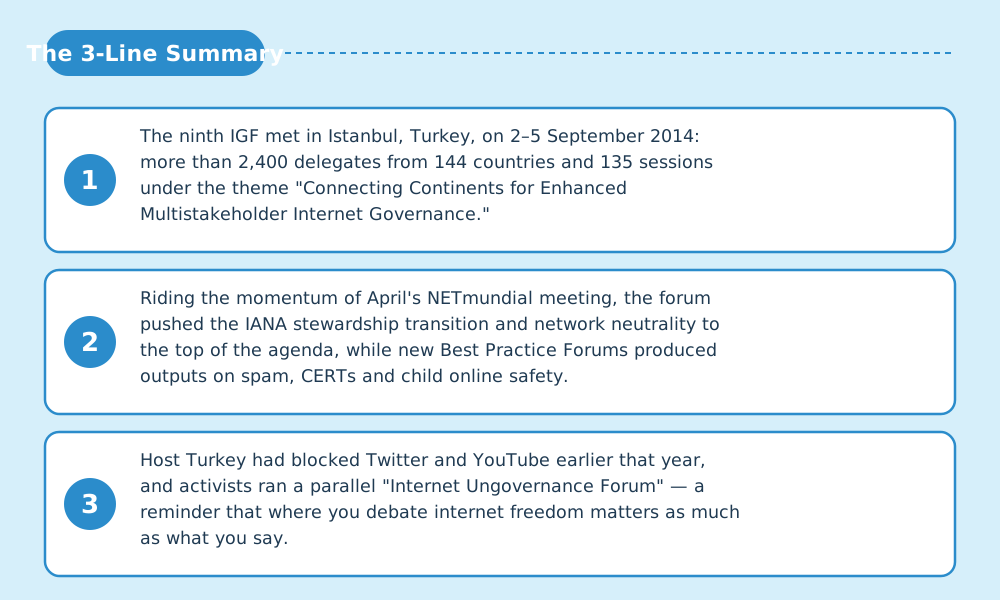
- The ninth IGF met in Istanbul, Turkey, on 2–5 September 2014: more than 2,400 delegates from 144 countries and 135 sessions under the theme "Connecting Continents for Enhanced Multistakeholder Internet Governance."
- Riding the momentum of April's NETmundial meeting, the forum pushed the IANA stewardship transition and network neutrality to the top of the agenda, while new Best Practice Forums produced outputs on spam, CERTs and child online safety.
- Host Turkey had blocked Twitter and YouTube earlier that year, and activists ran a parallel "Internet Ungovernance Forum" — a reminder that where you debate internet freedom matters as much as what you say.
Welcome — this is the Japan IGF Support Organization. This in-depth report on Global IGF 2014 in Istanbul draws on official outputs, session records and on-site reporting. In a hurry? The three lines above and the diagrams carry the gist.
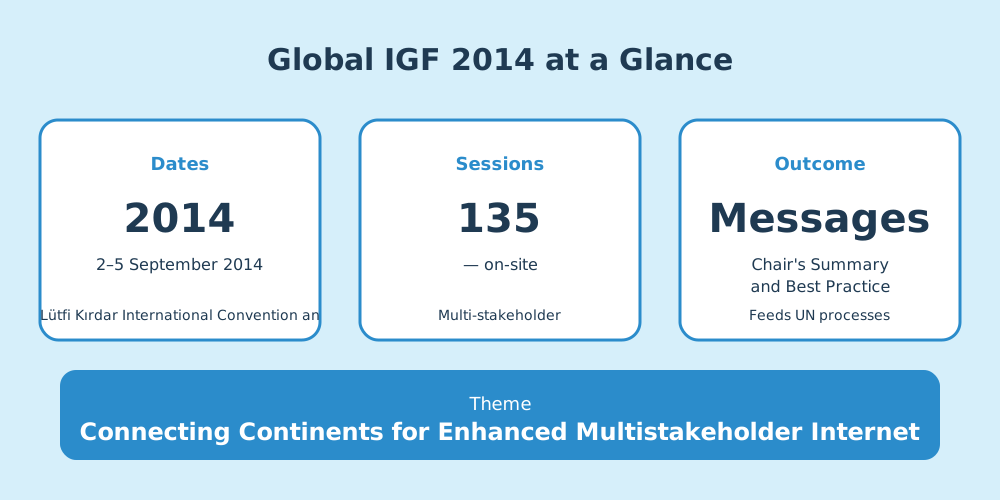
Conference at a Glance (from official records)
| Item | Detail |
|---|---|
| Edition | 9th IGF |
| Dates | 2–5 September 2014 |
| Venue | Lütfi Kırdar International Convention and Exhibition Centre, Istanbul, Turkey |
| Theme | Connecting Continents for Enhanced Multistakeholder Internet Governance |
| Participants | More than 2,400 on-site delegates from 144 countries, plus nearly 1,300 remote participants |
| Sessions | 135 |
| Pre-events | 14 |
| Best Practice Forums | 5 |
| Sub-themes | 8 |
| Host | Government of Turkey and the United Nations |
| Outcome | Chair's Summary and Best Practice Forum outcome documents |
(See the source list at the end of this article.)
Discussion Digest — from the Session Records
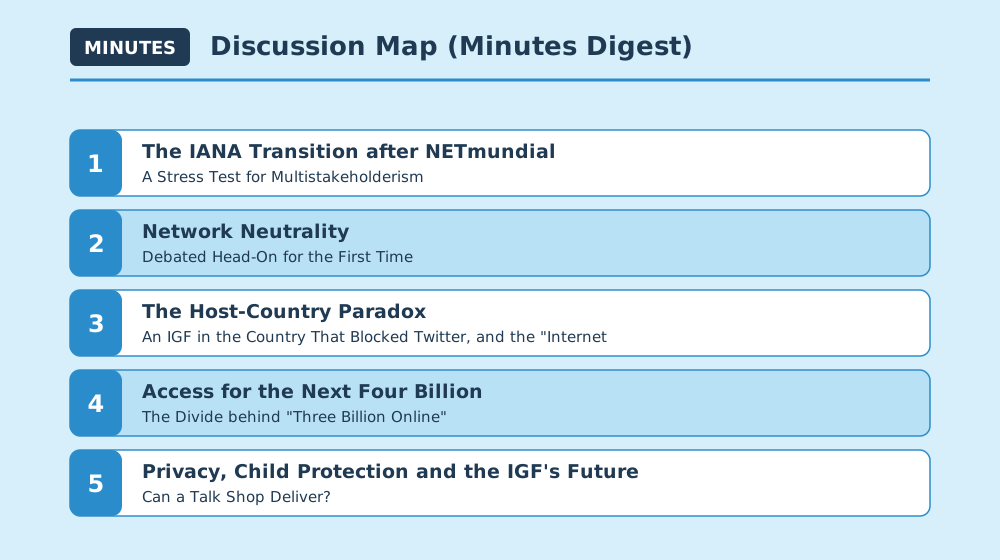
Key exchanges extracted from session records and transcripts.
1. The IANA Transition after NETmundial — A Stress Test for Multistakeholderism
Sessions: Main focus session "Evolution of the Internet Governance Ecosystem and the Future of the IGF" (4 September, Main Room)
"Multistakeholderism is more than a buzzword – it is a mature model that works to solve practical challenges"
— Salam Yamout (RIPE NCC Executive Board, closing session) [1][5]
- In March 2014 the US government had announced it would transition its stewardship of the IANA functions (managing domain names and IP addresses) to the global multistakeholder community; how to run that process was a central topic in Istanbul [1][5]
- Multiple workshops and a pre-event discussed how to carry forward the outcomes of April's NETmundial meeting in Brazil — its multistakeholder principles and roadmap [1][5]
- The technical community stressed keeping the Internet "a single, global network, unfragmented, neutral, providing end-to-end connections" [1][5]
2. Network Neutrality — Debated Head-On for the First Time
Sessions: Main focus session on Network Neutrality and workshop "Net Neutrality, Zero Rating and Development" (3 September)
"The question is: are the consumers in charge of where in the Internet they go and what they do with it?"
— Vint Cerf (Vice President and Chief Internet Evangelist, Google) [1][2]
- Against the backdrop of the US FCC rulemaking and European legislative debates, IGF 2014 elevated network neutrality to a main focus session for the first time, alongside the IANA transition [1][2]
- "Zero rating" — exempting certain apps from data charges — split opinion: is it a way to expand access in developing countries, or does it distort competition and user choice? [1][2]
3. The Host-Country Paradox — An IGF in the Country That Blocked Twitter, and the "Internet Ungovernance Forum"
Sessions: Parallel event outside the venue (4–5 September, Istanbul Bilgi University Santral Campus)
- Host Turkey had blocked access to Twitter and YouTube earlier that year, drawing criticism that the UN was discussing internet freedom in a country known for digital censorship [6][7][3]
- Turkish civil society group Alternative Informatics Association staged a parallel "Internet Ungovernance Forum" focused on censorship, surveillance and free expression, with participants including Julian Assange, Jacob Appelbaum and Amelia Andersdotter [6][7][3]
- Ironically, the official hashtag #IGF2014 drew more than 32,000 tweets reaching some 19 million users — on the very platform Turkey had blocked that year [6][7][3]
4. Access for the Next Four Billion — The Divide behind "Three Billion Online"
Sessions: Opening ceremony and main session "Policies Enabling Access, Growth and Development on the Internet" (3 September, Main Room)
"We want to foster an accessible, open, secure and trustworthy Internet"
— Thomas Gass (UN Assistant Secretary-General for Policy Coordination, UN DESA) [2]
- Nearly 3 billion people were expected to be online by the end of 2014 — two-thirds of them in developing countries — yet more than 4 billion remained offline, with only about 20 per cent of Africa's population connected [2]
- Policies to turn connectivity into an engine of growth and development — infrastructure investment, local content, multilingualism — headed the meeting's eight sub-themes as "Policies Enabling Access" [2]
5. Privacy, Child Protection and the IGF's Future — Can a Talk Shop Deliver?
Sessions: Digital trust and human rights sessions, and the closing session (5 September)
"The Internet Governance Forum allows everyone to come together in an open setting on equal footing to exchange ideas and have an open dialogue"
— Jānis Kārkliņš (Chair, IGF Multistakeholder Advisory Group) [3][4]
- In the post-Snowden context, privacy and surveillance, freedom of expression and association, and child online protection ran through the agenda, and ITU and UNICEF released their Guidelines for Industry on Child Online Protection during the meeting [3][4]
- Answering criticism that the IGF talks without delivering, five Best Practice Forums — on spam, CERTs, local content, child online safety and multistakeholder mechanisms — documented policy options, laying groundwork ahead of the UN General Assembly's decision on renewing the IGF mandate at the end of 2015 [3][4]
Three-Minute Short Talk — Your Questions Answered
Q. So what did the conference actually decide?
A. The IGF doesn't decide — it's the UN's forum where governments, companies and civil society talk as equals. But this edition produced a Chair's Summary plus Best Practice Forum outputs on spam, CERTs and child online safety, and it became the first global stage for working out how the US would hand over stewardship of the IANA functions — the Internet's address book.
Q. What was the most contentious topic?
A. The venue itself. Turkey had blocked Twitter and YouTube that very year, so activists asked whether internet freedom could credibly be discussed there — and ran a parallel "Internet Ungovernance Forum" in protest. Inside the venue, network neutrality and zero rating were debated head-on for the first time, and opinion split sharply.
Q. Why should I care?
A. The IANA transition that gathered momentum here was completed in 2016, moving oversight of the Internet's core resources away from any single government. And the fights over platform blocking and zero rating previewed the platform-regulation and net-neutrality debates every country faces today.
What Is Global IGF? (for first-time readers)
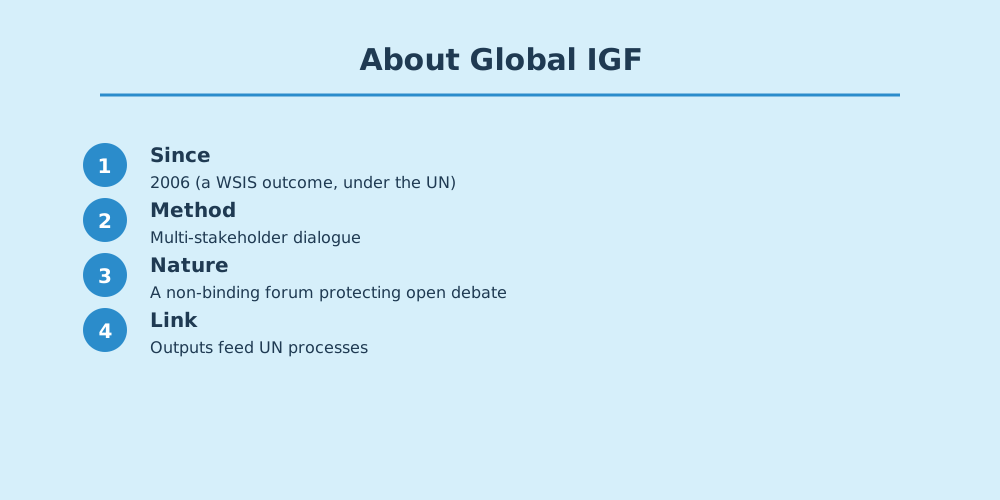
Global IGF has met annually under UN auspices since 2006 — the one global conference where governments, business, civil society, the technical community and youth debate internet governance as equals (the multistakeholder model).
Why It Matters to You
What was discussed here becomes the baseline for national digital policy, platform rules and AI regulation worldwide within a few years. The principles confirmed at the 2014 meeting are the foundation of the "next rules" for the phones, social platforms and AI services you use every day.
Sources & References
- IGF 2014 (archived official page) — UN IGF Secretariat (accessed 2026-07-10)
- With nearly 3 billion now online, UN-backed forum opens to debate key Internet issues — UN News (accessed 2026-07-10)
- UN-backed forum tackles privacy, boosting Internet access, protecting children online — UN News (accessed 2026-07-10)
- Internet Governance Forum — IGF IX, Istanbul, Turkey 2014 — en (accessed 2026-07-10)
- Ninth IGF Concludes in Istanbul — NRO (accessed 2026-07-10)
- Internet Ungovernance Forum — en (accessed 2026-07-10)
- Internet Ungovernance Forum – civil society counterbalance to IGF — EDRi (accessed 2026-07-10)
Quotes are translated or condensed from the records listed above. Bracketed numbers [n] refer to the source list.
Related links
- IGF official (NRI list): https://www.intgovforum.org/en/content/national-and-regional-igf-initiatives
- Japan IGF: https://japanigf.jp/
- Yuki Nakazawa's blog: https://nkzw.jp/category/igf/
Revision History
Rev. 1 — published 2 September 2014, 15:00 (Article published)
Rev. 2 — updated 10 July 2026, 14:28 (Fully revised into the in-depth edition: added the 3-line summary, minutes digest, short talk, source list and diagrams (all quotes verified against the listed sources))
— 中澤祐樹

