


The 3-Line Summary
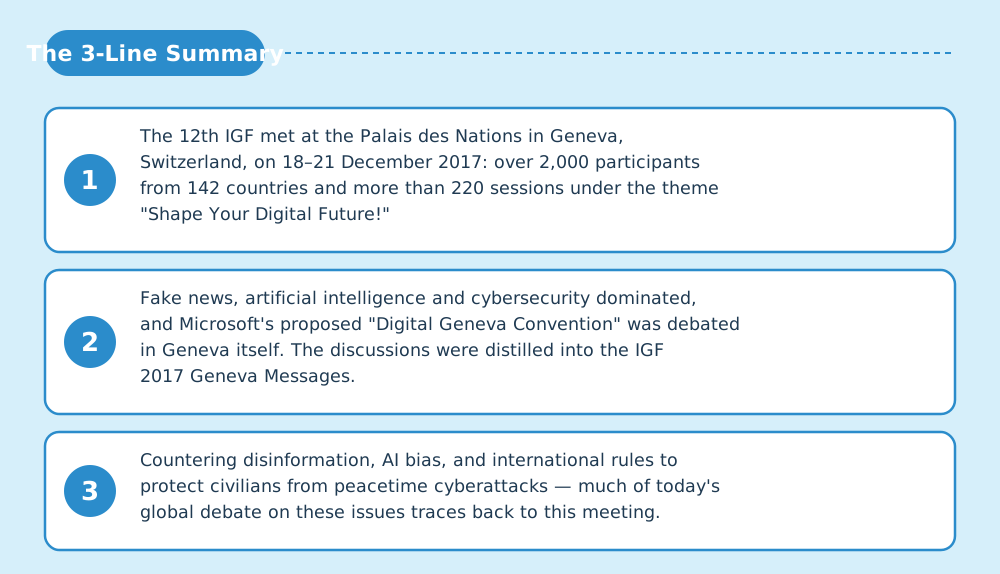
- The 12th IGF met at the Palais des Nations in Geneva, Switzerland, on 18–21 December 2017: over 2,000 participants from 142 countries and more than 220 sessions under the theme "Shape Your Digital Future!"
- Fake news, artificial intelligence and cybersecurity dominated, and Microsoft's proposed "Digital Geneva Convention" was debated in Geneva itself. The discussions were distilled into the IGF 2017 Geneva Messages.
- Countering disinformation, AI bias, and international rules to protect civilians from peacetime cyberattacks — much of today's global debate on these issues traces back to this meeting.
Welcome — this is the Japan IGF Support Organization. This in-depth report on Global IGF 2017 in Geneva draws on official outputs, session records and on-site reporting. In a hurry? The three lines above and the diagrams carry the gist.
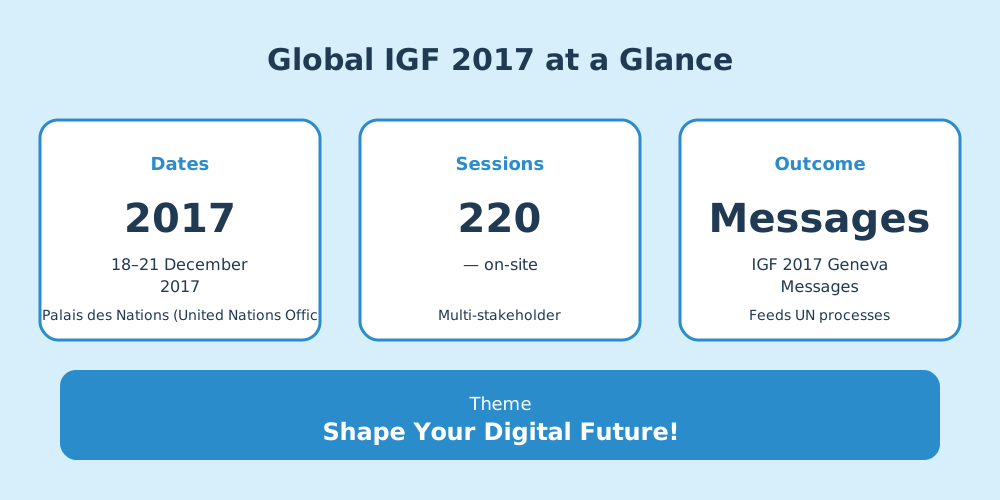
Conference at a Glance (from official records)
| Item | Detail |
|---|---|
| Edition | 12th annual IGF |
| Dates | 18–21 December 2017 |
| Venue | Palais des Nations (United Nations Office at Geneva), Geneva, Switzerland |
| Theme | Shape Your Digital Future! |
| Participants | Over 2,000 onsite participants from 142 countries |
| Online participants | 1,661 |
| Sessions | 220 (About 260 sessions if the 40 Day 0 events are included) |
| Remote hubs | 32 |
| Host | Government of Switzerland and the United Nations (welcoming remarks by Swiss President Doris Leuthard at the opening) |
| Outcome | IGF 2017 Geneva Messages |
(See the source list at the end of this article.)
Discussion Digest — from the Session Records
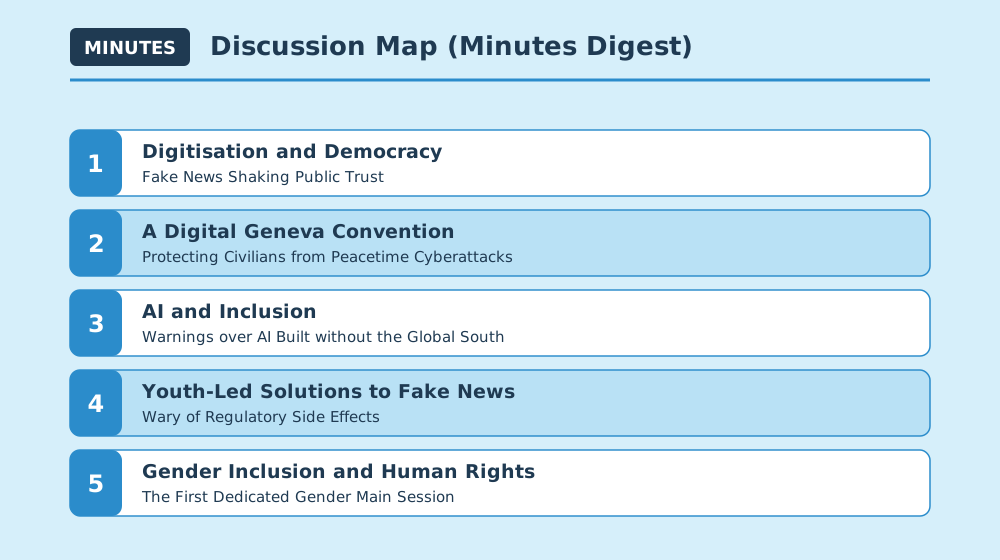
Key exchanges extracted from session records and transcripts.
1. Digitisation and Democracy — Fake News Shaking Public Trust
Sessions: High-Level Thematic Session "The Impact of Digitisation on Politics, Public Trust and Democracy" (19 December, 10:00–13:00)
"The digital space, as a cornerstone of the public policy space, can be a great enabler for more inclusive democratic discourse and participation, as well as more inclusive policy-making"
— Philipp Metzger (Director General, Swiss Federal Office of Communications; Host Chair) [3][2]
"Data is not neutral"
— Malavika Jayaram (Digital Asia Hub) [3][2]
- Frank La Rue (UNESCO) rejected the very term 'fake news', arguing the debate should be framed around 'misinformation' [3][2]
- EU Commissioner Mariya Gabriel stressed 'the need to earn the trust of citizens' when tackling misinformation [3][2]
- Echo chambers and filter bubbles cannot be fixed by fact-checking alone, noted Bobby Duffy of Ipsos [3][2]
2. A Digital Geneva Convention — Protecting Civilians from Peacetime Cyberattacks
Sessions: Workshop "A Digital Geneva Convention to protect cyberspace" (WS34, 19 December, 10:45–12:15)
"There is a need for a strategic cybersecurity framework to protect people in times of peace"
— Paul Nicholas (Senior Director for Trustworthy Computing, Microsoft) [4]
- Microsoft President Brad Smith's February 2017 'Digital Geneva Convention' proposal was debated head-on in Geneva, the city the idea is named after [4]
- Panellists probed how international humanitarian law applies to cyber operations and how hard it is to define a 'cyber attack', calling for multistakeholder rather than closed-door intergovernmental processes [4]
- Bilateral, regional and soft-law approaches should complement any multilateral treaty, argued speakers including Australia's Ambassador for Cyber Affairs Tobias Feakin [4]
3. AI and Inclusion — Warnings over AI Built without the Global South
Sessions: Workshop "Artificial Intelligence and Inclusion" (WS241, 18 December, 11:45–13:15)
"AI can be used to find discriminatory tendencies in humans"
— Kyung-Sin Park (Executive Director, Open Net Korea) [5]
- Speakers raised concerns that Global South perspectives are excluded from the development of AI architectures [5]
- Building on a November 2017 workshop in Rio de Janeiro on AI and inclusion, panellists stressed ethics, social context and interdisciplinarity over purely technical approaches [5]
- Rather than deepening bias, AI could be turned around to detect and correct discriminatory patterns in humans [5]
4. Youth-Led Solutions to Fake News — Wary of Regulatory Side Effects
Sessions: Workshop "Fake news and possible solutions to access information" (WS134, led by Young IGF, 20 December, 9:00–10:00)
"Technology is only a tool"
— Krishna Kumar Rajamannar (Internet Society, Chennai Chapter) [6]
- Nadia Tjahja framed the problem in three categories: unintentional false information, deliberate misinformation, and true facts spread maliciously to cause harm [6]
- Dutch Senator Arda Gerkens warned that legislative responses risk harming freedom of speech [6]
- Moderator Walid Al-Saqaf explained how blockchain's decentralised record-keeping could counter 'monopolies over information and news' [6]
5. Gender Inclusion and Human Rights — The First Dedicated Gender Main Session
Sessions: Main Session "Gender Inclusion and the Future of the Internet" and related human-rights sessions
"Expression and protection are not independent of one another and must go hand-in-hand"
— David Kaye (UN Special Rapporteur on Freedom of Expression) [8][2]
- For the first time in IGF history a main session was dedicated to gender, covering the digital divide affecting women and girls and online gender-based violence [8][2]
- Speakers urged treating affected communities as agents of change, not passive recipients of protection [8][2]
- Critics noted that responses to online hate speech too often restrict expression instead of addressing root causes [8][2]
Three-Minute Short Talk — Your Questions Answered
Q. So what did the conference actually decide?
A. The IGF doesn't 'decide' — it's the UN's forum where governments, companies and civil society talk as equals. The key threads were distilled into the short 'Geneva Messages', which fed later international digital-policy debates.
Q. What was the most contentious topic?
A. Fake news. Positions ranged from 'we shouldn't even use the term' to warnings that legislation would damage free speech. Microsoft's 'Digital Geneva Convention' proposal also split the room between treaty-based and multistakeholder approaches.
Q. Why should I care?
A. Rules on disinformation, AI bias and protecting civilians from cyberattacks are now mainstream policy everywhere — and much of that global conversation took shape at Geneva in 2017.
What Is Global IGF? (for first-time readers)
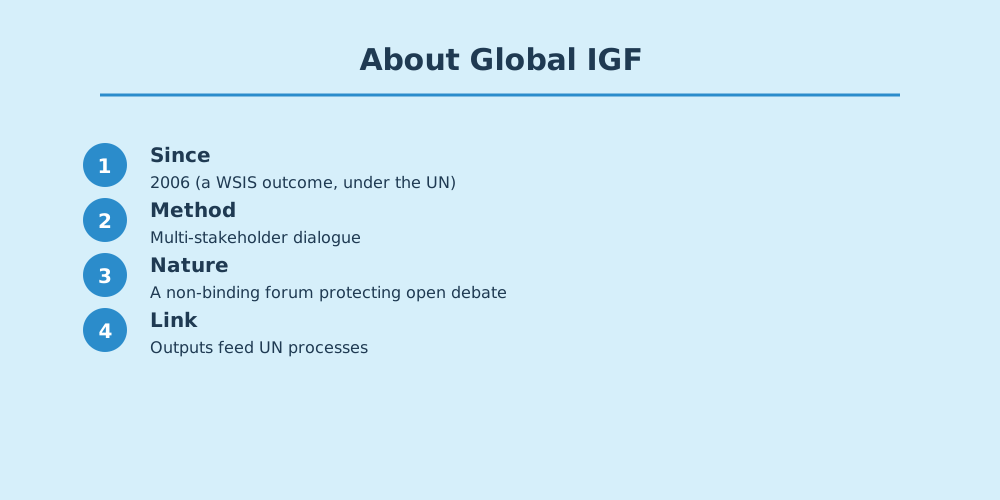
Global IGF has met annually under UN auspices since 2006 — the one global conference where governments, business, civil society, the technical community and youth debate internet governance as equals (the multistakeholder model).
Why It Matters to You
What was discussed here becomes the baseline for national digital policy, platform rules and AI regulation worldwide within a few years. The principles confirmed at the 2017 meeting are the foundation of the "next rules" for the phones, social platforms and AI services you use every day.
Sources & References
- IGF 2017: Geneva, Switzerland, 18-21 December — UN IGF Secretariat (accessed 2026-07-10)
- IGF 2017 'Geneva Messages' — UN IGF Secretariat (accessed 2026-07-10)
- High-level thematic session on impact of digitisation on politics, public trust, and democracy — session report — DiploFoundation (accessed 2026-07-10)
- A Digital Geneva Convention to protect cyberspace (WS34) — session report — DiploFoundation (accessed 2026-07-10)
- Artificial Intelligence and inclusion (WS241) — session report — DiploFoundation (accessed 2026-07-10)
- Fake news and possible solutions to access information, discussion led by Young IGF (WS134) — session report — DiploFoundation (accessed 2026-07-10)
- Internet Governance Forum — IGF XII, Geneva 2017 — en (accessed 2026-07-10)
- A bit of IGF 2017: Access, fake news, hate speech and empowerment — APC (accessed 2026-07-10)
Quotes are translated or condensed from the records listed above. Bracketed numbers [n] refer to the source list.
Related links
- IGF official (NRI list): https://www.intgovforum.org/en/content/national-and-regional-igf-initiatives
- Japan IGF: https://japanigf.jp/
- Yuki Nakazawa's blog: https://nkzw.jp/category/igf/
Revision History
Rev. 1 — published 18 December 2017, 17:00 (Article published)
Rev. 2 — updated 10 July 2026, 14:28 (Fully revised into the in-depth edition: added the 3-line summary, minutes digest, short talk, source list and diagrams (all quotes verified against the listed sources))
— 中澤祐樹

