


The 3-Line Summary
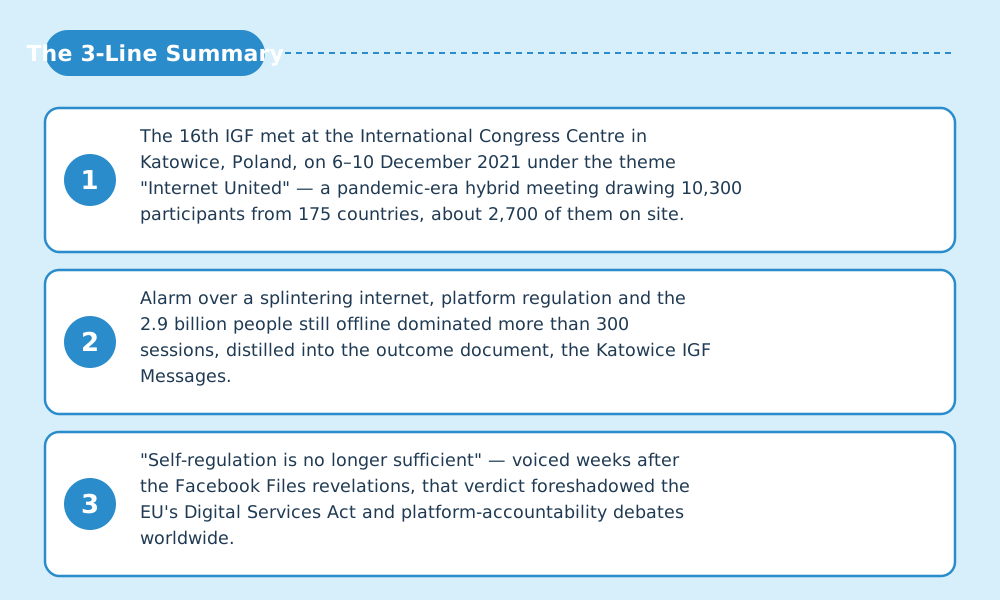
- The 16th IGF met at the International Congress Centre in Katowice, Poland, on 6–10 December 2021 under the theme "Internet United" — a pandemic-era hybrid meeting drawing 10,300 participants from 175 countries, about 2,700 of them on site.
- Alarm over a splintering internet, platform regulation and the 2.9 billion people still offline dominated more than 300 sessions, distilled into the outcome document, the Katowice IGF Messages.
- "Self-regulation is no longer sufficient" — voiced weeks after the Facebook Files revelations, that verdict foreshadowed the EU's Digital Services Act and platform-accountability debates worldwide.
Welcome — this is the Japan IGF Support Organization. This in-depth report on Global IGF 2021 in Katowice draws on official outputs, session records and on-site reporting. In a hurry? The three lines above and the diagrams carry the gist.
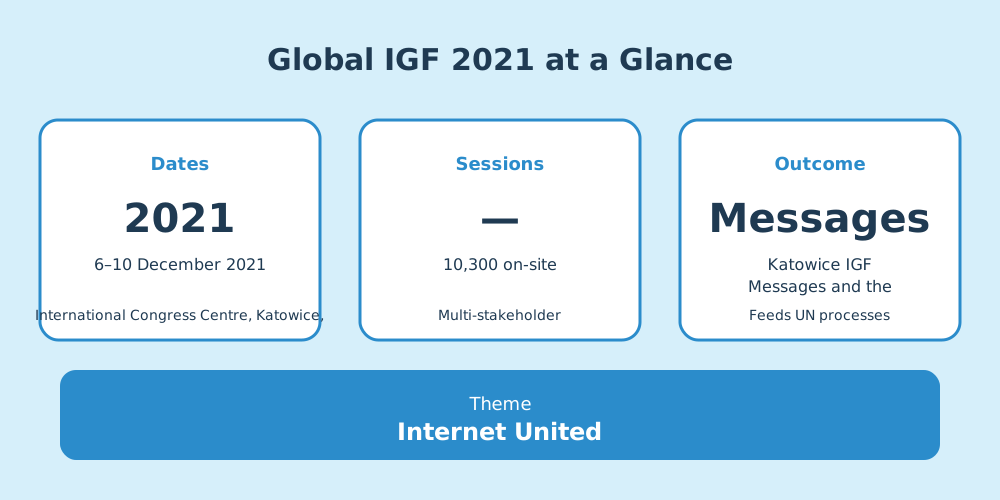
Conference at a Glance (from official records)
| Item | Detail |
|---|---|
| Edition | 16th annual IGF meeting |
| Dates | 6–10 December 2021 |
| Venue | International Congress Centre, Katowice, Poland (hybrid meeting) |
| Theme | Internet United |
| Participants | 10,300 (10,300 participants from 175 countries, about 2,700 of them on site) |
| Host | Government of Poland and the United Nations |
| Outcome | Katowice IGF Messages and the IGF 2021 Summary |
(See the source list at the end of this article.)
Discussion Digest — from the Session Records
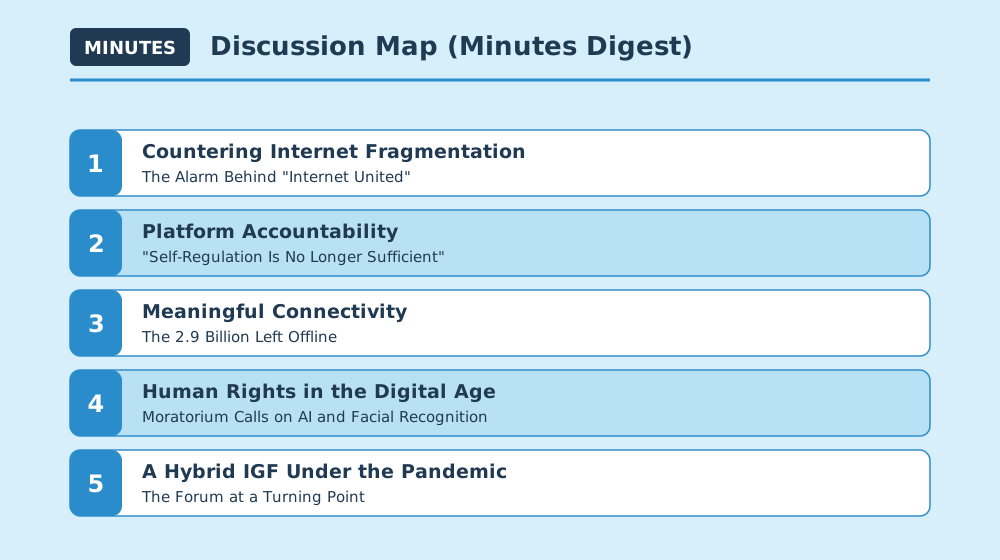
Key exchanges extracted from session records and transcripts.
1. Countering Internet Fragmentation — The Alarm Behind "Internet United"
Sessions: Opening Ceremony (6 December) and sessions on digital sovereignty and fragmentation
"We can only address these challenges united, through strengthened cooperation"
— António Guterres (UN Secretary-General, video message) [4][5][3]
- The theme "Internet United" framed the internet as one community connecting all its users — an explicit counterpoint to a splintering, state-by-state internet [4][5][3]
- Speakers warned that national policies pursuing "digital autonomy and digital sovereignty" risk fragmenting the internet, arguing that "enhancing autonomy does not necessarily require more regulation and control" [4][5][3]
- Internet pioneer Vint Cerf called for stronger digital cooperation to leverage "the internet as a global shared infrastructure and a global commons" [4][5][3]
2. Platform Accountability — "Self-Regulation Is No Longer Sufficient"
Sessions: Emerging Regulation track sessions, including "Clash of digital civilizations: governments and tech giants"
- A recurring verdict: "self-regulation is no longer sufficient to ensure trust, protect human rights, or stimulate innovation" — with tension persisting between calls for formal regulation and stronger self-regulation [4][1][7]
- The meeting came weeks after the Facebook Files reporting deepened distrust of platforms; "Emerging Regulation" covering market structure, content, data and consumer protection was one of six issue areas [4][1][7]
- The Katowice IGF Messages called for principles to govern online platforms and for responsible use of AI algorithms that avoids biases exacerbating inequalities [4][1][7]
3. Meaningful Connectivity — The 2.9 Billion Left Offline
Sessions: Universal Access and Meaningful Connectivity track sessions
- ITU data — 2.9 billion people, 37% of the world's population, still offline — echoed across sessions, as the debate shifted from simply getting people online to meaningful, safe connectivity [3][4][5][6]
- Internet users grew from 4.1 billion in 2019 to 4.9 billion in 2021 — 782 million new users — yet most of the unconnected live in developing countries, widening the gap [3][4][5][6]
- Decision-makers were urged to tackle the triple barrier of device shortages, weak infrastructure and low digital literacy [3][4][5][6]
4. Human Rights in the Digital Age — Moratorium Calls on AI and Facial Recognition
Sessions: Human rights sessions and Closing Ceremony (10 December)
"Seventy-three years ago, the UN General Assembly adopted the Universal Declaration of Human Rights. The COVID-19 pandemic, the climate crisis and the expansion of digital technology into all areas of our lives have created new threats to human rights"
— Maria Francesca Spatolisano (UN Assistant Secretary-General) [6][5]
- Human-rights risks of frontier technologies such as AI and facial recognition were debated head-on, including proposals for moratoriums and binding international agreements [6][5]
- Janusz Cieszyński, Poland's Secretary of State for Cyber Security, asked whether the forum would be remembered "for asking ourselves the questions of how human rights can be protected online" [6][5]
- Rising data breaches, cyberbullying and digital violence — disproportionately targeting women and girls — were treated as core agenda items [6][5]
5. A Hybrid IGF Under the Pandemic — The Forum at a Turning Point
Sessions: Closing sessions and the overall conduct of the meeting
- Of 10,300 participants from 175 countries, about 2,700 attended in person; the hybrid format was credited with enabling fruitful, detailed discussions among geographically dispersed stakeholders [8][7][4]
- Key views from 300-plus sessions were distilled into the seven-page Katowice IGF Messages, finalised after a public comment period [8][7][4]
- The IGF was described as being at a turning point, with the "IGF Plus" model, stronger links to national IGFs and expanded multilingual access flagged as next steps [8][7][4]
Three-Minute Short Talk — Your Questions Answered
Q. So what did the conference actually decide?
A. The IGF doesn't 'decide' — it's the UN's forum where governments, companies and civil society talk as equals. But the conclusions of its 300-plus sessions were distilled into the seven-page Katowice IGF Messages, finalised after public comment as recommendations to leaders everywhere.
Q. What was the most contentious topic?
A. Regulating big platforms. Meeting just weeks after the Facebook Files, those insisting that 'self-regulation is no longer sufficient' clashed head-on with those warning that hard regulation would stifle innovation.
Q. Why should I care?
A. The theme 'Internet United' was a warning against the 'splinternet' — an internet broken up along national borders. If fragmentation advances, foreign sites and services become unreachable. Katowice was about keeping the one internet you use every day in one piece.
What Is Global IGF? (for first-time readers)
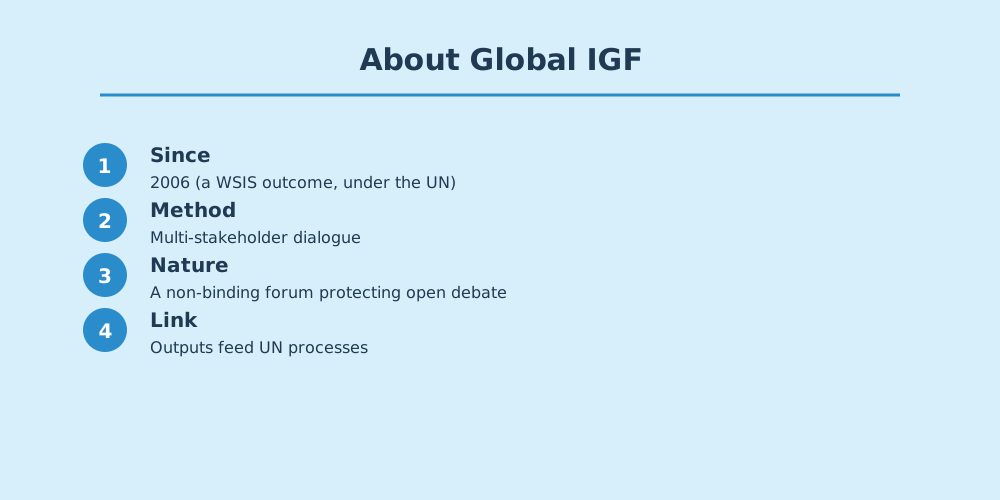
Global IGF has met annually under UN auspices since 2006 — the one global conference where governments, business, civil society, the technical community and youth debate internet governance as equals (the multistakeholder model).
Why It Matters to You
What was discussed here becomes the baseline for national digital policy, platform rules and AI regulation worldwide within a few years. The principles confirmed at the 2021 meeting are the foundation of the "next rules" for the phones, social platforms and AI services you use every day.
Sources & References
- IGF 2021 — UN IGF Secretariat (accessed 2026-07-10)
- Katowice IGF Messages (PDF) — UN IGF Secretariat (accessed 2026-07-10)
- Internet Governance Forum (IGF) 2021 — session reports & daily summaries — DiploFoundation (accessed 2026-07-10)
- IGF 2021 Final report — DiploFoundation (accessed 2026-07-10)
- Internet Governance Forum promotes inclusive digital future for all — UN News (accessed 2026-07-10)
- Calls for stronger digital rights, meaningful access, as Internet Governance Forum wraps up — UN DESA (accessed 2026-07-10)
- The Katowice Message, IGF 2021 — post-consultation version — gov.pl (accessed 2026-07-10)
- Meeting the "Internet United" challenge: when Poland hosted the Internet Governance Forum — フランス・ドメイン名レジストリ (accessed 2026-07-10)
Quotes are translated or condensed from the records listed above. Bracketed numbers [n] refer to the source list.
Related links
- IGF official (NRI list): https://www.intgovforum.org/en/content/national-and-regional-igf-initiatives
- Japan IGF: https://japanigf.jp/
- Yuki Nakazawa's blog: https://nkzw.jp/category/igf/
Revision History
Rev. 1 — published 6 December 2021, 17:00 (Article published)
Rev. 2 — updated 10 July 2026, 14:28 (Fully revised into the in-depth edition: added the 3-line summary, minutes digest, short talk, source list and diagrams (all quotes verified against the listed sources))
— 中澤祐樹

