

The 3-Line Summary
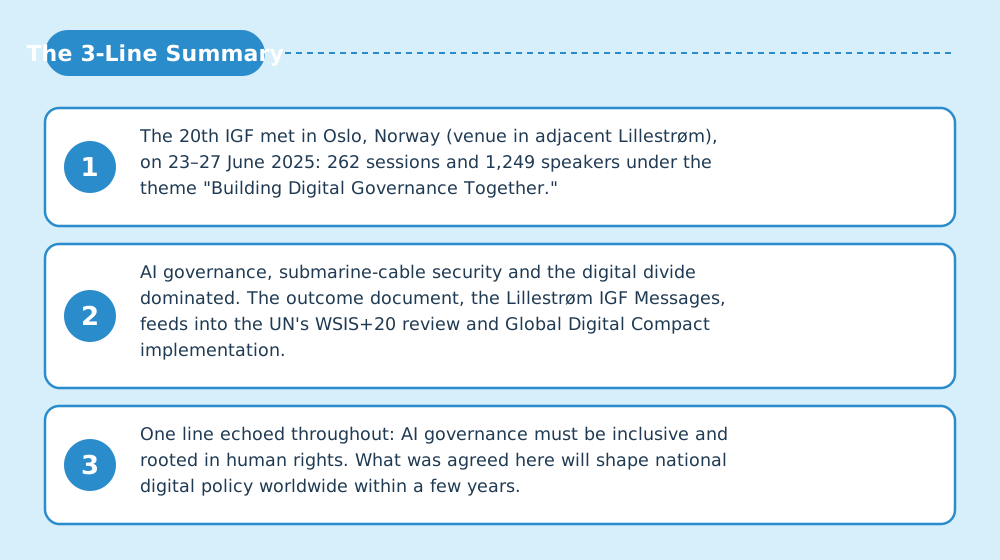
- The 20th IGF met in Oslo, Norway (venue in adjacent Lillestrøm), on 23–27 June 2025: 262 sessions and 1,249 speakers under the theme "Building Digital Governance Together."
- AI governance, submarine-cable security and the digital divide dominated. The outcome document, the Lillestrøm IGF Messages, feeds into the UN's WSIS+20 review and Global Digital Compact implementation.
- One line echoed throughout: AI governance must be inclusive and rooted in human rights. What was agreed here will shape national digital policy worldwide within a few years.
Welcome — this is the Japan IGF Support Organization. This in-depth report on Global IGF 2025 in Oslo draws on official outputs, session records and on-site reporting. In a hurry? The three lines above and the diagrams carry the gist.
📍 Officially the Oslo meeting; the venue, Nova Spektrum, is in Lillestrøm, adjacent to Oslo
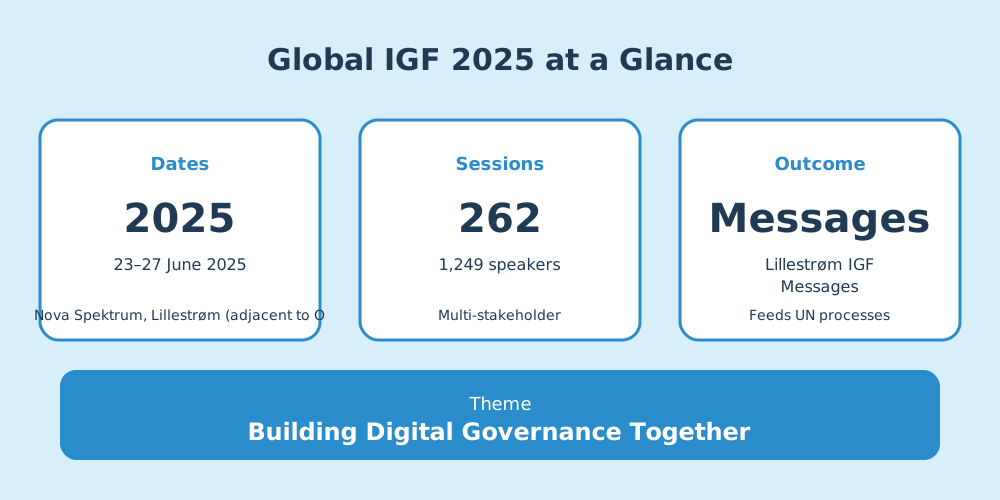
Conference at a Glance (from official records)
| Item | Detail |
|---|---|
| Dates | 23–27 June 2025 |
| Venue | Nova Spektrum, Lillestrøm (adjacent to Oslo), Norway |
| Theme | Building Digital Governance Together |
| Sessions | 262 |
| Speakers | 1,249 |
| Host | Government of Norway and the United Nations |
| Outcome | Lillestrøm IGF Messages |
| Note | 20th anniversary of the IGF |
(See the source list at the end of this article.)
Discussion Digest — from the Session Records
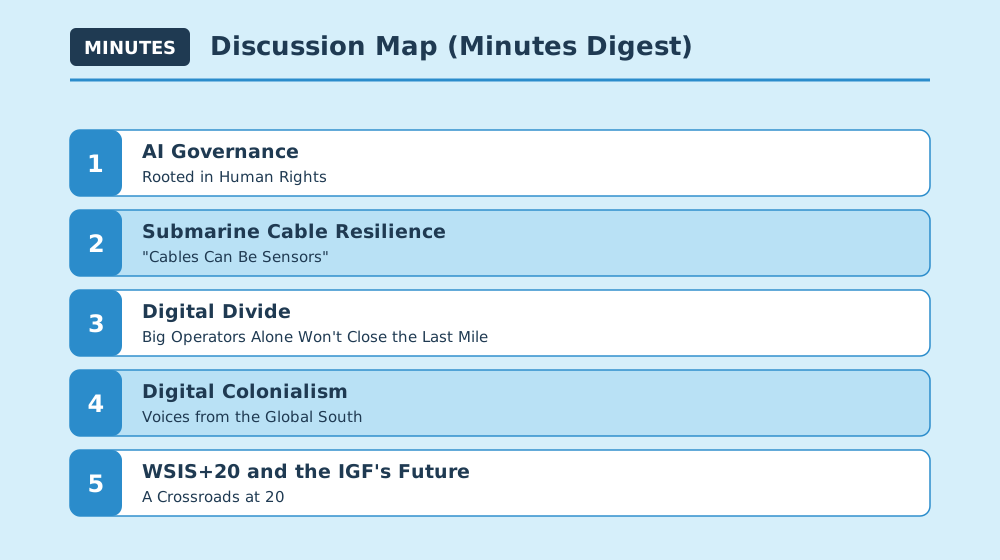
Key exchanges extracted from session records and transcripts.
1. AI Governance — Rooted in Human Rights
Sessions: Main Session "The Governance of Artificial Intelligence" (25 June, 11:30–13:00, Plenary Hall)
- Panellists agreed AI governance must be inclusive, context-aware and rooted in human rights [1][2]
- The IGF should play a stronger role in harmonising the world's fragmented AI-governance initiatives [1][2]
- Digital technologies should serve human rights and social good, not profit for a few [1][2]
2. Submarine Cable Resilience — "Cables Can Be Sensors"
Sessions: Submarine cable sessions
"Cables can be used as sensors to detect approaching threats — monitoring systems can see any object approaching the cable"
— Steiner Bjornstad (Tampnet) [3]
- After cable-cutting incidents in the Baltic and beyond, the physical security of subsea infrastructure rose to headline status for the first time in 20 years [3]
- Host Norway, a subsea-infrastructure power, presented detection technology and international coordination as twin tracks [3]
3. Digital Divide — Big Operators Alone Won't Close the Last Mile
Sessions: Connectivity and inclusion sessions
"A couple of companies dominate allocation of satellites in lower and medium earth orbits"
— Franz von Weizsaecker [2][3]
"Before IXPs, regional messages would go overseas to Europe, then return — IXPs keep traffic within the area, reducing costs"
— Chengetai Masango (IGF Secretariat) [2][3]
- "A diverse ecosystem of providers is essential for last-mile access; relying solely on large mobile operators is insufficient for reaching marginalised communities" (Lillestrøm IGF Messages) [2][3]
- The oligopoly risk of satellite broadband was contrasted with community networks and IXPs that keep connectivity local [2][3]
4. Digital Colonialism — Voices from the Global South
Sessions: Digital justice and inclusion sessions
"Global North actors shape norms while the South faces 'imposition' in digital policy decisions"
— Sabhanaz Rashid Diya [3]
- Multiple sessions raised structural critiques of AI and data-governance rules being set by developed countries [3]
- On the IGF's 20th anniversary, the limits of multilateralism and the raison d'être of the multistakeholder model were re-examined [3]
5. WSIS+20 and the IGF's Future — A Crossroads at 20
Sessions: Main Session (26 June) and others
- Participants affirmed the IGF's track record in shaping digital policy dialogue globally and locally — 'the IGF's success is a key outcome of WSIS' [1][4][5]
- Outcomes feed directly into Global Digital Compact implementation, the 2030 Agenda, and the WSIS+20 review at the end of 2025 — which includes renewal of the IGF's mandate [1][4][5]
Three-Minute Short Talk — Your Questions Answered
Q. So what did the conference actually decide?
A. The IGF doesn't 'decide' — it's the UN's forum where governments, companies and civil society talk as equals. But this year's discussions were distilled into the Lillestrøm IGF Messages and delivered straight into the UN's WSIS+20 review.
Q. What was the most contentious topic?
A. Who gets to write the rules for AI. The 'digital colonialism' critique — the Global North shaping norms while the South faces imposition — was debated head-on.
Q. Why should I care?
A. Submarine-cable security affects every country that depends on undersea links, and the 'human-rights-based' AI governance principle is becoming the baseline for national AI regulation worldwide.
What Is Global IGF? (for first-time readers)
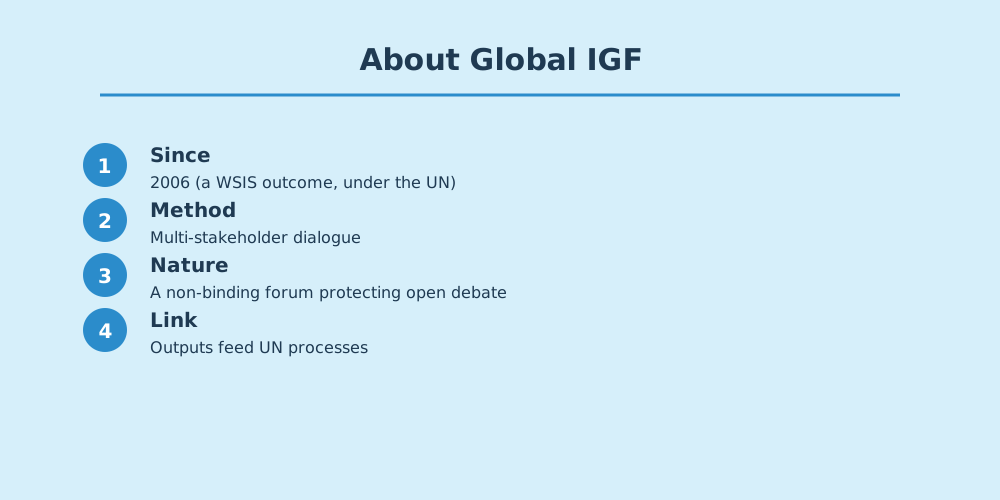
Global IGF has met annually under UN auspices since 2006 — the one global conference where governments, business, civil society, the technical community and youth debate internet governance as equals (the multistakeholder model).
Why It Matters to You
What was discussed here becomes the baseline for national digital policy, platform rules and AI regulation worldwide within a few years. The principles confirmed at the 2025 meeting are the foundation of the "next rules" for the phones, social platforms and AI services you use every day.
Sources & References
- IGF 2025 Outputs — UN IGF Secretariat (accessed 2026-07-10)
- Lillestrøm IGF Messages (PDF) — UN IGF Secretariat (accessed 2026-07-10)
- Internet Governance Forum 2025 — session reports & statistics — DiploFoundation (accessed 2026-07-10)
- Global digital cooperation in focus as 20th Internet Governance Forum concludes in Norway — UN DESA (accessed 2026-07-10)
- Internet Governance Forum opens, marking 20 years of leadership on global digital policy — press release (accessed 2026-07-10)
- IGF – the most important meeting place for Internet Governance — regjeringen.no (accessed 2026-07-10)
Quotes are translated or condensed from the records listed above. Bracketed numbers [n] refer to the source list.
Related links
- IGF official (NRI list): https://www.intgovforum.org/en/content/national-and-regional-igf-initiatives
- Japan IGF: https://japanigf.jp/
- Yuki Nakazawa's blog: https://nkzw.jp/category/igf/
Revision History
Rev. 1 — published 23 June 2025, 16:00 (Article published)
Rev. 2 — updated 10 July 2026, 14:28 (Fully revised into the in-depth edition: added the 3-line summary, minutes digest, short talk, source list and diagrams (all quotes verified against the listed sources))
— 中澤祐樹

