
The 3-Line Summary
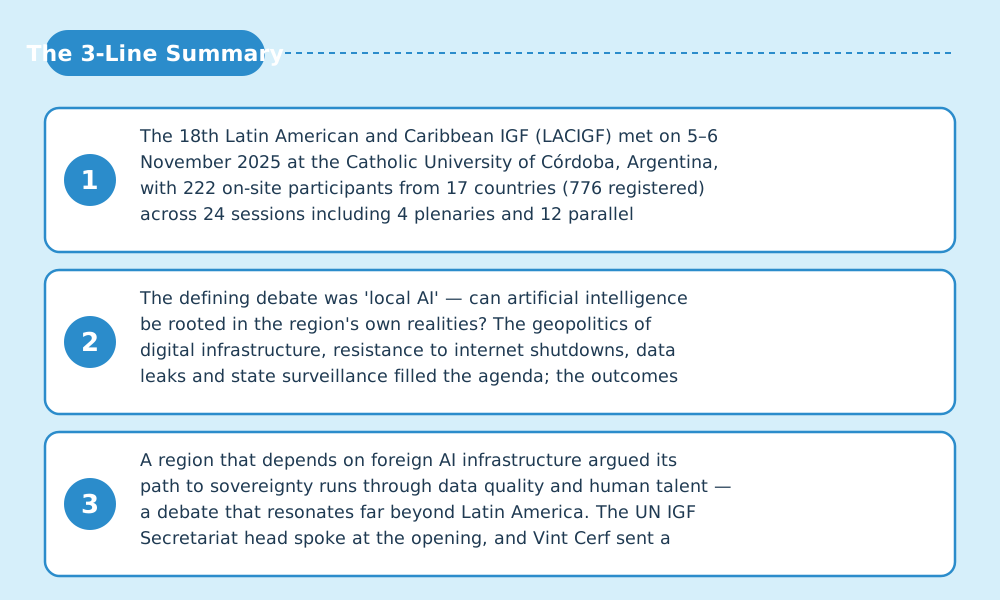
- The 18th Latin American and Caribbean IGF (LACIGF) met on 5–6 November 2025 at the Catholic University of Córdoba, Argentina, with 222 on-site participants from 17 countries (776 registered) across 24 sessions including 4 plenaries and 12 parallel sessions.
- The defining debate was 'local AI' — can artificial intelligence be rooted in the region's own realities? The geopolitics of digital infrastructure, resistance to internet shutdowns, data leaks and state surveillance filled the agenda; the outcomes were published in February 2026 as the LACIGF 2025 Messages and a Final Report.
- A region that depends on foreign AI infrastructure argued its path to sovereignty runs through data quality and human talent — a debate that resonates far beyond Latin America. The UN IGF Secretariat head spoke at the opening, and Vint Cerf sent a video greeting.
Welcome — this is the Japan IGF Support Organization. This in-depth report on LACIGF 2025 in Córdoba draws on official outputs, session records and on-site reporting. In a hurry? The three lines above and the diagrams carry the gist.
📍 The catalogue lists 'Montevideo, Uruguay, 2025', but official records show the 18th LACIGF (2025) was held in Córdoba, Argentina, hosted by Civic House and Wingu after an open call. No LACIGF took place in Montevideo in 2025.
Conference at a Glance (from official records)
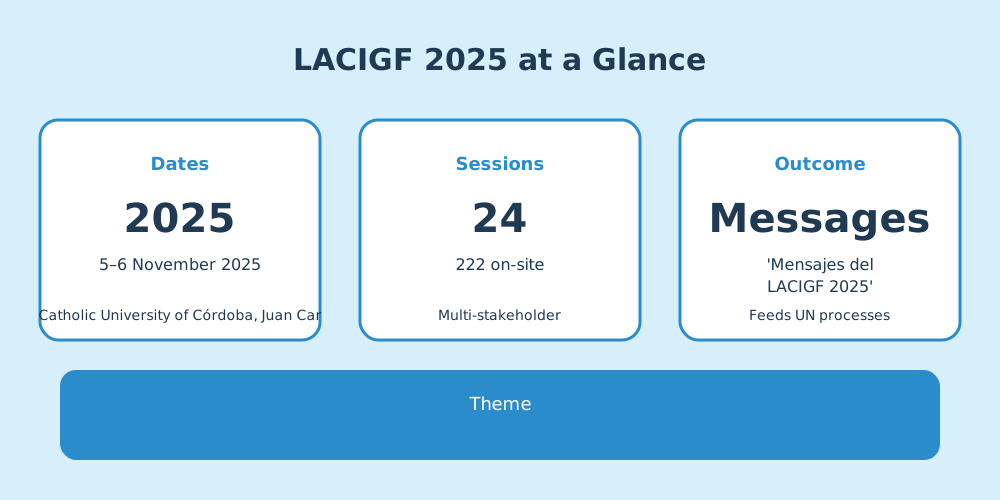
| Item | Detail |
|---|---|
| Edition | 18th edition (LACIGF 18) |
| Dates | 5–6 November 2025 |
| Venue | Catholic University of Córdoba, Juan Carlos Scannone S.J. Center Building, Córdoba, Argentina |
| Theme | Regional governance themes |
| On-site participants | 222 |
| Sessions | 24 |
| Host | Hosted by Civic House and Wingu (selected by open call) at the Catholic University of Córdoba; Secretariat: Colnodo |
| Outcome | 'Mensajes del LACIGF 2025' (Messages) and a Final Report, published in February 2026 |
(See the source list at the end of this article.)
Discussion Digest — from the Session Records
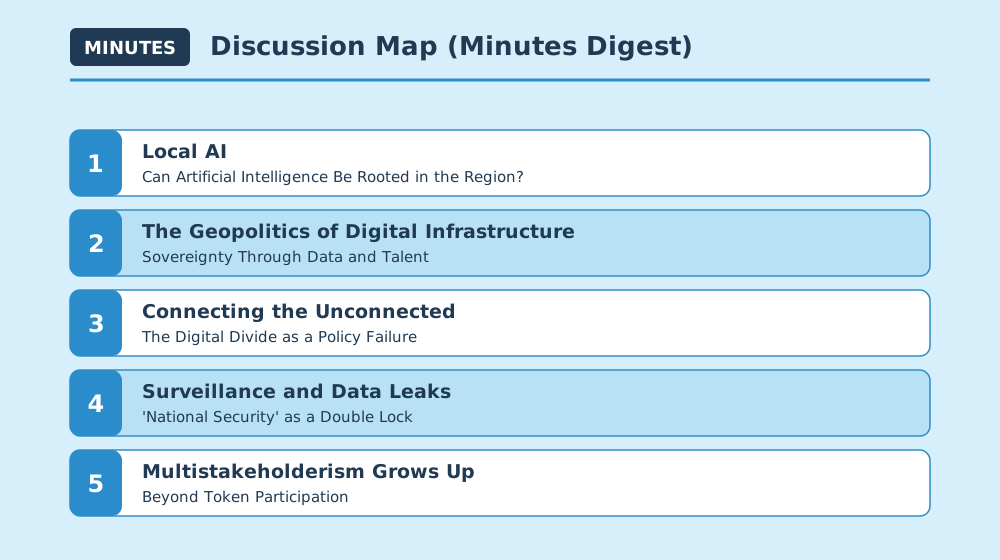
Key exchanges extracted from session records and transcripts.
1. Local AI — Can Artificial Intelligence Be Rooted in the Region?
Sessions: Plenary 4 'Local and Contextual Artificial Intelligence: Alternatives for Sustainable Digital Economies' (6 November, 16:00–17:30)
- Local AI was defined as inclusive AI 'with a purpose', reflecting the region's social, cultural, linguistic and economic realities — and refusing to reproduce data, energy and raw-material extractivism or dependence on the North-centred dominant model [2][3]
- No country in the region can replicate the capacity of global tech hubs alone; regional cooperation — regional language models, federated networks, regional data centres, shared governance frameworks — was framed as the enabling condition for AI sovereignty and development [2][3]
- Inclusion requires more than access to tools: women, youth, rural and indigenous communities must take part in decisions across the entire AI lifecycle, from design and development to regulation and governance [2][3]
2. The Geopolitics of Digital Infrastructure — Sovereignty Through Data and Talent
Sessions: Parallel session 'Geopolitics of digital infrastructure: can Latin America build sovereignty in the age of AI?' (5 November) and the quick talk on data centre infrastructure and digital sovereignty
- Digital sovereignty is not an end in itself but a prerequisite for inclusive development; the region cannot compete head-on in hardware in the short term, but holds a strategic advantage in data quality and human capital [3]
- The way forward: move from regulatory rhetoric to effective technical coordination, strengthen public digital infrastructure such as Brazil's Pix, and protect natural resources and human rights from data extractivism and digital colonialism [3]
- Hosting data centres alone does not confer sovereignty — what matters is 'cognitive sovereignty' over data processing and intelligence, with sustainability (energy and environmental costs) part of the same equation [3]
3. Connecting the Unconnected — The Digital Divide as a Policy Failure
Sessions: Parallel sessions on holistic public policies to connect the unconnected, meaningful connectivity and inclusion, and diversity, interculturality and connectivity (5–6 November)
- With a variety of technologies, business models and provider types already available, persistent gaps are a public-policy failure — connectivity 'is not a luxury but an enabler of life in society' [3][2]
- Brazil's regulatory asymmetry (lighter obligations for small operators) sustains more than 20,000 small regional ISPs serving smaller communities; alongside Colombia's proven community networks, they were presented as complements to large operators [3][2]
- Connectivity alone does not guarantee rights: meaningful access spans literacy, content and community appropriation of technology, designed from each territory's realities rather than imposed external models [3][2]
4. Surveillance and Data Leaks — 'National Security' as a Double Lock
Sessions: Quick talk 'Between opacity and control: government surveillance in Peru' (6 November) and parallel sessions on data leaks and 'Stamping Resistance'
- 'National security' now works as a double lock on rights: it justifies ever-less-exceptional surveillance powers while also grounding exemptions from transparency and access-to-information laws [3]
- The region's illegal data market is structural and persistent; leaked data fuels violence, extortion — disproportionately against women, girls and LGBTIQ+ people — and attacks on critical infrastructure. The gap is not norms but the capacity of states and platforms to prevent, investigate and dismantle the ecosystem [3]
- In a session where trans participants stamped their experiences into prints, messages included 'We are not a flaw in the system — it is a system that fails us' (from the Messages document, translated from Spanish) [3]
5. Multistakeholderism Grows Up — Beyond Token Participation
Sessions: Plenary 1 'Internet Governance: Evolution, Impact and Global, Regional and National Coordination' (5 November, 10:00–11:30)
- The multistakeholder model is a major achievement, but its chief vulnerability is non-meaningful participation — 'tokenism' that leaves power imbalances untouched and affected communities outside the room [2][3][5]
- Governance should not restart with every technological disruption (AI, IoT, the metaverse); it must rest on stable, rights-oriented principles centred on people and planet, avoiding fragmentation and building resilience through cooperation and shared responsibility [2][3][5]
- UN IGF Secretariat head Chengetai Masango spoke at the opening and Vint Cerf sent a video greeting; the 19th edition heads to Fortaleza, Brazil, in 2026, hosted by ABRINT, CGI.br and NIC.br [2][3][5]
Three-Minute Short Talk — Your Questions Answered
Q. So what did the forum actually decide?
A. It doesn't decide — but the debates across 24 sessions were distilled into the LACIGF 2025 Messages and a Final Report, published in February 2026, putting the region's priorities on record: local AI, data centres and sovereignty, resistance to internet shutdowns and more.
Q. What was the headline theme?
A. 'Local AI.' With AI development concentrated in the Global North, the closing plenary asked whether the region can build AI rooted in its own languages and realities through regional cooperation — competing not on hardware, but on data quality and human talent.
Q. Why should I care?
A. Does hosting data centres equal sovereignty? How should countries handle dependence on foreign AI? Is the digital divide a policy failure? These questions travel well beyond Latin America. Note: this event is catalogued as 'Montevideo 2025', but the 18th LACIGF actually met in Córdoba, Argentina.
What Is LACIGF? (for first-time readers)
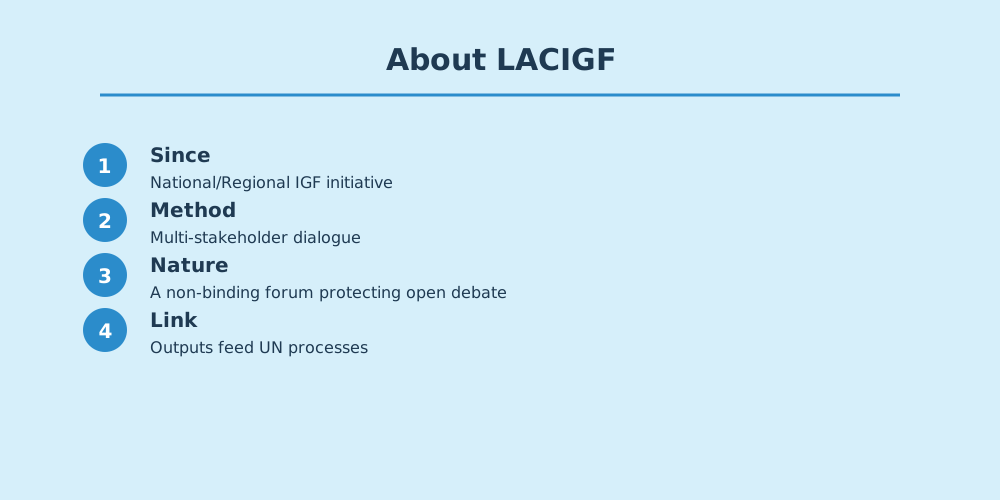
LACIGF is a National or Regional IGF Initiative (NRI), aligning local internet governance discussion with global IGF principles.
Why It Matters to You
What was discussed here becomes the baseline for national digital policy, platform rules and AI regulation worldwide within a few years. The principles confirmed at the 2025 meeting are the foundation of the "next rules" for the phones, social platforms and AI services you use every day.
Sources & References
- Edición 18 del LACIGF 2025 — LACIGF(公式) (accessed 2026-07-10)
- Final Report – 18 LACIGF 2025 (English, PDF) — LACIGF事務局(Colnodo) (accessed 2026-07-10)
- Mensajes del LACIGF – 2025 (PDF) — LACIGF事務局(Colnodo) (accessed 2026-07-10)
- Reporte y Mensajes 18 LACIGF — LACIGF(公式) (accessed 2026-07-10)
- Foro de Gobernanza de Internet de América Latina y el Caribe (LACIGF) 2025 — APC(進歩的コミュニケーション協会) (accessed 2026-07-10)
- Foros anteriores(過去大会一覧) — LACIGF(公式) (accessed 2026-07-10)
Quotes are translated or condensed from the records listed above. Bracketed numbers [n] refer to the source list.
Related links
- IGF official (NRI list): https://www.intgovforum.org/en/content/national-and-regional-igf-initiatives
- Japan IGF: https://japanigf.jp/
- Yuki Nakazawa's blog: https://nkzw.jp/category/igf/
Revision History
Rev. 1 — published 26 August 2025, 21:00 (Article published)
Rev. 2 — updated 10 July 2026, 14:28 (Fully revised into the in-depth edition: added the 3-line summary, minutes digest, short talk, source list and diagrams (all quotes verified against the listed sources))
— 中澤祐樹