

The 3-Line Summary
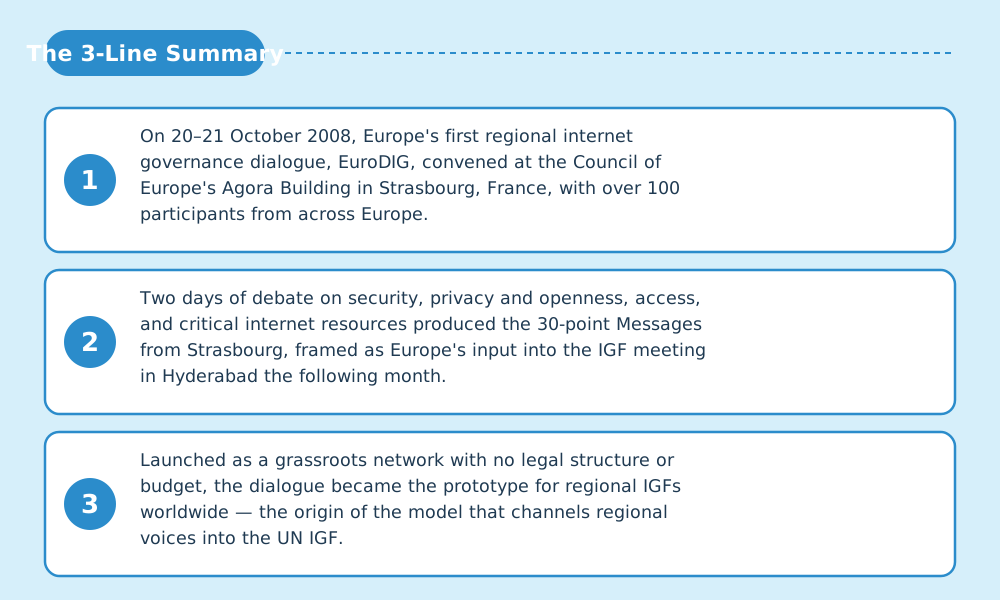
- On 20–21 October 2008, Europe's first regional internet governance dialogue, EuroDIG, convened at the Council of Europe's Agora Building in Strasbourg, France, with over 100 participants from across Europe.
- Two days of debate on security, privacy and openness, access, and critical internet resources produced the 30-point Messages from Strasbourg, framed as Europe's input into the IGF meeting in Hyderabad the following month.
- Launched as a grassroots network with no legal structure or budget, the dialogue became the prototype for regional IGFs worldwide — the origin of the model that channels regional voices into the UN IGF.
Welcome — this is the Japan IGF Support Organization. This in-depth report on EuroDIG 2008 in Strasbourg draws on official outputs, session records and on-site reporting. In a hurry? The three lines above and the diagrams carry the gist.
Conference at a Glance (from official records)
| Item | Detail |
|---|---|
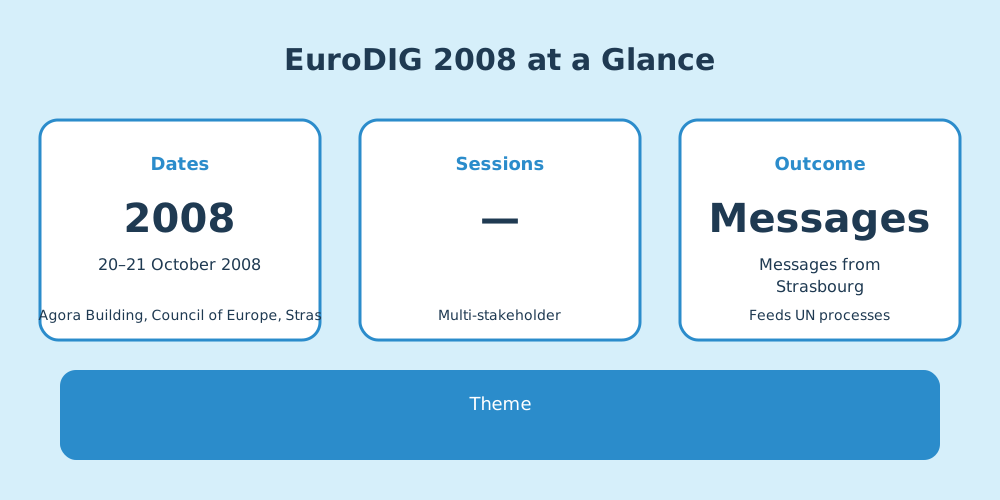
| Edition | 1st EuroDIG (inaugural meeting) |
| Dates | 20–21 October 2008 |
| Venue | Agora Building, Council of Europe, Strasbourg, France |
| Theme | Regional governance themes |
| Host | Facilitated and hosted by the Council of Europe; initiated by a volunteer network including Nominet, the French Foreign Ministry, ICC/BASIS, Swiss OFCOM and ISOC |
| Outcome | Messages from Strasbourg (30 messages) |
(See the source list at the end of this article.)
Discussion Digest — from the Session Records
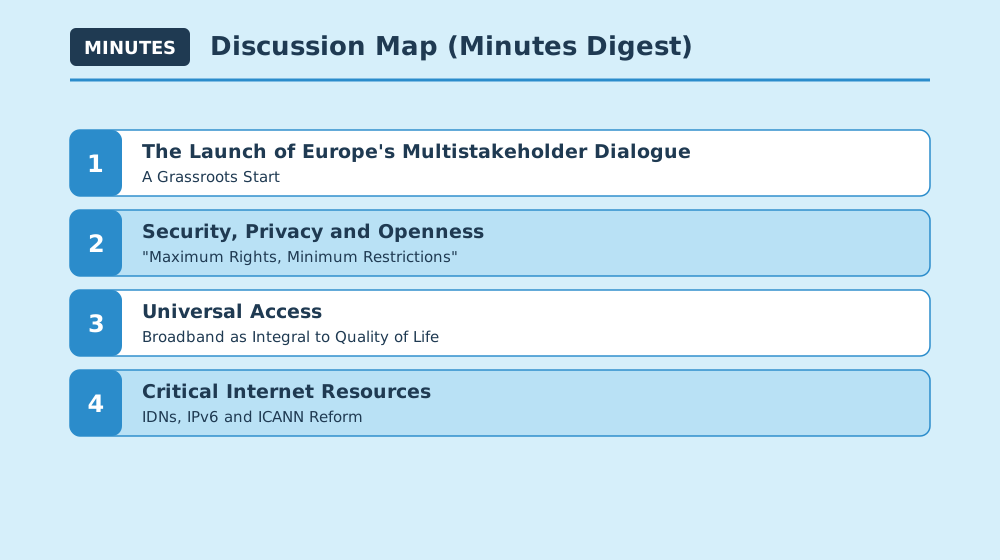
Key exchanges extracted from session records and transcripts.
1. The Launch of Europe's Multistakeholder Dialogue — A Grassroots Start
Sessions: Opening session and "Setting the scene – what is Internet governance for Europe?" (20 October)
- Volunteers from every sector — Martin Boyle (Nominet), Bertrand de la Chapelle (French Foreign Ministry), Lee Hibbard (Council of Europe), Wolfgang Kleinwächter (University of Aarhus), Thomas Schneider (Swiss OFCOM) and others — launched EuroDIG as a network without legal structure [3][2]
- The Messages were explicitly framed as input from Europe into the global debate, not a negotiated consensus text [3][2]
- National multistakeholder dialogues were growing across Europe, with support for expansion into Eastern Europe flagged as a priority [3][2]
2. Security, Privacy and Openness — "Maximum Rights, Minimum Restrictions"
Sessions: "European perspectives on security, privacy and openness" Parts I & II (20–21 October)
- Message 9 set out the principle that citizens and businesses should enjoy a maximum of rights, freedoms and services online, subject only to the minimum restrictions needed for the security and privacy they are entitled to expect [3][2]
- Social networks' handling of personal data, risk education for young people and growing workplace surveillance of employees were flagged as concerns [3][2]
- Security, privacy and openness are most effectively addressed together, with European policies grounded in human rights and the rule of law [3][2]
3. Universal Access — Broadband as Integral to Quality of Life
Sessions: "Universal Access to the Internet" (21 October, 9:15)
- Broadband access was described as integral to quality of life, with governments urged to promote affordable access [2][3]
- Universal service obligations should be designed on technology-neutral standards [2][3]
- Website accessibility should follow W3C and similar specifications, with public administrations leading by example [2][3]
4. Critical Internet Resources — IDNs, IPv6 and ICANN Reform
Sessions: "Managing critical Internet resources" (21 October, 14:00)
- Internationalised domain names and new top-level domains could benefit both European innovation and developing countries [2][3]
- Both public and private sectors were urged to accelerate the IPv4-to-IPv6 transition [2][3]
- ICANN and other bodies were called on to improve multistakeholder engagement and gender and geographical balance, with Internet of Things governance noted as a future issue [2][3]
Three-Minute Short Talk — Your Questions Answered
Q. What exactly is EuroDIG?
A. Europe's regional IGF. This 2008 Strasbourg meeting was the first: governments, business, civil society and technologists debated as equals and distilled the results into 'Messages' delivered to the UN IGF.
Q. Did it decide anything?
A. It makes no binding decisions, but it produced the 30-point Messages from Strasbourg — including the principle of maximum rights with minimum restrictions online, faster IPv6 transition and affordable broadband for all.
Q. Why does a 2008 meeting matter now?
A. The model it established — gathering regional voices and feeding them into the UN IGF — spread worldwide, including to the Asia-Pacific. Trace any regional IGF back far enough and you reach this first 100-person meeting.
What Is EuroDIG? (for first-time readers)
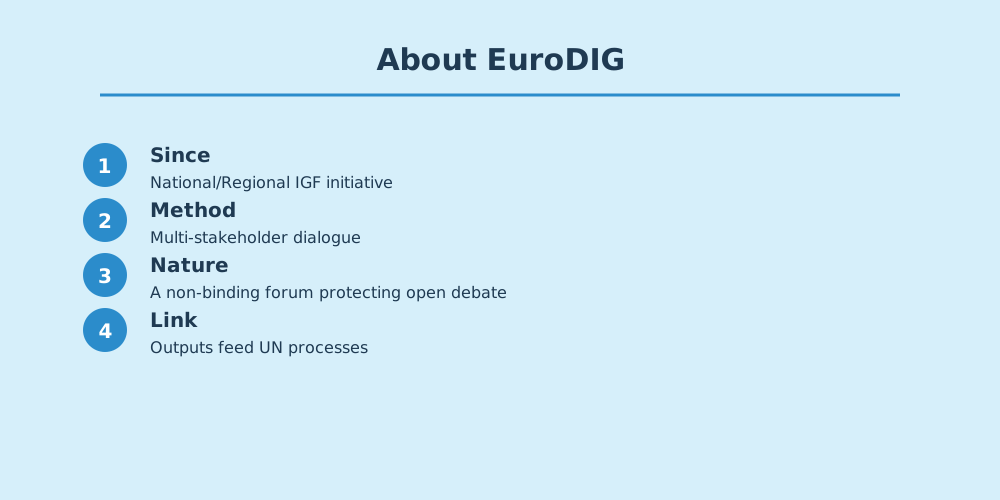
EuroDIG is a National or Regional IGF Initiative (NRI), aligning local internet governance discussion with global IGF principles.
Why It Matters to You
What was discussed here becomes the baseline for national digital policy, platform rules and AI regulation worldwide within a few years. The principles confirmed at the 2008 meeting are the foundation of the "next rules" for the phones, social platforms and AI services you use every day.
Sources & References
- EuroDIG 2008 — eurodigwiki.org (accessed 2026-07-10)
- Messages from Strasbourg – 2008 — eurodigwiki.org (accessed 2026-07-10)
- Messages from Strasbourg (PDF) — Council of Europe (accessed 2026-07-10)
- Programme overview 2008 — eurodigwiki.org (accessed 2026-07-10)
- European Dialogue on Internet Governance — en (accessed 2026-07-10)
- Hosting EuroDIG(歴代開催地一覧) — eurodig.org (accessed 2026-07-10)
Quotes are translated or condensed from the records listed above. Bracketed numbers [n] refer to the source list.
Related links
- IGF official (NRI list): https://www.intgovforum.org/en/content/national-and-regional-igf-initiatives
- Japan IGF: https://japanigf.jp/
- Yuki Nakazawa's blog: https://nkzw.jp/category/igf/
Revision History
Rev. 1 — published 20 October 2008, 09:00 (Article published)
Rev. 2 — updated 10 July 2026, 23:16 (Fully revised into the in-depth edition: added the 3-line summary, minutes digest, short talk, source list and diagrams (all quotes verified against the listed sources))
— 中澤祐樹