
The 3-Line Summary
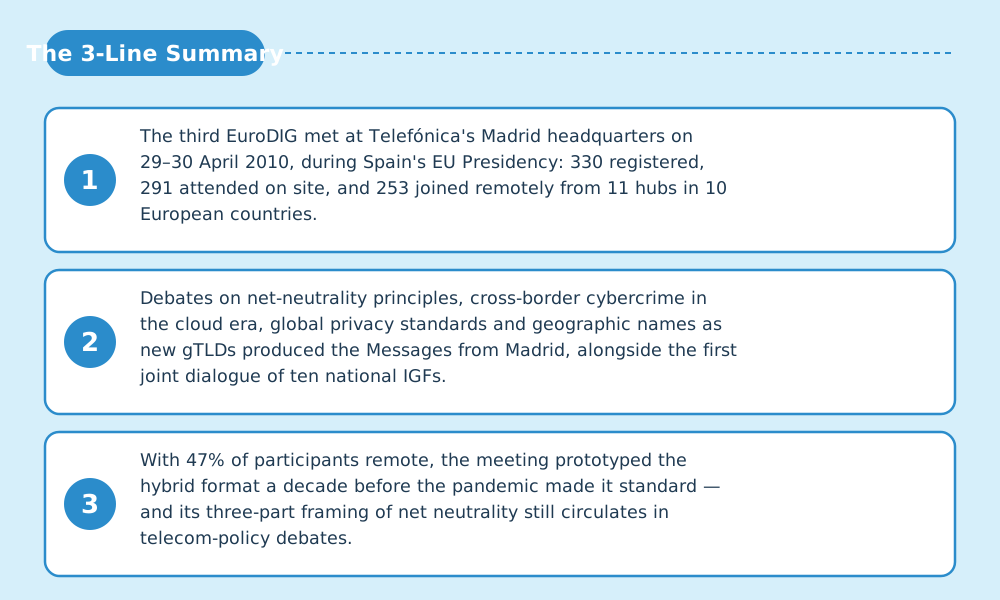
- The third EuroDIG met at Telefónica's Madrid headquarters on 29–30 April 2010, during Spain's EU Presidency: 330 registered, 291 attended on site, and 253 joined remotely from 11 hubs in 10 European countries.
- Debates on net-neutrality principles, cross-border cybercrime in the cloud era, global privacy standards and geographic names as new gTLDs produced the Messages from Madrid, alongside the first joint dialogue of ten national IGFs.
- With 47% of participants remote, the meeting prototyped the hybrid format a decade before the pandemic made it standard — and its three-part framing of net neutrality still circulates in telecom-policy debates.
Welcome — this is the Japan IGF Support Organization. This in-depth report on EuroDIG 2010 in Madrid draws on official outputs, session records and on-site reporting. In a hurry? The three lines above and the diagrams carry the gist.
Conference at a Glance (from official records)
| Item | Detail |
|---|---|
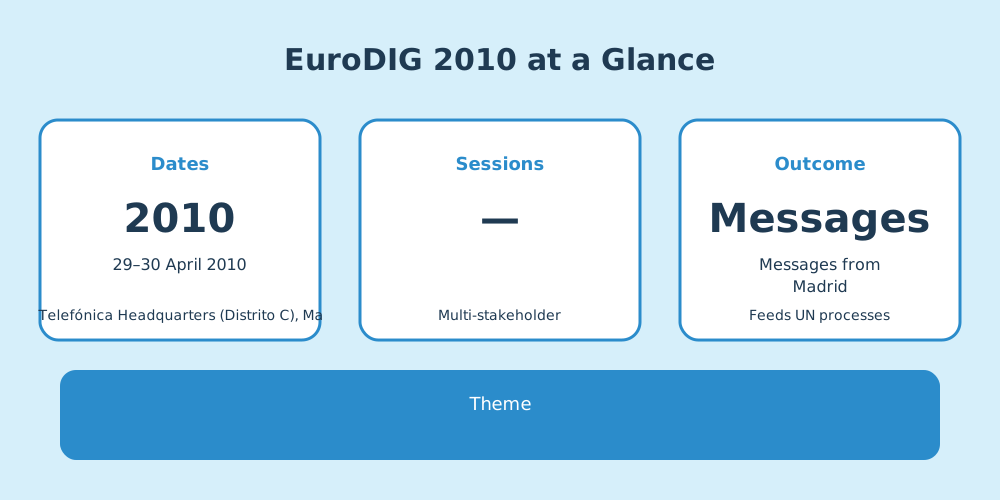
| Edition | 3rd EuroDIG |
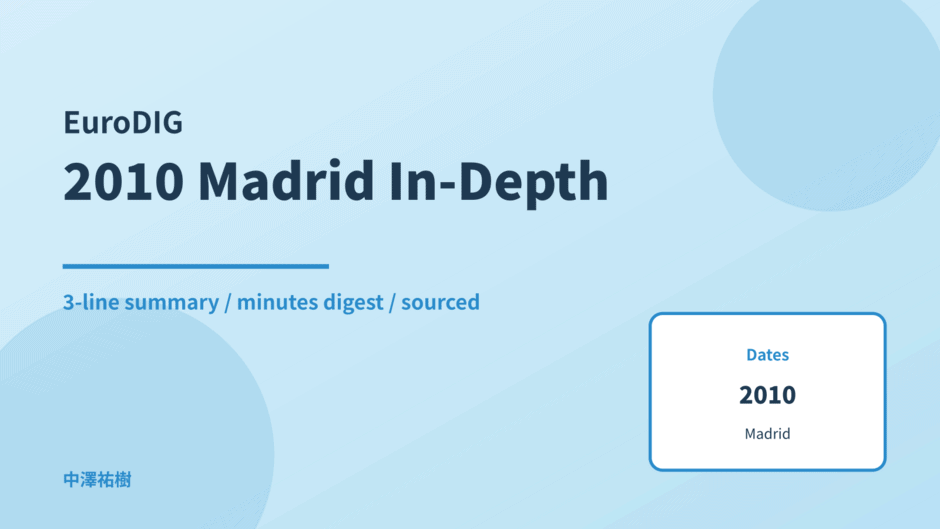
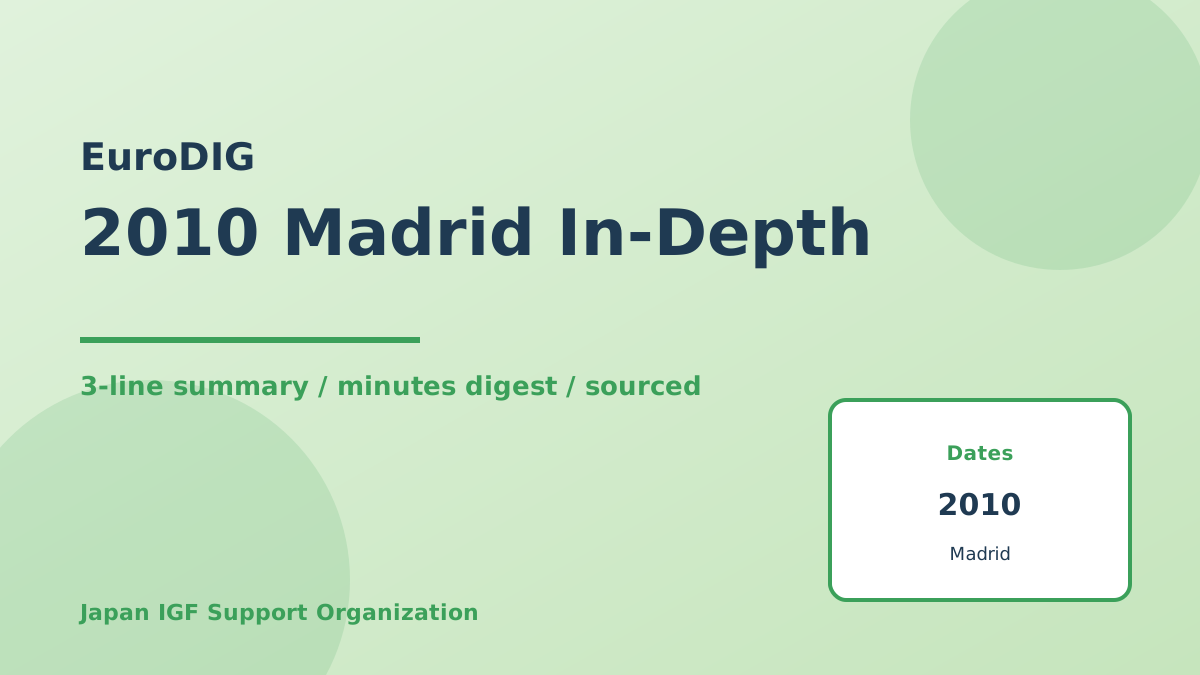
| Dates | 29–30 April 2010 |
| Venue | Telefónica Headquarters (Distrito C), Madrid, Spain |
| Theme | Regional governance themes |
| Registrations | 330 |
| Countries | 56 |
| Sessions | Opening session and national-IGF dialogue plus seven workshops and five plenaries |
| Remote participants | 253 |
| Remote hubs | 11 remote hubs in 10 countries (incl. Baku, Yerevan, Sarajevo, Tbilisi, Chisinau, Bucharest, Belgrade, Kyiv, Toulouse, Strasbourg) |
| Attendees | 291 |
| Chair | Sebastian Muriel, General Director of Red.es (Chairman) |
| Host | Organised by the Spanish IGF, the Council of Europe and Swiss OFCOM, with the support of Telefónica and Fundación Telefónica, Spain's Ministry of Industry, Tourism and Commerce (via red.es) and the City of Madrid, coinciding with the Spanish EU Presidency |
| Outcome | Messages from Madrid |
(See the source list at the end of this article.)
Discussion Digest — from the Session Records
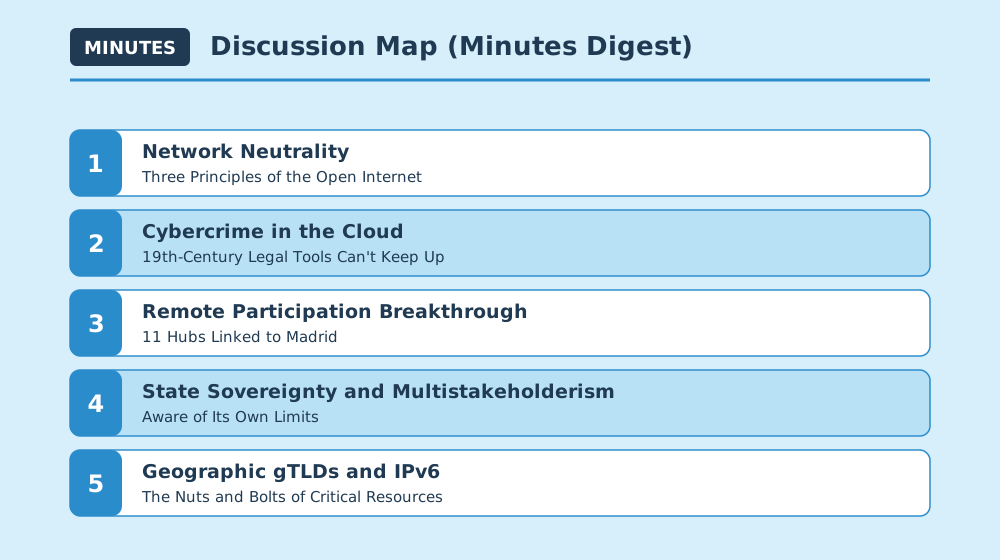
Key exchanges extracted from session records and transcripts.
1. Network Neutrality — Three Principles of the Open Internet
Sessions: Plenary 3: "Principles of 'network neutrality' and policies for an open Internet" (30 April, 11:45)
- The open internet was distilled into three principles: (1) no traffic discrimination based on sender or receiver, (2) unrestricted user choice and access to content, applications and services, (3) appropriate, reasonable and non-discriminatory traffic management [2]
- More certainty was demanded on what 'discrimination' and 'reasonable' traffic management actually entail [2]
- Key considerations flagged for the European Commission: no censorship, transparency, investment in open networks and infrastructure competition, fair competition across the value chain, and preserving innovation [2]
2. Cybercrime in the Cloud — 19th-Century Legal Tools Can't Keep Up
Sessions: Workshop 1: "Cross-border cybercrime jurisdiction under cloud computing" (29 April, 14:30)
- Traditional cooperation mechanisms such as MLATs and letters rogatory, rooted in the nineteenth century, were called too slow and cumbersome for collecting digital evidence in the cloud [2]
- The Budapest Convention and Convention 108 were named the starting points, with calls for wider ratification and better-resourced 24/7 contact points [2]
- A Council of Europe-led multistakeholder working group was proposed, and cloud governance was said to require clarified roles, easier international data transfers and global privacy standards [2]
3. Remote Participation Breakthrough — 11 Hubs Linked to Madrid
Sessions: Event-wide practice (a remote-participation moderator for every session)
- With 253 remote participants against 291 on site — 47% of the total — nearly half the meeting was online, remarkable for 2010 [2][1]
- Eleven hubs in ten countries, including Baku, Yerevan, Sarajevo, Tbilisi, Chisinau, Bucharest, Belgrade and Kyiv, connected via live video, real-time captioning and tweets [2][1]
- The hubs were run as part of a capacity-building programme for Central and Southern European stakeholders, deliberately widening participation from Europe's periphery [2][1]
4. State Sovereignty and Multistakeholderism — Aware of Its Own Limits
Sessions: Workshop 6 on state sovereignty and Plenary 4 on multistakeholderism (30 April)
- A candid assessment: multistakeholderism pits representative against participatory democracy, cannot by itself guarantee legitimacy, representativeness or universality, and is not immune to capture by special interests [2]
- Concepts from international law — equitable access to critical resources, state responsibility for acts within jurisdiction, due-diligence standards for private actors — were offered as building blocks for cross-border internet cooperation [2]
- Representatives of ten national IGF platforms held their first joint dialogue, confirming EuroDIG as the common European focal point for national debates [2]
5. Geographic gTLDs and IPv6 — The Nuts and Bolts of Critical Resources
Sessions: Workshop 2 on geographic names as new TLDs and Workshop 4 on the IPv6 transition
- The domain name space is a global common resource; the 'one size fits all' contract regime was blamed for delays to the new gTLD programme, and ICANN was urged to create a public-interest team of qualified experts [2]
- With IPv4 exhaustion advancing, EU member states were encouraged to lead IPv6 deployment, and regulators were told to learn IPv6 themselves before regulating [2]
- Entering potential new markets for trading IPv4 addresses was explicitly not recommended [2]
Three-Minute Short Talk — Your Questions Answered
Q. What was new about this meeting?
A. Nearly half the participants (47%) joined remotely, via 11 hubs in 10 countries from the Caucasus to the Balkans, linked by live video and real-time captioning — a hybrid-meeting experiment a decade ahead of its time.
Q. What mattered most in the substance?
A. The three-principle framing of net neutrality — no discrimination, user choice, reasonable traffic management — and the blunt finding that 19th-century mutual legal assistance cannot police cybercrime in the cloud era.
Q. Why should I care?
A. That net-neutrality framework still underpins telecom-policy debates worldwide, and the cross-border evidence problem it flagged remains unsolved in every jurisdiction.
What Is EuroDIG? (for first-time readers)
EuroDIG is a National or Regional IGF Initiative (NRI), aligning local internet governance discussion with global IGF principles.
Why It Matters to You
What was discussed here becomes the baseline for national digital policy, platform rules and AI regulation worldwide within a few years. The principles confirmed at the 2010 meeting are the foundation of the "next rules" for the phones, social platforms and AI services you use every day.
Sources & References
- EuroDIG 2010 — eurodigwiki.org (accessed 2026-07-10)
- Messages from Madrid (PDF) — Council of Europe (accessed 2026-07-10)
- Programme overview 2010 — eurodigwiki.org (accessed 2026-07-10)
- European Dialogue on Internet Governance — en (accessed 2026-07-10)
- Hosting EuroDIG(歴代開催地一覧) — eurodig.org (accessed 2026-07-10)
Quotes are translated or condensed from the records listed above. Bracketed numbers [n] refer to the source list.
Related links
- IGF official (NRI list): https://www.intgovforum.org/en/content/national-and-regional-igf-initiatives
- Japan IGF: https://japanigf.jp/
- Yuki Nakazawa's blog: https://nkzw.jp/category/igf/
Revision History
Rev. 1 — published 29 April 2010, 09:00 (Article published)
Rev. 2 — updated 10 July 2026, 23:16 (Fully revised into the in-depth edition: added the 3-line summary, minutes digest, short talk, source list and diagrams (all quotes verified against the listed sources))
— 中澤祐樹