


The 3-Line Summary
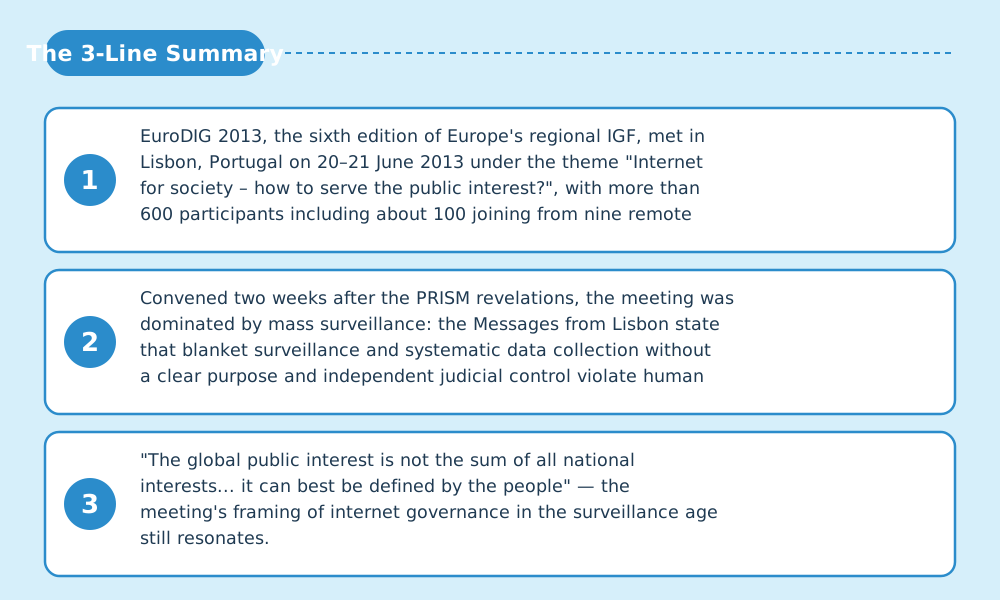
- EuroDIG 2013, the sixth edition of Europe's regional IGF, met in Lisbon, Portugal on 20–21 June 2013 under the theme "Internet for society – how to serve the public interest?", with more than 600 participants including about 100 joining from nine remote hubs.
- Convened two weeks after the PRISM revelations, the meeting was dominated by mass surveillance: the Messages from Lisbon state that blanket surveillance and systematic data collection without a clear purpose and independent judicial control violate human rights.
- "The global public interest is not the sum of all national interests… it can best be defined by the people" — the meeting's framing of internet governance in the surveillance age still resonates.
Welcome — this is the Japan IGF Support Organization. This in-depth report on EuroDIG 2013 in Lisbon draws on official outputs, session records and on-site reporting. In a hurry? The three lines above and the diagrams carry the gist.
Conference at a Glance (from official records)
| Item | Detail |
|---|---|
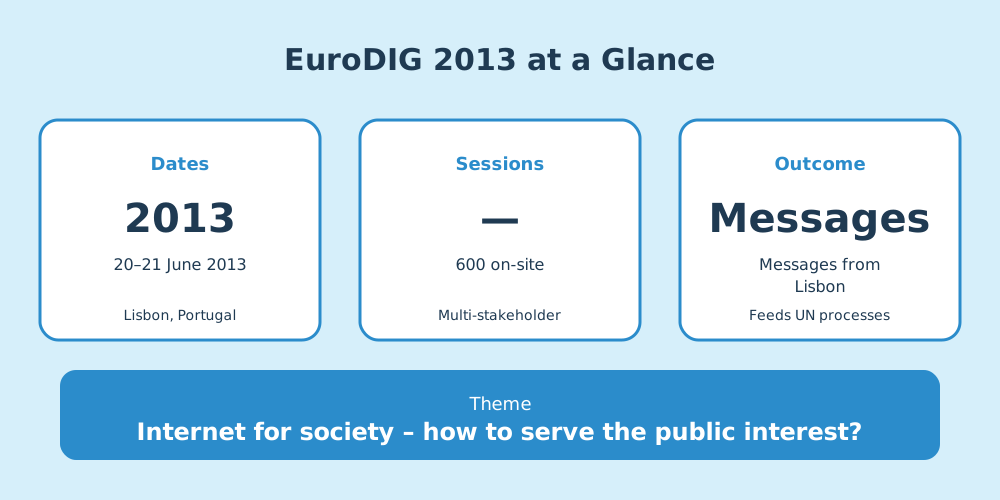
| Dates | 20–21 June 2013 |
| Venue | Lisbon, Portugal |
| Theme | Internet for society – how to serve the public interest? |
| Participants | 600 ("More than 600 participants" per the official Messages from Lisbon (526 on site, around 100 remote via 9 regional hubs; 318 from Portugal, 259 from other European countries, 49 from outside Europe)) |
| Host | ISOC Portugal, the Foundation for Science and Technology (FCT) and the Department for the Media (GMCS), co-organised by the Council of Europe, the Swiss Federal Office of Communications (OFCOM) and the European Broadcasting Union (EBU) |
| Outcome | Messages from Lisbon |
(See the source list at the end of this article.)
Discussion Digest — from the Session Records
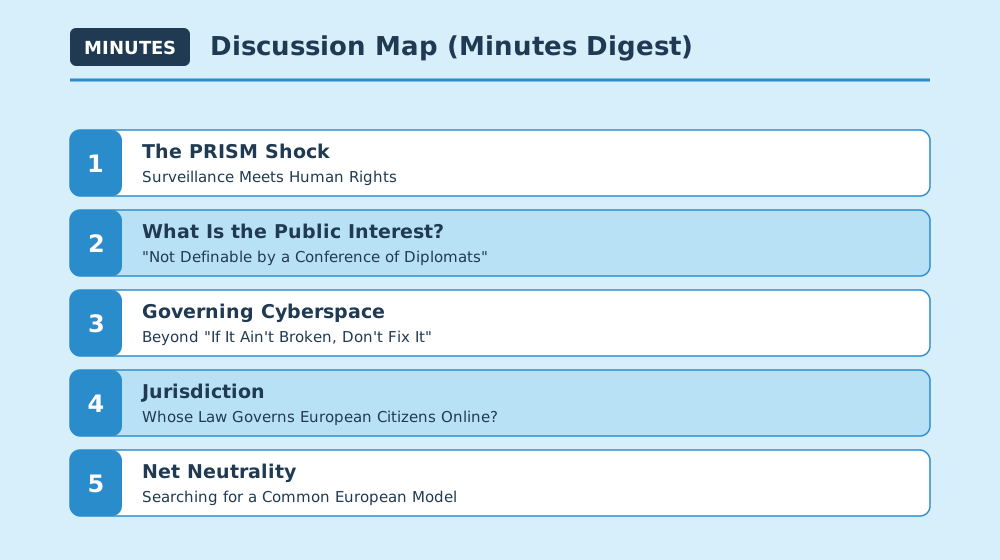
Key exchanges extracted from session records and transcripts.
1. The PRISM Shock — Surveillance Meets Human Rights
Sessions: Cross-cutting theme across plenaries (per the Messages)
- Fresh revelations about PRISM, XKeyscore and Tempora ran through nearly every discussion of user rights and privacy [2]
- "Surveillance measures are only legal when they pursue a legitimate aim necessary in a democratic society and are of an intensity proportionate to the aim pursued. Blanket surveillance and systematic data collection and data-mining without a clear purpose and independent judicial control violate human rights" (Messages from Lisbon) [2]
- Related debates agreed that the line between secret services and law enforcement is increasingly blurry [2]
2. What Is the Public Interest? — "Not Definable by a Conference of Diplomats"
Sessions: Plenary 1 "How to serve the public interest?" (20 June)
- "The global public interest is not the sum of all national interests and it thereby cannot be defined by a conference of diplomats. The global public interest can best be defined by the people" (Messages from Lisbon) [2]
- The Internet was framed as a commons, managed collectively and inclusively through participatory democracy [2]
- Participants warned against regulatory approaches done in silos and their unintended consequences, and stressed preserving the value of the distributed Internet architecture [2]
3. Governing Cyberspace — Beyond "If It Ain't Broken, Don't Fix It"
Sessions: Plenary 2 "Governing cyberspace: How to keep the Internet safe, free and open?" (20 June, 11:30)
"In the Internet space, things move horizontally, not vertically"
— Fadi Chehadé (CEO, ICANN) [3][2]
"If you don't share at the International level some rules, each region will do its own… we could create a regional Internet"
— Luigi Gambardella (Chair, ETNO) [3][2]
- Panellists called for principle-based rather than technology-specific regulation, scalable consensus-building models, and investment in education [3][2]
- The Messages concluded that the multistakeholder model has the most proximity to universal regulation [3][2]
4. Jurisdiction — Whose Law Governs European Citizens Online?
Sessions: Plenary 4 "Under which jurisdiction(s) are European citizens online?" (21 June)
- Appropriate frameworks are needed to ensure fair process and interoperability between heterogeneous legal orders [2]
- Procedural interfaces between states, platforms and users could defuse the creeping fragmentation of cross-border online spaces into realigned national cyberspaces — with the end of state sovereignty in cyberspace, and its usurpation across borders, called a question at the heart of EuroDIG and the IGF [2]
5. Net Neutrality — Searching for a Common European Model
Sessions: Workshop 3 "Searching for a common European model on network neutrality" (20 June)
- Participants called for a definition of "appropriate" traffic management and complete transparency in ISPs' offers [2]
- Managed services can be good for innovation, user experience and dynamism — but they need to happen "beside the open Internet" [2]
Three-Minute Short Talk — Your Questions Answered
Q. What did the conference actually decide?
A. Nothing binding — but the Messages from Lisbon drew a sharp line on surveillance: without a legitimate aim, proportionality and independent judicial control, it violates human rights. That became Europe's input to that year's UN IGF.
Q. What was the most contentious topic?
A. NSA mass surveillance. The Snowden revelations broke just two weeks before the meeting, so PRISM, XKeyscore and Tempora hung over every session — along with the question of where secret services end and law enforcement begins.
Q. Why should I care?
A. The balance between surveillance and judicial oversight concerns every democracy, and the 2013 warning that failing to share rules internationally would "create a regional Internet" reads today as an early forecast of the splinternet debate.
What Is EuroDIG? (for first-time readers)
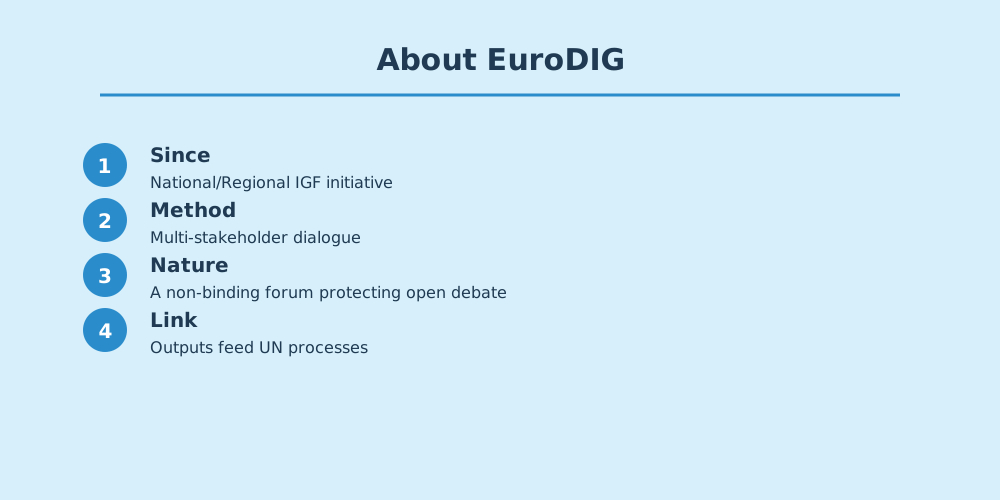
EuroDIG is a National or Regional IGF Initiative (NRI), aligning local internet governance discussion with global IGF principles.
Why It Matters to You
What was discussed here becomes the baseline for national digital policy, platform rules and AI regulation worldwide within a few years. The principles confirmed at the 2013 meeting are the foundation of the "next rules" for the phones, social platforms and AI services you use every day.
Sources & References
- EuroDIG 2013 — eurodigwiki.org (accessed 2026-07-10)
- Messages from Lisbon(成果文書PDF・参加統計収録) — EuroDIG事務局 (accessed 2026-07-10)
- Governing cyberspace: How to keep the Internet safe, free and open? – PL 02 2013(セッション記録) — eurodigwiki.org (accessed 2026-07-10)
- Category:2013(全セッション一覧) — eurodigwiki.org (accessed 2026-07-10)
- Messages from Berlin(2014年版・年次登録者統計を収録) — EuroDIG事務局 (accessed 2026-07-10)
Quotes are translated or condensed from the records listed above. Bracketed numbers [n] refer to the source list.
Related links
- IGF official (NRI list): https://www.intgovforum.org/en/content/national-and-regional-igf-initiatives
- Japan IGF: https://japanigf.jp/
- Yuki Nakazawa's blog: https://nkzw.jp/category/igf/
Revision History
Rev. 1 — published 20 June 2013, 09:00 (Article published)
Rev. 2 — updated 10 July 2026, 23:16 (Fully revised into the in-depth edition: added the 3-line summary, minutes digest, short talk, source list and diagrams (all quotes verified against the listed sources))
— 中澤祐樹

