


The 3-Line Summary
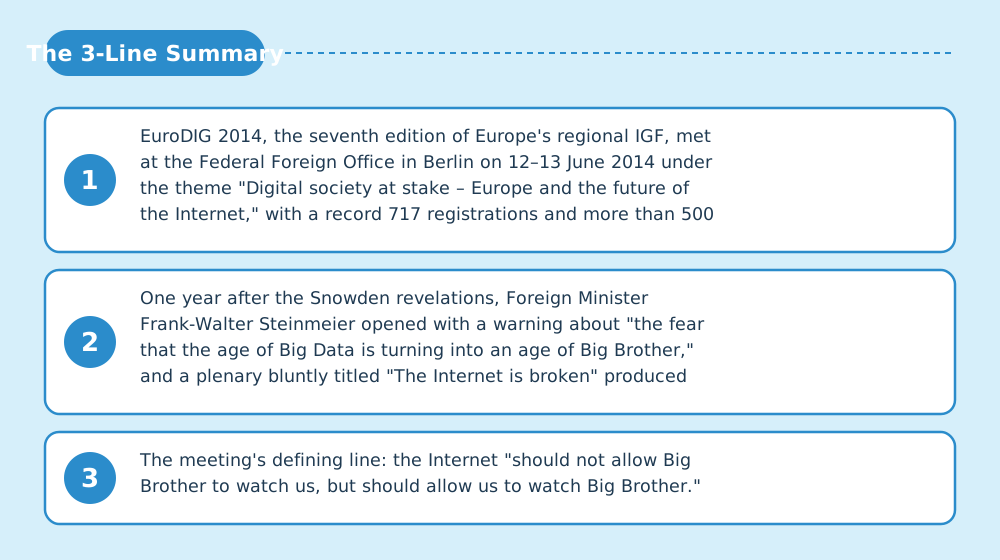
- EuroDIG 2014, the seventh edition of Europe's regional IGF, met at the Federal Foreign Office in Berlin on 12–13 June 2014 under the theme "Digital society at stake – Europe and the future of the Internet," with a record 717 registrations and more than 500 participants.
- One year after the Snowden revelations, Foreign Minister Frank-Walter Steinmeier opened with a warning about "the fear that the age of Big Data is turning into an age of Big Brother," and a plenary bluntly titled "The Internet is broken" produced messages extending to whistleblower protection.
- The meeting's defining line: the Internet "should not allow Big Brother to watch us, but should allow us to watch Big Brother."
Welcome — this is the Japan IGF Support Organization. This in-depth report on EuroDIG 2014 in Berlin draws on official outputs, session records and on-site reporting. In a hurry? The three lines above and the diagrams carry the gist.
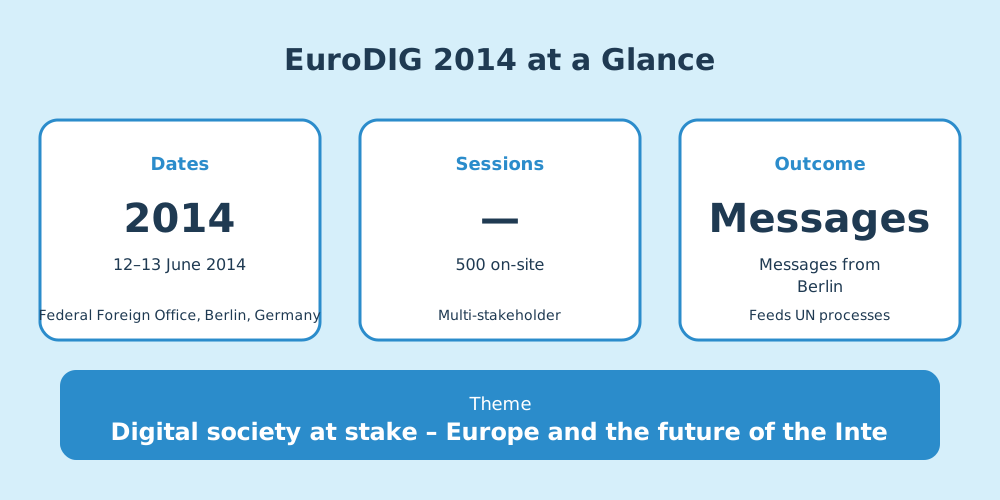
Conference at a Glance (from official records)
| Item | Detail |
|---|---|
| Dates | 12–13 June 2014 |
| Venue | Federal Foreign Office, Berlin, Germany |
| Theme | Digital society at stake – Europe and the future of the Internet |
| Participants | 500 ("More than 500 participants" per the official Messages from Berlin (around 100 remote via hubs in 5 countries; 366 from Germany, 302 from other European countries, 49 from outside Europe)) |
| Registrations | 717 (Per EuroDIG's official registration statistics — a new record at the time) |
| Host | Hosted by eco – Association of the German Internet Industry, under the patronage of the Federal Ministry for Economic Affairs and Energy, in cooperation with the Federal Foreign Office as the hosting location |
| Outcome | Messages from Berlin |
(See the source list at the end of this article.)
Discussion Digest — from the Session Records
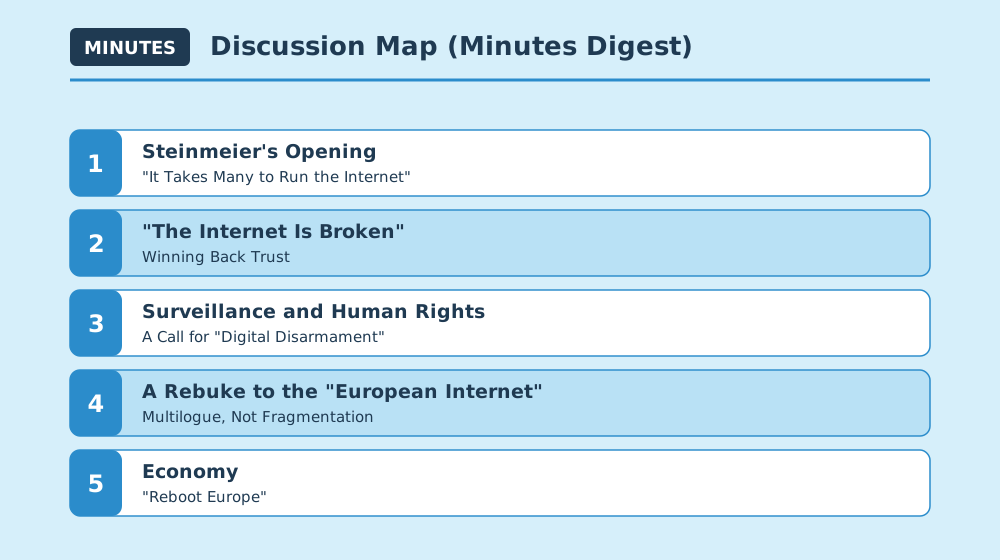
Key exchanges extracted from session records and transcripts.
1. Steinmeier's Opening — "It Takes Many to Run the Internet"
Sessions: Opening session (12 June, Federal Foreign Office)
"The Internet is different. It is, and it should be, a free, safe and open space. That is why we use this rather technical term: the multi-stakeholder model. Put simply: It takes many to run the internet. And it takes many to make sure it remains free, safe and open!"
— Frank-Walter Steinmeier (Federal Foreign Minister of Germany) [1]
"…there is fear of the omnipotent state. The fear that the age of Big Data is turning into an age of Big Brother"
— Frank-Walter Steinmeier (Federal Foreign Minister of Germany) [1]
- "No actor alone can balance freedom and security in the digital world, or ensure human rights and equal access. No government. No corporation," the minister stressed [1]
- The state can only play its governance role if it builds trust with citizens, international partners, businesses and users; eco chairman Michael Rotert and Commission Vice-President Neelie Kroes (by video) also gave welcoming addresses [1]
2. "The Internet Is Broken" — Winning Back Trust
Sessions: Plenary 3 "The Internet is broken – Bringing back trust in the Internet" (12 June)
"Trust… is a working society in which I can trust on the application of the rules we decide together. That's Democracy"
— Jan-Philipp Albrecht (MEP, rapporteur for the EU Data Protection Regulation) [3][1]
- Democratic oversight requires transparent application of the rule of law — and "institutions that do not respect (work outside of) the rule of law should be dismantled," the Messages state [3][1]
- "There is a moral responsibility to protect people on the Internet, including those who take great risks to blow the whistle on practices which do not respect human rights" [3][1]
- Microsoft's representative faced pointed questioning from Tor's Jacob Appelbaum over Skype and PRISM, underscoring corporate transparency as a precondition of trust [3][1]
3. Surveillance and Human Rights — A Call for "Digital Disarmament"
Sessions: Plenary 5 "Security, Internet principles and human rights" (13 June)
- By applying vague definitions of national security and terrorism, many governments take disproportionate measures such as mass surveillance — "digital disarmament is therefore urgently needed," the Messages declare [1]
- "The Internet should not allow Big Brother to watch us, but should allow us to watch Big Brother" [1]
- Internet security should be re-conceptualised around the core value of human rights [1]
4. A Rebuke to the "European Internet" — Multilogue, Not Fragmentation
Sessions: Opening plenary and Plenary 1 "Digital society at stake" (12 June)
- "The Internet is global and the periodic talk of an European Internet is counterproductive at best" — a direct rebuff to post-Snowden national-routing proposals [1]
- It remains unclear whether or how democratic oversight of surveillance is possible; multistakeholder work is needed to rebalance security in the context of human rights [1]
- "The Internet is a paradise lost – while it is unclear that paradise ever existed, we want it back. We should not accept limits on our on-line freedoms too easily," wrote rapporteur Avri Doria [1]
5. Economy — "Reboot Europe"
Sessions: Plenary 4 "Economy – How ICT can foster growth and development in Europe?" (13 June)
- Adapt education systems, encourage youth entrepreneurship, and address the stigma of failure in European society [1]
- "Reboot Europe – stop putting barriers up to protect the past at the expense of promoting the future – because the Internet is a chance for everyone" (Messages from Berlin) [1]
Three-Minute Short Talk — Your Questions Answered
Q. What did the conference actually decide?
A. Nothing binding — but the Messages from Berlin went unusually far: institutions operating outside the rule of law should be dismantled, protecting whistleblowers is a moral responsibility, and "digital disarmament" is urgent. This was Europe's reckoning one year after Snowden.
Q. What was the most contentious topic?
A. Corporate complicity in surveillance. On stage, a Microsoft executive was publicly pressed by Tor's Jacob Appelbaum over Skype's rearchitecture for PRISM, and panellists criticised European governments' failure to shelter Snowden.
Q. Why should I care?
A. The question of keeping the age of Big Data from becoming an age of Big Brother is universal — and Berlin's formula, with the foreign minister opening the event inside his own ministry, became a template for how states signal commitment to internet governance.
What Is EuroDIG? (for first-time readers)
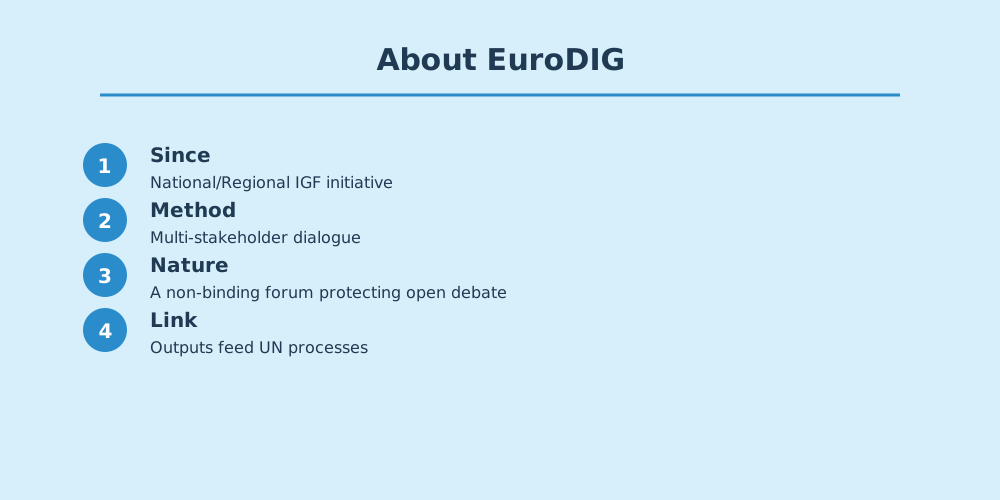
EuroDIG is a National or Regional IGF Initiative (NRI), aligning local internet governance discussion with global IGF principles.
Why It Matters to You
What was discussed here becomes the baseline for national digital policy, platform rules and AI regulation worldwide within a few years. The principles confirmed at the 2014 meeting are the foundation of the "next rules" for the phones, social platforms and AI services you use every day.
Sources & References
- Messages from Berlin(成果文書PDF・シュタインマイヤー演説抜粋と参加統計を収録) — EuroDIG事務局 (accessed 2026-07-10)
- EuroDIG 2014 — eurodigwiki.org (accessed 2026-07-10)
- The Internet is broken – Bringing back trust in the Internet – PL 03 2014(セッション記録) — eurodigwiki.org (accessed 2026-07-10)
- Category:2014(全セッション一覧) — eurodigwiki.org (accessed 2026-07-10)
Quotes are translated or condensed from the records listed above. Bracketed numbers [n] refer to the source list.
Related links
- IGF official (NRI list): https://www.intgovforum.org/en/content/national-and-regional-igf-initiatives
- Japan IGF: https://japanigf.jp/
- Yuki Nakazawa's blog: https://nkzw.jp/category/igf/
Revision History
Rev. 1 — published 12 June 2014, 09:00 (Article published)
Rev. 2 — updated 10 July 2026, 23:16 (Fully revised into the in-depth edition: added the 3-line summary, minutes digest, short talk, source list and diagrams (all quotes verified against the listed sources))
— 中澤祐樹

