


The 3-Line Summary
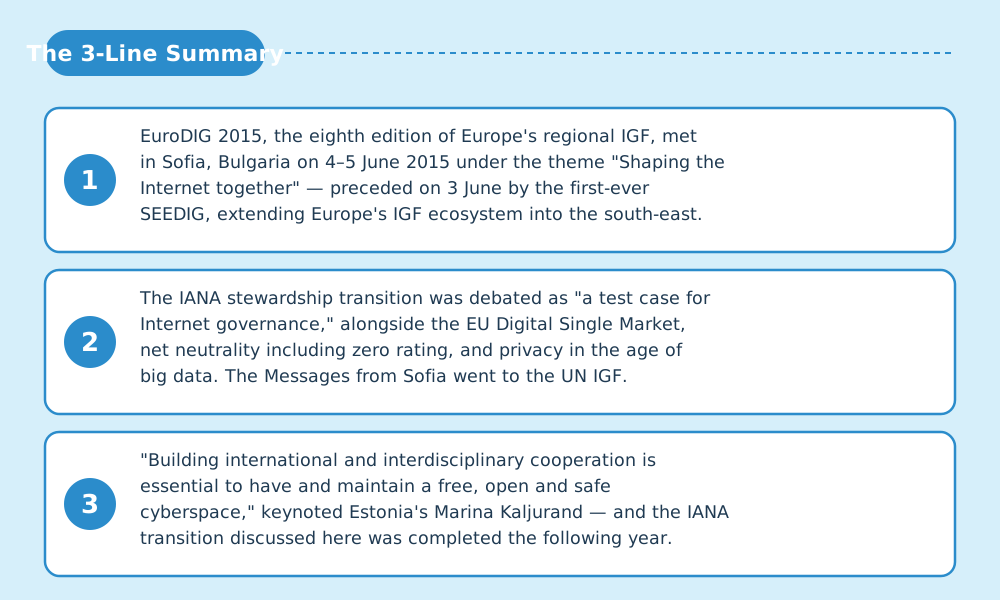
- EuroDIG 2015, the eighth edition of Europe's regional IGF, met in Sofia, Bulgaria on 4–5 June 2015 under the theme "Shaping the Internet together" — preceded on 3 June by the first-ever SEEDIG, extending Europe's IGF ecosystem into the south-east.
- The IANA stewardship transition was debated as "a test case for Internet governance," alongside the EU Digital Single Market, net neutrality including zero rating, and privacy in the age of big data. The Messages from Sofia went to the UN IGF.
- "Building international and interdisciplinary cooperation is essential to have and maintain a free, open and safe cyberspace," keynoted Estonia's Marina Kaljurand — and the IANA transition discussed here was completed the following year.
Welcome — this is the Japan IGF Support Organization. This in-depth report on EuroDIG 2015 in Sofia draws on official outputs, session records and on-site reporting. In a hurry? The three lines above and the diagrams carry the gist.
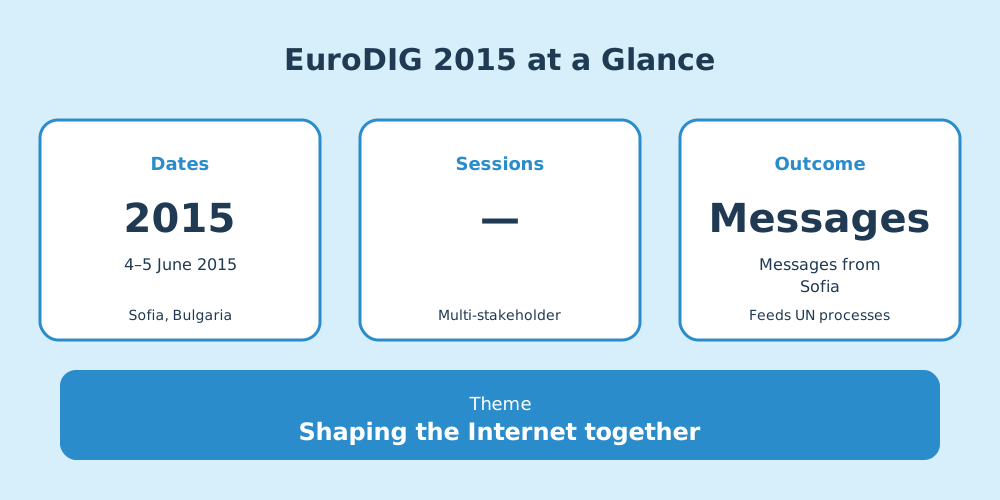
Conference at a Glance (from official records)
| Item | Detail |
|---|---|
| Dates | 4–5 June 2015 |
| Venue | Sofia, Bulgaria |
| Theme | Shaping the Internet together |
| Host | Hosted by UNICART in cooperation with the Bulgarian Ministry of Transport, Information Technology and Communications |
| Outcome | Messages from Sofia |
| First | The first-ever SEEDIG (South Eastern European Dialogue on Internet Governance) was held on 3 June as a EuroDIG pre-event |
(See the source list at the end of this article.)
Discussion Digest — from the Session Records
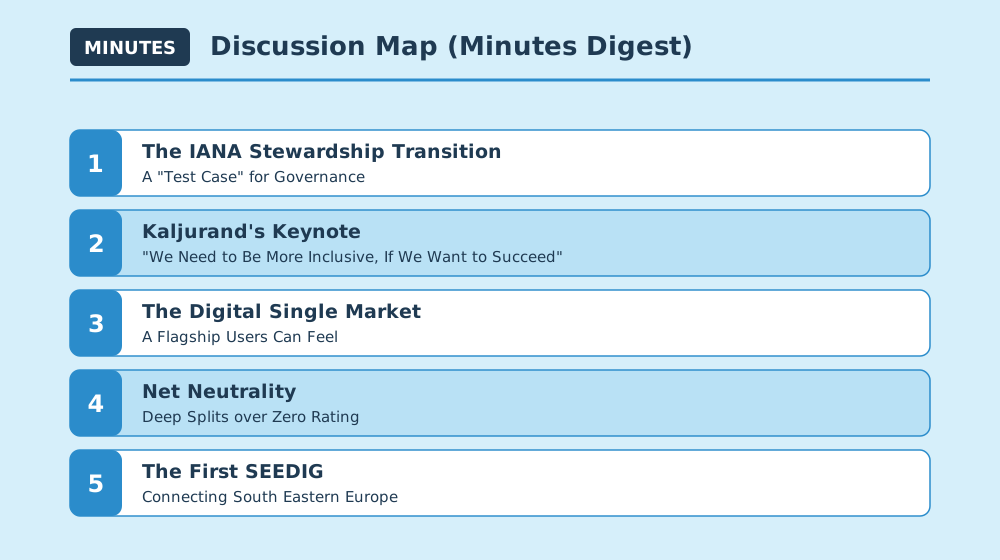
Key exchanges extracted from session records and transcripts.
1. The IANA Stewardship Transition — A "Test Case" for Governance
Sessions: Plenary 4 "The IANA stewardship transition: a test case for Internet governance?" (5 June)
- Success or failure of the process would have far-reaching geopolitical implications; the transition was framed as a potential landmark in the evolution of multistakeholder governance [1]
- Trust and accountability in the structures involved, including ICANN, were called key — and speakers noted the global discussion was not yet balanced in gender or north/south participation [1]
- With some UN member states turning IANA/ICANN issues into a point of contention in WSIS+10, participants discussed a European effort to shift the review's focus back to the Internet's role in development [1]
2. Kaljurand's Keynote — "We Need to Be More Inclusive, If We Want to Succeed"
Sessions: Keynote (5 June)
"Building international and interdisciplinary cooperation is essential to have and maintain a free, open and safe cyberspace"
— Marina Kaljurand (Undersecretary for Political Affairs, Estonian MFA; later Foreign Minister) [1][3]
"What we have learned from international co-operation is that we need to be more inclusive, if we want to succeed. We need to listen to other regions, we need to approach developing countries, not only our likeminded allies or the major cyber powers; we need to hear not only what the IT sector thinks, but what concerns many other sectors; and we need to reach out to academia to broaden our horizons"
— Marina Kaljurand (Undersecretary for Political Affairs, Estonian MFA; later Foreign Minister) [1][3]
- Drawing on Estonia's experience, she urged governments to start asking policy-relevant questions of academia, civil society and the private sector [1][3]
- In the welcoming address, Bulgaria's Deputy Minister Valery Borissov said "every aspect of the Internet needs to be carefully examined – accessibility and security, social and legal norms, the relationship between public and private sectors, freedom of expression and the protection of human rights" [1][3]
3. The Digital Single Market — A Flagship Users Can Feel
Sessions: Opening plenary "How can we shape the digital single market together?" (4 June; video speech by Commissioner Günther Oettinger)
- The European digital single market and multistakeholder internet governance were framed as mutually reinforcing, with Europe urged to lead in promoting an open, free and secure Internet ahead of that year's major global governance events [1][4][5]
- Due attention should go beyond economics to trust and the human rights of users — children being a particularly vulnerable group [1][4][5]
- One conclusion: Europe needs a flagship initiative that is real and touches users — roaming and investment in broadband infrastructure [1][4][5]
4. Net Neutrality — Deep Splits over Zero Rating
Sessions: Plenary 3 "How can the open Internet coexist with new IP services?" (5 June)
- The very term "network neutrality" is not well-defined, and there is disagreement about what it means [1]
- Concerns were raised over how to define "specialised services" and whether traffic-management techniques threaten human rights such as freedom of expression [1]
- On zero rating, viewpoints diverged widely — from a threat to freedom of expression to a simple commercial business practice [1]
5. The First SEEDIG — Connecting South Eastern Europe
Sessions: Pre-event: South Eastern European Dialogue on Internet Governance (SEEDIG) (3 June)
- The first SEEDIG met in Sofia as a sub-regional IGF for South Eastern Europe, feeding directly into EuroDIG sessions; participants were 36% civil society, 31% government and 18% private sector, with 73% from the SEE region and its neighbourhood [1]
- "We must all learn to have a stake and to have a say" — its messages called for stronger links between SEE realities and international governance work, and cooperation on technical challenges toward full universal acceptance of IDNs [1]
Three-Minute Short Talk — Your Questions Answered
Q. What did the conference actually decide?
A. Nothing binding — but the Messages from Sofia went to the UN IGF, framing the IANA stewardship transition as a test case for internet governance. The transition was indeed completed the following year, in 2016.
Q. What was the most contentious topic?
A. Zero rating — exempting particular apps from data charges. The room split cleanly between those who saw a threat to freedom of expression and those who saw a simple commercial practice.
Q. Why should I care?
A. The IANA functions underpin the DNS and IP addressing for the whole world, and the 2015 zero-rating debate foreshadowed the arguments every country has since had about sponsored-data plans.
What Is EuroDIG? (for first-time readers)
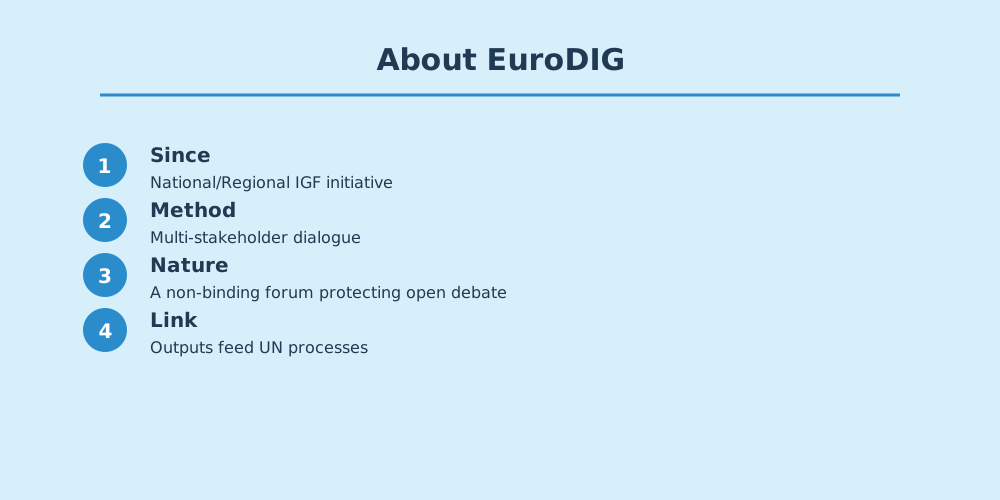
EuroDIG is a National or Regional IGF Initiative (NRI), aligning local internet governance discussion with global IGF principles.
Why It Matters to You
What was discussed here becomes the baseline for national digital policy, platform rules and AI regulation worldwide within a few years. The principles confirmed at the 2015 meeting are the foundation of the "next rules" for the phones, social platforms and AI services you use every day.
Sources & References
- Messages from Sofia(成果文書PDF・基調講演抜粋とSEEDIG報告を収録) — EuroDIG事務局 (accessed 2026-07-10)
- EuroDIG 2015 — eurodigwiki.org (accessed 2026-07-10)
- Keynote: Marina Kaljurand – 2015(基調講演ページ) — eurodigwiki.org (accessed 2026-07-10)
- How can we shape the digital single market together? – Opening plenary 2015(セッション記録) — eurodigwiki.org (accessed 2026-07-10)
- EuroDIG 2015 Report by Corinne Cath — RIPE NCC (accessed 2026-07-10)
- Category:2015(全セッション一覧) — eurodigwiki.org (accessed 2026-07-10)
Quotes are translated or condensed from the records listed above. Bracketed numbers [n] refer to the source list.
Related links
- IGF official (NRI list): https://www.intgovforum.org/en/content/national-and-regional-igf-initiatives
- Japan IGF: https://japanigf.jp/
- Yuki Nakazawa's blog: https://nkzw.jp/category/igf/
Revision History
Rev. 1 — published 4 June 2015, 09:00 (Article published)
Rev. 2 — updated 10 July 2026, 23:16 (Fully revised into the in-depth edition: added the 3-line summary, minutes digest, short talk, source list and diagrams (all quotes verified against the listed sources))
— 中澤祐樹

