


The 3-Line Summary
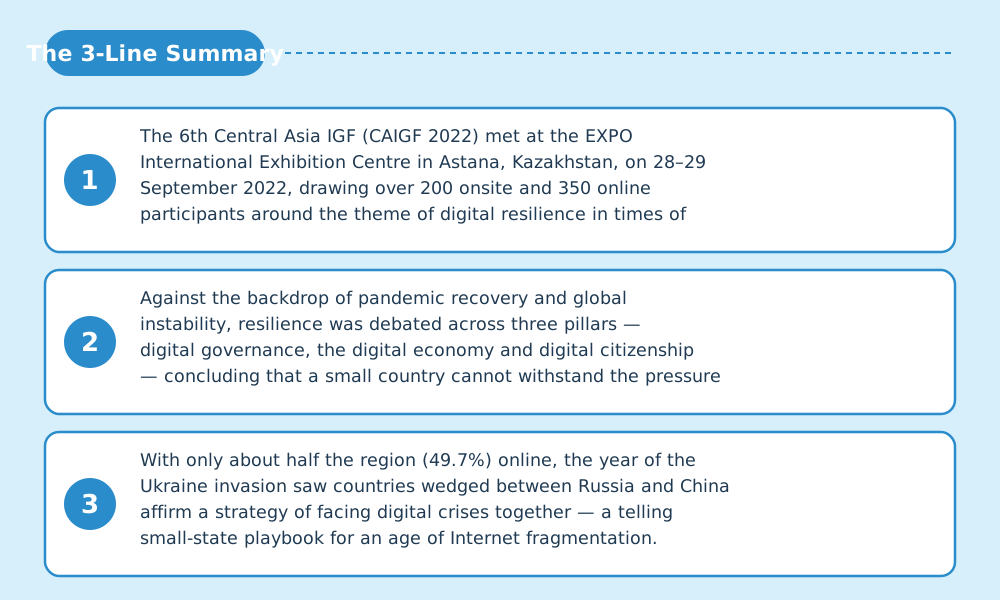
- The 6th Central Asia IGF (CAIGF 2022) met at the EXPO International Exhibition Centre in Astana, Kazakhstan, on 28–29 September 2022, drawing over 200 onsite and 350 online participants around the theme of digital resilience in times of crisis.
- Against the backdrop of pandemic recovery and global instability, resilience was debated across three pillars — digital governance, the digital economy and digital citizenship — concluding that a small country cannot withstand the pressure of big transnational corporations alone and only joint action can counter the risks.
- With only about half the region (49.7%) online, the year of the Ukraine invasion saw countries wedged between Russia and China affirm a strategy of facing digital crises together — a telling small-state playbook for an age of Internet fragmentation.
Welcome — this is the Japan IGF Support Organization. This in-depth report on CAIGF 2022 in Astana draws on official outputs, session records and on-site reporting. In a hurry? The three lines above and the diagrams carry the gist.
📍 [Catalogue discrepancy] The catalogue lists Dushanbe for 2022, which is incorrect: the 6th CAIGF (2022) was held at the EXPO International Exhibition Centre in Astana, Kazakhstan. Dushanbe, Tajikistan, hosted the 2nd edition in 2017 and is scheduled to host again in April 2026; the catalogue entry likely conflates these. Note that one page of the official site calls the 2022 event the 5th forum, but the official report submitted to the UN states it was the sixth
Conference at a Glance (from official records)
| Item | Detail |
|---|---|
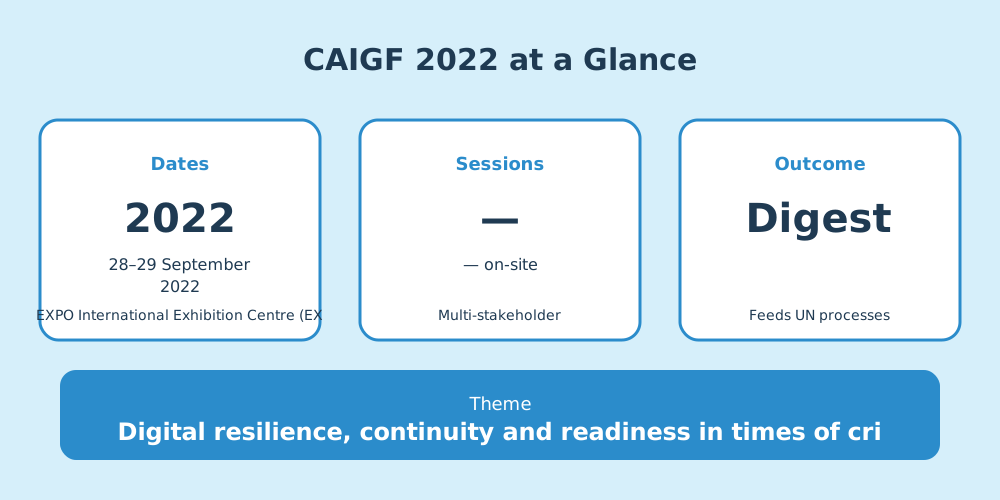
| Edition | 6th Central Asia IGF (per the official report) |
| Dates | 28–29 September 2022 |
| Venue | EXPO International Exhibition Centre (EXPO IEC), Astana, Kazakhstan |
| Theme | Digital resilience, continuity and readiness in times of crisis |
| Participants | More than 200 onsite and 350 online participants: state bodies of Kyrgyzstan, Kazakhstan, Uzbekistan, Tajikistan and Turkey, plus experts and business communities from more than 10 countries including Canada, China, Estonia, the USA, Moldova, Armenia and Georgia (per the official report) |
| Host | Organised by Kazakhstan's Ministry of Digital Development, Innovation and Aerospace Industry with the Civil Initiative on Internet Policy (CIIP) and the Astana Hub, supported by the Legal Policy Research Center (Almaty), the eGovernance Academy, the SecDev Foundation, Meta, IGFSA and Kaspersky, among others |
(See the source list at the end of this article.)
Discussion Digest — from the Session Records
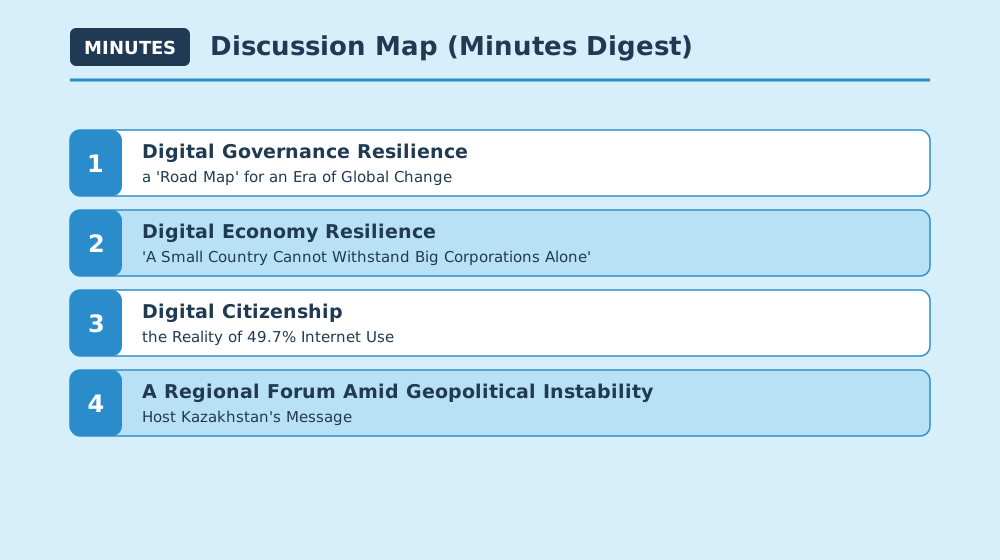
Key exchanges extracted from session records and transcripts.
1. Digital Governance Resilience — a 'Road Map' for an Era of Global Change
Sessions: Panel session 1 'Digital governance resilience' (28 September)
- Examined what makes a digital ecosystem sustainable enough to withstand post-pandemic crises, and the tools available to governments to keep national networks and digital assets running [1]
- Toomas Tirs, Estonia's ambassador to Kazakhstan, and Bakhtiyor Ryazaev, head of Uzbekistan's Artificial Intelligence Laboratory, shared their countries' solutions; the session concluded that stronger cooperation among Central Asian states would build a robust regional economic architecture and let the region weather future crises at far lower cost [1]
2. Digital Economy Resilience — 'A Small Country Cannot Withstand Big Corporations Alone'
Sessions: Panel session 2 'Digital economy resilience'
- George Chen, Meta's public policy director for Hong Kong, Taiwan and Mongolia, and digitalisation consultant Ruta Makareviciute argued for a common digital business ecosystem spanning the whole region [1]
- The official report's takeaway: a small country cannot stand the pressure of big trans-corporations — only joint action can counter the risks; international experts singled out cyber-risk as the top digital issue on which the region must pool experience [1]
3. Digital Citizenship — the Reality of 49.7% Internet Use
Sessions: Panel session 3 'Digital society resilience'
- Only about half of Central Asia's population (49.7%) uses the Internet — a gap the session flagged as narrowing opportunities for development and education, above all for the young [1]
- With presentations by international expert Eric Johnson and CyberSTAR regional coordinator Asomudin Atoev, the session concluded that active digital citizens able to shape public policy, and stronger digital rights, are key to the region's development [1]
4. A Regional Forum Amid Geopolitical Instability — Host Kazakhstan's Message
Sessions: Opening and closing takeaways (28–29 September)
- Askar Zhambakin, Kazakhstan's vice-minister of digital development, opened the forum, with welcoming remarks from digital ministries of Kyrgyzstan, Turkey and Uzbekistan; the report to the UN also disclosed the IGFSA-granted budget [1][2]
- Warning that global instability and political uncertainty could choke investment in the digital future and hit vulnerable communities hardest, participants affirmed that no country can anticipate and manage all crises alone — shared national and regional responses and long-term adaptation are required [1][2]
Three-Minute Short Talk — Your Questions Answered
Q. Did the meeting actually decide anything?
A. No binding decisions — it is a dialogue forum. But governments, business and civil society aligned on one direction: digital resilience cannot be secured by any single country and must be built regionally, and the conclusions were submitted to the global IGF community in an official report.
Q. What was the most contentious topic?
A. The power imbalance between small states and big tech. The shared diagnosis — a small country cannot withstand the pressure of big transnational corporations alone — led to a prescription of joint regional rule-making and pooled cyber-risk experience.
Q. Why should I care?
A. With only half its population online, Central Asia is a fast-growing digital market, and the spectacle of small states banding together to face global platforms mirrors platform-regulation debates everywhere.
What Is CAIGF? (for first-time readers)
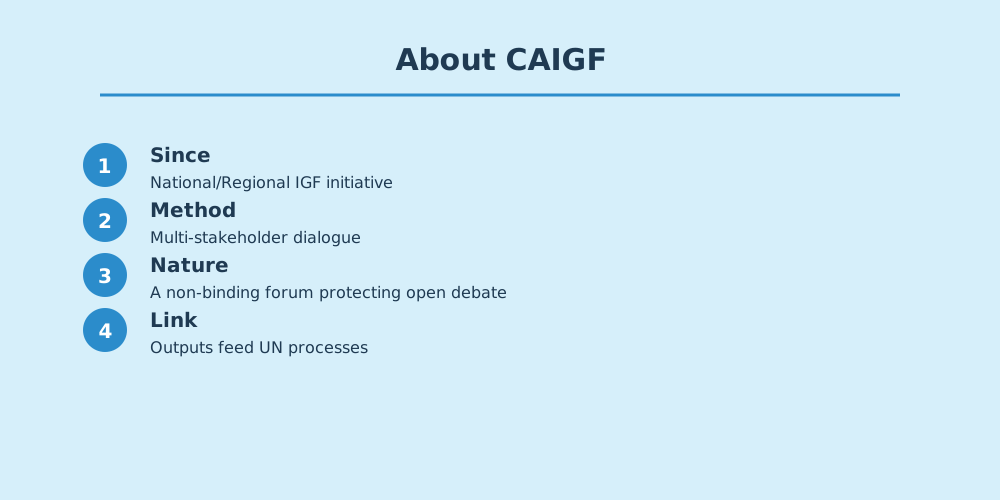
CAIGF is a National or Regional IGF Initiative (NRI), aligning local internet governance discussion with global IGF principles.
Why It Matters to You
What was discussed here becomes the baseline for national digital policy, platform rules and AI regulation worldwide within a few years. The principles confirmed at the 2022 meeting are the foundation of the "next rules" for the phones, social platforms and AI services you use every day.
Sources & References
- Central Asia Internet Governance Forum — REPORT 2022 (PDF) — caigf.org (accessed 2026-07-11)
- About 2022 CAIGF — caigf.org (accessed 2026-07-11)
- Central Asia IGF (CAIGF) — NRI record — UN IGF Secretariat (accessed 2026-07-11)
- Central Asia Internet Governance Forum (CAIGF) — APC (accessed 2026-07-11)
- The second CAIGF was held in Dushanbe — CIIP, キルギス (accessed 2026-07-11)
Quotes are translated or condensed from the records listed above. Bracketed numbers [n] refer to the source list.
Related links
- IGF official (NRI list): https://www.intgovforum.org/en/content/national-and-regional-igf-initiatives
- Japan IGF: https://japanigf.jp/
- Yuki Nakazawa's blog: https://nkzw.jp/category/igf/
Revision History
Rev. 1 — published 20 September 2022, 14:00 (Article published)
Rev. 2 — updated 11 July 2026, 02:14 (Fully revised into the in-depth edition: added the 3-line summary, minutes digest, short talk, source list and diagrams (all quotes verified against the listed sources))
— 中澤祐樹

