

The 3-Line Summary
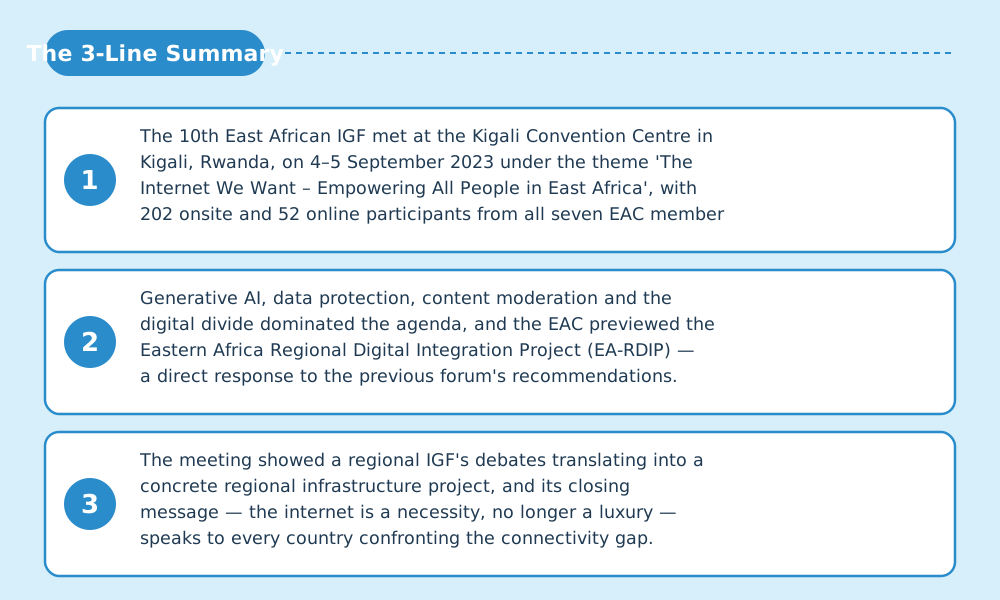
- The 10th East African IGF met at the Kigali Convention Centre in Kigali, Rwanda, on 4–5 September 2023 under the theme 'The Internet We Want – Empowering All People in East Africa', with 202 onsite and 52 online participants from all seven EAC member states.
- Generative AI, data protection, content moderation and the digital divide dominated the agenda, and the EAC previewed the Eastern Africa Regional Digital Integration Project (EA-RDIP) — a direct response to the previous forum's recommendations.
- The meeting showed a regional IGF's debates translating into a concrete regional infrastructure project, and its closing message — the internet is a necessity, no longer a luxury — speaks to every country confronting the connectivity gap.
Welcome — this is the Japan IGF Support Organization. This in-depth report on East African IGF 2023 in Kigali draws on official outputs, session records and on-site reporting. In a hurry? The three lines above and the diagrams carry the gist.
📍 The catalogue lists both Addis Ababa and Kigali; official records confirm Kigali. Addis Ababa hosted the 2022 global IGF, which likely explains the confusion
Conference at a Glance (from official records)
| Item | Detail |
|---|---|
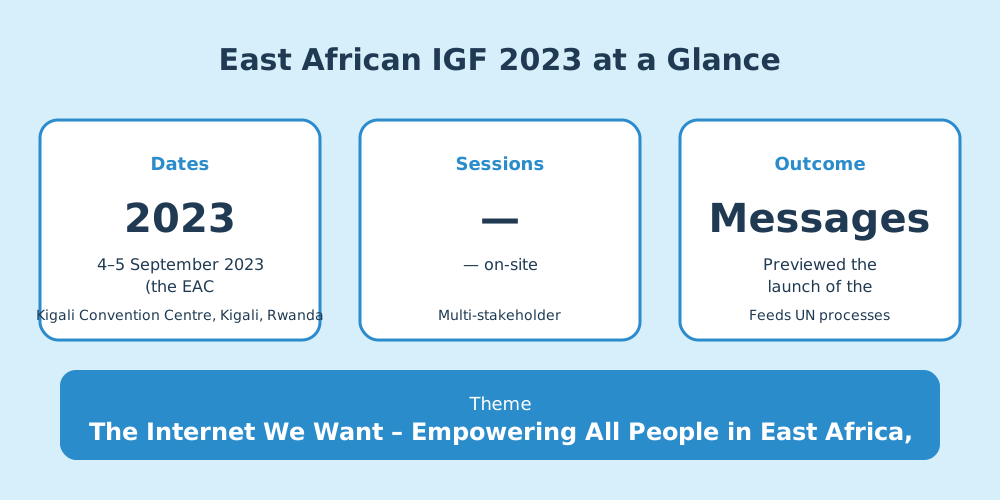
| Edition | 10th edition |
| Dates | 4–5 September 2023 (the EAC announcement lists two days; the official report records the main meeting on 5 September, preceded by the East Africa School of Internet Governance) |
| Venue | Kigali Convention Centre, Kigali, Rwanda |
| Theme | The Internet We Want – Empowering All People in East Africa, aligned with the 2023 global IGF theme |
| Participants | 202 onsite and 52 online participants from all seven EAC member states |
| Host | Jointly hosted by the EAC and Rwanda's Ministry of ICT and Innovation through the Rwanda Internet Community and Technology Alliance (RICTA) |
| Outcome | Previewed the launch of the Eastern Africa Regional Digital Integration Project (EA-RDIP) |
(See the source list at the end of this article.)
Discussion Digest — from the Session Records
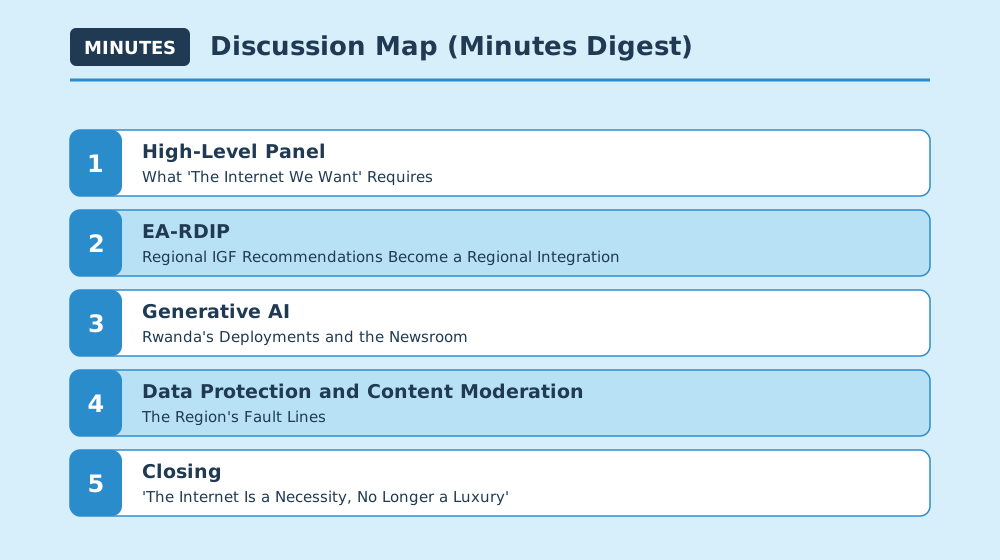
Key exchanges extracted from session records and transcripts.
1. High-Level Panel — What 'The Internet We Want' Requires
Sessions: High-Level Panel 'The Internet We Want – Empowering All People in East Africa' (moderated by Rosemary Kimwatu, Chair of the Kenya IGF)
"Despite the 95% 4G coverage in Rwanda, there are not as many users utilizing the network and therefore initiatives on digital literacy for citizens and affordability of the devices are key in realizing the Internet we want in East Africa"
— Christian Muhirwa (CEO, Broadband Systems Corporation Ltd) [1]
- A secure, affordable and accessible internet for all East Africans was affirmed as the shared goal, with calls to fix last-mile connectivity and use Universal Access Funds where investment is not commercially viable [1]
- On generative AI, the region was urged to track trends, keep policymakers informed, and use regional meetings to weigh benefits against risks [1]
- Panellists cautioned that tackling content-layer harms — child sexual abuse material, disinformation, online hate — must not undermine freedom of expression [1]
2. EA-RDIP — Regional IGF Recommendations Become a Regional Integration Project
Sessions: Opening ceremony and EAC briefing
"The Eastern Africa Regional Digital Integration Project is in response to the discussions and recommendations of the 9th East Africa Internet Governance Forum and aims to drive digital market integration by expanding broadband connectivity and improving the digital service environment"
— Eng. Daniel Murenzi (Principal Information Technology Officer, EAC) [1][4]
- EA-RDIP was presented as the EAC's flagship initiative to bridge the digital divide, reduce connectivity costs and empower marginalised groups such as youth, persons with disabilities and women [1][4]
- The project was held up as proof that forum debates can translate into real regional programmes — a validation of IGF-style multistakeholder dialogue [1][4]
3. Generative AI — Rwanda's Deployments and the Newsroom
Sessions: Session One: Generative AI In Media Hits Speed Bumps — Do Humans Have the Answers?
"The future holds for efficiency and convenience, hence the need for automation for fast and efficient service delivery"
— Jonan Katende (Business Manager, Justice Chatbot Limited) [1]
- Rwanda showcased AI deployments — automated traffic enforcement, healthcare efficiency and local-language translation, drone-based blood delivery, and farmer support — describing a shift from foundational policy to applications [1]
- In media, data journalism and AI-assisted reporting were highlighted, alongside the challenge of moving Africa from consumer of European-made content to creator of content and technology [1]
- Panellists called for harmonised regional AI rules that stop short of over-regulation that would stifle innovation [1]
4. Data Protection and Content Moderation — The Region's Fault Lines
Sessions: Session Two: Unlocking the Future of Data Protection in East Africa / Session Three: Local to Regional — Content Moderation and Freedom of Expression (organised under UNESCO's Social Media 4 Peace project)
- Using the AU Data Policy Framework as a common yardstick, panellists urged interoperability of national data-protection laws and harmonised cross-border data rules, citing Rwanda's law requiring authorisation to host personal data abroad [1]
- Hate speech on social media was reported to be rising amid the conflict between the DRC and Rwanda, with instability in one country shown to spill across the region [1]
- Content moderation by major platforms was criticised as prioritising the US and Canada over African languages and contexts; Kenya's pilot multistakeholder coalition on content moderation and free expression was shared as a regional template [1]
5. Closing — 'The Internet Is a Necessity, No Longer a Luxury'
Sessions: Closing ceremony (5 September)
"Africa, particularly East Africa, has missed many revolutions and must participate in this one to avoid a loss of generations"
— Hon. Prof. Nshuti Manasseh (Minister of State in charge of the EAC, Rwanda) [1][3][4]
"To create the internet we want, we must ensure that it is accessible to all and that it is not too expensive"
— Yves Iradukunda (Permanent Secretary, Rwanda Ministry of ICT and Innovation) [1][3][4]
- In closing, Rwanda's Minister of State for EAC affairs called for comprehensive action on AI, emerging technologies, internet fragmentation, cybercrime, data governance and the digital divide — a digital revolution that leaves no one behind [1][3][4]
- Regional leaders were urged to make connectivity universal, affordable and accessible, treating the internet as a necessity rather than a luxury [1][3][4]
Three-Minute Short Talk — Your Questions Answered
Q. What did the forum actually decide?
A. No resolutions — but a big announcement: EA-RDIP, a regional project to expand broadband and digital services. The EAC's ICT officer said it responds directly to the previous (9th) forum's recommendations — a rare case of a talking shop's output becoming a funded programme.
Q. What was the most charged topic?
A. Content moderation. With hate speech rising on social media amid DRC–Rwanda tensions, panellists confronted the fact that major platforms' moderation prioritises the US and Canada and fails African languages and contexts.
Q. Why should I care?
A. Rwanda's paradox — 95% 4G coverage but far fewer actual users — shows that infrastructure alone doesn't close digital divides. 'Meaningful connectivity', including device affordability and literacy, is the lesson for every country.
What Is East African IGF? (for first-time readers)
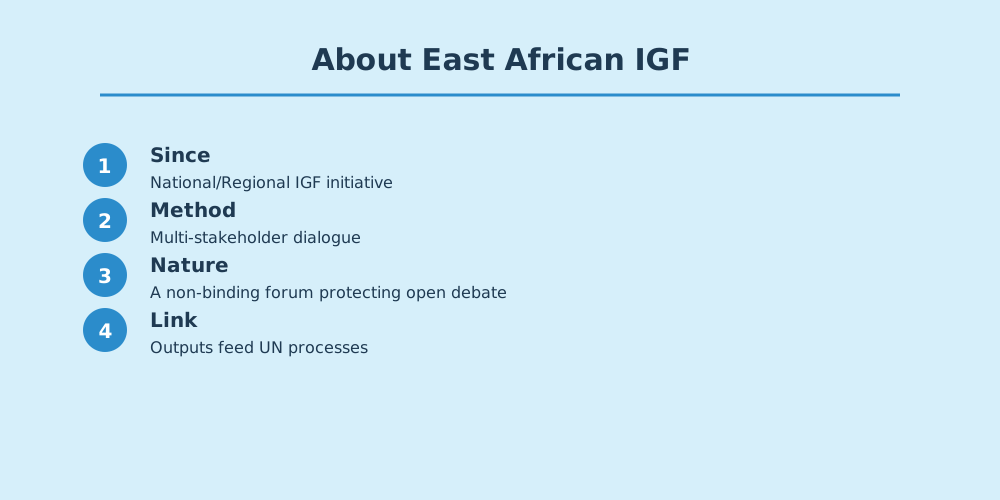
East African IGF is a National or Regional IGF Initiative (NRI), aligning local internet governance discussion with global IGF principles.
Why It Matters to You
What was discussed here becomes the baseline for national digital policy, platform rules and AI regulation worldwide within a few years. The principles confirmed at the 2023 meeting are the foundation of the "next rules" for the phones, social platforms and AI services you use every day.
Sources & References
- East Africa Internet Governance Forum Report 2023 (PDF) — 東アフリカ共同体(EAC)/EAIGF事務局 (accessed 2026-07-11)
- East Africa Internet Governance Forum — 第10回EAIGF開催告知(キガリ・コンベンションセンター、2023年9月4〜5日) — EAIGF(公式サイト) (accessed 2026-07-11)
- EAC Partner States urged to establish partnerships, collaboration in developing 'The Internet We Want' — KBC(ケニア放送協会) (accessed 2026-07-11)
- EAC Gears for Launch of Regional Digital Integration Project — The Kenyan Wall Street (accessed 2026-07-11)
- Publications — East Africa Internet Governance Forum — EAIGF(公式サイト) (accessed 2026-07-11)
Quotes are translated or condensed from the records listed above. Bracketed numbers [n] refer to the source list.
Related links
- IGF official (NRI list): https://www.intgovforum.org/en/content/national-and-regional-igf-initiatives
- Japan IGF: https://japanigf.jp/
- Yuki Nakazawa's blog: https://nkzw.jp/category/igf/
Revision History
Rev. 1 — published 3 September 2023, 15:00 (Article published)
Rev. 2 — updated 11 July 2026, 02:14 (Fully revised into the in-depth edition: added the 3-line summary, minutes digest, short talk, source list and diagrams (all quotes verified against the listed sources))
— 中澤祐樹