


The 3-Line Summary
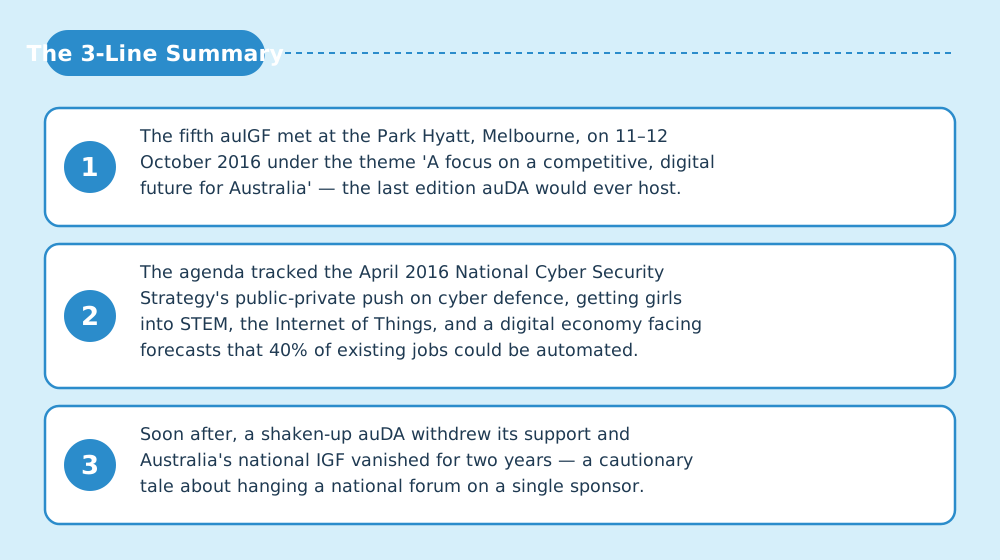
- The fifth auIGF met at the Park Hyatt, Melbourne, on 11–12 October 2016 under the theme 'A focus on a competitive, digital future for Australia' — the last edition auDA would ever host.
- The agenda tracked the April 2016 National Cyber Security Strategy's public-private push on cyber defence, getting girls into STEM, the Internet of Things, and a digital economy facing forecasts that 40% of existing jobs could be automated.
- Soon after, a shaken-up auDA withdrew its support and Australia's national IGF vanished for two years — a cautionary tale about hanging a national forum on a single sponsor.
Welcome — this is the Japan IGF Support Organization. This in-depth report on auIGF 2016 (Australian Internet Governance Forum) draws on official outputs, session records and on-site reporting. In a hurry? The three lines above and the diagrams carry the gist.
Conference at a Glance (from official records)
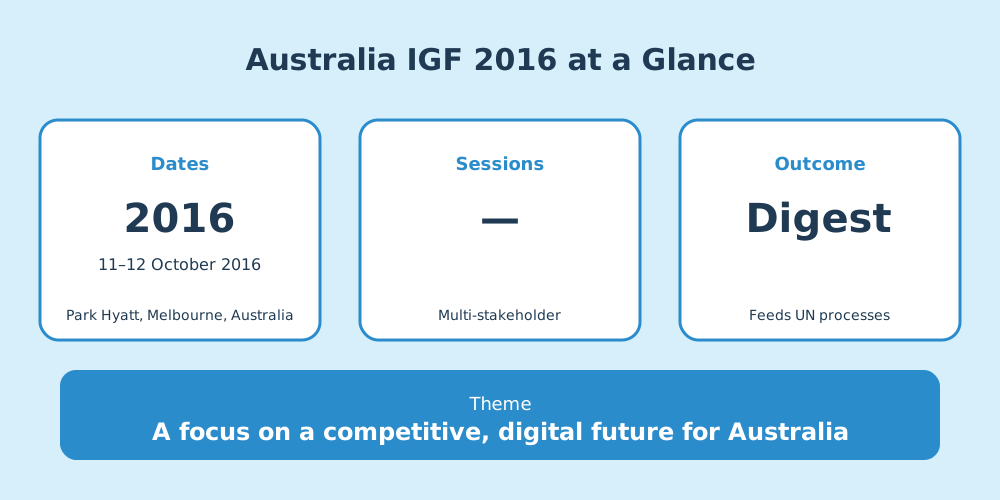
| Item | Detail |
|---|---|
| Official name | auIGF 2016 (Australian Internet Governance Forum) |
| Edition | Fifth and final edition hosted by auDA |
| Dates | 11–12 October 2016 |
| Venue | Park Hyatt, Melbourne, Australia |
| Theme | A focus on a competitive, digital future for Australia |
| Host | .au Domain Administration Ltd (auDA); opened by Board Chair Stuart Benjamin and CEO Cameron Boardman, with Ian Cover as MC |
(See the source list at the end of this article.)
Discussion Digest — from the Session Records
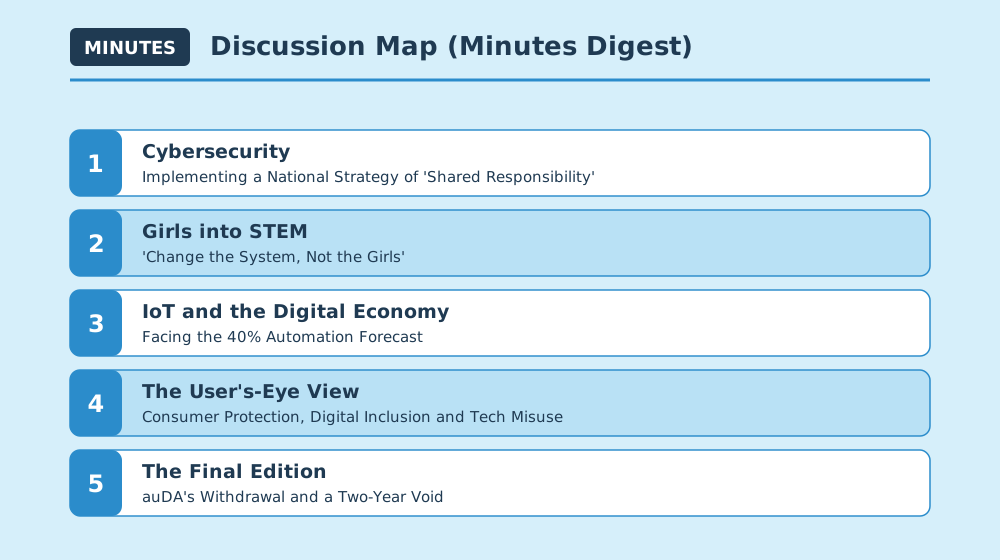
Key exchanges extracted from session records and transcripts.
1. Cybersecurity — Implementing a National Strategy of 'Shared Responsibility'
Sessions: Opening plenary 'The exponentially growing threat' (11 October, 9:45, Ballroom; moderated by Rachael Falk)
- The April 2016 National Cyber Security Strategy framed cybersecurity as a shared responsibility built on five pillars — stronger defences, education, partnerships, R&D and global awareness; the panel mapped how organisations of any size could pool resources against the threat [2][4][1]
- Speakers included Alastair MacGibbon, by then the PM's Special Adviser on Cyber Security, and Rachael Falk, who had led cyber awareness for Telstra's 35,000 staff and was announced as auDA's incoming Director of Technology, Security and Strategy days before the event [2][4][1]
- A companion workshop took best practice down to small businesses running websites and online payments [2][4][1]
2. Girls into STEM — 'Change the System, Not the Girls'
Sessions: Plenary 'Getting girls into STEM' (11 October, 11:30, Ballroom; moderated by Dr Rowan Brookes)
- Following up the 2015 finding that female computer-science graduation kept falling despite the IT boom, panellists included Victoria's inaugural Lead Scientist Leonie Walsh, Associate Professor Catherine Lang and Girls' Programming Network's Renee Noble [5][2]
- Lang argued the very question 'how do we get girls into STEM?' implies the deficit lies with the girls, and called for systemic fixes — teacher training and curriculum access — instead [5][2]
- The panel converged on three moves: change the environment rather than the girls, integrate STEM into the curriculum to reach root causes, and make diverse female role models visible [5][2]
3. IoT and the Digital Economy — Facing the 40% Automation Forecast
Sessions: Plenaries 'IoT — What's now? What's the future?' (12 October, 9:45; moderated by APNIC's Pablo Hinojosa) and 'Networked digital economy' (11:30)
- The IoT plenary, moderated by APNIC's Pablo Hinojosa, weighed self-reporting connected objects — in sustainability and health — against the security questions they raise [2]
- The digital economy plenary confronted forecasts that 40% of existing Australian jobs could be lost to computerisation, invoking economist Robert Skidelsky's question of whether we 'must rethink our collective attitudes towards consumption, work, leisure, and the distribution of income' [2]
- Chaired by the Grattan Institute's Jim Minifie, it translated the conference theme — a competitive and fair digital future — into economic policy terms [2]
4. The User's-Eye View — Consumer Protection, Digital Inclusion and Tech Misuse
Sessions: Workshops on consumer protection and auDA policy, digital inclusion, and 'Picking up the pieces' (11–12 October)
- The consumer protection workshop started from 'who do you call about a scam .au site?', walking through auDA policy and enforcement links, with ACCAN's Teresa Corbin among the speakers [2]
- The digital inclusion workshop argued fast broadband is only the beginning — technology and skills must follow — and assigned the task to government, industry and civil society alike [2]
- 'Picking up the pieces' ran a school-based hypothetical on technology misuse, with legal aid, education, sexual-assault services and Victoria Police calling for partnership with the tech industry [2]
5. The Final Edition — auDA's Withdrawal and a Two-Year Void
Sessions: (Aftermath)
- After this edition auDA announced it would cease facilitating the auIGF, following an executive shake-up and a review of its community activities; archived auIGF papers and reports were later removed from its websites [6][7][3]
- In May 2017 Cyber Ambassador Dr Tobias Feakin convened stakeholders who agreed an auIGF-type event remained valuable, and the October 2017 International Cyber Engagement Strategy committed the government to supporting an annual community-led forum [6][7][3]
- After a two-year void, volunteers relaunched the national IGF as NetThing in 2019 — a case study in both the fragility of single-sponsor national IGFs and the community's power to rebuild [6][7][3]
Three-Minute Short Talk — Your Questions Answered
Q. Why was this the last one?
A. auDA, the sole host and funder, went through a management shake-up in 2016 and a review of its community activities, then pulled out. The forum's content wasn't the problem — its sponsor's internal politics were. Australia's national IGF disappeared for two years until volunteers revived it as NetThing in 2019.
Q. What stood out in the discussions?
A. Two things: turning the new 'shared responsibility' National Cyber Security Strategy into practice, and the STEM panel's reframing — the deficit isn't in the girls, it's in the system around them.
Q. Why should I care?
A. It is the clearest demonstration that a national IGF resting on one organisation's budget can vanish overnight. Every country running a national forum — including Japan — draws its diversify-your-backers lesson from this story.
What Is Australia IGF? (for first-time readers)
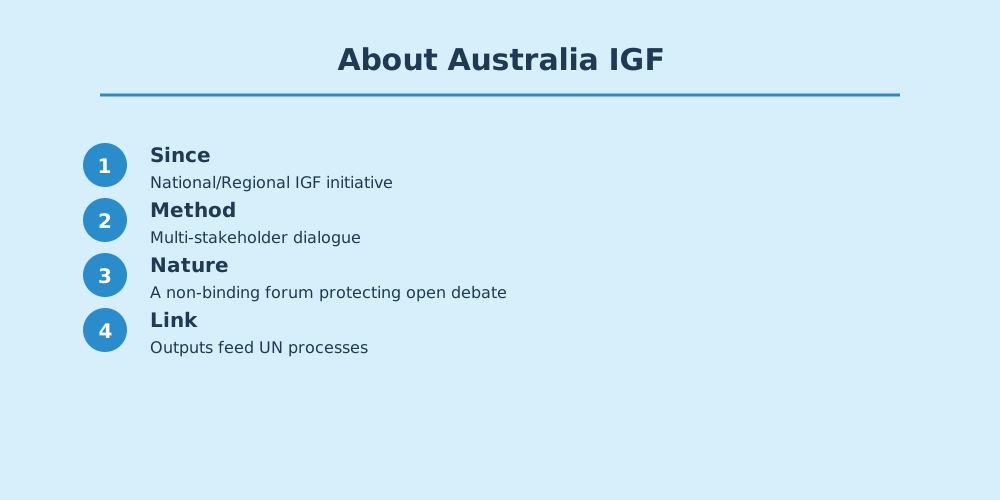
Australia IGF is a National or Regional IGF Initiative (NRI), aligning local internet governance discussion with global IGF principles.
Why It Matters to You
What was discussed here becomes the baseline for national digital policy, platform rules and AI regulation worldwide within a few years. The principles confirmed at the 2016 meeting are the foundation of the "next rules" for the phones, social platforms and AI services you use every day.
Sources & References
- Australian Internet Governance Forum (auIGF) 2016 — DiploFoundation (accessed 2026-07-11)
- auIGF 2016 Schedule(全セッション・登壇者一覧) — auIGF / auDA(Wayback Machineアーカイブ) (accessed 2026-07-11)
- auIGF 2016 Registration(会場パークハイアット・メルボルンの宿泊案内を記載) — auIGF / auDA(Wayback Machineアーカイブ) (accessed 2026-07-11)
- The finishing touches to an incredible 2016 auIGF list of speakers(2016-10-05, Cameron Boardman CEO名義) — auIGF / auDA(Wayback Machineアーカイブ) (accessed 2026-07-11)
- Three Steps to Increase Diversity in STEM(2016-11-03, Dr Rowan Brookesによる事後報告) — auIGF / auDA(Wayback Machineアーカイブ) (accessed 2026-07-11)
- Australian Internet Community – planning a way forward — Australian Community Internet Governance (accessed 2026-07-11)
- Australia: Doing the right thing — Internet governance country report — GISWatch / APC (accessed 2026-07-11)
- Australian Internet Governance Forum (auIGF) — .au Domain Administration Ltd (accessed 2026-07-11)
Quotes are translated or condensed from the records listed above. Bracketed numbers [n] refer to the source list.
Related links
- IGF official (NRI list): https://www.intgovforum.org/en/content/national-and-regional-igf-initiatives
- Japan IGF: https://japanigf.jp/
- Yuki Nakazawa's blog: https://nkzw.jp/category/igf/
Revision History
Rev. 1 — published 23 June 2016, 09:00 (Article published)
Rev. 2 — updated 16 July 2026, 20:09 (Fully revised into the in-depth edition: added the 3-line summary, minutes digest, short talk, source list and diagrams (all quotes verified against the listed sources))
— 中澤祐樹

