


The 3-Line Summary
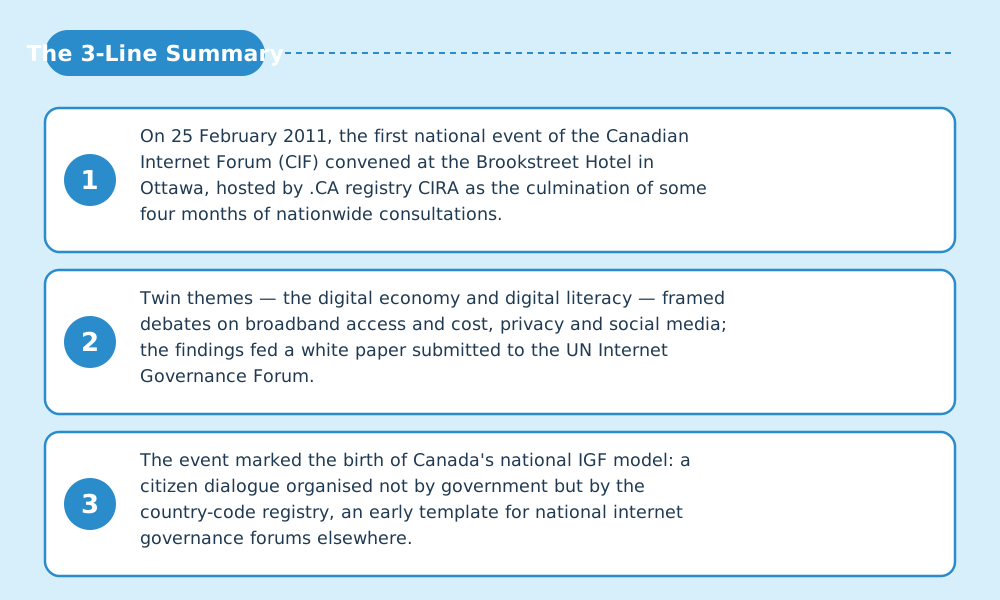
- On 25 February 2011, the first national event of the Canadian Internet Forum (CIF) convened at the Brookstreet Hotel in Ottawa, hosted by .CA registry CIRA as the culmination of some four months of nationwide consultations.
- Twin themes — the digital economy and digital literacy — framed debates on broadband access and cost, privacy and social media; the findings fed a white paper submitted to the UN Internet Governance Forum.
- The event marked the birth of Canada's national IGF model: a citizen dialogue organised not by government but by the country-code registry, an early template for national internet governance forums elsewhere.
Welcome — this is the Japan IGF Support Organization. This in-depth report on Canadian Internet Forum (CIF) 2011 draws on official outputs, session records and on-site reporting. In a hurry? The three lines above and the diagrams carry the gist.
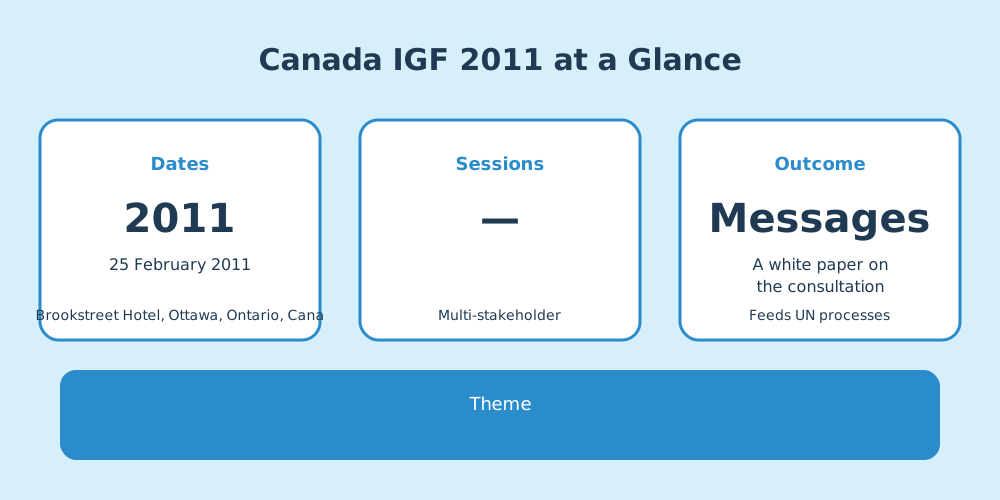
Conference at a Glance (from official records)
| Item | Detail |
|---|---|
| Official name | Canadian Internet Forum (CIF) 2011 |
| Dates | 25 February 2011 |
| Venue | Brookstreet Hotel, Ottawa, Ontario, Canada |
| Theme | Regional governance themes |
| Host | CIRA (Canadian Internet Registration Authority), in partnership with the International Institute for Sustainable Development (IISD) and the Media Awareness Network (MNet) |
| Outcome | A white paper on the consultation findings, submitted to the UN Internet Governance Forum |
(See the source list at the end of this article.)
Discussion Digest — from the Session Records
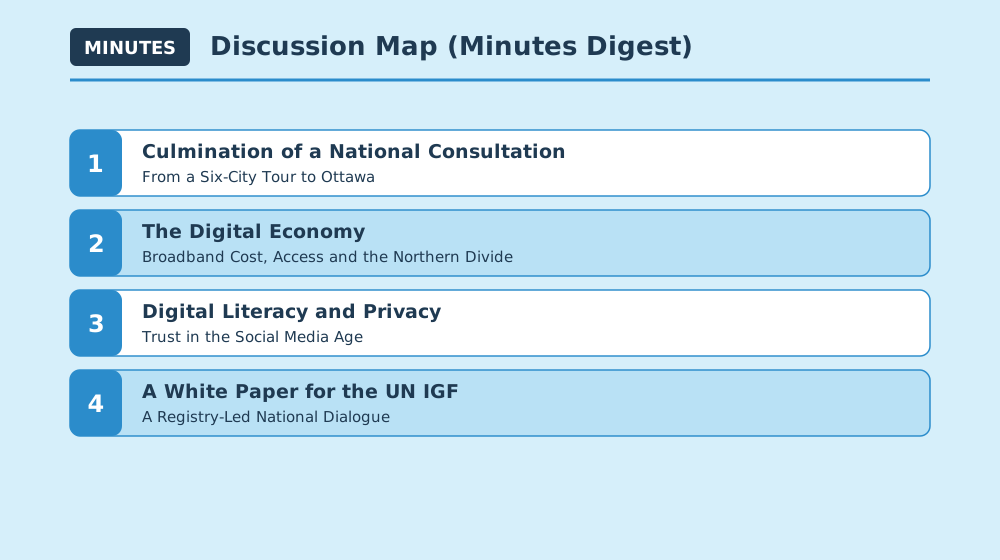
Key exchanges extracted from session records and transcripts.
1. Culmination of a National Consultation — From a Six-City Tour to Ottawa
Sessions: National event (25 February 2011, 9 a.m.–5 p.m., followed by a reception)
"A Canadian Internet forum will really allow us to take the pulse of Canadians with regard to how the Internet is run in Canada and around the world (statement at the consultation launch, 8 November 2010)"
— Byron Holland (President and CEO, CIRA) [1][2]
- Regional consultations in November 2010 covered six cities — Winnipeg, Halifax, Iqaluit, Toronto, Montreal and Vancouver — and fed, with an online consultation, into the national event [1][2]
- Attendance was free, with lunch served and an English/French webcast for citizens who could not travel to Ottawa [1][2]
- The forum was billed as 'an opportunity to discuss, debate and propose directions for the development, deployment and governance of the Internet in Canada' [1][2]
2. The Digital Economy — Broadband Cost, Access and the Northern Divide
Sessions: Digital economy track (economic development, broadband, cyber-crime, innovation)
- Across the consultations, broadband access and cost surfaced repeatedly as Canada's headline internet issue [2][3]
- In Iqaluit, in the Arctic, roughly 15 invited participants examined the internet's role in economic development, framing remote-region connectivity as an economic problem [2][3]
- The economic-development theme also covered cyber-crime, security and innovation, with IISD helping design the consultations [2][3]
3. Digital Literacy and Privacy — Trust in the Social Media Age
Sessions: Digital literacy track and expert panel
- Privacy, how social media was driving the internet's future, and questions of trust and ethics anchored the discussions [1]
- Panellists included Jacob Glick (Policy Counsel, Google Canada), Dr. Gerri Sinclair, Marc Blanchet (Viagénie) and Jim Roche (President and CEO, CANARIE) [1]
- Canadian technology commentator Leonard Brody delivered the keynote [1]
4. A White Paper for the UN IGF — A Registry-Led National Dialogue
Sessions: Outcome compilation
- The consultation findings were compiled into a white paper and delivered to the UN Internet Governance Forum [2][5]
- The UN IGF's NRI records note that CIRA initiated the first Canadian Internet Forum in 2011 as its sole sponsor and administrator [2][5]
- A registry-led rather than government-led design became a reference model for national IGF initiatives elsewhere [2][5]
Three-Minute Short Talk — Your Questions Answered
Q. What did this meeting actually do?
A. It didn't decide anything — it was Canada's first national forum for citizens to debate the internet's future. Views gathered in six cities and online since late 2010 converged in Ottawa on 25 February 2011, and fed a white paper delivered to the UN IGF.
Q. Who ran it — the government?
A. No. CIRA, the non-profit that manages Canada's .CA domain, hosted it with the IISD and the Media Awareness Network. Attendance was free, with an English and French webcast.
Q. Why does it matter now?
A. It was an early template for national IGFs: a bottom-up dialogue run by the technical community rather than government, tackling issues — broadband cost, rural connectivity, privacy — that still dominate digital policy.
What Is Canada IGF? (for first-time readers)
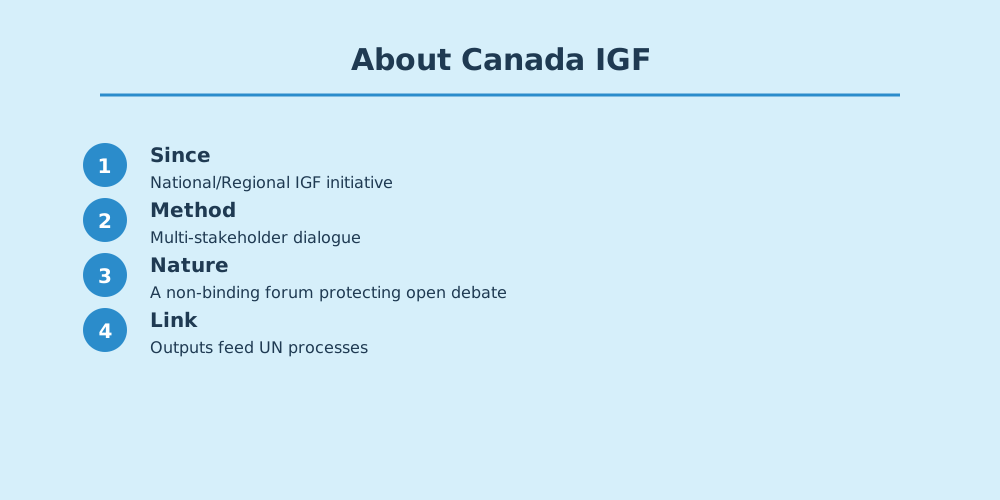
Canada IGF is a National or Regional IGF Initiative (NRI), aligning local internet governance discussion with global IGF principles.
Why It Matters to You
What was discussed here becomes the baseline for national digital policy, platform rules and AI regulation worldwide within a few years. The principles confirmed at the 2011 meeting are the foundation of the "next rules" for the phones, social platforms and AI services you use every day.
Sources & References
- Canadian Internet Forum (event page) — Federation for the Humanities and Social Sciences (accessed 2026-07-11)
- CIRA to engage Canadians on the role of the Internet in their lives (8 November 2010) — CIRA(CNW/newswire.ca プレスリリース) (accessed 2026-07-11)
- Media Advisory – CIRA to hold consultation in Iqaluit on the Internet's role in economic development (12 November 2010) — CIRA(CNW/newswire.ca プレスリリース) (accessed 2026-07-11)
- Canada — country report: Internet governance — APC (accessed 2026-07-11)
- Canada IGF(NRI記録。直接アクセスは403のため検索スニペットで内容確認) — UN IGF Secretariat (accessed 2026-07-11)
Quotes are translated or condensed from the records listed above. Bracketed numbers [n] refer to the source list.
Related links
- IGF official (NRI list): https://www.intgovforum.org/en/content/national-and-regional-igf-initiatives
- Japan IGF: https://japanigf.jp/
- Yuki Nakazawa's blog: https://nkzw.jp/category/igf/
Revision History
Rev. 1 — published 6 July 2011, 16:00 (Article published)
Rev. 2 — updated 16 July 2026, 20:09 (Fully revised into the in-depth edition: added the 3-line summary, minutes digest, short talk, source list and diagrams (all quotes verified against the listed sources))
— 中澤祐樹

