

The 3-Line Summary
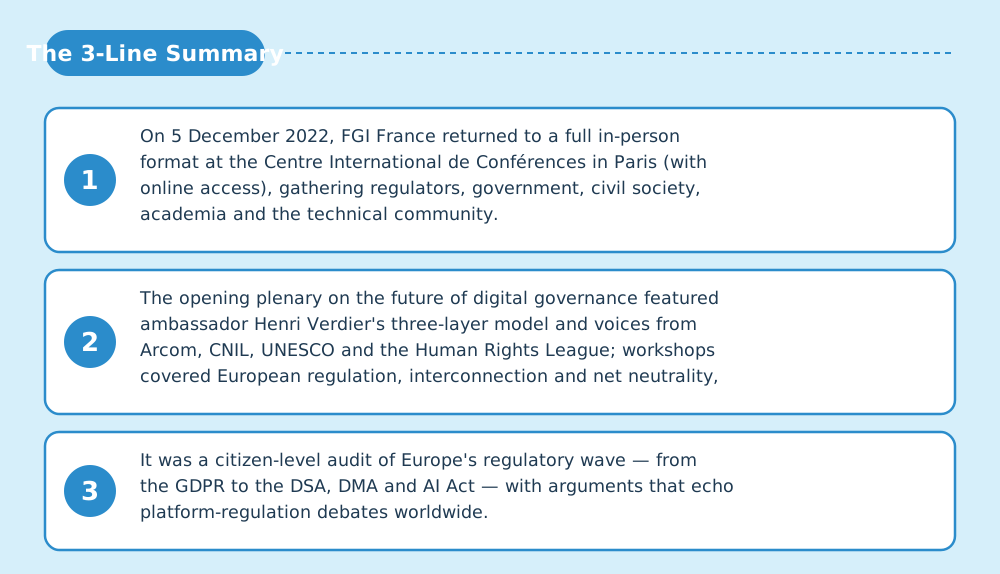
- On 5 December 2022, FGI France returned to a full in-person format at the Centre International de Conférences in Paris (with online access), gathering regulators, government, civil society, academia and the technical community.
- The opening plenary on the future of digital governance featured ambassador Henri Verdier's three-layer model and voices from Arcom, CNIL, UNESCO and the Human Rights League; workshops covered European regulation, interconnection and net neutrality, internet fragmentation and responsible digital training, before a closing plenary on the environment and remarks by minister Jean-Noël Barrot.
- It was a citizen-level audit of Europe's regulatory wave — from the GDPR to the DSA, DMA and AI Act — with arguments that echo platform-regulation debates worldwide.
Welcome — this is the Japan IGF Support Organization. This in-depth report on FGI France 2022 (French Internet Governance Forum) draws on official outputs, session records and on-site reporting. In a hurry? The three lines above and the diagrams carry the gist.
Conference at a Glance (from official records)
| Item | Detail |
|---|---|
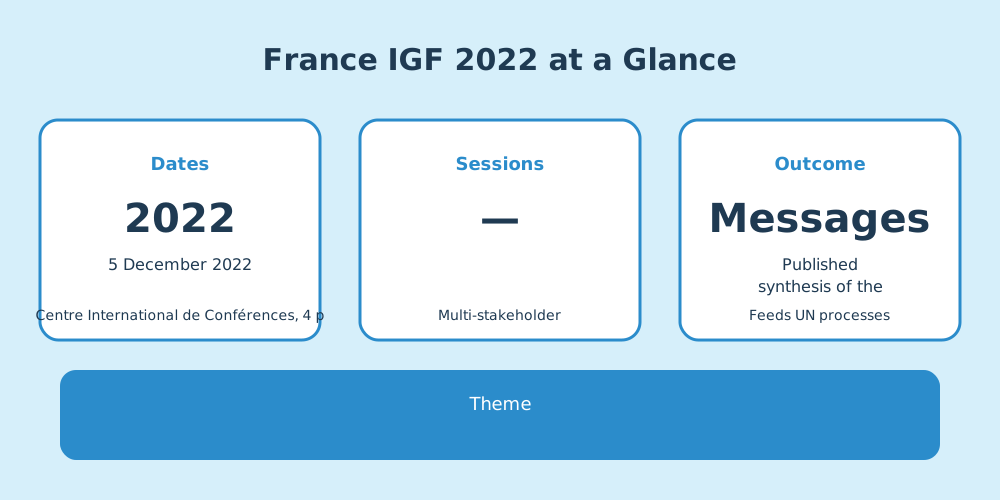
| Official name | FGI France 2022 (French Internet Governance Forum) |
| Dates | 5 December 2022 |
| Venue | Centre International de Conférences, 4 place Jussieu, Paris 5e, and online |
| Theme | Regional governance themes |
| Host | FGI France organising committee (a multistakeholder coalition including Internet Society France, Afnic and Renaissance Numérique) |
| Outcome | Published synthesis of the opening plenary, 'What future for digital governance?' (Afnic / Renaissance Numérique) |
(See the source list at the end of this article.)
Discussion Digest — from the Session Records
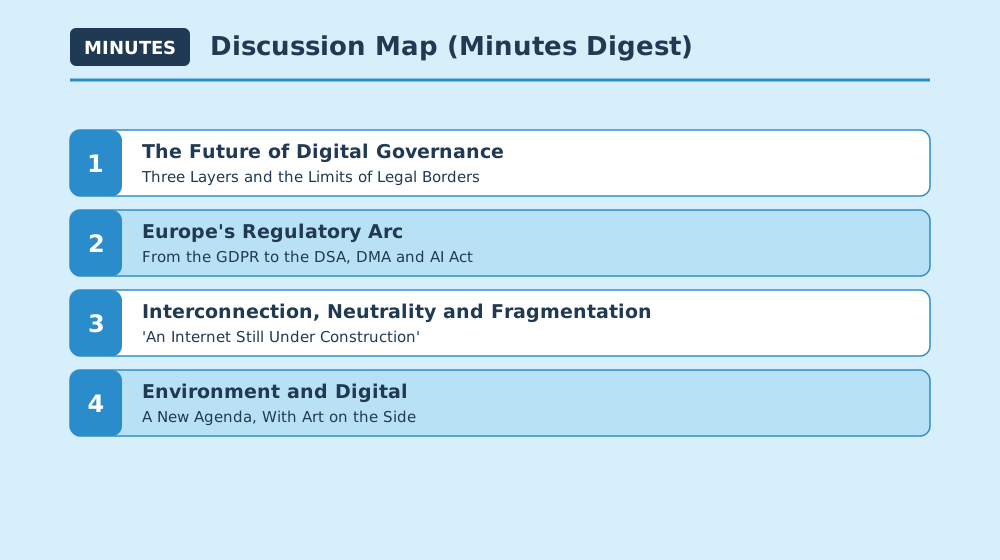
Key exchanges extracted from session records and transcripts.
1. The Future of Digital Governance — Three Layers and the Limits of Legal Borders
Sessions: Opening plenary 'What future for digital governance?' (10:00, moderated by Lucien Castex, Afnic, and Jessica Galissaire, Renaissance Numérique)
"The Internet pre-exists regulation, and the borders of the Internet are not the borders of laws"
— Benoît Loutrel (Arcom) [3][1]
"Where are the young people in the room? For whom are we governing the Internet?"
— Tawfik Jelassi (UNESCO Assistant Director-General) [3][1]
- France's digital ambassador Henri Verdier argued that governance must distinguish the infrastructure, protocol and application layers rather than conflating them [3][1]
- Gilles Brégant (ANFR) flagged satellite constellations as the internet's 'third dimension', with some 50,000 low-orbit satellites expected by 2028 and governance of ownership and access still open [3][1]
- Maryse Artiguelong of the Human Rights League criticised the lack of upstream civil-society involvement in decision-making, placing hopes in France's National Council for Digital Refoundation [3][1]
2. Europe's Regulatory Arc — From the GDPR to the DSA, DMA and AI Act
Sessions: Opening plenary and workshop 'What digital future for Europe?' (13:45–15:00)
"It is one of the first European regulations to apply even to companies located outside the European Union"
— Thomas Dautieu (CNIL) [3][2]
- Starting from the GDPR's extraterritorial reach, participants asked whether the European wave — DSA, DMA, AI Act — can amount to 'open regulation', noting that European regulators increasingly coordinate through networks rather than isolated national frameworks [3][2]
- Speakers repeatedly grounded internet governance in European values: human rights, openness, accessibility and multistakeholder participation [3][2]
3. Interconnection, Neutrality and Fragmentation — 'An Internet Still Under Construction'
Sessions: Workshops 'Interconnection and net neutrality' (11:20–12:35, moderated by Samih Souissi, ANSSI) and 'Internet fragmentation' (13:45–15:00, moderated by Julien Rossi, Université Paris 8)
- Samih Souissi (ANSSI) led the interconnection and net-neutrality workshop while Julien Rossi (Université Paris 8) led the fragmentation workshop, unpacking the technical and political drivers of a splintering internet [1][2]
- Afnic's post-event review summed up the forum as examining 'an internet still under construction', arguing that avoiding fragmentation requires sustained multistakeholder dialogue [1][2]
4. Environment and Digital — A New Agenda, With Art on the Side
Sessions: Closing plenary 'Environment: towards a new digital agenda' (16:00)
- Speakers stressed that multi-disciplinary skills are essential to reconcile the digital and ecological transitions; former digital minister Axelle Lemaire argued for innovation paired with simplicity and frugality [2][1]
- Jean-Noël Barrot, France's minister for digital transition and telecommunications, delivered the closing governmental remarks [2][1]
- 'Les arts d'à côté' displayed more than twenty original artworks, including drawings by the artist Placide, translating internet governance into citizen-facing art [2][1]
Three-Minute Short Talk — Your Questions Answered
Q. What is this forum for?
A. It is France's national IGF: government, regulators, business, civil society and researchers debate internet governance as equals, feeding into the UN's global IGF. The 2022 edition was the first full in-person forum after the pandemic.
Q. What was the most contentious point?
A. Who governs which layer. Arcom's remark that 'the borders of the Internet are not the borders of laws' captured the dilemma of applying national rules to a borderless network, while civil society protested being left out of upstream decisions.
Q. Why should I care?
A. The DSA, DMA and AI Act discussed here now shape how the platforms and AI services you use every day operate — and topics like satellite mega-constellations and digital sustainability have since gone global.
What Is France IGF? (for first-time readers)
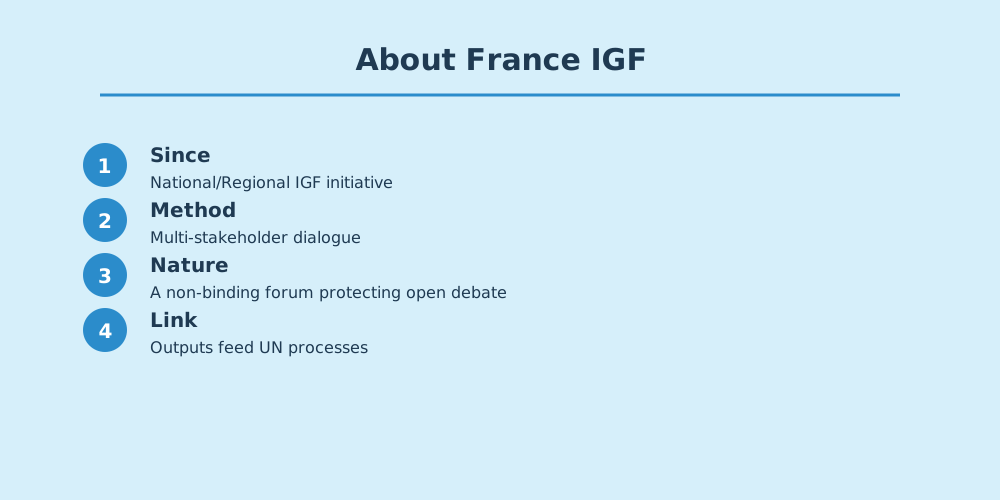
France IGF is a National or Regional IGF Initiative (NRI), aligning local internet governance discussion with global IGF principles.
Why It Matters to You
What was discussed here becomes the baseline for national digital policy, platform rules and AI regulation worldwide within a few years. The principles confirmed at the 2022 meeting are the foundation of the "next rules" for the phones, social platforms and AI services you use every day.
Sources & References
- Programme du Forum sur la Gouvernance de l'Internet France 2022 : le 5 décembre à Paris et en ligne — Internet Society France (accessed 2026-07-11)
- Un internet en construction : retours sur le FGI France 2022(英語版: An internet still under construction) — Afnic(事後レポート) (accessed 2026-07-11)
- Quel futur pour les gouvernances du numérique ?(開幕プレナリー・サマリー) — Renaissance Numérique (accessed 2026-07-11)
- FGI France 2022 : 5 décembre 2022 à Paris et en ligne — Internet Society France (accessed 2026-07-11)
- French Internet Governance Forum 2022(アジェンダ) — Afnic (accessed 2026-07-11)
- FGI France 公式サイト(沿革・アーカイブ) — igf-france.fr (accessed 2026-07-11)
Quotes are translated or condensed from the records listed above. Bracketed numbers [n] refer to the source list.
Related links
- IGF official (NRI list): https://www.intgovforum.org/en/content/national-and-regional-igf-initiatives
- Japan IGF: https://japanigf.jp/
- Yuki Nakazawa's blog: https://nkzw.jp/category/igf/
Revision History
Rev. 1 — published 6 June 2022, 11:00 (Article published)
Rev. 2 — updated 16 July 2026, 20:09 (Fully revised into the in-depth edition: added the 3-line summary, minutes digest, short talk, source list and diagrams (all quotes verified against the listed sources))
— 中澤祐樹