


The 3-Line Summary
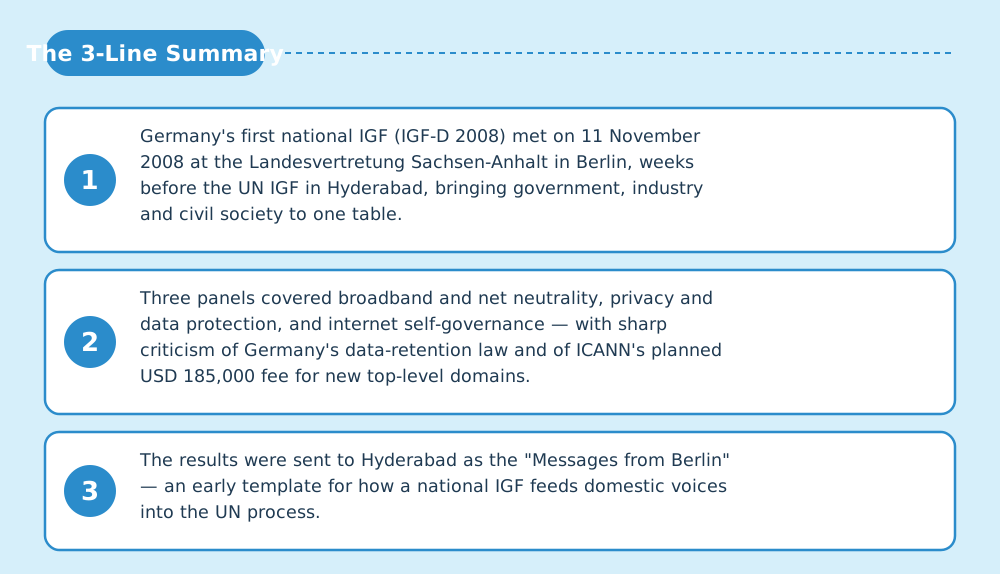
- Germany's first national IGF (IGF-D 2008) met on 11 November 2008 at the Landesvertretung Sachsen-Anhalt in Berlin, weeks before the UN IGF in Hyderabad, bringing government, industry and civil society to one table.
- Three panels covered broadband and net neutrality, privacy and data protection, and internet self-governance — with sharp criticism of Germany's data-retention law and of ICANN's planned USD 185,000 fee for new top-level domains.
- The results were sent to Hyderabad as the "Messages from Berlin" — an early template for how a national IGF feeds domestic voices into the UN process.
Welcome — this is the Japan IGF Support Organization. This in-depth report on I. Internet Governance Forum Deutschland (IGF-D 2008) draws on official outputs, session records and on-site reporting. In a hurry? The three lines above and the diagrams carry the gist.
Conference at a Glance (from official records)
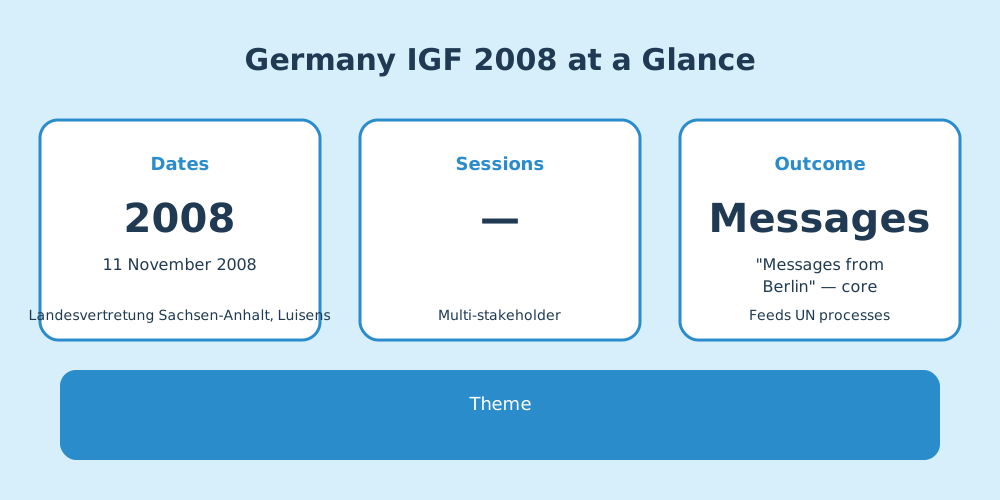
| Item | Detail |
|---|---|
| Official name | I. Internet Governance Forum Deutschland (IGF-D 2008) |
| Dates | 11 November 2008 |
| Venue | Landesvertretung Sachsen-Anhalt, Luisenstraße 18, Berlin |
| Theme | Regional governance themes |
| Purpose | German preparatory summit for the 3rd UN IGF in Hyderabad, India (December 2008) |
| Host | eco (Association of the German Internet Industry), DGVN (German UN Association), DENIC, ISOC.DE (Internet Society German Chapter), and the journal MMR |
| Outcome | "Messages from Berlin" — core statements contributed to the Hyderabad IGF discussions |
(See the source list at the end of this article.)
Discussion Digest — from the Session Records
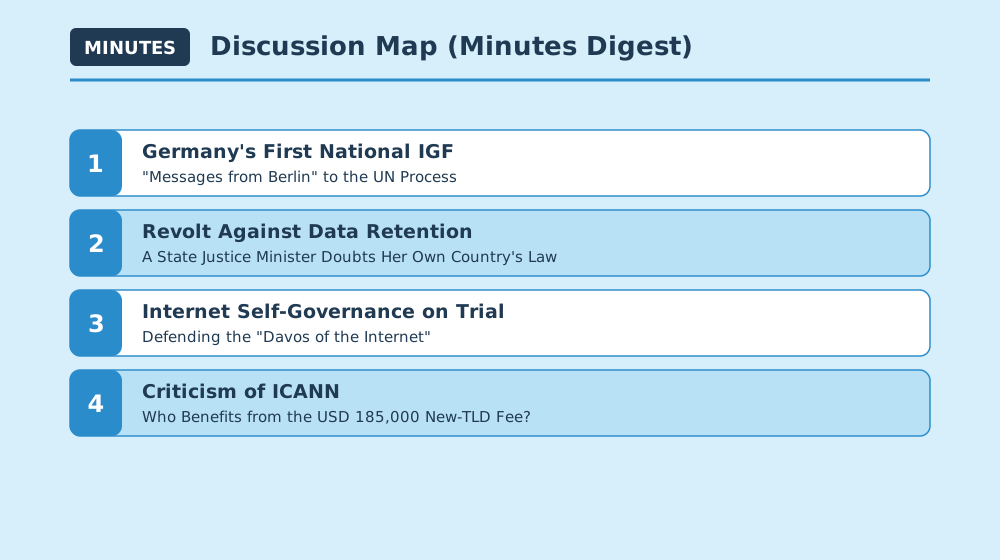
Key exchanges extracted from session records and transcripts.
1. Germany's First National IGF — "Messages from Berlin" to the UN Process
Sessions: Opening by DGVN Secretary-General Beate Wagner, stocktaking lecture by Prof. Wolfgang Kleinwächter, and a video message from IGF Chair Nitin Desai
- IGF-D was founded in summer 2008 by Annette Mühlberg, Prof. Wolfgang Kleinwächter and others under DGVN patronage; the 11 November meeting was framed as Germany's preparatory summit for the UN IGF in Hyderabad [1][2][5]
- Nitin Desai, chair of the UN IGF and adviser to the UN Secretary-General, sent a video message — a direct link to the UN process from day one [1][2][5]
- The outcome was compiled as the "Messages from Berlin" and submitted as Germany's contribution to the Hyderabad IGF [1][2][5]
2. Revolt Against Data Retention — A State Justice Minister Doubts Her Own Country's Law
Sessions: Panel 2: "Security, Privacy and Data Protection on the Internet — In Search of a New Balance" (14:30–16:00)
"I am no champion of data retention. I doubt whether it can prevent even a single crime of international terrorism"
— Angela Kolb (Justice Minister of Saxony-Anhalt) [3][1]
"I am afraid that more and more people will have to store more and more data about me"
— Hans Peter Dittler (Board, Internet Society German Chapter) [3][1]
- As the forum met, constitutional challenges to Germany's year-old data-retention law were pending in Karlsruhe; the host state's own justice minister startled the room by predicting the law would produce nothing but 'data graveyards' [3][1]
- Federal Data Protection Commissioner Peter Schaar warned of a Cold-War-style surveillance arms race, citing UK proposals to retain communication content as its logical end point [3][1]
- Philipp Weidenhiller of school-rating site spickmich.de argued Web 2.0 users themselves police platform operators, while Schaar demanded privacy-friendly default settings from providers [3][1]
3. Internet Self-Governance on Trial — Defending the "Davos of the Internet"
Sessions: Panel 3: "The Future of the IGF: Contribution to Internet Self-Governance" (16:30–18:00, moderated by Prof. Kleinwächter)
"The problems of internet administration and the allocation of top-level domains can no longer be solved with the existing UN systems"
— Peter Voß (Head of International ICT Policy, Federal Ministry of Economics and Technology; German government representative to the IGF) [4][1]
"(The IGF is) necessary to maintain the very system of self-regulation"
— Harald A. Summa (Managing Director of eco; CEO of DE-CIX) [4][1]
- Days earlier ITU Secretary-General Hamadoun Touré had dismissed the IGF as an expensive talking shop; panellists from government, industry and civil society lined up to defend it [4][1]
- Michael Niebel of the European Commission conceded the IGF reaches 'no conclusions' but argued it debates issues discussed globally nowhere else and feeds them back to decision-making bodies [4][1]
- Alternatives to US primacy in internet administration, speakers argued, can only be properly discussed in the space between the standards-focused ITU and the domain manager ICANN [4][1]
4. Criticism of ICANN — Who Benefits from the USD 185,000 New-TLD Fee?
Sessions: Exchanges in Panel 3 (DENIC, Afilias, ICANN ALAC member)
- Annette Mühlberg of ICANN's At-Large Advisory Committee attacked the planned USD 185,000 application fee for new top-level domains, noting the non-profit had no plan for returning such income to the public good [4]
- DENIC CEO Sabine Dolderer accused ICANN of overstepping its mandate with contract clauses untenable under national law; Afilias chairman Philipp Grabensee judged ICANN's pro-competition goals only 'partly successful' [4]
- The European Commission's Michael Niebel asked whether even cities would have to pay a planned USD 75,000 annual fee just to use their own names as address zones [4]
Three-Minute Short Talk — Your Questions Answered
Q. What was this meeting, exactly?
A. The first German national IGF — a domestic rehearsal for the UN's Internet Governance Forum in Hyderabad, where government, business and civil society hammered out shared positions, delivered to the UN as the 'Messages from Berlin'.
Q. What was the most contentious issue?
A. Surveillance and privacy. The host state's own justice minister publicly doubted Germany's data-retention law, and the federal privacy commissioner warned of a surveillance arms race.
Q. Why does a 2008 meeting still matter?
A. It is one of the earliest national IGFs — the model of feeding domestic multistakeholder debate into the UN process that later spread worldwide, from Europe to Japan.
What Is Germany IGF? (for first-time readers)
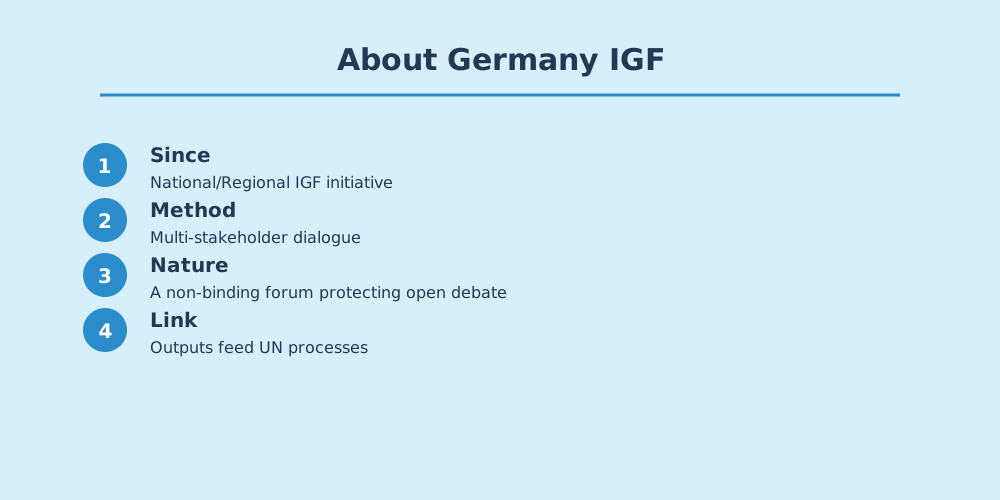
Germany IGF is a National or Regional IGF Initiative (NRI), aligning local internet governance discussion with global IGF principles.
Why It Matters to You
What was discussed here becomes the baseline for national digital policy, platform rules and AI regulation worldwide within a few years. The principles confirmed at the 2008 meeting are the foundation of the "next rules" for the phones, social platforms and AI services you use every day.
Sources & References
- Programm 2008 — Vorbereitungsgipfel für das Internet Governance Forum der UN in Hyderabad/Indien — IGF-D(旧公式サイト igf-d.de、Wayback Machine保存) (accessed 2026-07-11)
- IGF-D 2008 — I. Internet Governance Forum Deutschland(公式Historieページ) — IGF-D e.V.(2020年版公式サイト、Wayback Machine保存) (accessed 2026-07-11)
- Sachsen-Anhalts Justizministerin zweifelt am Nutzen der Vorratsdatenspeicherung(Stefan Krempl, 2008-11-11) — heise online(Wayback Machine保存) (accessed 2026-07-11)
- Die Internet-Selbstverwaltung auf dem Prüfstand(Stefan Krempl, 2008-11-12) — heise online(Wayback Machine保存) (accessed 2026-07-11)
- Internet Governance Forum Deutschland(IGF-D設立経緯・Messages from Berlinの仕組み) — DiploFoundation (accessed 2026-07-11)
Quotes are translated or condensed from the records listed above. Bracketed numbers [n] refer to the source list.
Related links
- IGF official (NRI list): https://www.intgovforum.org/en/content/national-and-regional-igf-initiatives
- Japan IGF: https://japanigf.jp/
- Yuki Nakazawa's blog: https://nkzw.jp/category/igf/
Revision History
Rev. 1 — published 11 June 2008, 12:00 (Article published)
Rev. 2 — updated 16 July 2026, 20:09 (Fully revised into the in-depth edition: added the 3-line summary, minutes digest, short talk, source list and diagrams (all quotes verified against the listed sources))
— 中澤祐樹

