


The 3-Line Summary
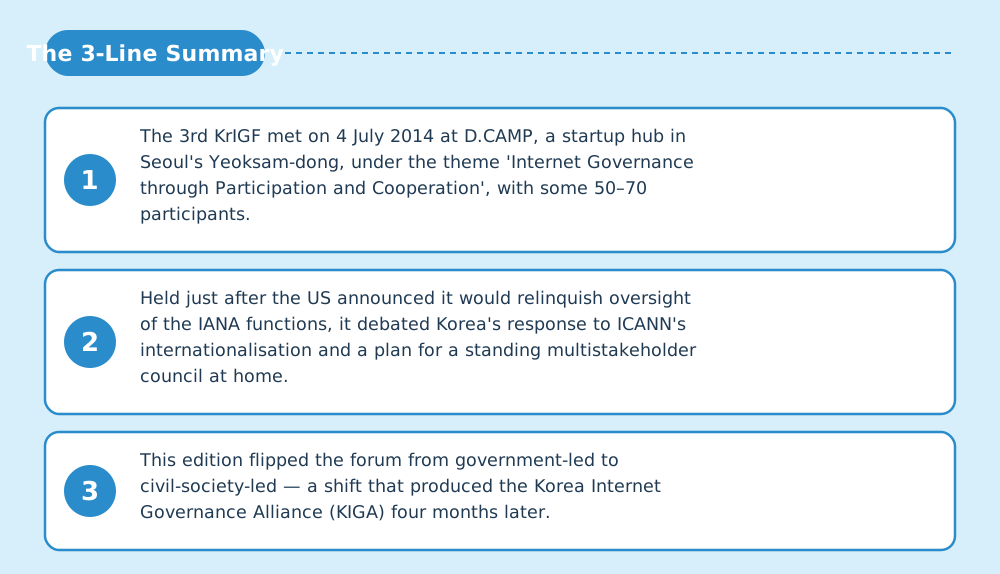
- The 3rd KrIGF met on 4 July 2014 at D.CAMP, a startup hub in Seoul's Yeoksam-dong, under the theme 'Internet Governance through Participation and Cooperation', with some 50–70 participants.
- Held just after the US announced it would relinquish oversight of the IANA functions, it debated Korea's response to ICANN's internationalisation and a plan for a standing multistakeholder council at home.
- This edition flipped the forum from government-led to civil-society-led — a shift that produced the Korea Internet Governance Alliance (KIGA) four months later.
Welcome — this is the Japan IGF Support Organization. This in-depth report on 3rd Korea Internet Governance Forum (KrIGF 2014) draws on official outputs, session records and on-site reporting. In a hurry? The three lines above and the diagrams carry the gist.
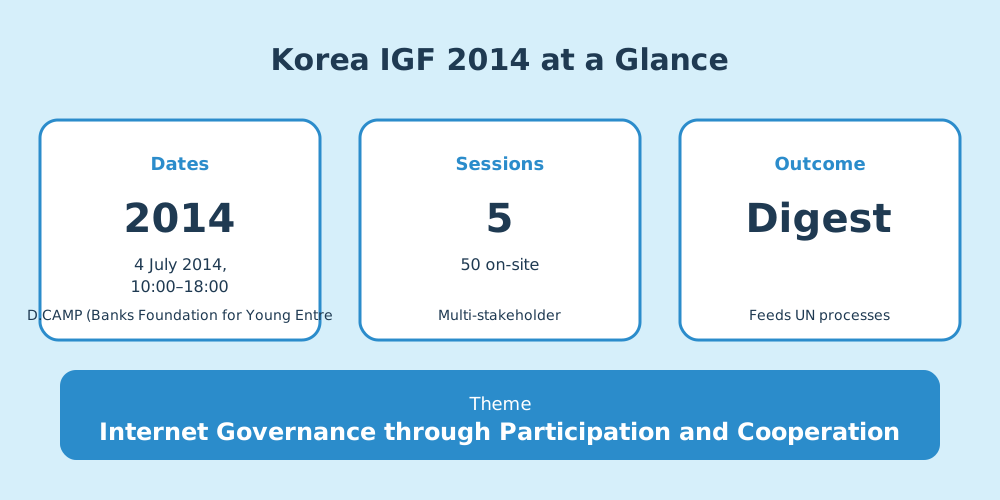
Conference at a Glance (from official records)
| Item | Detail |
|---|---|
| Official name | 3rd Korea Internet Governance Forum (KrIGF 2014) |
| Dates | 4 July 2014, 10:00–18:00 |
| Venue | D.CAMP (Banks Foundation for Young Entrepreneurs), 6F Multipurpose Hall, Yeoksam-dong, Seoul |
| Theme | Internet Governance through Participation and Cooperation |
| Participants | 50 |
| Sessions | 5 |
| Keynote | Keynote 'Multi-stakeholder Model – under development' by Prof. Kilnam Chon (KAIST) |
| Host | KrIGF Organising Committee — proposed by civil society, academia and business; co-hosted with KISA, Naver, Daum, Gabia and Google |
(See the source list at the end of this article.)
Discussion Digest — from the Session Records
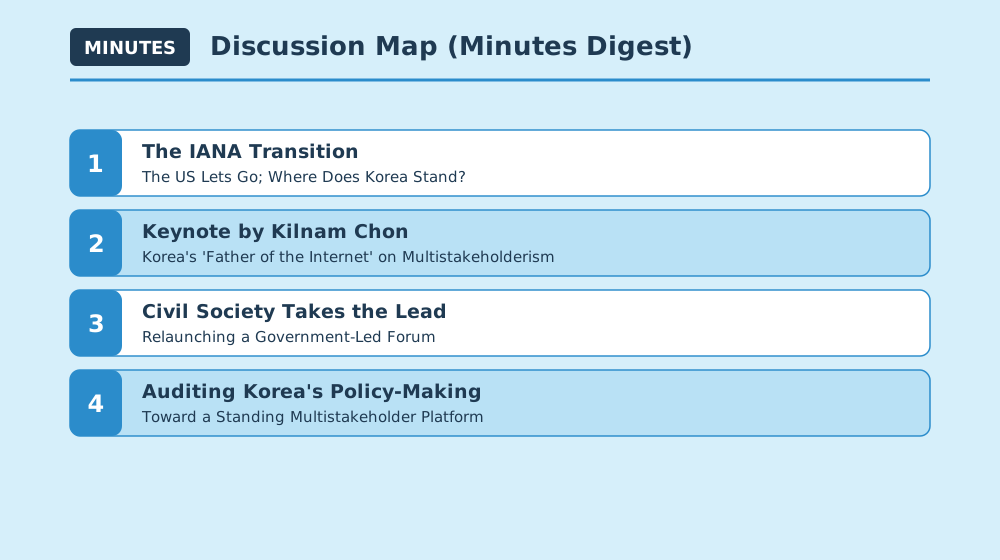
Key exchanges extracted from session records and transcripts.
1. The IANA Transition — The US Lets Go; Where Does Korea Stand?
Sessions: Workshop 1 'ICANN/IANA internationalisation and Korea's position' (11:00–12:30, moderated by Prof. Lee Young-eum, KNOU)
- Coming right after the March 2014 NTIA announcement that the US would hand over stewardship of the IANA functions, KAIST's Lee Dong-man presented on the transition, debated by Open Net's Jeon Eung-hwi and KISA's Hwang In-pyo [1][2]
- At stake was how Korea would engage as control of the internet's core resources moved from US oversight to a global multistakeholder arrangement [1][2]
2. Keynote by Kilnam Chon — Korea's 'Father of the Internet' on Multistakeholderism
Sessions: Keynote 'Multi-stakeholder Model – under development' (10:30–10:50)
- Prof. Kilnam Chon of KAIST, revered as the father of the Korean internet, delivered the keynote on the multistakeholder model as a work in progress [1][2]
- Opening remarks came from all camps at once — the science ministry's Song Kyung-hee, KAIST's Lee Dong-man, Daum's Lee Byung-sun and Open Net's Jeon Eung-hwi — signalling a genuinely multistakeholder relaunch [1][2]
3. Civil Society Takes the Lead — Relaunching a Government-Led Forum
Sessions: Multiple sessions
- This edition was proposed by civil society, academia and business, with KISA joining later as co-host — a reversal of the agency-led first two forums, as GISWatch records [4][3]
- Inspired by NETmundial and Brazil's CGI.br model, the Korea Internet Governance Alliance (KIGA) — a 29-member volunteer multistakeholder council — was founded that November and has hosted the KrIGF ever since [4][3]
4. Auditing Korea's Policy-Making — Toward a Standing Multistakeholder Platform
Sessions: Workshop 2 'Evaluating existing internet policy-making' (13:30–15:00) and Workshop 3 'Building a domestic multistakeholder policy platform' (15:30–17:00)
- Workshop 2, moderated by attorney Yoon Jong-soo, put Korea's existing policy-making processes under review with panellists including KISO's Kim Kyung-tae and Jinbonet's Oh Byung-il [2][5]
- In Workshop 3, attorney Kim Bo-ra-mi presented a blueprint for a standing multistakeholder policy platform — groundwork for KIGA's founding months later [2][5]
- Civil society had done its homework: that February the Net Neutrality Users Forum published a book-length study, 'Talking About Internet Governance' [2][5]
Three-Minute Short Talk — Your Questions Answered
Q. What did this meeting actually achieve?
A. No resolutions, but real consequences: the blueprint for a standing multistakeholder council debated here became KIGA, founded just four months later.
Q. What was the most contentious topic?
A. Who should steward the internet's core resources after the US let go of IANA oversight — and, at home, how to open up Korea's government-led policy-making.
Q. Why should I care?
A. This is a rare, well-documented moment of a national IGF flipping from government-run to community-run — a case study for any country debating who writes its internet rules.
What Is Korea IGF? (for first-time readers)
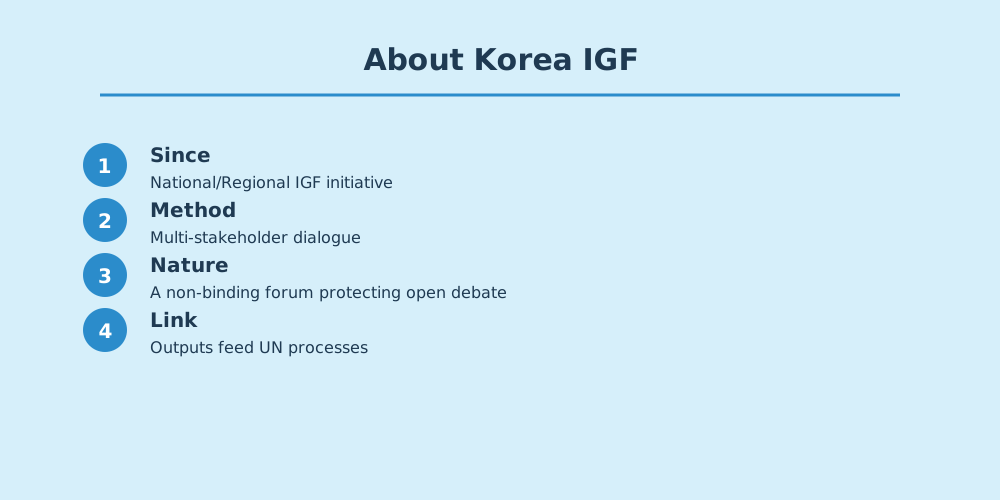
Korea IGF is a National or Regional IGF Initiative (NRI), aligning local internet governance discussion with global IGF principles.
Why It Matters to You
What was discussed here becomes the baseline for national digital policy, platform rules and AI regulation worldwide within a few years. The principles confirmed at the 2014 meeting are the foundation of the "next rules" for the phones, social platforms and AI services you use every day.
Sources & References
- 2014 KrIGF 개요(第3回フォーラム概要) — KrIGF公式サイト(Kr-IGF 한국 인터넷거버넌스포럼) (accessed 2026-07-11)
- 2014 프로그램(第3回フォーラム プログラム) — KrIGF公式サイト(Kr-IGF 한국 인터넷거버넌스포럼) (accessed 2026-07-11)
- 한국 인터넷거버넌스포럼 (KrIGF) 소개・개최 이력(開催履歴表) — KRNIC 한국인터넷정보센터(KISA運営) (accessed 2026-07-11)
- Korea, Republic of — Internet governance country report — Global Information Society Watch(APC) (accessed 2026-07-11)
- 인터넷거버넌스를 말하다(電子書籍『インターネットガバナンスを語る』) — 망중립성이용자포럼(網中立性利用者フォーラム・進歩ネットワークセンター掲載) (accessed 2026-07-11)
Quotes are translated or condensed from the records listed above. Bracketed numbers [n] refer to the source list.
Related links
- IGF official (NRI list): https://www.intgovforum.org/en/content/national-and-regional-igf-initiatives
- Japan IGF: https://japanigf.jp/
- Yuki Nakazawa's blog: https://nkzw.jp/category/igf/
Revision History
Rev. 1 — published 19 July 2014, 11:00 (Article published)
Rev. 2 — updated 16 July 2026, 20:09 (Fully revised into the in-depth edition: added the 3-line summary, minutes digest, short talk, source list and diagrams (all quotes verified against the listed sources))
— 中澤祐樹

