

The 3-Line Summary
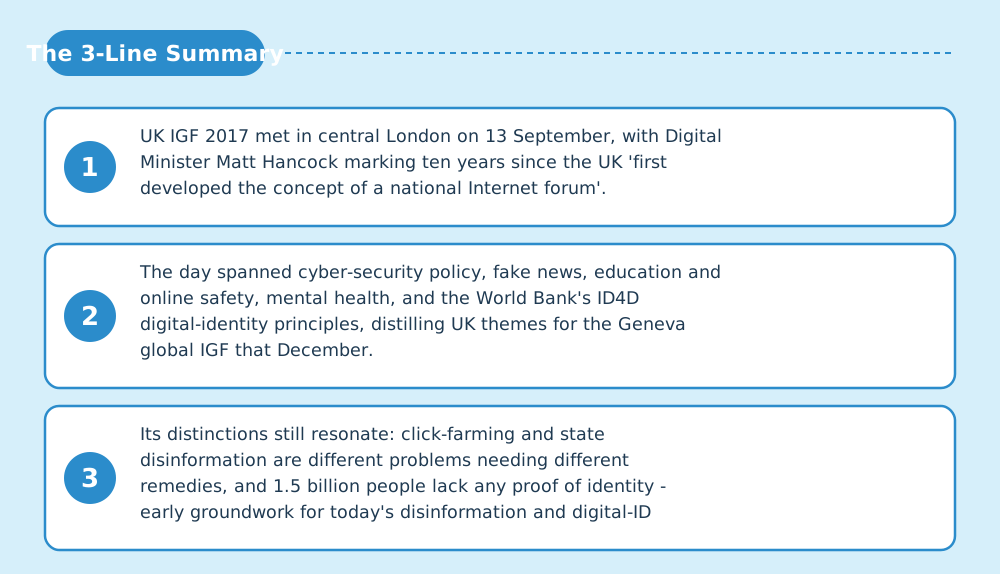
- UK IGF 2017 met in central London on 13 September, with Digital Minister Matt Hancock marking ten years since the UK 'first developed the concept of a national Internet forum'.
- The day spanned cyber-security policy, fake news, education and online safety, mental health, and the World Bank's ID4D digital-identity principles, distilling UK themes for the Geneva global IGF that December.
- Its distinctions still resonate: click-farming and state disinformation are different problems needing different remedies, and 1.5 billion people lack any proof of identity – early groundwork for today's disinformation and digital-ID debates.
Welcome — this is the Japan IGF Support Organization. This in-depth report on UK Internet Governance Forum 2017 draws on official outputs, session records and on-site reporting. In a hurry? The three lines above and the diagrams carry the gist.
Conference at a Glance (from official records)
| Item | Detail |
|---|---|
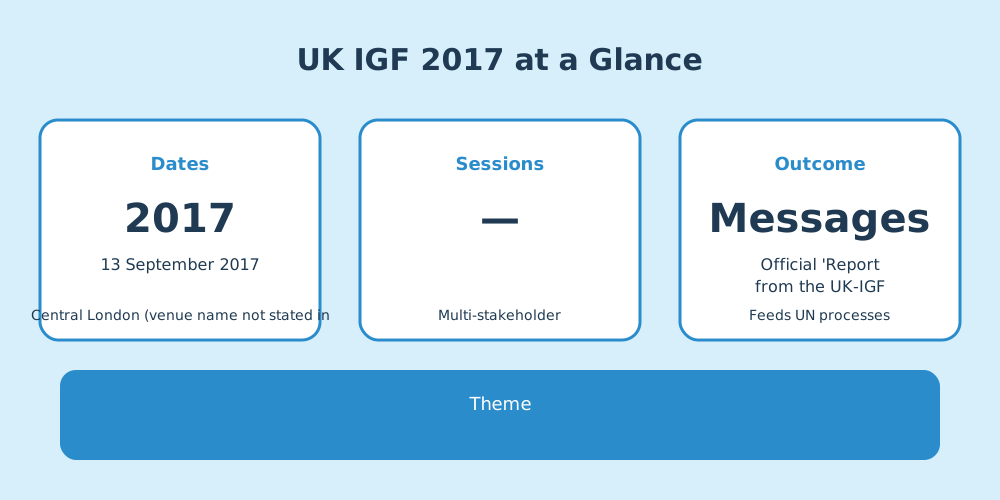
| Official name | UK Internet Governance Forum 2017 |
| Dates | 13 September 2017 |
| Venue | Central London (venue name not stated in the official report) |
| Theme | Regional governance themes |
| Keynote | Rt Hon Matt Hancock MP, Minister of State for Digital (DCMS) |
| Outcome | Official 'Report from the UK-IGF 2017', feeding UK themes into the Geneva global IGF |
(See the source list at the end of this article.)
Discussion Digest — from the Session Records
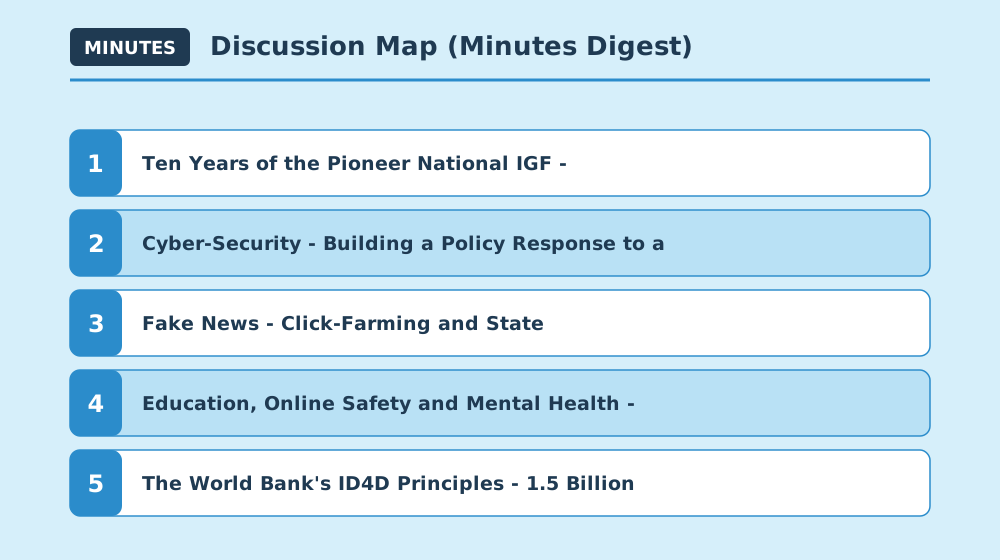
Key exchanges extracted from session records and transcripts.
1. Ten Years of the Pioneer National IGF – Hancock's 'Free, Open and Safe' Internet
Sessions: Ministerial address by Rt Hon Matt Hancock MP, Minister for Digital
"It was ten years ago that we first developed the concept of a national Internet forum, modelled on the global Internet Governance Forum."
— Rt Hon Matt Hancock MP (Minister for Digital) [2][1]
"We seek an internet that is free, open and safe, that fosters innovation, where standards are driven by experts, in which all stakeholders have a say in how the internet is run."
— Rt Hon Matt Hancock MP (Minister for Digital) [2][1]
- The government itself marked the UK as originator of the world's first national IGF (full speech text on gov.uk) [2][1]
- Per the official report, the speech called for the UK to lead the governance debate 'drawing on a degree of self-confidence in our shared values' [2][1]
2. Cyber-Security – Building a Policy Response to a Clear Threat
Sessions: Panel 'Cyber-Security: Building a Policy Response to an Eminent Threat' and talk 'Cyber Resilient Businesses'
- Panellists from McAfee, CGI, Imperial College and the National Cyber Security Centre agreed the threat is growing exponentially with IoT, with AI adding complexity [1]
- Four priorities: boardroom awareness of cyber risk, closing the skills gap, user education, and fit-for-purpose regulation setting internationally agreed standards focused on broad principles, not operational detail [1]
- PwC's Richard Horne set out how firms build cyber-resilience: secure processes not just secure kit, openness to independent review, and recording incidents to learn the lessons [1]
3. Fake News – Click-Farming and State Disinformation Are Different Problems
Sessions: 'Fake News' panel chaired by Nominet, with Demos, Business Insider, Chi Onwurah MP and Facebook
- The panel distinguished frivolous click-harvesting stories from far more harmful state-sponsored disinformation – two distinct phenomena demanding different policy solutions [1]
- Some called the absence of online rules for political messaging a 'regulation deficit'; others warned over-regulation could prove anti-competitive or a back door to state surveillance. There was strong support for platforms taking more editorial responsibility [1]
- The debate closed agreeing no technical fix is likely – improving digital literacy is key [1]
4. Education, Online Safety and Mental Health – Beyond Restrict-and-Block
Sessions: 'Education and Online Safety' and 'Mental Health and Accessibility Online' sessions
- The key to resilient children is an environment that supports young people's choices, not one that just restricts and blocks – children who fear losing device access often do not report abuse [1]
- Dr Rachel O'Connell argued industry had pushed responsibility for user well-being back onto online communities, when technical solutions already exist to identify those most at risk for professional intervention [1]
- An emerging 'identity as a service' industry could let platforms serve age-appropriate content and ensure young users' posts reach only their peers [1]
5. The World Bank's ID4D Principles – 1.5 Billion People Without Proof of Identity
Sessions: Breakouts 'Shaping Your Digital Future – World Bank Principles on Identification', chaired by Nominet Trust, ICANN and BCS
- The World Bank estimated in 2016 that 1.5 billion people in developing countries cannot prove who they are – a major barrier to development. Three breakout groups tested the ID4D initiative's 10 principles on inclusion, design and governance [1]
- Design challenges included future-proofing a system that must run a full human lifespan, and the risk that scope creep beyond ID would capture more data and erode trust [1]
- Despite reservations, delegates concluded the principles are a useful contribution and urged the UN IGF to co-opt them rather than duplicate the effort [1]
Three-Minute Short Talk — Your Questions Answered
Q. So what did the meeting decide?
A. Nothing binding – it is a forum where UK stakeholders debate as equals. The 2017 discussions were distilled into a report feeding the UK's themes into the global IGF in Geneva that December. An open preparatory meeting in May had crowdsourced the agenda.
Q. What was the headline topic?
A. Fake news. The panel's distinction – profit-driven click-farming versus state-sponsored disinformation, each needing different remedies – became a foundation of today's disinformation policy. Facebook executives and MPs argued the case for and against regulation.
Q. Why should I care?
A. The ID4D digital-identity principles and the disinformation framework debated here now shape digital-ID schemes and anti-disinformation policy worldwide. And after ten years, the UK's national IGF remained the template other countries copied.
What Is UK IGF? (for first-time readers)
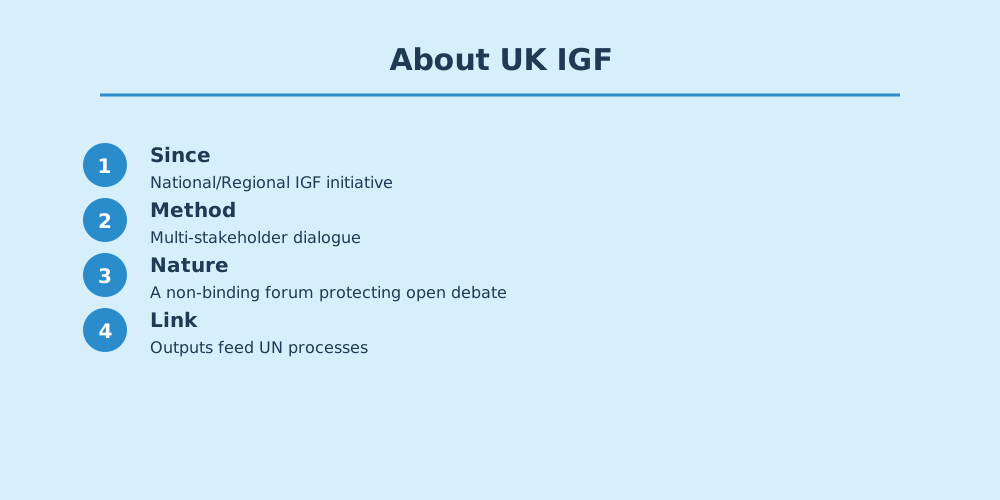
UK IGF is a National or Regional IGF Initiative (NRI), aligning local internet governance discussion with global IGF principles.
Why It Matters to You
What was discussed here becomes the baseline for national digital policy, platform rules and AI regulation worldwide within a few years. The principles confirmed at the 2017 meeting are the foundation of the "next rules" for the phones, social platforms and AI services you use every day.
Sources & References
- Report from the UK-IGF 2017(公式報告書PDF) — UK IGF(Nominet・BCS・ICANN後援) (accessed 2026-07-11)
- The Future of the Internet(ハンコック演説全文、2017-09-13 UK IGF) — 英国政府(GOV.UK) (accessed 2026-07-11)
- 2017 UK IGF(公式イベントページ、開催日・準備会合の根拠) — UK IGF(公式サイト) (accessed 2026-07-11)
- Events – UK IGF(歴代イベント一覧) — UK IGF(公式サイト) (accessed 2026-07-11)
Quotes are translated or condensed from the records listed above. Bracketed numbers [n] refer to the source list.
Related links
- IGF official (NRI list): https://www.intgovforum.org/en/content/national-and-regional-igf-initiatives
- Japan IGF: https://japanigf.jp/
- Yuki Nakazawa's blog: https://nkzw.jp/category/igf/
Revision History
Rev. 1 — published 6 October 2017, 11:00 (Article published)
Rev. 2 — updated 16 July 2026, 20:09 (Fully revised into the in-depth edition: added the 3-line summary, minutes digest, short talk, source list and diagrams (all quotes verified against the listed sources))
— 中澤祐樹