


The 3-Line Summary
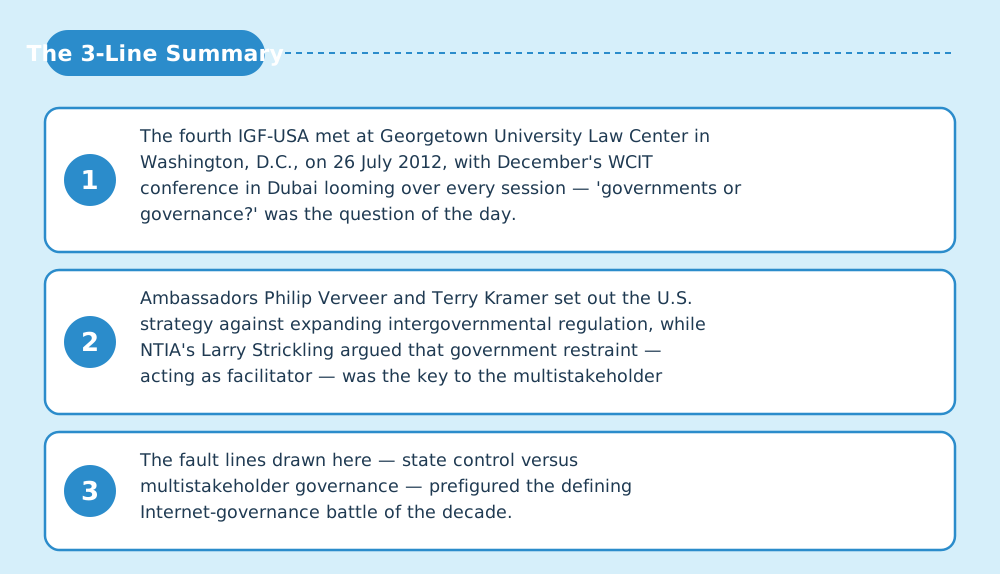
- The fourth IGF-USA met at Georgetown University Law Center in Washington, D.C., on 26 July 2012, with December's WCIT conference in Dubai looming over every session — 'governments or governance?' was the question of the day.
- Ambassadors Philip Verveer and Terry Kramer set out the U.S. strategy against expanding intergovernmental regulation, while NTIA's Larry Strickling argued that government restraint — acting as facilitator — was the key to the multistakeholder model's success.
- The fault lines drawn here — state control versus multistakeholder governance — prefigured the defining Internet-governance battle of the decade.
Welcome — this is the Japan IGF Support Organization. This in-depth report on IGF-USA 2012 draws on official outputs, session records and on-site reporting. In a hurry? The three lines above and the diagrams carry the gist.
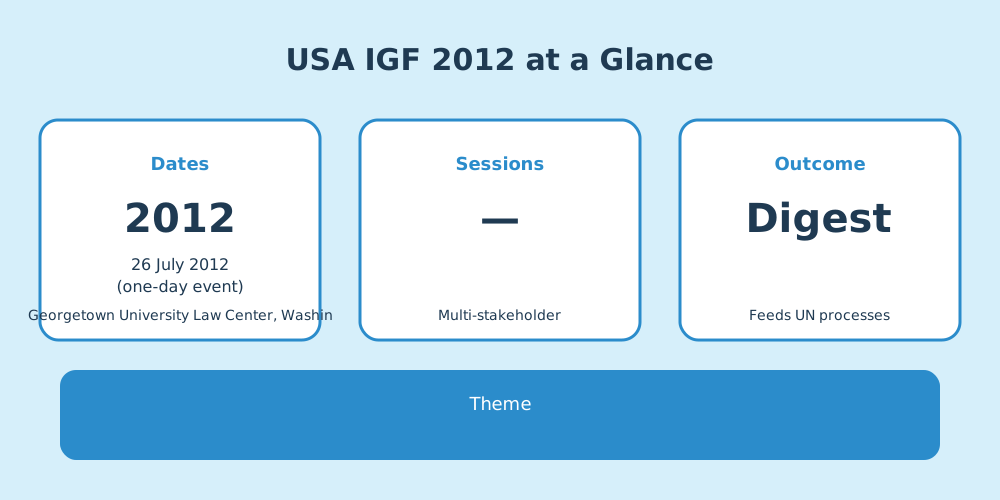
Conference at a Glance (from official records)
| Item | Detail |
|---|---|
| Official name | IGF-USA 2012 |
| Edition | Fourth annual IGF-USA (Elon University's coverage explicitly calls it 'the fourth annual conference'; the series began in 2009) |
| Dates | 26 July 2012 (one-day event) |
| Venue | Georgetown University Law Center, Washington, D.C. |
| Theme | Regional governance themes |
| Host | IGF-USA multistakeholder steering committee (chief catalyst Marilyn Cade) |
(See the source list at the end of this article.)
Discussion Digest — from the Session Records
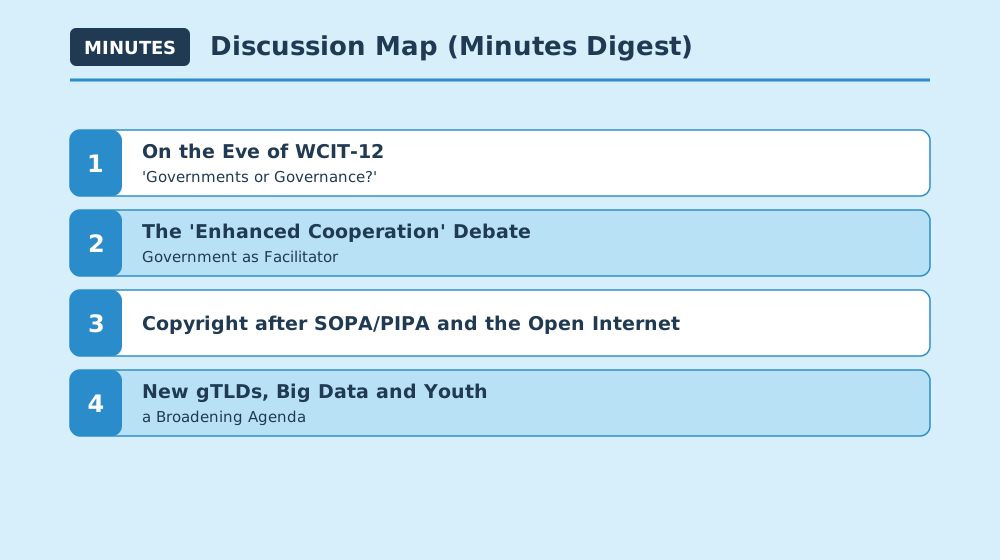
Key exchanges extracted from session records and transcripts.
1. On the Eve of WCIT-12 — 'Governments or Governance?'
Sessions: Opening keynote by Ambassador Philip Verveer and WCIT Ambassador Terry Kramer
"The multistakeholder model is the only effective one that will work"
— Terry Kramer (U.S. Ambassador to WCIT) [2][1]
"When it comes time for us to advocate directly (for Internet freedom), it will be very important that we come from a position of knowledge and fact, not just ideology"
— Terry Kramer (U.S. Ambassador to WCIT) [2][1]
"Our principal goal for WCIT involves maintaining this enabling environment, with complete confidence that if we are successful the benefits of information and communications technology will continue to increase and to expand to billions of additional people"
— Ambassador Philip Verveer (U.S. State Department) [2][1]
- With the renegotiation of the ITRs at December's WCIT in Dubai approaching, wariness of attempts to extend ITU authority over the Internet set the tone for the day [2][1]
- Kramer declared that 'the Internet is too global to have one organization in control' and pledged opposition to any broadening of the ITRs that could facilitate censorship [2][1]
2. The 'Enhanced Cooperation' Debate — Government as Facilitator
Sessions: Remarks by NTIA Administrator Larry Strickling
"We have focused on enhanced cooperation and finding ways for the global Internet community to have a more direct say in matters of Internet governance"
— Lawrence Strickling (Assistant Secretary of Commerce; NTIA Administrator) [3]
"Limiting ourselves to the role of facilitator is absolutely key to the ultimate success of the (multistakeholder model). We will press ahead"
— Lawrence Strickling (Assistant Secretary of Commerce; NTIA Administrator) [3]
- Strickling warned that some countries would use WCIT and similar venues 'to justify greater governmental control over the Internet', promising U.S. pushback through inclusiveness and transparency [3]
- He recast the long-running WSIS concept of 'enhanced cooperation' as giving the global community a more direct say — not expanding intergovernmental authority [3]
3. Copyright after SOPA/PIPA and the Open Internet
Sessions: Workshops 'Copyright Futures' (scenario planning) and 'Open Internet Challenges'
- Months after the SOPA/PIPA bills collapsed under mass online protest, Georgetown Law students and faculty ran a scenario-planning exercise on the future of copyright [1][4]
- Freedom House's Robert Guerra organised the 'Open Internet Challenges' workshop on threats to expression and access, with civil-society voices including Rebecca MacKinnon (New America Foundation) and Marc Rotenberg (EPIC) on the day's rosters [1][4]
4. New gTLDs, Big Data and Youth — a Broadening Agenda
Sessions: Workshops on new gTLDs, big data in the cloud, the Youth Forum and ICTs for disaster response
- Weeks after ICANN revealed the new gTLD application list (June 2012), a workshop co-organised by trademark practitioner Brian Winterfeldt examined the expanding domain space, while ISOC and ARIN experts tracked the evolution of critical Internet resources [1][4]
- Tracks on big data in the cloud, ICTs for disaster response and cybersecurity policy ran alongside a Youth Forum, with all sessions reporting back to the closing plenary [1][4]
Three-Minute Short Talk — Your Questions Answered
Q. What was the dominant theme?
A. December's WCIT conference. Two U.S. ambassadors used the forum to preview America's strategy against extending UN telecom regulations to the Internet — a dress rehearsal for Dubai.
Q. What does 'governments or governance' mean?
A. Whether Internet rules should be set by intergovernmental treaty or by multistakeholder processes where governments, business and civil society participate as equals. It was the opening plenary's title.
Q. How did WCIT turn out?
A. The U.S. — joined by Japan and dozens of others — refused to sign the revised ITRs that December. The 'knowledge and fact' preparation strategy aired here foreshadowed that split.
What Is USA IGF? (for first-time readers)
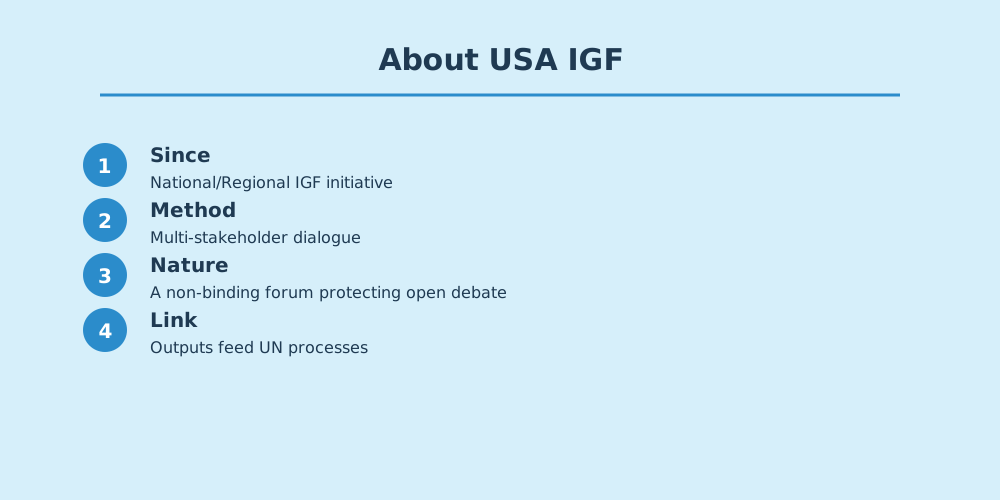
USA IGF is a National or Regional IGF Initiative (NRI), aligning local internet governance discussion with global IGF principles.
Why It Matters to You
What was discussed here becomes the baseline for national digital policy, platform rules and AI regulation worldwide within a few years. The principles confirmed at the 2012 meeting are the foundation of the "next rules" for the phones, social platforms and AI services you use every day.
Sources & References
- IGF-USA 2012(公式アーカイブページ) — IGF-USA (accessed 2026-07-11)
- Opening Keynote: Phil Verveer, U.S. State Department(テリー・クレイマー大使との合同基調の記録) — Elon University Imagining the Internet (accessed 2026-07-11)
- US NTIA Statement: Remarks by Larry Strickling, Administrator — Elon University Imagining the Internet (accessed 2026-07-11)
- Internet Governance Forum – USA, 2012(セッション別記録アーカイブ) — Elon University Imagining the Internet (accessed 2026-07-11)
Quotes are translated or condensed from the records listed above. Bracketed numbers [n] refer to the source list.
Related links
- IGF official (NRI list): https://www.intgovforum.org/en/content/national-and-regional-igf-initiatives
- Japan IGF: https://japanigf.jp/
- Yuki Nakazawa's blog: https://nkzw.jp/category/igf/
Revision History
Rev. 1 — published 2 October 2012, 12:00 (Article published)
Rev. 2 — updated 16 July 2026, 20:09 (Fully revised into the in-depth edition: added the 3-line summary, minutes digest, short talk, source list and diagrams (all quotes verified against the listed sources))
— 中澤祐樹

