


The 3-Line Summary
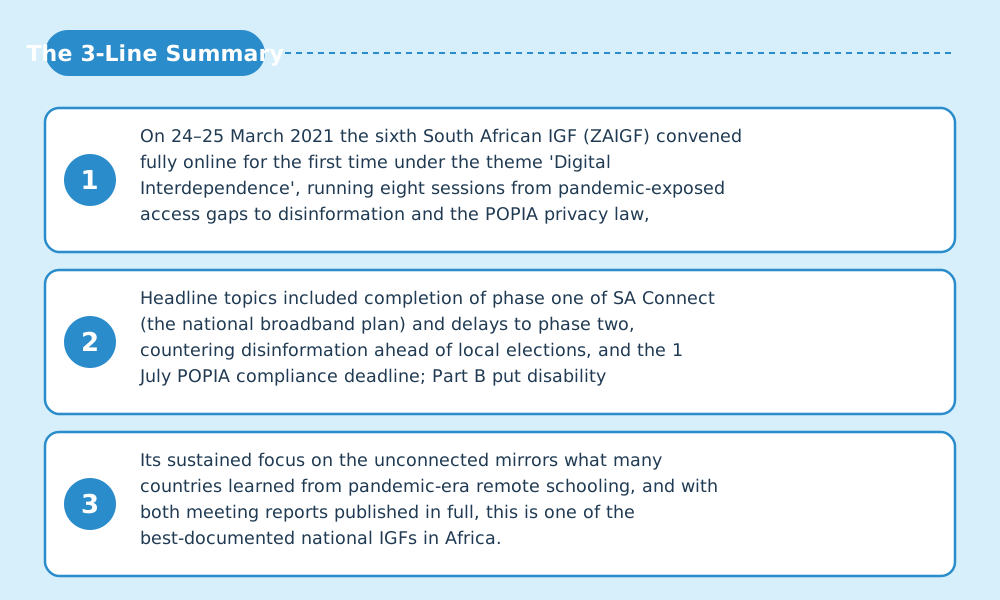
- On 24–25 March 2021 the sixth South African IGF (ZAIGF) convened fully online for the first time under the theme 'Digital Interdependence', running eight sessions from pandemic-exposed access gaps to disinformation and the POPIA privacy law, followed later in the year by a hybrid 'Part B'.
- Headline topics included completion of phase one of SA Connect (the national broadband plan) and delays to phase two, countering disinformation ahead of local elections, and the 1 July POPIA compliance deadline; Part B put disability accessibility and AI bias front and centre.
- Its sustained focus on the unconnected mirrors what many countries learned from pandemic-era remote schooling, and with both meeting reports published in full, this is one of the best-documented national IGFs in Africa.
Welcome — this is the Japan IGF Support Organization. This in-depth report on South African Internet Governance Forum (ZAIGF) 2021 draws on official outputs, session records and on-site reporting. In a hurry? The three lines above and the diagrams carry the gist.
📍 The sixth meeting was fully online; a supplementary 'Part B' followed in hybrid format later in 2021 (its report is dated 22 January 2022 and does not record the exact meeting dates)
Conference at a Glance (from official records)
| Item | Detail |
|---|---|
| Official name | South African Internet Governance Forum (ZAIGF) 2021 |
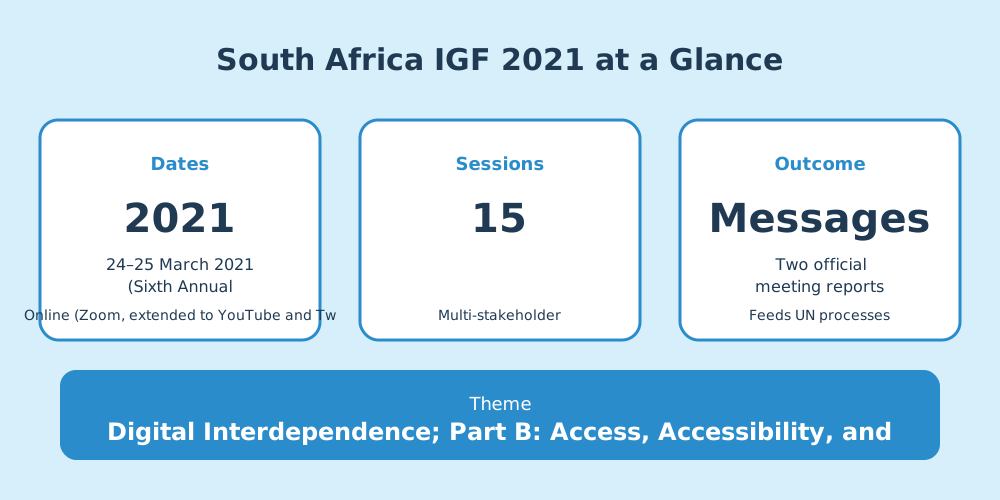
| Dates | 24–25 March 2021 (Sixth Annual Meeting, online) plus Part B in late 2021 (hybrid; exact dates not published) |
| Venue | Online (Zoom, extended to YouTube and Twitter); Part B held in hybrid format |
| Theme | Digital Interdependence; Part B: Access, Accessibility, and Digital Inclusion |
| Sessions | 15 |
| Host | ZAIGF Multi-Stakeholder Committee with ZADNA and the Department of Communications and Digital Technologies (DCDT), in collaboration with ISOC Gauteng and ELIG |
| Outcome | Two official meeting reports (main and Part B) with recommendations; election of a new eight-member Multi-Stakeholder Committee (three-year term) chaired by Adv. Zanyiwe Nthatisi-Asare |
| Note | Sixth Annual Meeting (official count from the 2011 establishment) |
(See the source list at the end of this article.)
Discussion Digest — from the Session Records
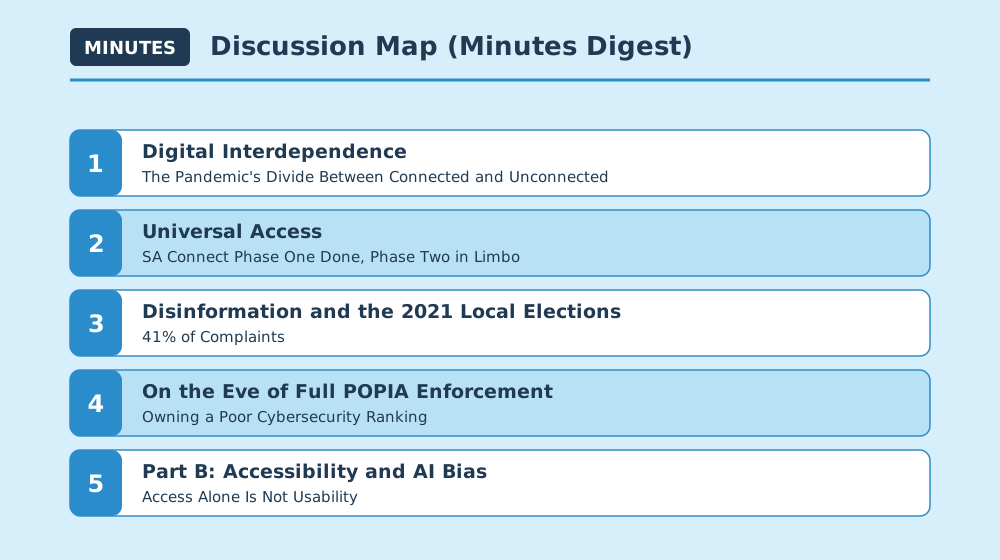
Key exchanges extracted from session records and transcripts.
1. Digital Interdependence — The Pandemic's Divide Between Connected and Unconnected
Sessions: Opening ceremony and keynote by Deputy Minister Pinky Kekana (24 March, 09:00)
- ZADNA CEO Molehe Wesi opened the forum and Deputy Minister Pinky Kekana delivered the keynote, reporting that in the pre-forum consultation the 'inclusion of vulnerable groups, security and trust' won overwhelming support among ten candidate themes [1]
- The 'Digital Interdependence' theme captured the need for government, business and civil society to jointly govern the pandemic-accelerated digital web, positioning the forum as the national dialogue ahead of the global IGF in Katowice that December [1]
- Session 1 concluded that the government's reliance on online learning as the only option under hard lockdown had exposed stark inequality, excluding many rural learners [1]
2. Universal Access — SA Connect Phase One Done, Phase Two in Limbo
Sessions: Session 2, 'Universal access and connecting the unconnected' (24 March, 11:30)
- Phase one of SA Connect — connecting schools, health facilities and government sites in eight rural districts — was completed in January 2021, but phase two remained unstarted pending a DBSA–DCDT feasibility study [1]
- Community networks' obstacles were identified as scarce technical skills and spectrum costs, with TV white space (TVWS) offered as a fee-free route to affordable rural connectivity [1]
- Panellists from ICASA, the DCDT and local wireless ISPs also confirmed provinces may roll out their own broadband, coordinated through forums to avoid duplication [1]
3. Disinformation and the 2021 Local Elections — 41% of Complaints
Sessions: Session 6a, 'Disinformation in the lead up to the 2021 local government elections' (25 March, 11:30)
- Media Monitoring Africa (MMA) reported that 41% of roughly 900 complaints it received were disinformation, and expected the volume to rise ahead of that year's local elections [1]
- The 2019 election pattern — false polling-station addresses and other 'logistics' disinformation — was recalled, AI-manipulated video flagged as a rising threat, and digital-literacy tooling urged for the electoral commission and parties [1]
- Countermeasures showcased included MMA's citizen-reporting '411' initiative and Google's Project Shield for protecting high-profile websites, with media urged to own their fact-checking responsibility [1]
4. On the Eve of Full POPIA Enforcement — Owning a Poor Cybersecurity Ranking
Sessions: Session 7, 'Privacy and protection of personal information' (25 March, 13:45), with Session 6b
- With the POPIA compliance deadline of 1 July 2021 looming, panellists from Digitally Legal, the Information Regulator and the Film and Publications Board took stock — opening with the sobering self-assessment that South Africa ranked 31st worst in the world for cybersecurity [1]
- The companion cybersecurity session (6b) named ransomware the most common attack type — two reported incidents were recovered without paying ransoms — and highlighted that online abuse falls disproportionately on women ('cyber-misogyny') [1]
- Citizens' ignorance of their privacy rights and reporting channels was called the weakest link, prompting calls for joint awareness campaigns by citizens, regulators and industry [1]
5. Part B: Accessibility and AI Bias — Access Alone Is Not Usability
Sessions: Part B Session 1 (rights of persons with disabilities) and Session 2 (AI technologies employed in South Africa)
"AI is a combination of diverse types of technologies that learn and act like humans"
— A representative of the State Information Technology Agency (SITA), as recorded in the official Part B report [2]
- In Part B ('Access, Accessibility, and Digital Inclusion'), Blind SA and the Centre for Human Rights argued that online resources are often accessible yet unusable; assistive braille devices can cost up to R100,000, and over 65% of physically impaired South Africans cannot participate fully in the cyberworld [2]
- The AI session found South Africa has no law governing AI — POPIA section 57(1)'s prior-authorisation rule being the only bias safeguard — and urged home-grown AI tied to local social challenges plus human-rights due diligence before adopting Western-built systems [2]
- Keynoting for the DCDT, acting Deputy Director-General Nonkqubela Jordan-Dyani framed broadband rollout, spectrum licensing and the analogue switch-off as keys to closing the divide, and pressed for greater youth participation in policy dialogue [2]
Three-Minute Short Talk — Your Questions Answered
Q. What made this year special?
A. It was the first fully online edition — and effectively met twice, in March and again for a hybrid 'Part B' later in the year. With both reports published, it's unusually well documented for an African national IGF.
Q. What was the most pressing issue?
A. The pandemic access gap. When online schooling became the only option, rural children without connectivity were simply shut out of learning — a reality that ran beneath every session.
Q. Why should outsiders care?
A. The agenda — enforcing a new privacy law (POPIA), fighting pre-election disinformation, confronting AI bias before regulation exists — mirrors what most democracies were grappling with at the very same moment.
What Is South Africa IGF? (for first-time readers)
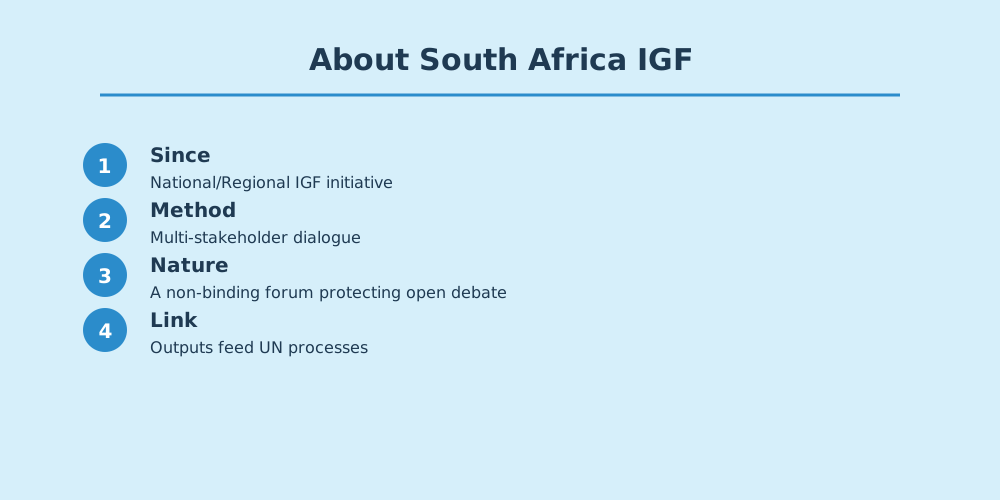
South Africa IGF is a National or Regional IGF Initiative (NRI), aligning local internet governance discussion with global IGF principles.
Why It Matters to You
What was discussed here becomes the baseline for national digital policy, platform rules and AI regulation worldwide within a few years. The principles confirmed at the 2021 meeting are the foundation of the "next rules" for the phones, social platforms and AI services you use every day.
Sources & References
- ZAIGF Sixth Annual Meeting Report "Digital Interdependence" (PDF) — ZAIGF委員会・ZADNA・DCDT (accessed 2026-07-11)
- ZAIGF 2021 Part B Meeting Report "Access, Accessibility, and Digital Inclusion" (PDF) — ZAIGF委員会・ZADNA・DCDT (accessed 2026-07-11)
- ZADNA Annual Report 2020/2021 (PDF) — ZADNA (accessed 2026-07-11)
- South Africa IGF — NRI initiative record — intgovforum.org (accessed 2026-07-11)
- History of ZAIGF — internetgovernance.org.za (accessed 2026-07-11)
Quotes are translated or condensed from the records listed above. Bracketed numbers [n] refer to the source list.
Related links
- IGF official (NRI list): https://www.intgovforum.org/en/content/national-and-regional-igf-initiatives
- Japan IGF: https://japanigf.jp/
- Yuki Nakazawa's blog: https://nkzw.jp/category/igf/
更新履歴
第1稿投稿 2026年7月15日 10時16分(記事コンテンツアップ)
— 中澤祐樹

