


The 3-Line Summary
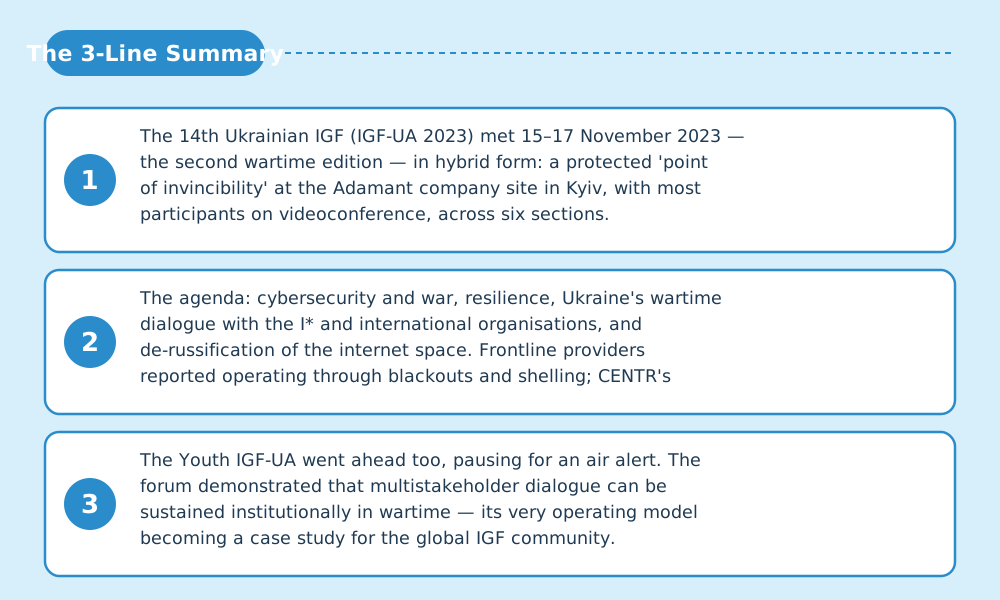
- The 14th Ukrainian IGF (IGF-UA 2023) met 15–17 November 2023 — the second wartime edition — in hybrid form: a protected 'point of invincibility' at the Adamant company site in Kyiv, with most participants on videoconference, across six sections.
- The agenda: cybersecurity and war, resilience, Ukraine's wartime dialogue with the I and international organisations, and de-russification of the internet space. Frontline providers reported operating through blackouts and shelling; CENTR's suspension of the Russian registry's membership was among the developments discussed.*
- The Youth IGF-UA went ahead too, pausing for an air alert. The forum demonstrated that multistakeholder dialogue can be sustained institutionally in wartime — its very operating model becoming a case study for the global IGF community.
Welcome — this is the Japan IGF Support Organization. This in-depth report on IGF-UA 2023 (14th Ukrainian Internet Governance Forum) draws on official outputs, session records and on-site reporting. In a hurry? The three lines above and the diagrams carry the gist.
Conference at a Glance (from official records)
| Item | Detail |
|---|---|
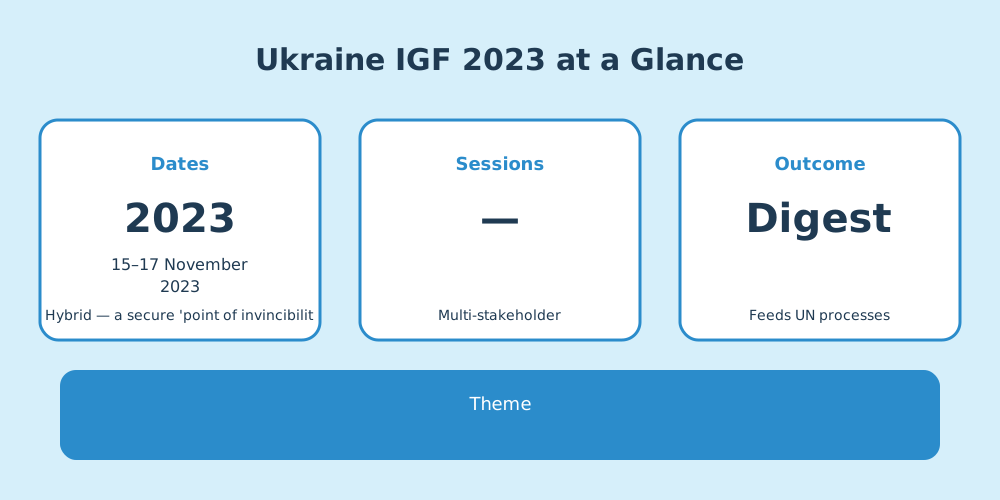
| Official name | IGF-UA 2023 (14th Ukrainian Internet Governance Forum) |
| Edition | 14th edition |
| Dates | 15–17 November 2023 |
| Venue | Hybrid — a secure 'point of invincibility' on the Adamant company site in Kyiv, plus videoconference |
| Theme | Regional governance themes |
| Host | Internet Association of Ukraine (InAU), Commission on Science and IT of the USPP and the NGO European Media Platform, sponsored by RIPE NCC and the Internet Society |
(See the source list at the end of this article.)
Discussion Digest — from the Session Records
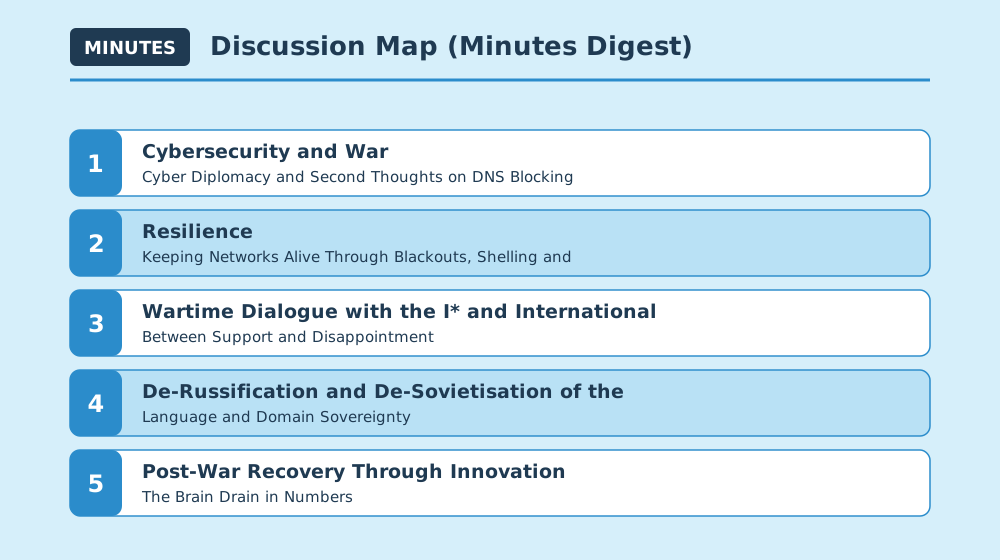
Key exchanges extracted from session records and transcripts.
1. Cybersecurity and War — Cyber Diplomacy and Second Thoughts on DNS Blocking
Sessions: Section 1 'Cybersecurity and War' (mod. Ivan Pietukhov, USPP Commission on Science and IT)
- Cyber diplomacy faces a structural problem, participants noted: relationship-building is undermined on any international platform where Russia — which violates all norms of international law — is present [1]
- The state's use of 'dubious approaches' such as blocking DNS zones and individual resources to defend the information space was criticised, including draft law 8087: Ukraine should not copy the aggressor's methods, but learn from established democracies and act systematically and transparently [1]
- Researchers demonstrated generative-AI applications that rapidly produce asymmetric scenarios for hardening the cyber defence of systems, including critical infrastructure [1]
2. Resilience — Keeping Networks Alive Through Blackouts, Shelling and Mobilisation
Sessions: Section 4 'Resilience' (mod. Olena Kushnir, InAU)
- Frontline and backbone providers laid out their reality: blackouts, mass procurement of uninterruptible power supplies, intensifying missile strikes, problems reserving staff from conscription, curfew passes for repair crews, and mounting cyberattacks [1]
- Subsidies were proposed for frontline providers squeezed between subscriber outflow and rising network-maintenance costs, alongside stronger state engagement in network sustainability [1]
- A voluntary IP-address transfer freeze, coordinated with RIPE NCC, was explained as a mechanism to protect increasingly valuable IP resources from wartime leakage [1]
3. Wartime Dialogue with the I* and International Organisations — Between Support and Disappointment
Sessions: Section 5 'Ukraine's Dialogue with I* and International Organisations in Conditions of War' (mod. Oksana Prykhodko, European Media Platform)
- The section's assessment: all I* and international organisations supported Ukraine after the full-scale aggression, but not all condemned the aggressor. CENTR suspended the membership of Russia's .ru Coordination Center, while in other bodies — ICANN was named — representatives of the aggressor state hold management positions even contrary to statutory documents [1]
- RIPE NCC was credited with the highest level of mutual understanding with the Ukrainian community, and stakeholders were urged to engage actively in the Global Digital Compact and the WSIS+20 review [1]
4. De-Russification and De-Sovietisation of the Internet Space — Language and Domain Sovereignty
Sessions: Section 6 'De-Russification and De-Sovietisation in the Internet Space' (mod. Svitlana Tkachenko, Hostmaster)
- A representative of the State Language Protection Commissioner presented Content Analysis Center research showing a steady strengthening of Ukrainian on social networks and YouTube; the education ombudsman stressed the need for more quality Ukrainian-language content [1]
- Replacing Russian-language names in internet identifiers (domain names) was framed as the other face of de-russification, with the initiator of the domain de-russification movement sharing experience and Latvia's record on expanding state-language use online cited as international reference [1]
- The agreed conclusion: expanding state-language use in both content and identifiers requires systematic, careful work by the state, business and civil society [1]
5. Post-War Recovery Through Innovation — The Brain Drain in Numbers
Sessions: Section 3 'Innovative Development for the Post-War Reconstruction of Ukraine' (mod. Andrii Pazyuk)
- On the knowledge-economy index Ukraine ranked 63rd in 2022, down from 56th in 2012; education fell from 21st to 58th and innovation from 59th to 63rd, while targeted ICT-sector stimulation lifted that sector from 77th to 56th [1][4]
- With up to 8 million people — mostly women and children — having left in 2022 and the population projected at 30 million by 2030, participants warned universities and vocational schools are 'running out of applicants' [1][4]
- The National IP & Innovations Hub being built on UKRNOIVI, and the Ukrainian Cluster Alliance's Manifesto on transition to Industry 5.0, were presented as pillars of innovation-driven recovery [1][4]
Three-Minute Short Talk — Your Questions Answered
Q. How was year two of wartime hosting managed?
A. Hybrid: most joined by videoconference, while the admin team worked offline from a protected 'point of invincibility' at the Adamant site in Kyiv, with power backup and shelter. Automatic Ukrainian-English subtitles debuted.
Q. What was the starkest report?
A. Frontline providers' daily reality — blackouts, missile strikes, staff conscription, repair crews needing curfew passes — and the improvisation that keeps networks running, plus proposed subsidies.
Q. Why should I care?
A. Continuity of communications under disaster or attack is a universal concern, and the CENTR/ICANN debates pose a global question: how should the internet's technical community respond to war?
What Is Ukraine IGF? (for first-time readers)
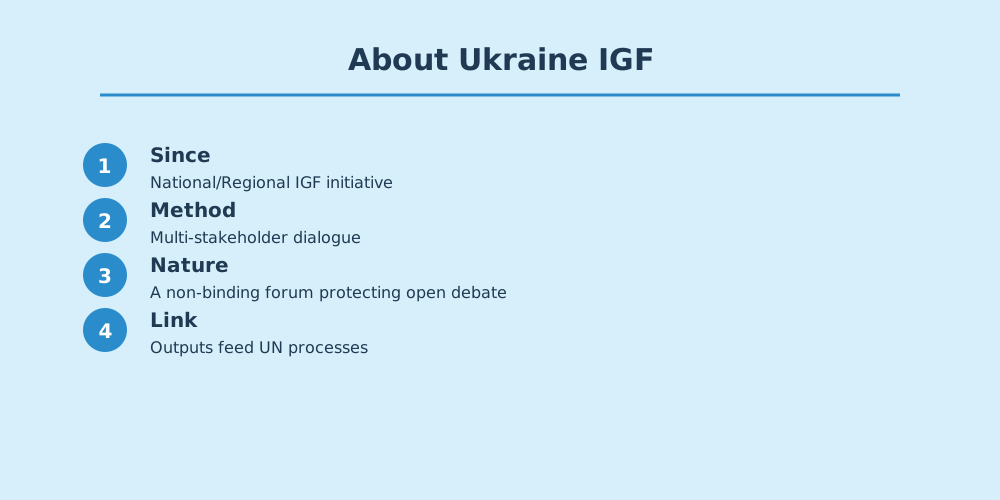
Ukraine IGF is a National or Regional IGF Initiative (NRI), aligning local internet governance discussion with global IGF principles.
Why It Matters to You
What was discussed here becomes the baseline for national digital policy, platform rules and AI regulation worldwide within a few years. The principles confirmed at the 2023 meeting are the foundation of the "next rules" for the phones, social platforms and AI services you use every day.
Sources & References
- Ukrainian IGF-UA 2023 Annual Report(XIV Український форум 公式年次報告書・英語DOCX) — IGF-UA組織委員会 (accessed 2026-07-17)
- IGF-UA 2023 公式アーカイブサイト(14-й Український форум з управління Інтернетом IGF-UA 2023、11月15-17日・キーウ) — IGF-UA組織委員会 (accessed 2026-07-17)
- VI Український молодіжний форум з управління Інтернетом Youth IGF-UA(第6回ユース版の中継動画) — I-UA.tv(メディアパートナー) (accessed 2026-07-17)
- XIV Український форум з управління інтернетом (IGF-UA)(国家知財機関NIPOの参加報告: 国家IP&イノベーションハブの発表) — ウクライナ国家知的財産機関(NIPO) (accessed 2026-07-17)
- IGF-UA 公式報告書一覧(Річний звіт IGF-UA 2023の配布ページ) — IGF-UA組織委員会 (accessed 2026-07-17)
Quotes are translated or condensed from the records listed above. Bracketed numbers [n] refer to the source list.
Related links
- IGF official (NRI list): https://www.intgovforum.org/en/content/national-and-regional-igf-initiatives
- Japan IGF: https://japanigf.jp/
- Yuki Nakazawa's blog: https://nkzw.jp/category/igf/
更新履歴
第1稿投稿 2026年7月17日 20時00分(記事コンテンツアップ)
— 中澤祐樹

