


The 3-Line Summary
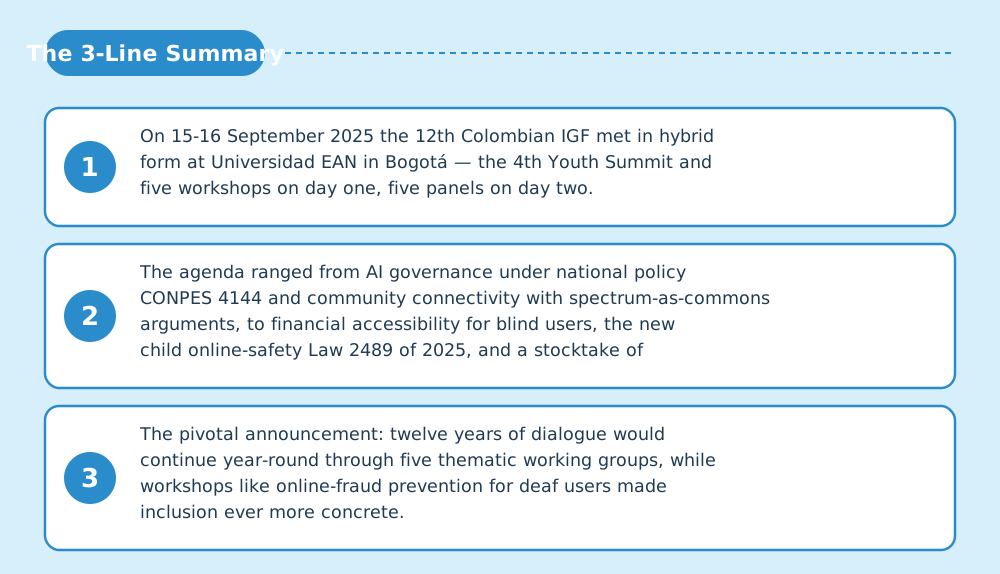
- On 15-16 September 2025 the 12th Colombian IGF met in hybrid form at Universidad EAN in Bogotá — the 4th Youth Summit and five workshops on day one, five panels on day two.
- The agenda ranged from AI governance under national policy CONPES 4144 and community connectivity with spectrum-as-commons arguments, to financial accessibility for blind users, the new child online-safety Law 2489 of 2025, and a stocktake of governance itself — conclusions published as the 'Mensajes' outcome document.
- The pivotal announcement: twelve years of dialogue would continue year-round through five thematic working groups, while workshops like online-fraud prevention for deaf users made inclusion ever more concrete.
Welcome — this is the Japan IGF Support Organization. This in-depth report on 12º Foro Colombiano de Gobernanza de Internet (12th Colombian Internet Governance Forum) draws on official outputs, session records and on-site reporting. In a hurry? The three lines above and the diagrams carry the gist.
Conference at a Glance (from official records)
| Item | Detail |
|---|---|
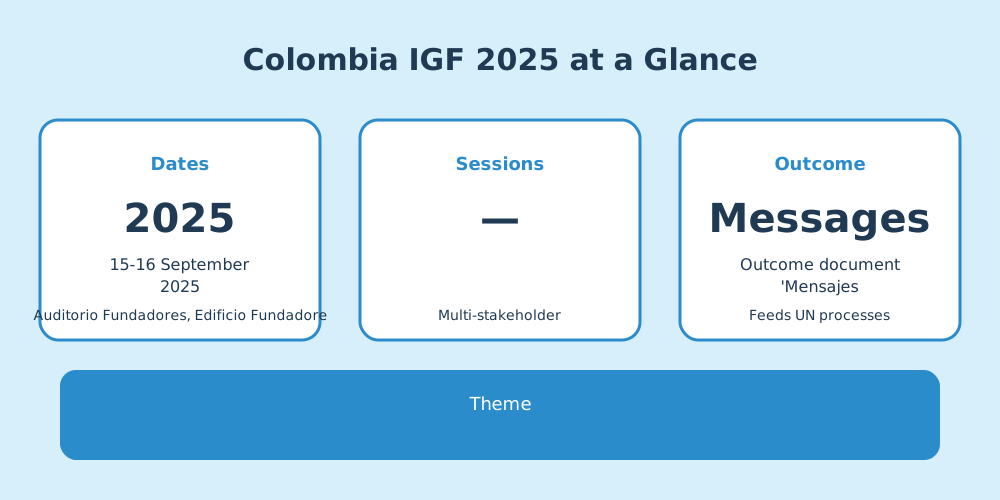
| Official name | 12º Foro Colombiano de Gobernanza de Internet (12th Colombian Internet Governance Forum) |
| Dates | 15-16 September 2025 |
| Venue | Auditorio Fundadores, Edificio Fundadores, Universidad EAN, Carrera 11 # 78-47, Bogotá |
| Theme | Regional governance themes |
| Format | Hybrid (on site plus Zoom and YouTube) |
| Host | Mesa Colombiana de Gobernanza de Internet (forum coordinator: Julián Casasbuenas G., director of Colnodo) |
| Outcome | Outcome document 'Mensajes centrales y conclusiones' of the 12th forum, published as a PDF on the official site |
(See the source list at the end of this article.)
Discussion Digest — from the Session Records
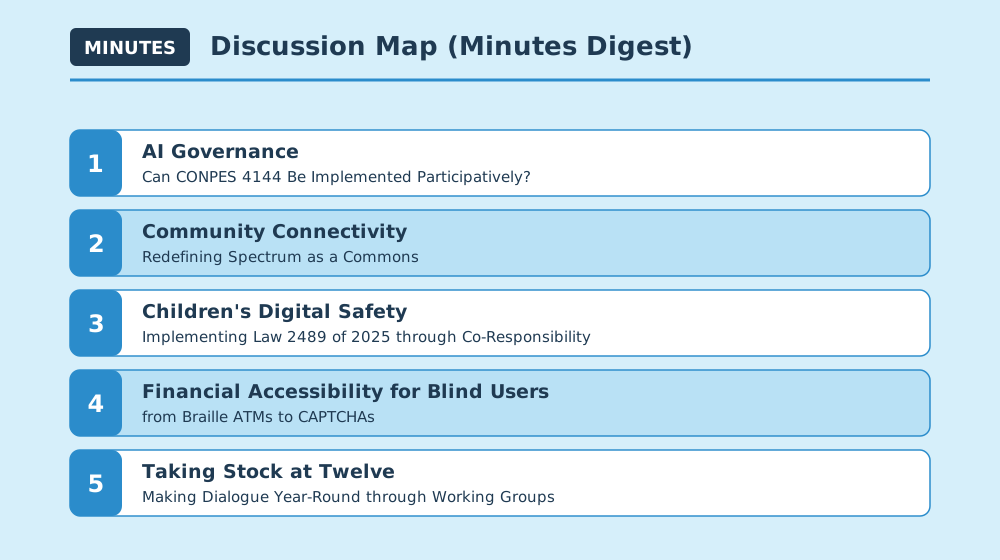
Key exchanges extracted from session records and transcripts.
1. AI Governance — Can CONPES 4144 Be Implemented Participatively?
Sessions: Session 4 'What AI do we want for Colombia?' (16 Sept, moderator: Umut Pájaro Velásquez, president of ISOC Colombia)
- Taking national AI policy CONPES 4144 as the starting point, the outcome document sets the task of building a participatory governance mechanism involving state, business, academia and civil society that learns from international good practice without copying it blindly [1][2]
- Its conclusions: map and capacitate distinct populations first so debate is not left to experts, because public policy without participatory governance loses efficacy and errs [1][2]
- With ALAI's Pablo Nieto and Fundación Corona's Diana Dajer on stage, AI's impact zones were named: democracy (disinformation, funding fraud), health, data protection and copyright [1][2]
2. Community Connectivity — Redefining Spectrum as a Commons
Sessions: Session 2 'Community connectivity in Colombia' (16 Sept, moderator: Olga Paz, Colnodo)
- The outcome document states that spectrum should be understood not just as an economic resource but as a common good generating inclusion and social welfare, with allocation models beyond auctions to be examined [1][2]
- Regulatory advances were confirmed: MinTIC Decree 1079 of 2023 institutionalising fixed community internet (ICF) and CRC Resolution 7712 of 2025 setting differentiated conditions [1][2]
- With a builder of the Indigenous community network Jxa'h Wejxa ('Network of the Wind', Cauca), MinTIC, spectrum agency ANE, Universidad ICESI and Nokia at one table, debate spanned the 900 MHz band, access to the FUTIC fund and energy-inclusive sustainability [1][2]
3. Children's Digital Safety — Implementing Law 2489 of 2025 through Co-Responsibility
Sessions: Session 5 'Safe digital environments' (16 Sept)
- Implementation of Law 2489 of 2025 on children's digital safety led the session, concluding that it must proceed through co-responsibility among state, private sector, civil society and families, balancing innovation with rights protection [1][2]
- Requisites for genuinely safe digital environments were listed: digital literacy as a cross-cutting axis, early-warning systems, recognition of territorial inequalities, and differentiated approaches for disability and diverse cultural contexts [1][2]
- A day-one workshop on online fraud against deaf people grounded the safety agenda in a concrete community [1][2]
4. Financial Accessibility for Blind Users — from Braille ATMs to CAPTCHAs
Sessions: Session 3 'Accessibility for the financial consumer with visual disability' (16 Sept, Digital Wellbeing group)
- Barriers in digital finance were itemised first-hand: inaccessible wallet apps and credit cards, visual-only ATMs, and unempathetic customer service [1][2]
- Recorded recommendations: WCAG 2.1 compliance, labelled buttons, removal of security barriers like CAPTCHAs, tactile card markers, ATMs with braille keypads and flexible timing, and staff training [1][2]
- With speakers including the co-founder of accessible-tech firm CODAC, the session concluded that despite normative advances, universal accessibility remains distant [1][2]
5. Taking Stock at Twelve — Making Dialogue Year-Round through Working Groups
Sessions: Session 1 'Visions and reflections on internet governance in Colombia' (16 Sept, moderator: Adriana Castro, Universidad Externado) and the closing synthesis
- Opening remarks converged on governance existing only as the sum of all stakeholders' wills, with tasks named in the outcome document: wider territorial participation, youth and gender perspectives, and recognition of organised communities [1][2][3]
- Five year-round working groups were announced — meaningful access, safe digital environments, embedding governance, AI, disinformation — moving dialogue beyond one-off events [1][2][3]
- With founding-era figures such as .CO's Eduardo Santoyo and Karisma's Pilar Sáenz on stage, the recorded conclusions demanded broad participatory debate before internet legislation and transparency from every participating actor about its motivations [1][2][3]
Three-Minute Short Talk — Your Questions Answered
Q. What did it decide?
A. Nothing binding — but conclusions were published as the 'Mensajes' outcome document, and five standing working groups (AI, disinformation, meaningful access, safe digital environments, embedding governance) turned an annual event into year-round dialogue.
Q. What was the most striking debate?
A. Spectrum as a commons: a builder of the Indigenous-run 'Network of the Wind' sat with the regulator and Nokia to discuss non-auction spectrum allocation and the 900 MHz band.
Q. Why should I care?
A. Child online-safety law and accessible digital finance are on legislative agendas worldwide; the practice of putting affected communities on stage and recording conclusions in an outcome document travels well.
What Is Colombia IGF? (for first-time readers)
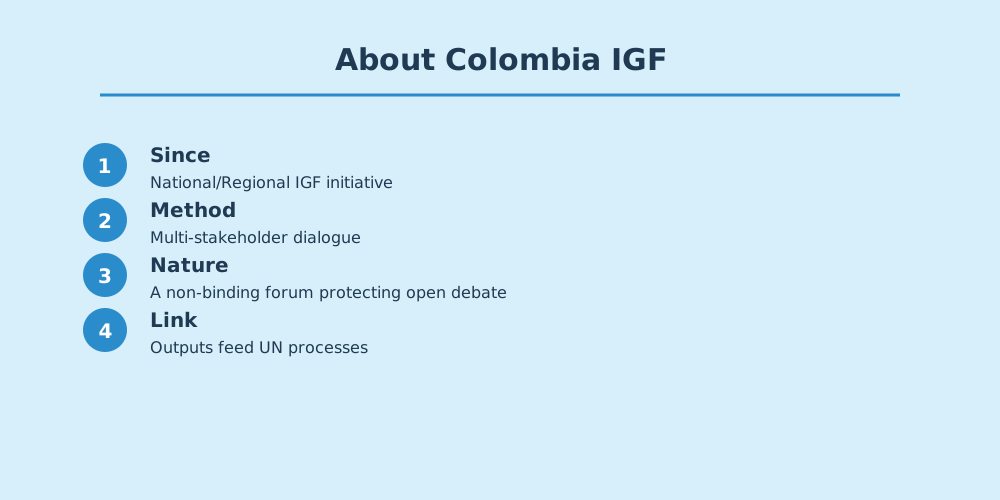
Colombia IGF is a National or Regional IGF Initiative (NRI), aligning local internet governance discussion with global IGF principles.
Why It Matters to You
What was discussed here becomes the baseline for national digital policy, platform rules and AI regulation worldwide within a few years. The principles confirmed at the 2025 meeting are the foundation of the "next rules" for the phones, social platforms and AI services you use every day.
Sources & References
- Mensajes centrales y conclusiones del 12 Foro Colombiano de Gobernanza de Internet(成果文書PDF: 全5セッションの登壇者・結論) — gobernanzadeinternet.co (accessed 2026-07-22)
- Mensajes del Foro Colombiano de Gobernanza de Internet 2025(成果文書の公式掲載ページ) — gobernanzadeinternet.co (accessed 2026-07-22)
- Foro de Gobernanza 2025 — Acerca del 12º Foro Colombiano de Gobernanza de Internet(会期前公式サイト: 会場・日程・テーマ・Youthサミット・タラー) — Mesa Colombiana de Gobernanza de Internet(Wayback Machine 2025年9月4日スナップショット) (accessed 2026-07-22)
- Foros anteriores(第XII回=2025年9月15-16日・Universidad EANの記録) — gobernanzadeinternet.co (accessed 2026-07-22)
- Mesa Colombiana de Gobernanza de Internet(2025年第12回のEAN大学開催・コーディネーターJulián Casasbuenas・NRI公認の記録) — Colnodo(Wayback Machineアーカイブ) (accessed 2026-07-22)
Quotes are translated or condensed from the records listed above. Bracketed numbers [n] refer to the source list.
Related links
- IGF official (NRI list): https://www.intgovforum.org/en/content/national-and-regional-igf-initiatives
- Japan IGF: https://japanigf.jp/
- Yuki Nakazawa's blog: https://nkzw.jp/category/igf/
更新履歴
第1稿投稿 2026年7月10日 10時41分(記事コンテンツアップ)
— 中澤祐樹

