


The 3-Line Summary
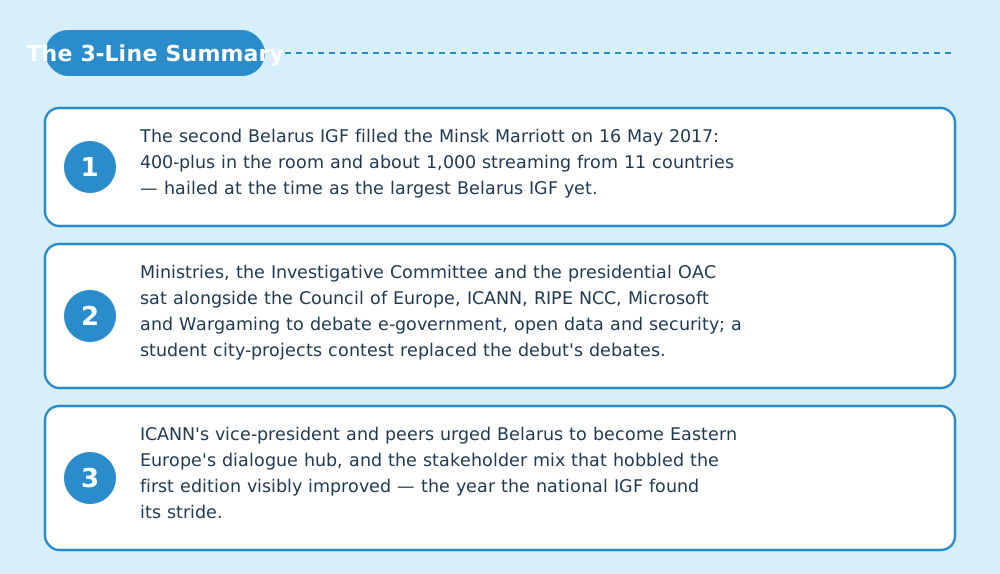
- The second Belarus IGF filled the Minsk Marriott on 16 May 2017: 400-plus in the room and about 1,000 streaming from 11 countries — hailed at the time as the largest Belarus IGF yet.
- Ministries, the Investigative Committee and the presidential OAC sat alongside the Council of Europe, ICANN, RIPE NCC, Microsoft and Wargaming to debate e-government, open data and security; a student city-projects contest replaced the debut's debates.
- ICANN's vice-president and peers urged Belarus to become Eastern Europe's dialogue hub, and the stakeholder mix that hobbled the first edition visibly improved — the year the national IGF found its stride.
Welcome — this is the Japan IGF Support Organization. This in-depth report on Belarus IGF 2017 — the 2nd Belarus Internet Governance Forum draws on official outputs, session records and on-site reporting. In a hurry? The three lines above and the diagrams carry the gist.
Conference at a Glance (from official records)
| Item | Detail |
|---|---|
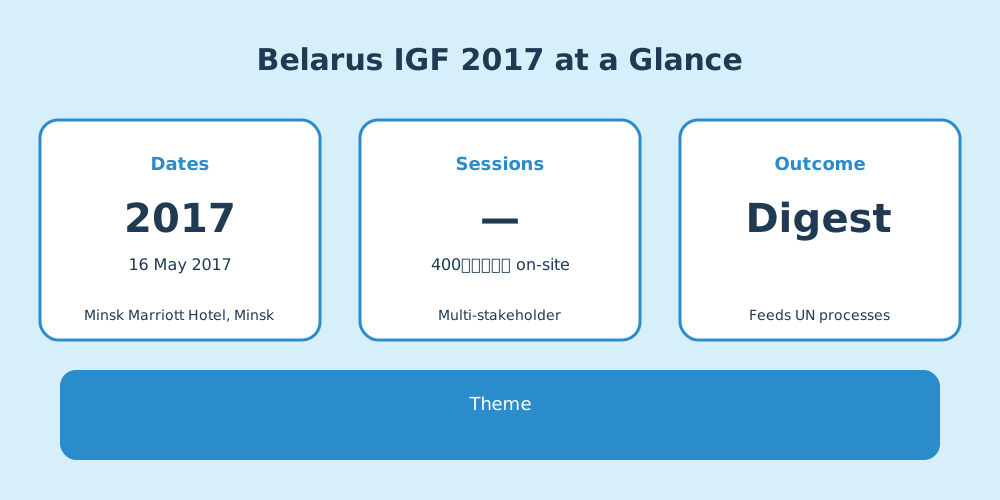
| Official name | Belarus IGF 2017 — the 2nd Belarus Internet Governance Forum |
| Edition | Second edition |
| Dates | 16 May 2017 |
| Venue | Minsk Marriott Hotel, Minsk |
| Theme | Regional governance themes |
| Participants | Over 400 in-person participants; about 1,000 watched the livestream from Belarus and 11 other countries |
| Host | Organised by hoster.by; participants included the Ministry of Communications, the Investigative Committee, the presidential Operations and Analysis Centre (OAC), the Council of Europe, ICANN and RIPE NCC |
(See the source list at the end of this article.)
Discussion Digest — from the Session Records
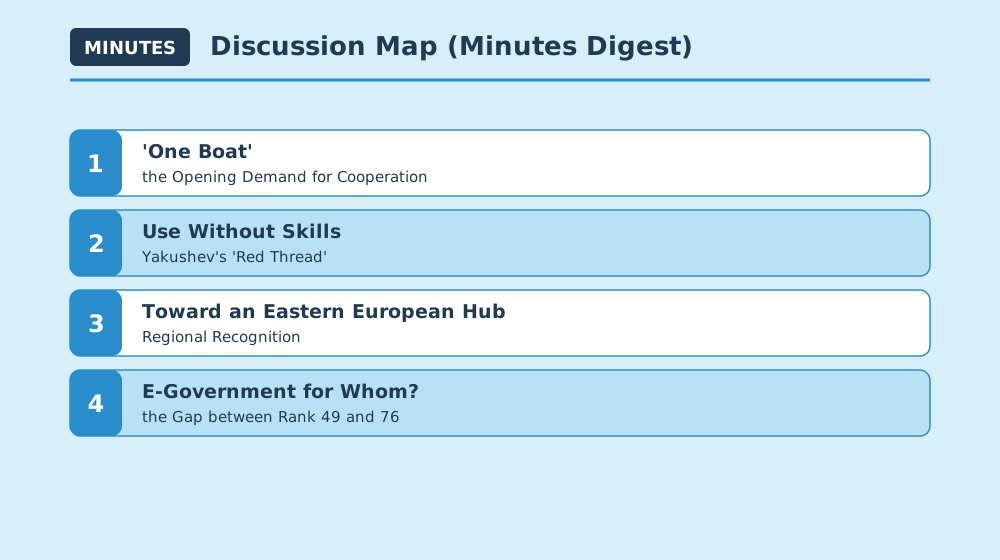
Key exchanges extracted from session records and transcripts.
1. 'One Boat' — the Opening Demand for Cooperation
Sessions: Opening session, 16 May 2017
"I call on colleagues from business and the non-profit sector, and from the state, not to look down on each other. For better or worse, we are all in one boat. If each stakeholder rows in their own direction without coordinating with the rest, at best the boat stands still — at worst it simply sinks (translated from Russian)"
— Sergey Povalishev, director of hoster.by and forum organiser [1]
- The forum's mission was spelled out: establish dialogue among all internet-industry actors and start processes that will shape the net's development for years [1]
- The breadth was striking — the Communications Ministry, Investigative Committee, presidential OAC, Council of Europe, ICANN, RIPE NCC, Beltelecom, Microsoft, Wargaming, Artezio, SecDev Group, and the ccTLD administrators of Russia, Ukraine and Armenia [1]
2. Use Without Skills — Yakushev's 'Red Thread'
Sessions: Plenary discussions
"The use of the internet requires skills (translated from Russian; as headlined in the official wrap-up)"
— Mikhail Yakushev, ICANN Vice-President [1]
- One thread ran through the day: most people who work at computers daily cannot really use the internet and know almost nothing about security [1]
- The second thread: social relations and regulation form far more slowly than the internet develops. Business should be the locomotive of reform, the state its conductor, society the one specifying what it needs [1]
- The wrap-up also recorded criticism of authorities measuring internet-security performance by the number of blocked sites [1]
3. Toward an Eastern European Hub — Regional Recognition
Sessions: International and youth-focused segments
- Experts including Yakushev and APTLD's Leonid Todorov praised the forum's level and urged Belarus to become the mouthpiece of the whole Eastern European region; speakers came from eight countries, from Russia and Ukraine to the Netherlands and Canada [1][3]
- Russian ccTLD chief Andrey Vorobyev noted the forum had anticipated the global youth trend — student debates in 2016, and in 2017 a city-projects contest won by an IoT/Big Data interactive-box concept [1][3]
- At the open-data roundtable, even government participants frankly acknowledged fragmented inter-agency work [1][3]
4. E-Government for Whom? — the Gap between Rank 49 and 76
Sessions: E-government roundtable, moderated by Marina Sokolova
- Belarus ranked 49th of 193 on the UN e-government index but only 76th on e-participation — the gap framing the debate: the state goes online, but its model of engaging citizens does not change [2]
- Moderator Marina Sokolova (Baltic Internet Policy Initiative/BIPART, IGF MAG member) invoked the World Bank's Digital Dividends finding that the internet reinforces existing state-citizen relations rather than transforming them [2]
- Povalishev framed the goal as turning e-government from serving internal agency needs toward citizens' needs — through discussion, not criticism of what had been built [2]
Three-Minute Short Talk — Your Questions Answered
Q. What kind of meeting was this?
A. The second Belarus IGF: 400-plus people at the Minsk Marriott, nearly 1,000 streaming from 11 countries — with ministries and investigators in the same room as ICANN, RIPE NCC and Microsoft.
Q. What was the biggest issue?
A. Who e-government is for. Belarus's rank of 49 on e-government but 76 on e-participation crystallised the debate: digitising the state without changing how it treats citizens.
Q. Why should I care?
A. That e-participation gap is universal — every digitising government faces it — and the forum shows a multistakeholder dialogue running even under an authoritarian system.
What Is Belarus IGF? (for first-time readers)
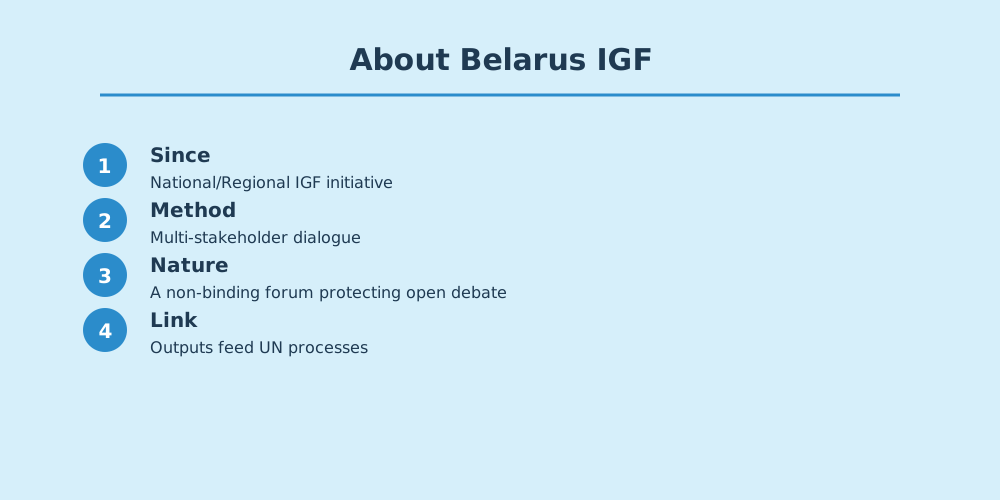
Belarus IGF is a National or Regional IGF Initiative (NRI), aligning local internet governance discussion with global IGF principles.
Why It Matters to You
What was discussed here becomes the baseline for national digital policy, platform rules and AI regulation worldwide within a few years. The principles confirmed at the 2017 meeting are the foundation of the "next rules" for the phones, social platforms and AI services you use every day.
Sources & References
- Итоги самого масштабного Belarus IGF в цифрах, фактах и цитатах(公式総括記事、2017-05-19付。Wayback保存) — Belarus IGF(igf.by、Internet Archive経由) (accessed 2026-07-23)
- Электронное правительство — для государства или для людей?(電子政府円卓会議の公式解説記事、2017-05-03付。Wayback保存) — Belarus IGF(igf.by、Internet Archive経由) (accessed 2026-07-23)
- Belarus IGF(国別レポート: 第2回でステークホルダー代表性が改善) — APC (accessed 2026-07-23)
- Belarus IGF 英語版サイト(2018年版トップ: 「Read the report of Belarus IGF 2017」リンク。Wayback保存) — Belarus IGF(igf.by、Internet Archive経由) (accessed 2026-07-23)
Quotes are translated or condensed from the records listed above. Bracketed numbers [n] refer to the source list.
Related links
- IGF official (NRI list): https://www.intgovforum.org/en/content/national-and-regional-igf-initiatives
- Japan IGF: https://japanigf.jp/
- Yuki Nakazawa's blog: https://nkzw.jp/category/igf/
更新履歴
第1稿投稿 2026年8月1日 15時09分(記事コンテンツアップ)
— 中澤祐樹

