


The 3-Line Summary
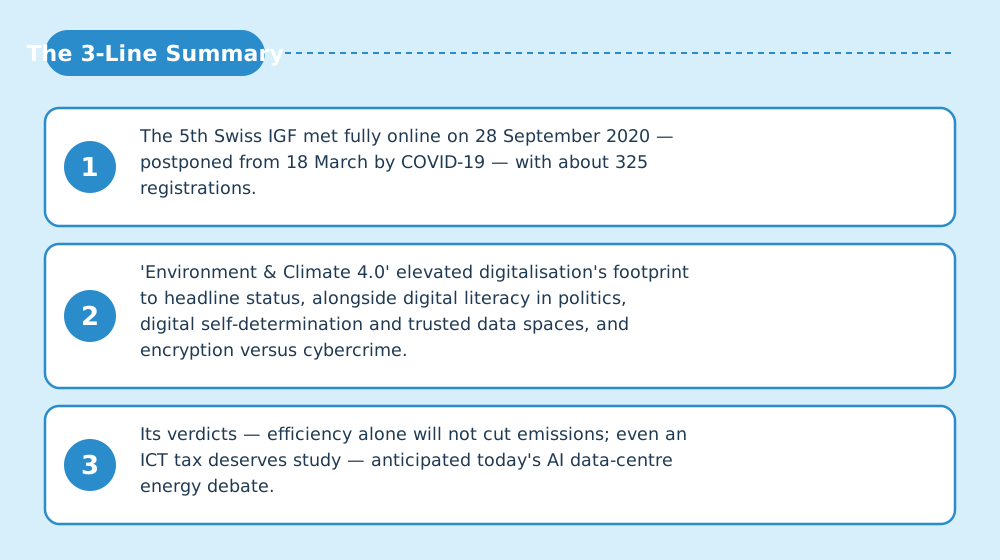
- The 5th Swiss IGF met fully online on 28 September 2020 — postponed from 18 March by COVID-19 — with about 325 registrations.
- 'Environment & Climate 4.0' elevated digitalisation's footprint to headline status, alongside digital literacy in politics, digital self-determination and trusted data spaces, and encryption versus cybercrime.
- Its verdicts — efficiency alone will not cut emissions; even an ICT tax deserves study — anticipated today's AI data-centre energy debate.
Welcome — this is the Japan IGF Support Organization. This in-depth report on Swiss IGF 2020 (5th Swiss Internet Governance Forum) draws on official outputs, session records and on-site reporting. In a hurry? The three lines above and the diagrams carry the gist.
📍 Originally planned for 18 March 2020 at Welle 7, Bern; postponed due to COVID-19 and held fully online on 28 September
Conference at a Glance (from official records)
| Item | Detail |
|---|---|
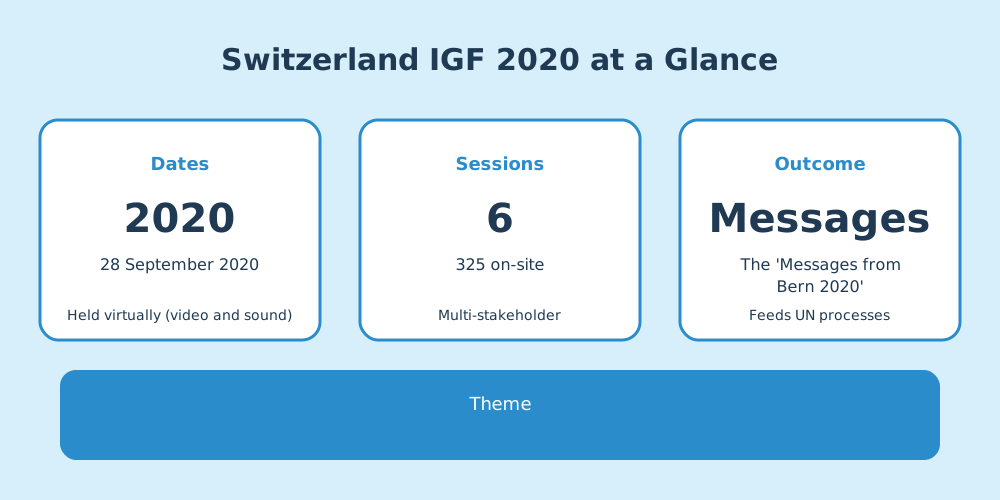
| Official name | Swiss IGF 2020 (5th Swiss Internet Governance Forum) |
| Dates | 28 September 2020 |
| Venue | Held virtually (video and sound) |
| Theme | Regional governance themes |
| Participants | 325 (The official site records about 325 enrolments within the registration period) |
| Sessions | 6 (Three plenaries and three workshops) |
| Host | Multistakeholder steering group under OFCOM patronage |
| Outcome | The 'Messages from Bern 2020', submitted to the UN IGF and EuroDIG; compiled by Olivier MJ Crépin-Leblond, Andrin Eichin and Dominique Keller |
(See the source list at the end of this article.)
Discussion Digest — from the Session Records
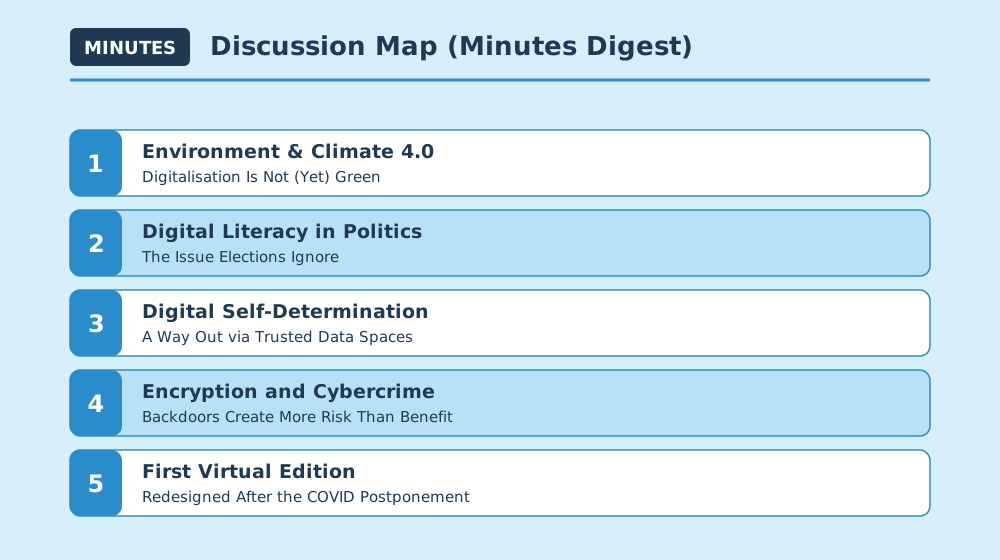
Key exchanges extracted from session records and transcripts.
1. Environment & Climate 4.0 — Digitalisation Is Not (Yet) Green
Sessions: Plenary 1 'Environment & Climate 4.0'
- Digitalisation's environmental effects were framed in three levels — direct device impact, ICT-enabled eco-efficiency, and behavioural feedback — with the blunt verdict that 'so far, digitisation has had a negative impact' [1]
- Energy may simply be too cheap: with Switzerland introducing a CO2 tax on airline tickets, participants asked whether an ICT tax should be studied too [1]
- Options ranged from carbon-neutral data centres to energy labels for phones and curbing data-volume growth — but the circular economy alone will not suffice; consumption itself must fall [1]
2. Digital Literacy in Politics — The Issue Elections Ignore
Sessions: Plenary 2 'Awareness, skills and ideas in politics and administration'
- Digitalisation barely featured in the 2019 federal election campaign; only a quarter of candidates joined a digital-affinity study (Greens and Green Liberals leading at 30% each), and parties lack clear positions [1]
- Not everyone can be an expert, but Parliament needs training — and terms and principles must be explained in language accessible to non-experts [1]
- Administration should be courageous and open to experimentation: ideas bottom-up, funding top-down (a 'digital fund' via cantons and municipalities), and direct democracy improved with digital decision-making [1]
3. Digital Self-Determination — A Way Out via Trusted Data Spaces
Sessions: Plenary 3 'Self-determination in the digital space'
- With data concentration challenging basic values, a project on digital self-determination and trusted data spaces was presented as a way out of the trade-off between protecting fundamental rights and innovative data use [1]
- Is 'self-determination over personal information' globally scalable — or should focus shift to concrete harms of data processing, such as discrimination? [1]
- The paradox of rising mistrust of profiling coexisting with unawareness of one's own data disclosure was emphasised; strengthening local and regional data spaces and quality labels were discussed [1]
4. Encryption and Cybercrime — Backdoors Create More Risk Than Benefit
Sessions: Workshop 3 'Cybersecurity & cybercrime: global challenges – local solutions?'
- The message was unambiguous: encryption is essential for security, and every attempt to weaken it or build in backdoors creates more risks than benefits [1]
- Cybercrime is heavily underreported — reporting must become easier, victims deserve feedback on investigations, and security firms can reveal the true extent of the many smaller cases [1]
- Education is key to prevention and security — also for the next 3.5 billion users coming online in the coming years [1]
5. First Virtual Edition — Redesigned After the COVID Postponement
Sessions: Meeting logistics
- Planned for 18 March at Welle 7, the meeting was postponed by COVID-19 and held online on 28 September, including workshops on platform regulation and 'Libraries 4.0' (e-book access, Web Archive Switzerland) [2][1]
- About 325 registrations marked a big widening of participation compared with the ~80 in-person attendees of the early editions [2][1]
Three-Minute Short Talk — Your Questions Answered
Q. What did it decide?
A. Nothing binding — the 'Messages from Bern 2020' went to the UN IGF and EuroDIG, headlined by digitalisation's environmental footprint.
Q. Most contentious point?
A. Climate measures versus incentives — up to and including the idea of taxing ICT like air travel.
Q. Why care?
A. The rebound-effect warning — efficiency gains get eaten by growing consumption — predicted the AI data-centre energy debate five years early.
What Is Switzerland IGF? (for first-time readers)
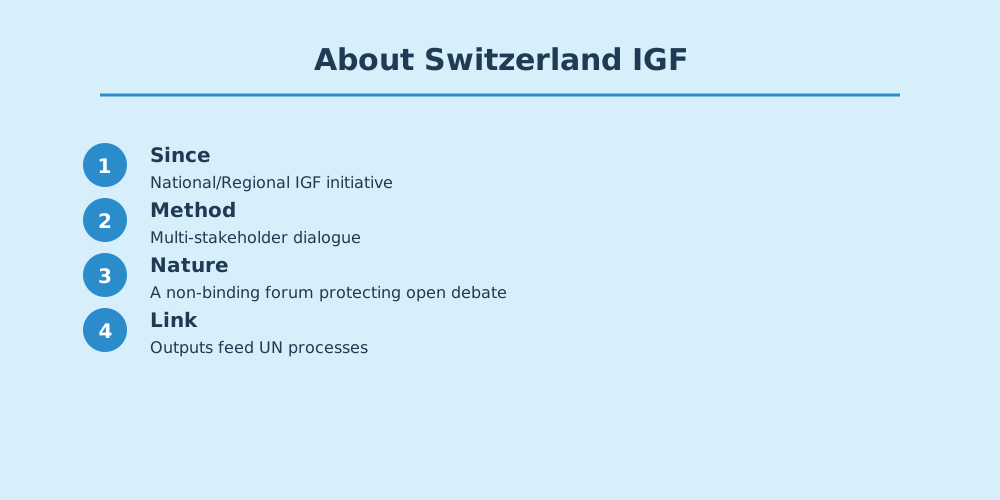
Switzerland IGF is a National or Regional IGF Initiative (NRI), aligning local internet governance discussion with global IGF principles.
Why It Matters to You
What was discussed here becomes the baseline for national digital policy, platform rules and AI regulation worldwide within a few years. The principles confirmed at the 2020 meeting are the foundation of the "next rules" for the phones, social platforms and AI services you use every day.
Sources & References
- Messages from Bern (Swiss IGF 2020) — Swiss IGF (accessed 2026-07-23)
- Swiss IGF 2020(大会ページ、延期経緯と登録者数) — igf.swiss (accessed 2026-07-23)
- About the Swiss IGF — igf.swiss (accessed 2026-07-23)
- National IGFs — Western European and Others Regional Group (WEOG) — 国連IGF事務局(Waybackアーカイブ) (accessed 2026-07-23)
Quotes are translated or condensed from the records listed above. Bracketed numbers [n] refer to the source list.
Related links
- IGF official (NRI list): https://www.intgovforum.org/en/content/national-and-regional-igf-initiatives
- Japan IGF: https://japanigf.jp/
- Yuki Nakazawa's blog: https://nkzw.jp/category/igf/
更新履歴
第1稿投稿 2026年8月10日 11時57分(記事コンテンツアップ)
— 中澤祐樹

