


The 3-Line Summary
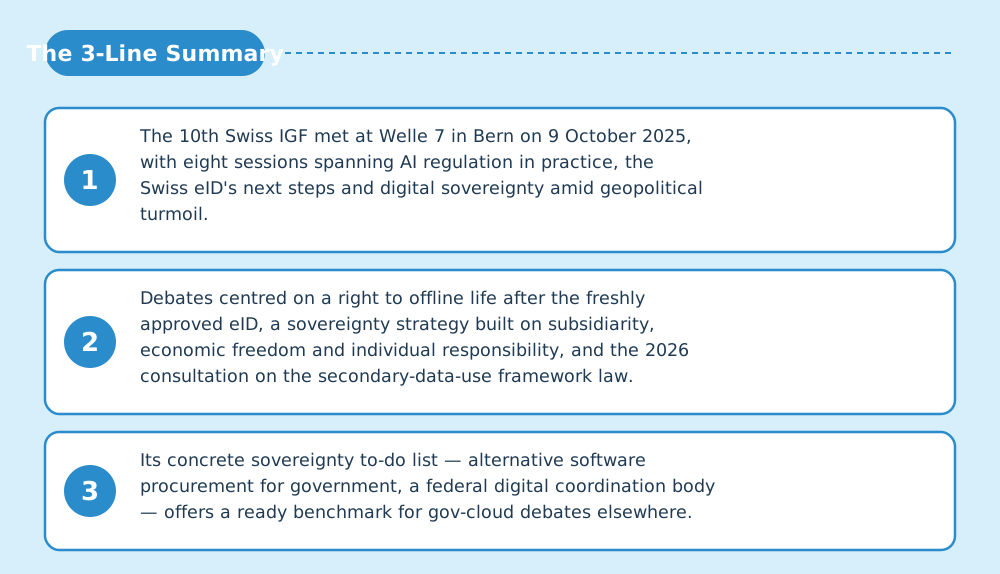
- The 10th Swiss IGF met at Welle 7 in Bern on 9 October 2025, with eight sessions spanning AI regulation in practice, the Swiss eID's next steps and digital sovereignty amid geopolitical turmoil.
- Debates centred on a right to offline life after the freshly approved eID, a sovereignty strategy built on subsidiarity, economic freedom and individual responsibility, and the 2026 consultation on the secondary-data-use framework law.
- Its concrete sovereignty to-do list — alternative software procurement for government, a federal digital coordination body — offers a ready benchmark for gov-cloud debates elsewhere.
Welcome — this is the Japan IGF Support Organization. This in-depth report on Swiss IGF 2025 (10th Swiss Internet Governance Forum) draws on official outputs, session records and on-site reporting. In a hurry? The three lines above and the diagrams carry the gist.
Conference at a Glance (from official records)
| Item | Detail |
|---|---|
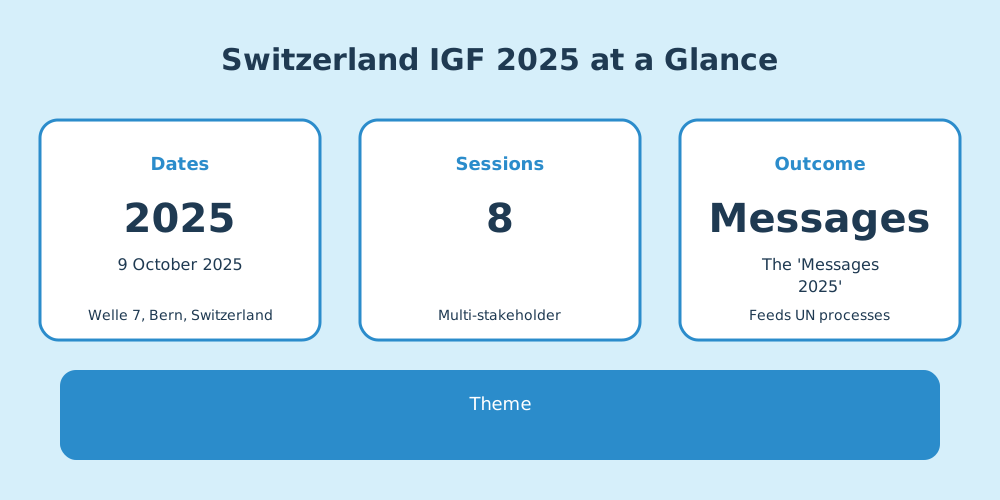
| Official name | Swiss IGF 2025 (10th Swiss Internet Governance Forum) |
| Dates | 9 October 2025 |
| Venue | Welle 7, Bern, Switzerland |
| Theme | Regional governance themes |
| Sessions | 8 (Eight sessions: AI regulation in practice, child protection, the Swiss eID, digital democracy, digital sovereignty, code/copyright/competence, data governance, and inclusive AI transformation) |
| Host | Managed by the Swiss Internet & Digital Governance association (SIDG) under OFCOM patronage |
| Outcome | The 'Messages 2025', published in German, French and English, feeding into the UN IGF and EuroDIG |
| Note | The 10th edition since 2015; moved from the usual June slot to October |
(See the source list at the end of this article.)
Discussion Digest — from the Session Records
Key exchanges extracted from session records and transcripts.
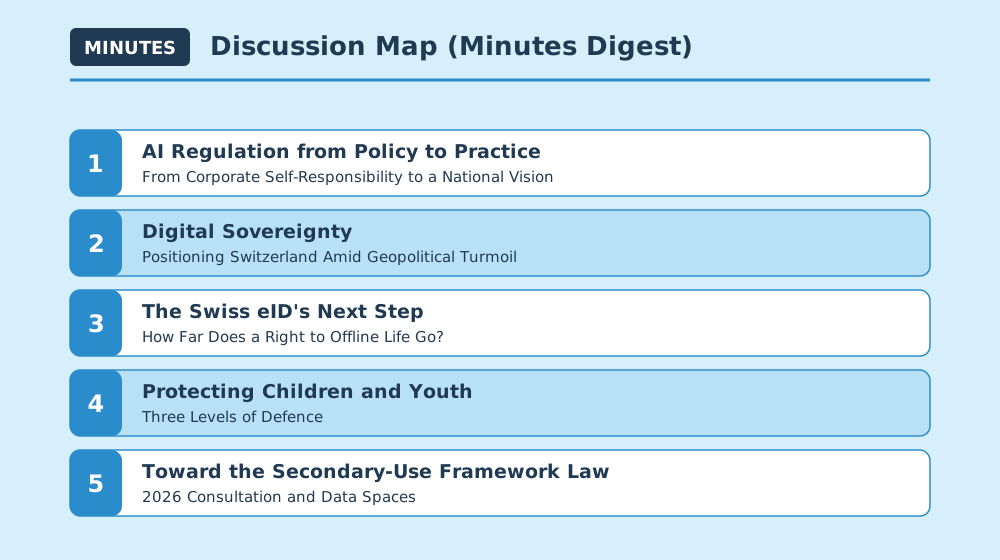
1. AI Regulation from Policy to Practice — From Corporate Self-Responsibility to a National Vision
Sessions: Session 1 'From Policy to Practice: Can AI Regulation Align Competitiveness with Responsible AI Adoption?'
- AI has established itself as a permanent component of society; appropriate regulation is needed to create legal certainty for public and private sectors alike — the status quo relies heavily on corporate self-responsibility [1]
- A more comprehensive national vision is needed; Switzerland has the potential to assume a pioneering role [1]
- AI regulation should contain provisions promoting AI literacy — for citizens and, no less, policy competence among decision-makers, with comprehensive continuing education for all relevant actors [1]
2. Digital Sovereignty — Positioning Switzerland Amid Geopolitical Turmoil
Sessions: Session 5 'Digital sovereignty in geopolitical turmoil: How should Switzerland position itself?'
- Two developments raise sovereignty's stakes: changes in the international order and AI-sharpened global competition; digitally connected Switzerland has profited greatly, but digital dependencies are becoming security-policy challenges [1]
- Switzerland's sovereignty strategy under development rests on three core values: subsidiarity, economic freedom and individual responsibility [1]
- Timely action is required: procuring alternative software for the administration, examining cooperation with European initiatives, and establishing a federal coordinating body for digital affairs [1]
3. The Swiss eID's Next Step — How Far Does a Right to Offline Life Go?
Sessions: Session 3 'Swiss eID, what's next?'
- The eID's technical implementation demonstrates Swiss competence, but raises strategic questions — including where and to what extent a right to offline presence and alternative access options should exist [1]
- The participatory approach chosen for the eID's development proved valuable and should model future processes, with better communication from the citizens' perspective [1]
- Trust in state digital solutions must be strengthened proactively; overarching principles ensuring coherence between different pieces of legislation should be prioritised [1]
4. Protecting Children and Youth — Three Levels of Defence
Sessions: Session 2 'Child and youth protection'
- The digital world brings children both risks (profiling, tracking, security flaws) and opportunities (innovative education, participation); minors' digital footprints — including data shared by guardians — pose particular challenges, and responsibility cannot rest on often-overwhelmed guardians alone [1]
- Effective protection requires equal work on three levels: privacy by design from the procurement of learning apps (technical), child-centred processes in schools, platforms and authorities (institutional), and digitally competent guardians and teachers (societal) [1]
- The best interests of the child must be established as the supreme principle of action in the digital space [1]
5. Toward the Secondary-Use Framework Law — 2026 Consultation and Data Spaces
Sessions: Session 7 'Data, data protection and data governance'
- The Federal Council will open consultation on a framework law for the secondary use of data in 2026 and has made it the focus of its digitalisation goals for that year [1]
- The discussion must proceed at various levels with different stakeholders, respecting differences between data categories in fundamental-rights protection, innovation and economic interests [1]
- Trustworthy data spaces are needed to make informational self-determination practical; secondary use should serve both individual and economic benefit [1]
Three-Minute Short Talk — Your Questions Answered
Q. What did it decide?
A. Nothing binding — eight sessions were distilled into the trilingual 'Messages 2025' for the UN IGF and EuroDIG. It was the 10th edition since 2015.
Q. Biggest issue?
A. The right to offline life after the eID's approval — the more digital the state, the more seriously the analogue option must be protected.
Q. Why care?
A. The sovereignty to-do list — alternative software for government, a federal digital coordination body — mirrors gov-cloud sovereignty debates in many countries.
What Is Switzerland IGF? (for first-time readers)
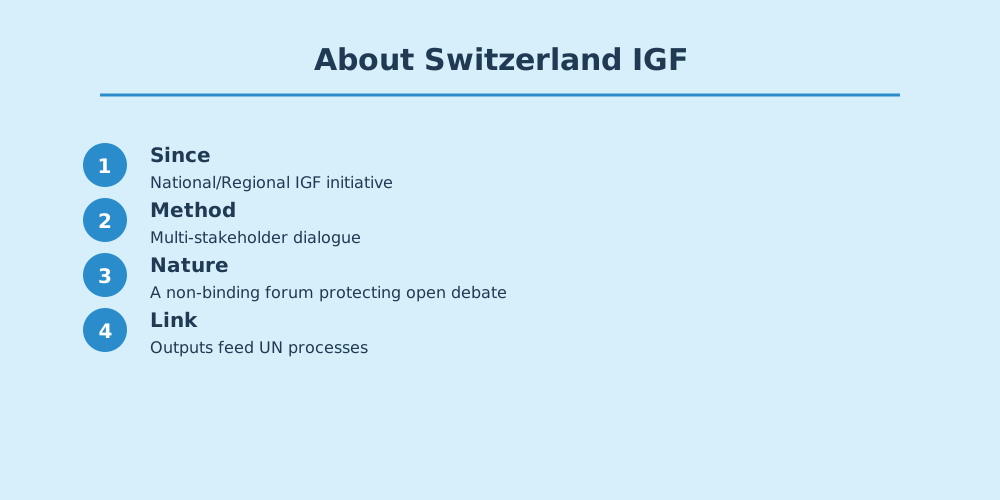
Switzerland IGF is a National or Regional IGF Initiative (NRI), aligning local internet governance discussion with global IGF principles.
Why It Matters to You
What was discussed here becomes the baseline for national digital policy, platform rules and AI regulation worldwide within a few years. The principles confirmed at the 2025 meeting are the foundation of the "next rules" for the phones, social platforms and AI services you use every day.
Sources & References
- Messages Swiss IGF 2025(独・仏・英) — Swiss IGF (accessed 2026-07-23)
- Swiss IGF 2025(大会ページ) — igf.swiss (accessed 2026-07-23)
- About the Swiss IGF — igf.swiss (accessed 2026-07-23)
- National IGFs — WEOG(Swiss IGF年次会合「9 October 2025, Bern」の記録) — 国連IGF事務局(Waybackアーカイブ) (accessed 2026-07-23)
Quotes are translated or condensed from the records listed above. Bracketed numbers [n] refer to the source list.
Related links
- IGF official (NRI list): https://www.intgovforum.org/en/content/national-and-regional-igf-initiatives
- Japan IGF: https://japanigf.jp/
- Yuki Nakazawa's blog: https://nkzw.jp/category/igf/
更新履歴
第1稿投稿 2026年8月7日 13時45分(記事コンテンツアップ)
— 中澤祐樹

