


The 3-Line Summary
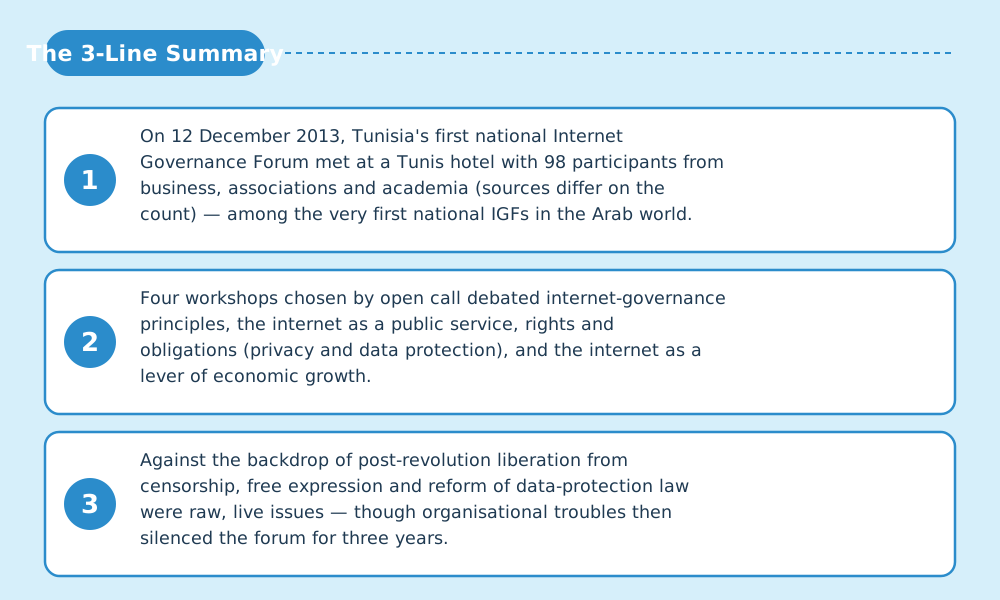
- On 12 December 2013, Tunisia's first national Internet Governance Forum met at a Tunis hotel with 98 participants from business, associations and academia (sources differ on the count) — among the very first national IGFs in the Arab world.
- Four workshops chosen by open call debated internet-governance principles, the internet as a public service, rights and obligations (privacy and data protection), and the internet as a lever of economic growth.
- Against the backdrop of post-revolution liberation from censorship, free expression and reform of data-protection law were raw, live issues — though organisational troubles then silenced the forum for three years.
Welcome — this is the Japan IGF Support Organization. This in-depth report on IGF Tunisie 2013 — first edition of the Tunisian national Internet Governance Forum (IGF-TN) draws on official outputs, session records and on-site reporting. In a hurry? The three lines above and the diagrams carry the gist.
Conference at a Glance (from official records)
| Item | Detail |
|---|---|
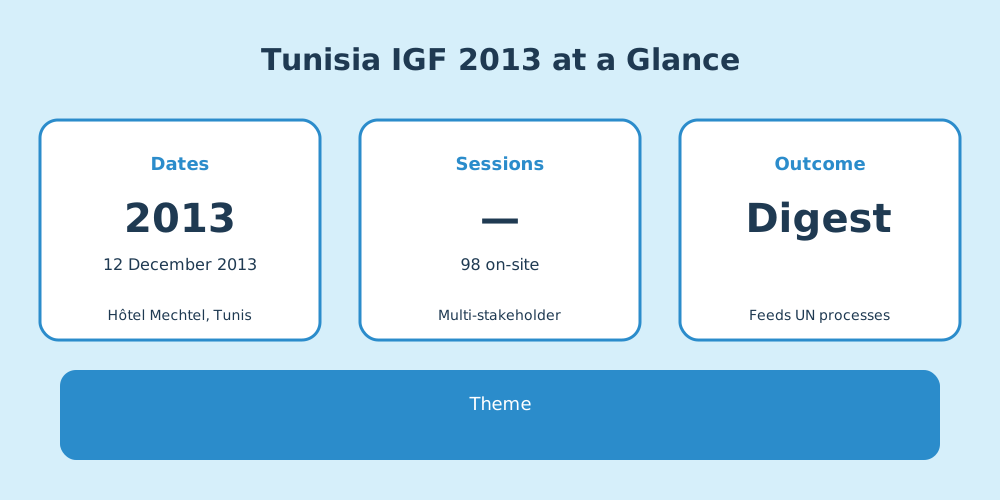
| Official name | IGF Tunisie 2013 — first edition of the Tunisian national Internet Governance Forum (IGF-TN) |
| Dates | 12 December 2013 |
| Venue | Hôtel Mechtel, Tunis (The official report says 'a hotel in the city of Tunis'; the Mechtel Hotel name comes from MAG member Khaled Koubaa's record) |
| Theme | Regional governance themes |
| Participants | 98 (Both the official report and Koubaa's record say 98 participants; the GISWatch 2017 country report says about 20 — a source conflict, so articles should avoid asserting the figure) |
| Host | The 12-member MAG of IGF-TN, with the telecoms regulator Instance Nationale des Télécommunications (INT) as permanent secretariat |
(See the source list at the end of this article.)
Discussion Digest — from the Session Records
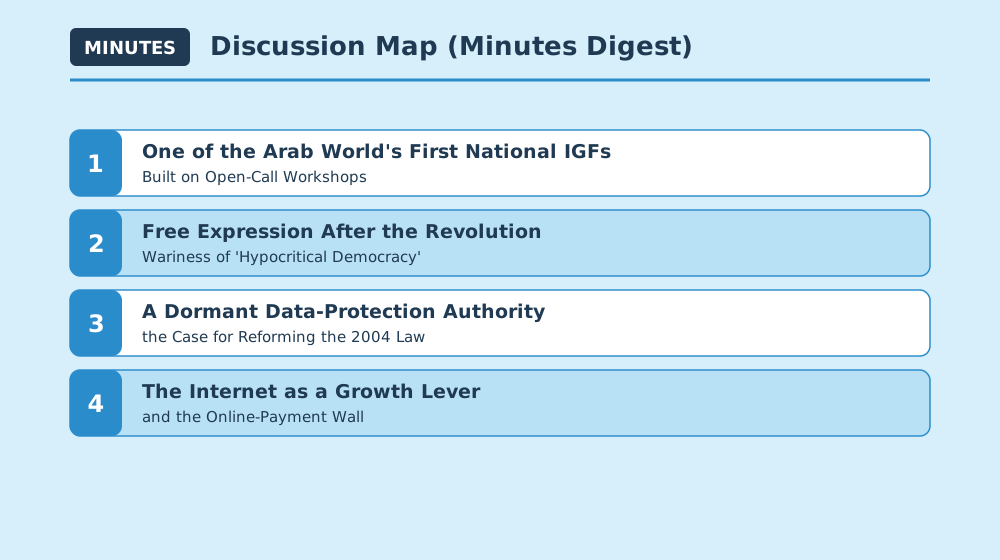
Key exchanges extracted from session records and transcripts.
1. One of the Arab World's First National IGFs — Built on Open-Call Workshops
Sessions: Opening plenary and forum design
- MAG president Farouk Kamoun (head of SESAME University) opened by framing the forum as one of the very first such initiatives in the Arab world, with openness, transparency and multistakeholderism as the keys to success [1][2]
- Workshop organisers were selected through a 28-day open call (20 September–18 October 2013), fielding lawyers, engineers and economists from government, business, civil society and academia [1][2]
- In plenary, ATTIC president Ridha Guellouz traced the IGF's genesis and WSIS-review questions, ministerial adviser Mohamed Ben Amor set out three phases of government support for national IGFs, and Google's North Africa manager Khaled Koubaa covered the technical side of the multistakeholder approach [1][2]
2. Free Expression After the Revolution — Wariness of 'Hypocritical Democracy'
Sessions: Workshop 2, 'Is the Internet a public service?' (organised by FMAI)
- Communications expert Fatma Kilani walked from Tunisia's history of censorship to post-revolution liberalisation, warning that democracy can prove hypocritical and urging the necessary legal safeguards (summarised from the French report) [1]
- FMAI executive director Tijani Ben Jemaa pressed for stronger access on capacity, quality and price, and called IPv6 migration an urgent necessity [1]
- ATI's Wafa Dahmani, addressing the national internet-development strategy, demanded publication of the still-unreleased results of the June 2013 Tabarka strategy meeting [1]
3. A Dormant Data-Protection Authority — the Case for Reforming the 2004 Law
Sessions: Workshop 3, 'The Internet in Tunisia: rights and obligations' (organised by the CNRS/UPMC Sorbonne lab, moderated by Meryem Marzouki)
- Law professor Chawki Gaddès questioned the silence of the data-protection authority INPDCP despite its intended role, cataloguing the flaws of the 2004 data-protection law (organic law 2004-63) and the amendments needed [1]
- The Council of Europe's Sophie Kwasny presented Convention 108 on automated processing of personal data and its international reach — a path for anchoring Tunisian data protection to international standards [1]
- ENSI professor Mohamed Said Ouerghi introduced privacy by design, and THD CEO Walid Naffati argued for public awareness in the age of social networks [1]
4. The Internet as a Growth Lever — and the Online-Payment Wall
Sessions: Workshop 4, 'The Internet as a lever of growth and economic development' (organised by INFOTICA)
- UTICA executive Kais Sellami laid out the new B2B opportunities of cloud computing and big data [1]
- Commerce-ministry e-commerce director Lazhar Bennour, presenting national statistics, identified online payment and counterfeiting as the brakes on online services and challenged industry to solve them [1]
- INFOTICA president Karim Ahres pressed the regulator for a clear national vision, agile regulation and support for technological convergence, while operator Tunisiana shared its nationwide internet-rollout record [1]
Three-Minute Short Talk — Your Questions Answered
Q. What was discussed?
A. Three years after the revolution, Tunisia's state, business, civil society and academia debated internet governance together for the first time: free expression, data-protection reform, access prices and e-commerce.
Q. What was the rawest issue?
A. The memory of censorship. Fresh from liberalisation, speakers warned that democracy can prove hypocritical and openly criticised the dormant data-protection authority.
Q. Why should I care?
A. A national IGF born in Tunis — host city of WSIS 2005 — carries historic weight, and the question it tackled, rebuilding internet governance during a transition from authoritarianism, keeps recurring worldwide.
What Is Tunisia IGF? (for first-time readers)
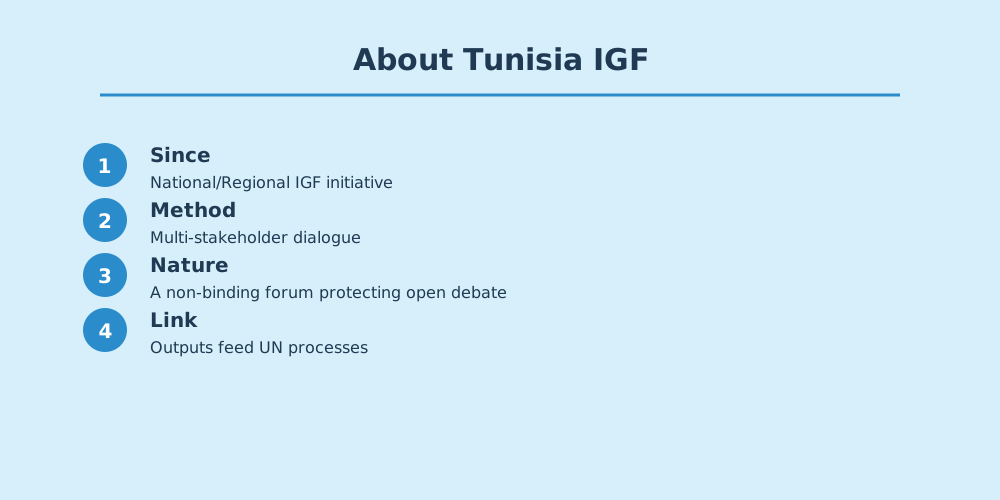
Tunisia IGF is a National or Regional IGF Initiative (NRI), aligning local internet governance discussion with global IGF principles.
Why It Matters to You
What was discussed here becomes the baseline for national digital policy, platform rules and AI regulation worldwide within a few years. The principles confirmed at the 2013 meeting are the foundation of the "next rules" for the phones, social platforms and AI services you use every day.
Sources & References
- IGF Tunisie – Rapport 2013(公式最終報告書。全セッションの議事要旨・スポンサー・公募過程。仏語) — IGF-TN(チュニジア国内IGF)/Wayback Machineアーカイブ (accessed 2026-07-23)
- IGF-TN Rapport d'activités 2013-2017(活動報告書。設立2012-09-04・MAG選出2013-03-30・参加98人・中断の内情。仏語) — IGF-TN/国連IGF事務局サイト掲載 (accessed 2026-07-23)
- Tunisia Internet Governance Forum(MAG委員クバア氏の事後記録。会場メシュテル・ホテル・98人) — koubaa.net (accessed 2026-07-23)
- Internet governance: Tunisia(第1回の評価と中断の分析。参加者数「約20人」と記載) — APC (accessed 2026-07-23)
Quotes are translated or condensed from the records listed above. Bracketed numbers [n] refer to the source list.
Related links
- IGF official (NRI list): https://www.intgovforum.org/en/content/national-and-regional-igf-initiatives
- Japan IGF: https://japanigf.jp/
- Yuki Nakazawa's blog: https://nkzw.jp/category/igf/
更新履歴
第1稿投稿 2026年8月5日 8時26分(記事コンテンツアップ)
— 中澤祐樹

