


The 3-Line Summary
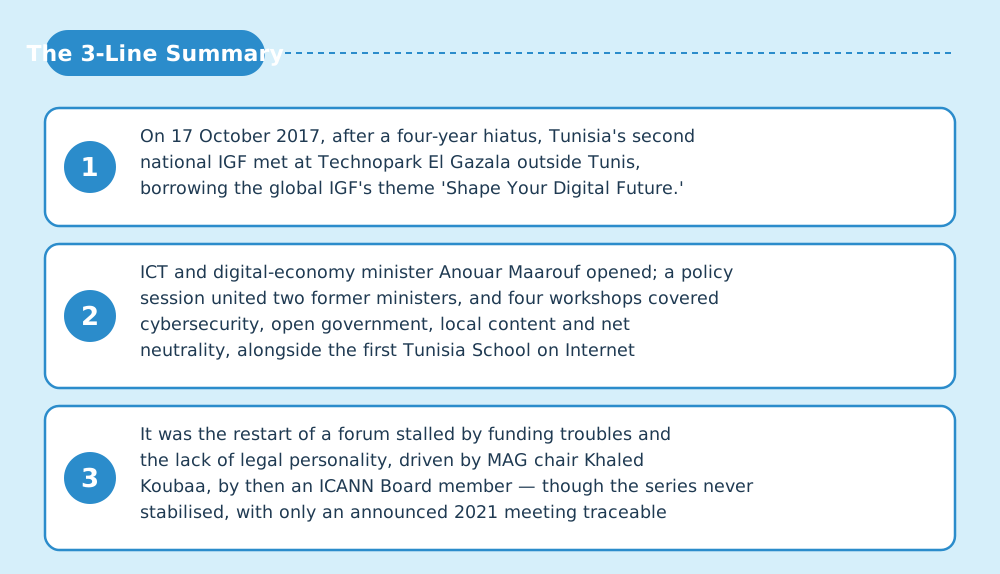
- On 17 October 2017, after a four-year hiatus, Tunisia's second national IGF met at Technopark El Gazala outside Tunis, borrowing the global IGF's theme 'Shape Your Digital Future.'
- ICT and digital-economy minister Anouar Maarouf opened; a policy session united two former ministers, and four workshops covered cybersecurity, open government, local content and net neutrality, alongside the first Tunisia School on Internet Governance (TSIG).
- It was the restart of a forum stalled by funding troubles and the lack of legal personality, driven by MAG chair Khaled Koubaa, by then an ICANN Board member — though the series never stabilised, with only an announced 2021 meeting traceable afterwards.
Welcome — this is the Japan IGF Support Organization. This in-depth report on IGF Tunisie 2017 — second edition of the Tunisian national Internet Governance Forum draws on official outputs, session records and on-site reporting. In a hurry? The three lines above and the diagrams carry the gist.
📍 Catalogue city: Tunis. The venue, Technopark El Gazala, is an ICT hub in Ariana governorate in greater Tunis
Conference at a Glance (from official records)
| Item | Detail |
|---|---|
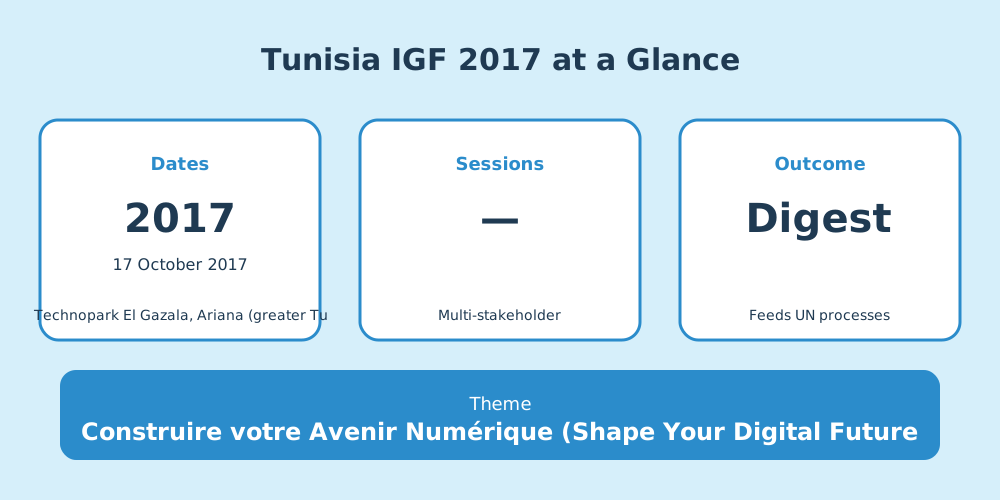
| Official name | IGF Tunisie 2017 — second edition of the Tunisian national Internet Governance Forum |
| Dates | 17 October 2017 |
| Venue | Technopark El Gazala, Ariana (greater Tunis) |
| Theme | Construire votre Avenir Numérique (Shape Your Digital Future) |
| Side events | Preceded by the first Tunisia School on Internet Governance (TSIG), a one-day training |
| Host | The IGF-TN MAG chaired by Khaled Koubaa, adopting the same theme as the global IGF in Geneva |
(See the source list at the end of this article.)
Discussion Digest — from the Session Records
Key exchanges extracted from session records and transcripts.
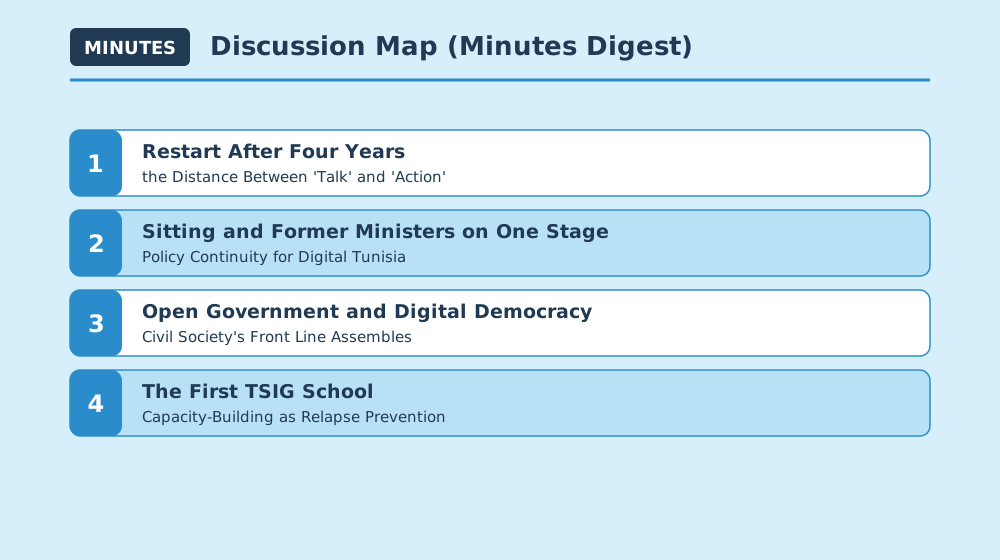
1. Restart After Four Years — the Distance Between 'Talk' and 'Action'
Sessions: The forum's backstory
- IGF-TN's activity report frankly records why the forum stalled: with no defined legal form the MAG could not open a bank account or collect sponsorship, and absenteeism routinely broke quorum [3][2]
- MAG elections on 28 January 2017 renewed the body, with Koubaa (private sector), Dahmani (public), Laabidi (academia) and Laaribi (civil society) carried over for continuity [3][2]
- GISWatch's Tunisia report framed the restart as closing the gap between policy 'talk' and actual policymaking in an independent venue, making the audit of past failures an explicit goal [3][2]
2. Sitting and Former Ministers on One Stage — Policy Continuity for Digital Tunisia
Sessions: Opening (9:30) and main session 'Internet governance and regulation: forging a new digital Tunisia' (11:00)
- Minister Anouar Maarouf opened; MAG chair and ICANN Board member Khaled Koubaa gave the welcome, and IGF Support Association president Markus Kummer sent a recorded address [1]
- The main session united former ministers Mongi Marzoug and Noomene Fehri with AICTO secretary-general Mohamed Ben Amor and ministerial adviser Ridha Debbabi, moderated by MAG vice-president Wafa Dahmani — a line-up built to interrogate policy continuity across governments [1]
- The closing session on the value of the multistakeholder approach in decision-making brought together ICANN ALAC's Tijani Ben Jemaa, ATI technical director Zied Dridi and Smart Tunisia CEO Elyes Jeribi [1]
3. Open Government and Digital Democracy — Civil Society's Front Line Assembles
Sessions: Workshop 2, 'OpenGov and digital democracy: technology's impact on transparent governance and politics' (12:30)
- Former youth state-secretary Faten Kallel, access-to-information authority (INAI) member Hajer Trabelsi, former Al Bawsala president Chaima Bouhlel and ARTICLE 19's Tunisia director Saloua Ghazouani assembled post-revolution Tunisia's transparency and civic-tech vanguard [1]
- In parallel, Workshop 1 on cybersecurity and privacy in the digital age drew INPDCP council member Kamel Rezgui and the head of the Elgazala Innovation Centre [1]
- Workshop 4 took on net neutrality, with telecoms regulator INTT's president Hichem Besbes debating alongside Orange and Tunisie Télécom representatives [1]
4. The First TSIG School — Capacity-Building as Relapse Prevention
Sessions: 1st Tunisia School on Internet Governance (TSIG), a one-day training preceding the forum
- A one-day school for students, activists, engineers and human-rights advocates ran ahead of the forum, deliberately widening the pool of governance practitioners [2][1]
- Workshop 3 on local content development brought THD, the ATUGE France president and IntilaQ's CEO to discuss content as the engine of Tunisia's internet growth [2][1]
- GISWatch listed the post-restart tasks: connecting national debate to the global IGF process and strengthening governance at the local level [2][1]
Three-Minute Short Talk — Your Questions Answered
Q. What was this edition?
A. The restart of a forum dormant for four years: the sitting minister opened, two former ministers joined the stage, and one day covered cybersecurity, open government, local content and net neutrality.
Q. Why the four-year gap?
A. The MAG had no legal personality — it literally could not open a bank account — so funding dried up and quorums collapsed; the January 2017 elections and a renewed line-up made the restart possible.
Q. Why should I care?
A. It shows both how fragile volunteer-run national IGFs are and one antidote — pairing the forum with a school to grow new practitioners — a useful comparison for any country's IGF sustainability debate.
What Is Tunisia IGF? (for first-time readers)
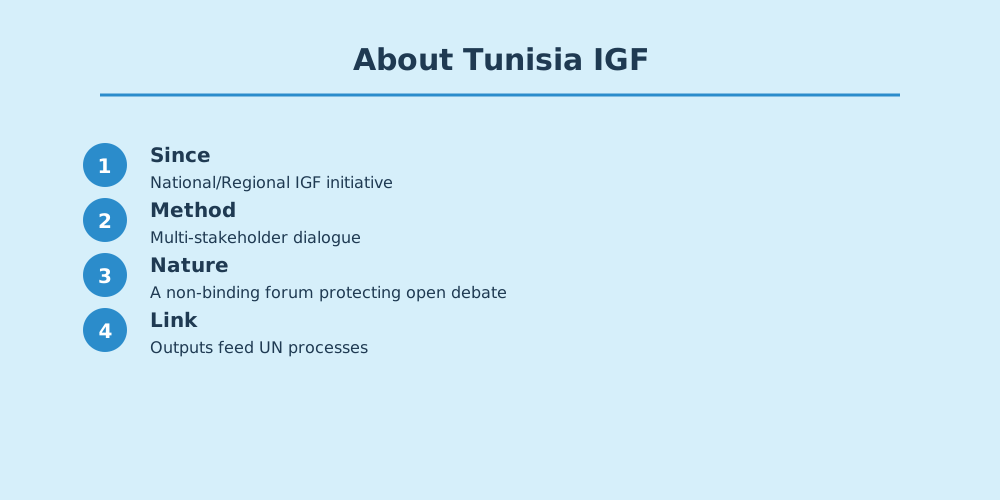
Tunisia IGF is a National or Regional IGF Initiative (NRI), aligning local internet governance discussion with global IGF principles.
Why It Matters to You
What was discussed here becomes the baseline for national digital policy, platform rules and AI regulation worldwide within a few years. The principles confirmed at the 2017 meeting are the foundation of the "next rules" for the phones, social platforms and AI services you use every day.
Sources & References
- IGF Tunisie 2017(公式サイトの大会ページ: 日付・会場・テーマ・全セッションと登壇者。仏語) — IGF-TN(igf.tn、Wayback Machineアーカイブ 2017年11月7日取得) (accessed 2026-07-23)
- Internet governance: Tunisia(第2回の文脈・TSIG・中断期間「2013年12月〜2017年10月に会合なし」の明記) — APC (accessed 2026-07-23)
- IGF-TN Rapport d'activités 2013-2017(活動報告書: 中断の内情・2017年1月28日MAG改選。仏語) — IGF-TN/国連IGF事務局サイト掲載 (accessed 2026-07-23)
- African Regional Group(チュニジア欄: 「2012年組織化」・掲載報告書は2017年分のみ) — UN IGF Secretariat (accessed 2026-07-23)
Quotes are translated or condensed from the records listed above. Bracketed numbers [n] refer to the source list.
Related links
- IGF official (NRI list): https://www.intgovforum.org/en/content/national-and-regional-igf-initiatives
- Japan IGF: https://japanigf.jp/
- Yuki Nakazawa's blog: https://nkzw.jp/category/igf/
更新履歴
第1稿投稿 2026年8月8日 20時15分(記事コンテンツアップ)
— 中澤祐樹

