


The 3-Line Summary
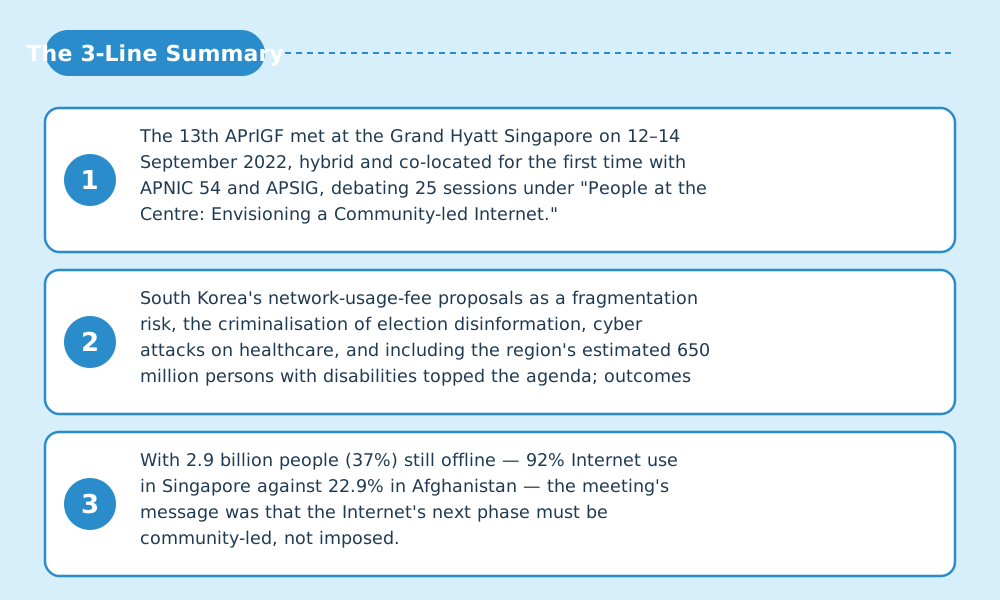
- The 13th APrIGF met at the Grand Hyatt Singapore on 12–14 September 2022, hybrid and co-located for the first time with APNIC 54 and APSIG, debating 25 sessions under "People at the Centre: Envisioning a Community-led Internet."
- South Korea's network-usage-fee proposals as a fragmentation risk, the criminalisation of election disinformation, cyber attacks on healthcare, and including the region's estimated 650 million persons with disabilities topped the agenda; outcomes fed the Synthesis Document published in November.
- With 2.9 billion people (37%) still offline — 92% Internet use in Singapore against 22.9% in Afghanistan — the meeting's message was that the Internet's next phase must be community-led, not imposed.
Welcome — this is the Japan IGF Support Organization. This in-depth report on AprIGF 2022 in Singapore draws on official outputs, session records and on-site reporting. In a hurry? The three lines above and the diagrams carry the gist.
📍 The 13th APrIGF, preceded by a Day 0 capacity-building day on 11 September. Co-located for the first time with APNIC 54 and APSIG 2022, with APNIC as co-host of the hybrid event, within a combined conference week (8–15 September) that included technical workshops
Conference at a Glance (from official records)
| Item | Detail |
|---|---|
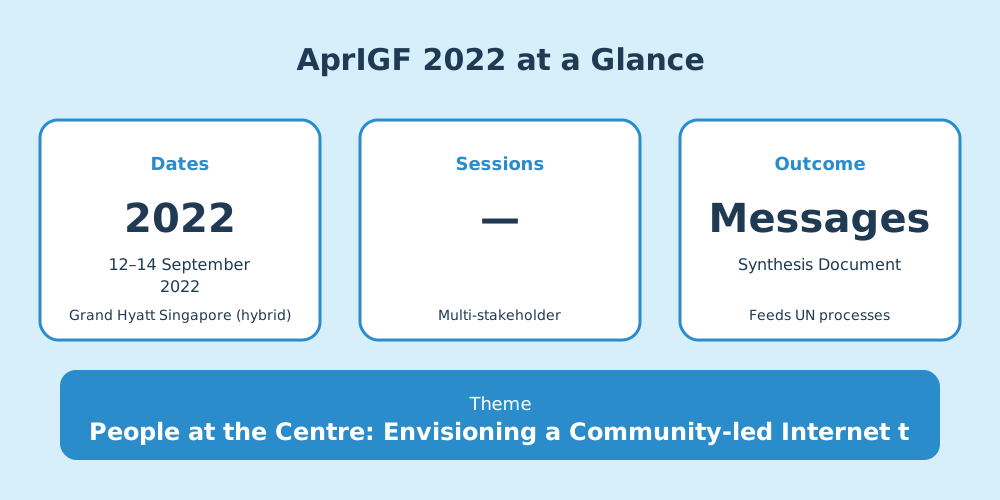
| Dates | 12–14 September 2022 |
| Venue | Grand Hyatt Singapore (hybrid) |
| Theme | People at the Centre: Envisioning a Community-led Internet that is Inclusive, Sustainable and Trusted |
| Tracks | Three high-level thematic tracks — Inclusion, Sustainability and Trust — continuing the format introduced in 2021 |
| Host | Hosted by the APrIGF Multistakeholder Steering Group with APNIC as co-host; Secretariat run by DotAsia Organisation |
| Outcome | Synthesis Document (final version published 25 November 2022) |
(See the source list at the end of this article.)
Discussion Digest — from the Session Records
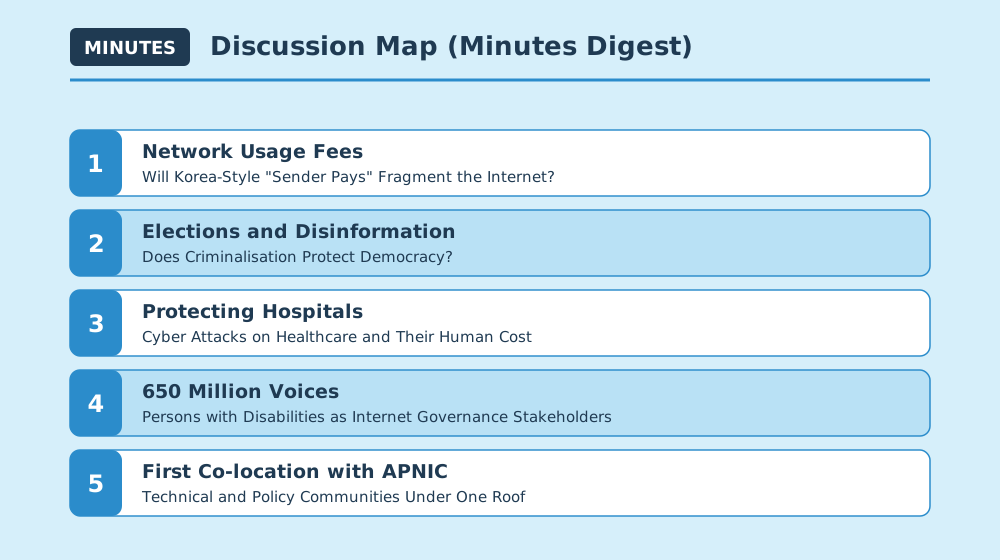
Key exchanges extracted from session records and transcripts.
1. Network Usage Fees — Will Korea-Style "Sender Pays" Fragment the Internet?
Sessions: Sustainability track (Internet interoperability and resilience discussions)
- Network-usage-fee proposals like South Korea's "Sending Party Network Pays" policy and the data-delivery costs considered by the European Commission add costs to network and data accessibility and could potentially fragment the Internet [1]
- Policymakers should weigh unintended consequences for the workings of the Internet when developing new regulation — keeping the network interoperable comes first [1]
- Resilience tools for typhoon- and earthquake-prone economies — Locally Accessible Cloud Systems (LACS) and LEO satellite constellations — were examined as ways to keep people connected through disasters [1]
2. Elections and Disinformation — Does Criminalisation Protect Democracy?
Sessions: "Social Media Regulation during Elections: Expanding or Limiting Digital Democracy?" and "Combating Disinformation from COVID-19 to the General Election"
- An unfortunate Asian trend toward more government regulation and criminal punishment for misinformation was flagged as especially problematic for political and election-related content [1]
- Targeted political advertising should be clearly identifiable and categorised as info-advertisements, and election bodies should deploy "digital election observers" to monitor such content [1]
- The broader fix is digital literacy — fact-checking and critical thinking taught in schools — combined with government–civil society collaboration, industry self-regulation and community-based transparency [1]
3. Protecting Hospitals — Cyber Attacks on Healthcare and Their Human Cost
Sessions: "Protecting the Healthcare Sector from Cyber Harm" (Trust track)
- Hospitals already strained by the pandemic faced increasingly sophisticated cyberattacks, in a number of cases directly delaying or postponing patient treatment — framed as a matter of potentially devastating humanitarian consequences [1]
- Since attackers ignore borders: share information across sectors and countries, train healthcare workers in cyber hygiene, normalise two-factor authentication, and break down organisational silos in IT security [1]
- Governments should establish Disaster Recovery Centres and national or sector-specific CERTs, strengthen confidence-building measures across APAC, and hold healthcare system vendors accountable for security holes in their products [1]
4. 650 Million Voices — Persons with Disabilities as Internet Governance Stakeholders
Sessions: "Strengthening the disability voice in Internet Governance" and other disability and accessibility sessions
- An estimated 650 million persons with disabilities live in Asia Pacific, yet digital disparities greatly inhibit their digital rights — their voices must be integrated into Internet governance discussions if no one is to be left behind [1]
- Accessibility of both online and onsite capacity-building sessions should follow the IGF Dynamic Coalition on Accessibility and Disability (DCAD) guidelines [1]
- Pandemic-era remote learning hit students with disabilities in higher education hard; public and private initiatives should provide connectivity, learning-management tools and assistive technology — with inclusion in the ICT job sector also on the table [1]
5. First Co-location with APNIC — Technical and Policy Communities Under One Roof
Sessions: Meeting-wide (held in the same venue and week as APNIC 54 and APSIG 2022)
- For the first time APrIGF was co-located with APNIC 54 and APSIG, with APNIC as co-host; the combined conference week drew 558 on-site and 635 online participants from 69 economies (per APNIC) [1][3][4]
- 2.9 billion people — 37% of the world's population — remain unconnected, and the regional gap is stark: 92% Internet use in Singapore versus 22.9% in Afghanistan [1][3][4]
- Fellowship pathways for emerging voices and a youth statement drafted by Asia Pacific yIGF participants embodied the "People at the Centre" theme of a community-led Internet [1][3][4]
Three-Minute Short Talk — Your Questions Answered
Q. So what did the conference actually decide?
A. Nothing binding — it's the Asia-Pacific edition of the IGF. In 2022 it shared a venue with the technical community's APNIC 54 for the first time, and its discussions were distilled into a Synthesis Document feeding the global IGF in Addis Ababa that November and wider UN processes.
Q. What was the most contentious topic?
A. Network usage fees. South Korea's 'Sending Party Network Pays' approach — making big content providers pay ISPs for traffic — was flagged as well-intentioned regulation that could undermine interoperability and fragment the Internet.
Q. Why should I care?
A. Because the fights aired here went global: network-fee bills echoed into the EU's 'fair share' debate, hospitals worldwide faced ransomware, and the 650-million-strong disability community's claim to a seat at the Internet governance table concerns every connected society.
What Is AprIGF? (for first-time readers)
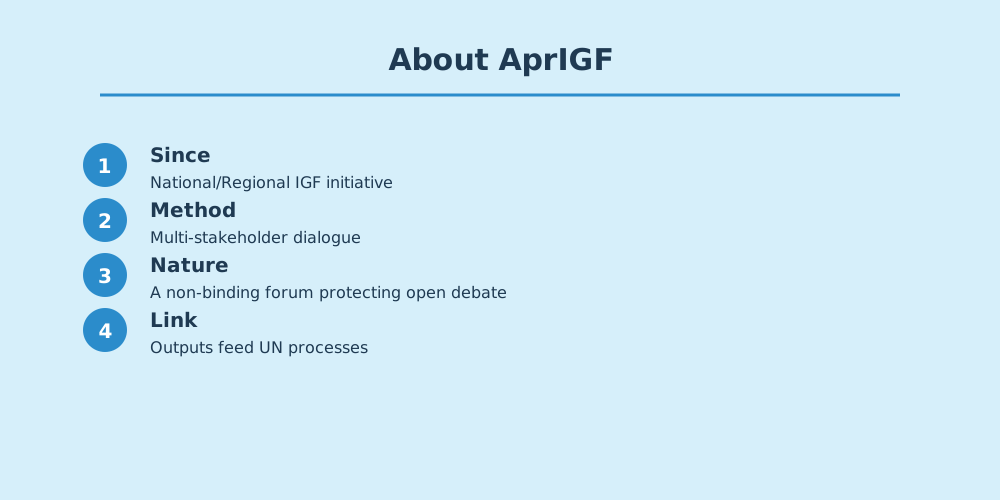
AprIGF is a National or Regional IGF Initiative (NRI), aligning local internet governance discussion with global IGF principles.
Why It Matters to You
What was discussed here becomes the baseline for national digital policy, platform rules and AI regulation worldwide within a few years. The principles confirmed at the 2022 meeting are the foundation of the "next rules" for the phones, social platforms and AI services you use every day.
Sources & References
- Asia Pacific Regional Internet Governance Forum 2022 Synthesis Document (PDF) — APrIGF Secretariat (accessed 2026-07-10)
- It's Official: APrIGF 2022 will be held in Singapore this September! — APrIGF.Asia(公式サイト) (accessed 2026-07-10)
- Register now for APNIC 54, APrIGF 2022 and APSIG 2022, Singapore — APNIC Blog (accessed 2026-07-10)
- APNIC 54: Thank you and farewell — APNIC Blog (accessed 2026-07-10)
- APC at the 2022 Asia Pacific Regional IGF: Promoting a community-led internet — Association for Progressive Communications (accessed 2026-07-10)
- APrIGF 2022 Synthesis Document — APrIGF.Asia(公式サイト) (accessed 2026-07-10)
Quotes are translated or condensed from the records listed above. Bracketed numbers [n] refer to the source list.
Related links
- IGF official (NRI list): https://www.intgovforum.org/en/content/national-and-regional-igf-initiatives
- Japan IGF: https://japanigf.jp/
- Yuki Nakazawa's blog: https://nkzw.jp/category/igf/
Revision History
Rev. 1 — published 12 September 2022, 09:00 (Article published)
Rev. 2 — updated 10 July 2026, 23:16 (Fully revised into the in-depth edition: added the 3-line summary, minutes digest, short talk, source list and diagrams (all quotes verified against the listed sources))
— 中澤祐樹

