


The 3-Line Summary
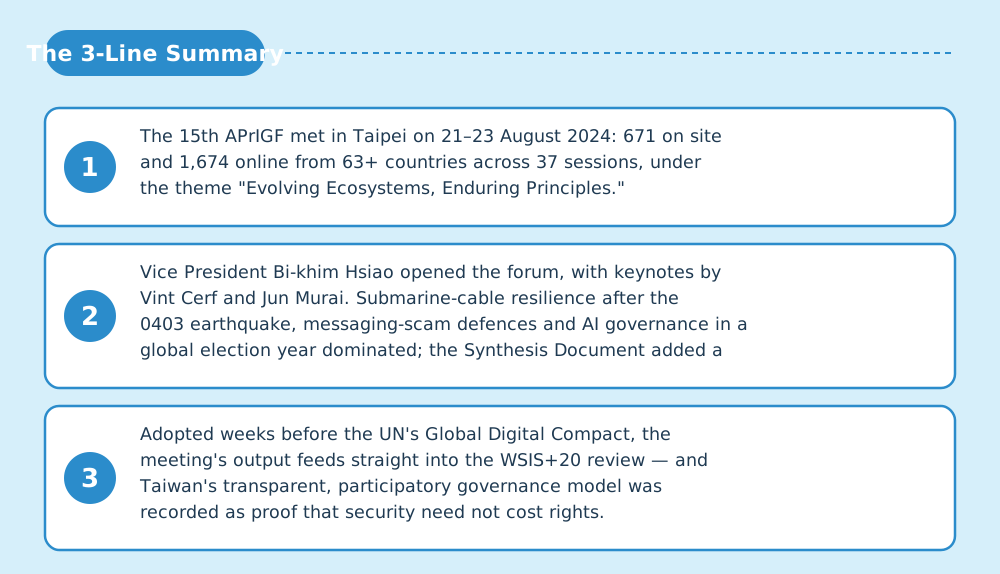
- The 15th APrIGF met in Taipei on 21–23 August 2024: 671 on site and 1,674 online from 63+ countries across 37 sessions, under the theme "Evolving Ecosystems, Enduring Principles."
- Vice President Bi-khim Hsiao opened the forum, with keynotes by Vint Cerf and Jun Murai. Submarine-cable resilience after the 0403 earthquake, messaging-scam defences and AI governance in a global election year dominated; the Synthesis Document added a first-ever Call to Action.
- Adopted weeks before the UN's Global Digital Compact, the meeting's output feeds straight into the WSIS+20 review — and Taiwan's transparent, participatory governance model was recorded as proof that security need not cost rights.
Welcome — this is the Japan IGF Support Organization. This in-depth report on AprIGF 2024 in Taipei draws on official outputs, session records and on-site reporting. In a hurry? The three lines above and the diagrams carry the gist.
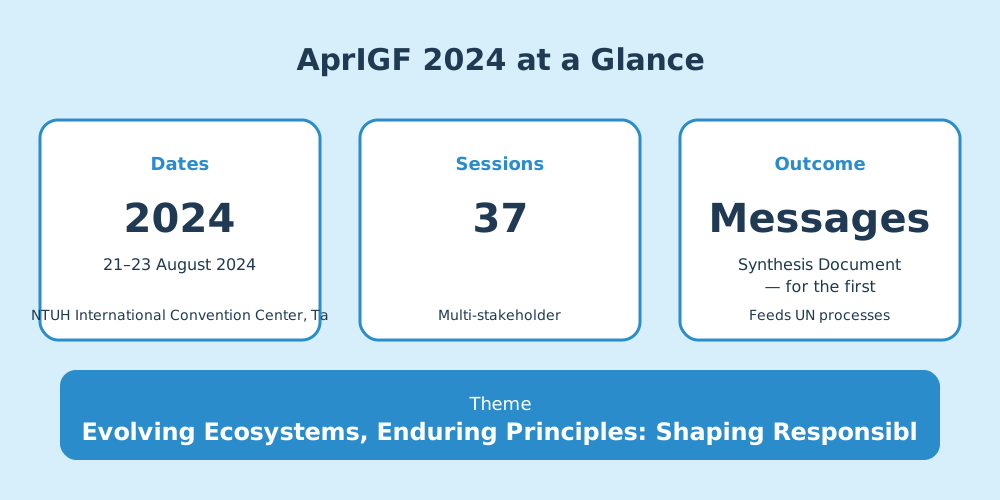
Conference at a Glance (from official records)
| Item | Detail |
|---|---|
| Edition | 15th APrIGF; the forum's return to Taipei since the 2016 meeting |
| Dates | 21–23 August 2024 |
| Venue | NTUH International Convention Center, Taipei (hybrid) |
| Theme | Evolving Ecosystems, Enduring Principles: Shaping Responsible Internet Governance |
| Sessions | 37 |
| Host | Jointly organised by Taiwan's Ministry of Digital Affairs (moda), the Taiwan Network Information Center (TWNIC, local host) and the Taiwan Internet Governance Forum (TWIGF) |
| Outcome | Synthesis Document — for the first time including a Call to Action for Stakeholders |
(See the source list at the end of this article.)
Discussion Digest — from the Session Records
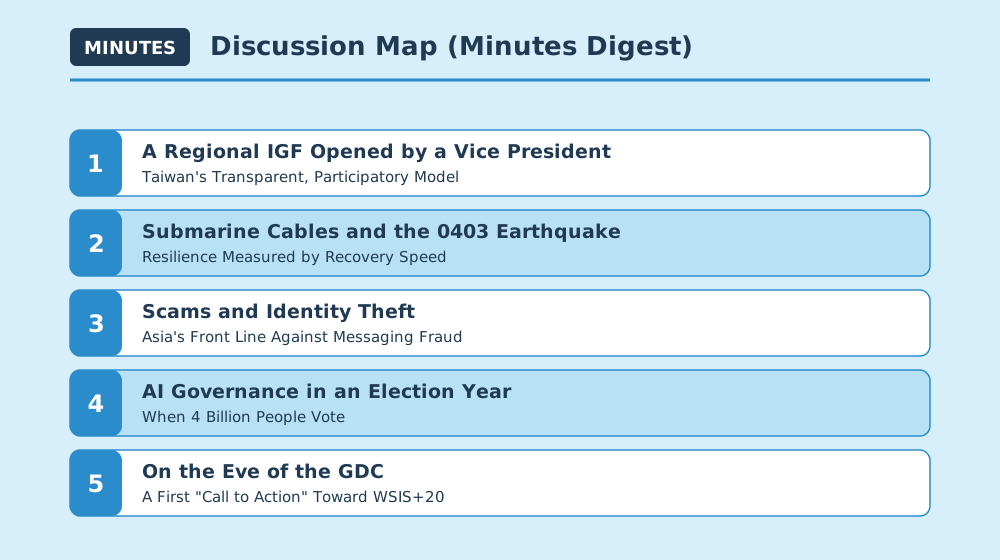
Key exchanges extracted from session records and transcripts.
1. A Regional IGF Opened by a Vice President — Taiwan's Transparent, Participatory Model
Sessions: Opening ceremony (21 August), keynotes, and closing plenary
"The pace of technological innovation and internet development is outstripping the existing governance structures"
— Bi-khim Hsiao (Vice President, Taiwan) [2][4][1]
- Vice President Bi-khim Hsiao addressed the opening; keynotes came from Vint Cerf and Jun Murai of Keio University, with Audrey Tang appearing in the closing plenary [2][4][1]
- Taiwan's civic platform JOIN and fact-checking tool Cofacts were recorded in the Synthesis Document as a blueprint for achieving security without compromising rights [2][4][1]
- Digital Minister Yennun Huang stressed balancing innovation with social responsibility and protecting citizens' digital rights and privacy [2][4][1]
2. Submarine Cables and the 0403 Earthquake — Resilience Measured by Recovery Speed
Sessions: Resilience track: "Internet infrastructure resilience during disaster event – Case Study for the 0403 Taiwan Earthquake" and "Strengthening the Digital Resilience of Taiwan"
- Using the 3 April 2024 Taiwan earthquake as a case study, resilience was defined not as preventing harm but as how fast systems return to normal operation [1]
- Policy recommendations included mandating Business Continuity Plans for all ISPs and telecom providers and requiring multiple uplink routes [1]
- After the CrowdStrike outage, conflicts of interest at multinationals running critical infrastructure — and aligning data-centre regulation with Internet governance — also came under scrutiny [1]
3. Scams and Identity Theft — Asia's Front Line Against Messaging Fraud
Sessions: Security & Trust track: "Defending against Digital Deception" and "Messaging scam and combatting to protect human rights and democracy"
- Against SIM-swap account takeovers, the forum recommended biometric verification at SIM issuance combined with telecom-provider liability when accounts are hijacked [1]
- Vietnam's facial-recognition requirement for large transfers was noted to be bypassable with a photo — a candidate for regional rollout only after technical hardening [1]
- AI-based content validation and sender-identification rules were endorsed with conditions: privacy, free expression, and encouragement of end-to-end encryption [1]
4. AI Governance in an Election Year — When 4 Billion People Vote
Sessions: Ethical Governance of Emerging Technologies track
- With roughly 4 billion people voting in 64+ countries in 2024, AI's power to amplify disinformation framed the AI-accountability debate [1]
- A regulatory framework that encourages innovation while ensuring ethical use — and making AI's benefits reach vulnerable, marginalised communities — was set as the condition for not widening digital divides [1]
- Transparency and consent in data usage, mitigation of algorithmic bias, and accountability for monetisation of personal data were core threads [1]
5. On the Eve of the GDC — A First "Call to Action" Toward WSIS+20
Sessions: Townhall sessions (21–22 August) and the Synthesis Document process
- A month after the meeting, the Global Digital Compact was adopted at the UN Summit of the Future (22 September 2024) — its impact on the multistakeholder model loomed over the whole forum [1]
- The Synthesis Document introduced a first-ever Call to Action, listing concrete commitments for governments, the technical community, academia, civil society and the private sector ahead of the WSIS+20 review and IGF mandate renewal [1]
- On regulatory harmonisation, the region split: India and Singapore preferred divergent rules while Australia and Japan pushed for consistency and collaboration [1]
Three-Minute Short Talk — Your Questions Answered
Q. So what did the conference actually decide?
A. It's a dialogue forum, not a decision body — but this year's Synthesis Document added a first-ever Call to Action: concrete commitments for each stakeholder group heading into the 2025 WSIS+20 review.
Q. What made the Taipei edition special?
A. Taiwan's Vice President opened it and the digital ministry co-hosted — a whole-of-nation affair. Taiwan's civic-tech tools JOIN and Cofacts were held up as proof that security doesn't have to cost rights.
Q. Why should I care?
A. Because the playbook debated here — earthquake-tested cable resilience, Business Continuity Plans for ISPs, scam defences, AI rules in an election year — is exactly what governments worldwide are now writing into law.
What Is AprIGF? (for first-time readers)
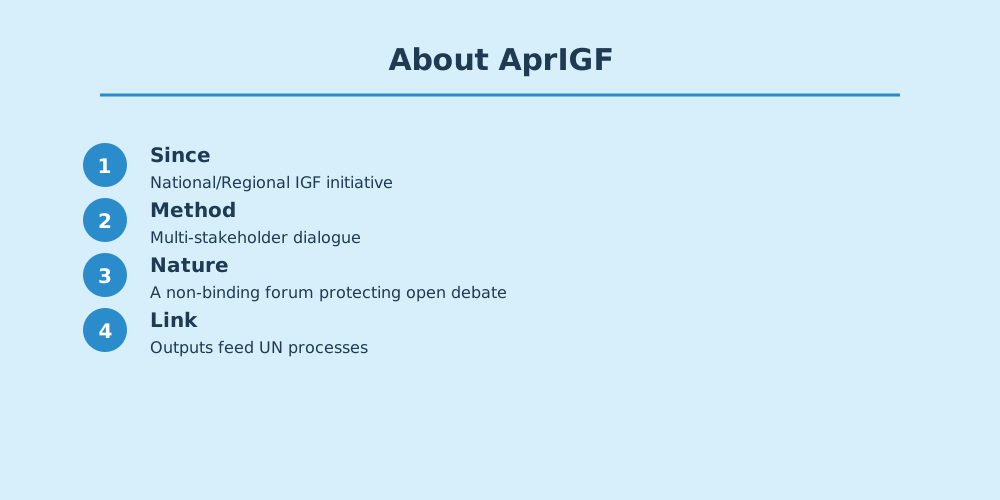
AprIGF is a National or Regional IGF Initiative (NRI), aligning local internet governance discussion with global IGF principles.
Why It Matters to You
What was discussed here becomes the baseline for national digital policy, platform rules and AI regulation worldwide within a few years. The principles confirmed at the 2024 meeting are the foundation of the "next rules" for the phones, social platforms and AI services you use every day.
Sources & References
- Asia Pacific Regional Internet Governance Forum Taipei 2024 Synthesis Document (PDF) — APrIGF Secretariat (accessed 2026-07-10)
- 2024 Asia Pacific Regional Internet Governance Forum (APrIGF) Opens to Explore Future Directions of Digital Governance — Ministry of Digital Affairs, Taiwan (accessed 2026-07-10)
- APrIGF 2024 Overarching Theme: Evolving Ecosystems, Enduring Principles: Shaping Responsible Internet Governance — APrIGF 2024公式サイト(TWNIC) (accessed 2026-07-10)
- Multistakeholder digital governance is the key to meaningful use of internet and other technologies – Reflections from APrIGF 2024 — GDIP (accessed 2026-07-10)
- APC network in Taiwan: DRAPAC24 and APrIGF — APC (accessed 2026-07-10)
Quotes are translated or condensed from the records listed above. Bracketed numbers [n] refer to the source list.
Related links
- IGF official (NRI list): https://www.intgovforum.org/en/content/national-and-regional-igf-initiatives
- Japan IGF: https://japanigf.jp/
- Yuki Nakazawa's blog: https://nkzw.jp/category/igf/
Revision History
Rev. 1 — published 19 August 2024, 10:00 (Article published)
Rev. 2 — updated 10 July 2026, 14:28 (Fully revised into the in-depth edition: added the 3-line summary, minutes digest, short talk, source list and diagrams (all quotes verified against the listed sources))
— 中澤祐樹
」の朝食_3.メインディッシュ_DSC_2964-160x160.jpg)
