


The 3-Line Summary
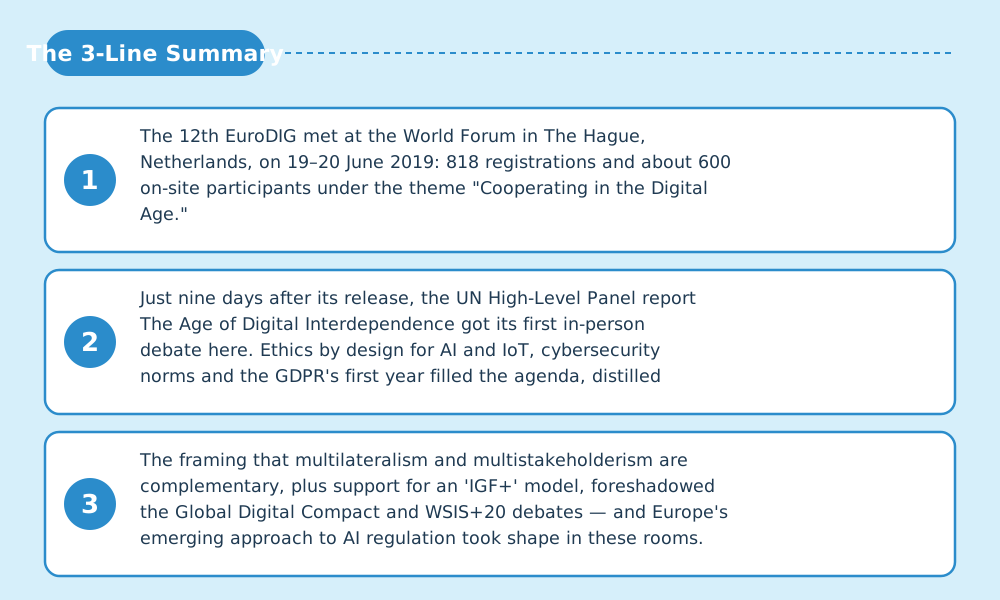
- The 12th EuroDIG met at the World Forum in The Hague, Netherlands, on 19–20 June 2019: 818 registrations and about 600 on-site participants under the theme "Cooperating in the Digital Age."
- Just nine days after its release, the UN High-Level Panel report The Age of Digital Interdependence got its first in-person debate here. Ethics by design for AI and IoT, cybersecurity norms and the GDPR's first year filled the agenda, distilled into the Messages from The Hague.
- The framing that multilateralism and multistakeholderism are complementary, plus support for an 'IGF+' model, foreshadowed the Global Digital Compact and WSIS+20 debates — and Europe's emerging approach to AI regulation took shape in these rooms.
Welcome — this is the Japan IGF Support Organization. This in-depth report on EuroDIG 2019 in The Hague draws on official outputs, session records and on-site reporting. In a hurry? The three lines above and the diagrams carry the gist.
Conference at a Glance (from official records)
| Item | Detail |
|---|---|
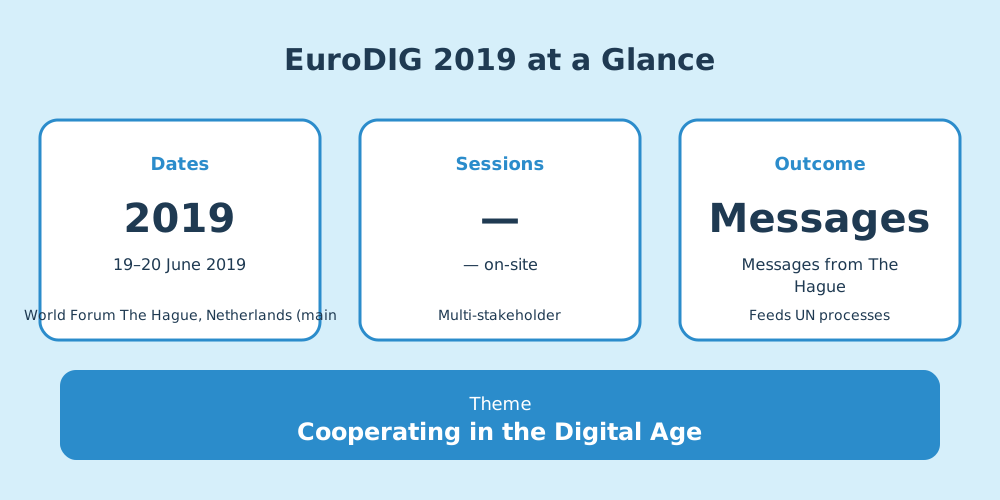
| Edition | 12th EuroDIG |
| Dates | 19–20 June 2019 |
| Venue | World Forum The Hague, Netherlands (main hall: King Willem-Alexander Auditorium) |
| Theme | Cooperating in the Digital Age |
| Participants | about 600 participants picking up badges (818 registrations online and on the spot) |
| Registrations | 818 |
| Host | Hosted by the Netherlands Ministry of Economic Affairs and Climate Policy with ECP (Platform for the Information Society), the Municipality of The Hague and SIDN (the .nl registry) |
| Outcome | Messages from The Hague |
(See the source list at the end of this article.)
Discussion Digest — from the Session Records
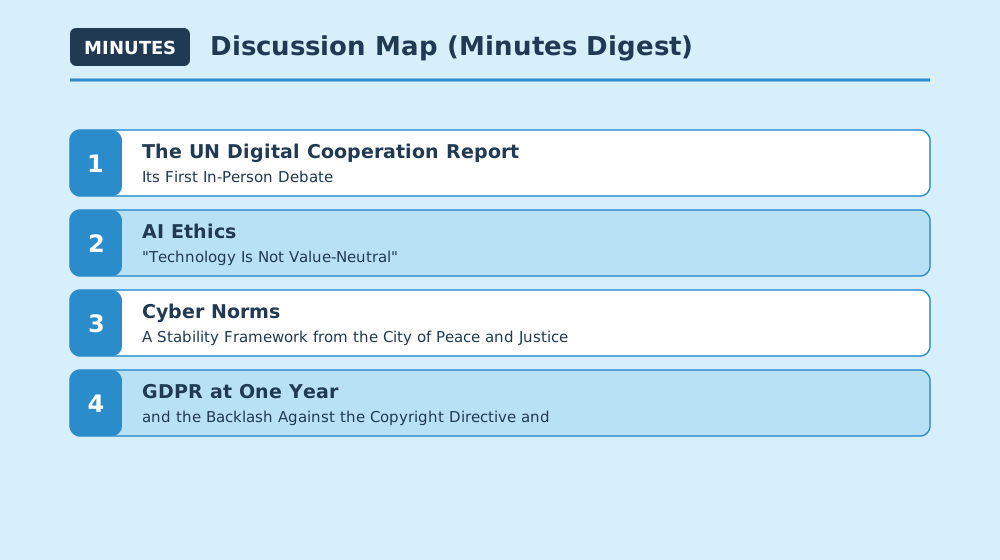
Key exchanges extracted from session records and transcripts.
1. The UN Digital Cooperation Report — Its First In-Person Debate
Sessions: "Digital Cooperation – Report of the UN high level panel" Part I (19 June, 16:00) and Part II (20 June, 9:00)
- Nine days after its 10 June release, the UN Secretary-General's High-Level Panel report The Age of Digital Interdependence received its first physical discussion anywhere, here at EuroDIG [1][2]
- Participants framed multilateralism and multistakeholderism as complementary rather than fundamentally opposed; cooperation should 'connect the dots' among existing processes, not be imposed on them [1][2]
- The 'IGF+' model — building on the IGF's strengths while fixing weaknesses in norm-making and state participation — was debated, with European input to be compiled for the IGF in Berlin that November [1][2]
2. AI Ethics — "Technology Is Not Value-Neutral"
Sessions: Keynote by Commissioner Mariya Gabriel (19 June, 12:20) and plenary "Ethics by design – Moving from ethical principles to practical solutions" (PL 5, 20 June, 11:00)
"Technology is not value-free or value neutral. On the contrary, it is permeated by the values."
— Mariya Gabriel (European Commissioner for Digital Economy and Society) [4][1]
"Do we want a society that is at the service of people or a society where people are manipulated by digital actors?"
— Mariya Gabriel [4][1]
- Opinions converged on governing AI and IoT through ethics, guiding principles and 'by design' measures without hampering innovation — ethics and trust by design emerged as the most promising route to privacy and data protection [4][1]
- The Council of Europe voiced concern about AI deepening discrimination and eroding human oversight, reporting work to align ethics frameworks across its member states [4][1]
3. Cyber Norms — A Stability Framework from the City of Peace and Justice
Sessions: Plenary "Making norms work – Pursuing effective cybersecurity" (PL 4, 20 June, 9:30) and pre-event "Global Commission on the Stability of Cyberspace – Towards a cyber stability framework" (PRE 7, 18 June)
- Fittingly for The Hague, the Global Commission on the Stability of Cyberspace held a pre-event presenting its cyber stability framework, months before its final report that November [1][3]
- While many noted the abundance of existing norms and declarations, a growing majority argued soft law and non-binding rules are not enough; giving the IGF greater norm-proposing powers was cautiously floated [1][3]
- The Council of Europe promoted the Budapest Convention and its Second Additional Protocol, then under negotiation, to tackle cross-border electronic evidence [1][3]
4. GDPR at One Year — and the Backlash Against the Copyright Directive and e-Evidence
Sessions: Workshop "GDPR Implementation" (WS 2), flash "Does GDPR work?" and plenary "The European Copyright Reform" (PL 6, 20 June, 14:00)
- The GDPR was lauded as a regulatory approach reflecting the will of a group of states with common values, with 'upscaling' such regional rules into global solutions seen as a promising avenue [1][2]
- The freshly adopted EU Copyright Directive came under fire for siding too strongly with rights holders such as publishers and record labels, accepting the risk of over-blocking online content [1][2]
- The e-Evidence proposal was contested for exposing platform providers to requests from all EU member states rather than the authorities where they are located [1][2]
Three-Minute Short Talk — Your Questions Answered
Q. So what did the conference actually decide?
A. EuroDIG doesn't decide — but this edition compiled Europe's first collective response to the UN digital cooperation report, released just nine days earlier, and sent it with the Messages from The Hague to the IGF in Berlin that November.
Q. What was the most contentious topic?
A. The freshly adopted EU Copyright Directive. A plenary titled 'what just happened, what's next' pitted rights-holder protection against fears of over-blocking — a sharp contrast with the praise heaped on the GDPR.
Q. Why should I care?
A. 'Ethics by design' championed here became the backbone of AI regulation, including the EU AI Act, and the IGF+ debate feeds directly into today's Global Digital Compact and WSIS+20 negotiations.
What Is EuroDIG? (for first-time readers)
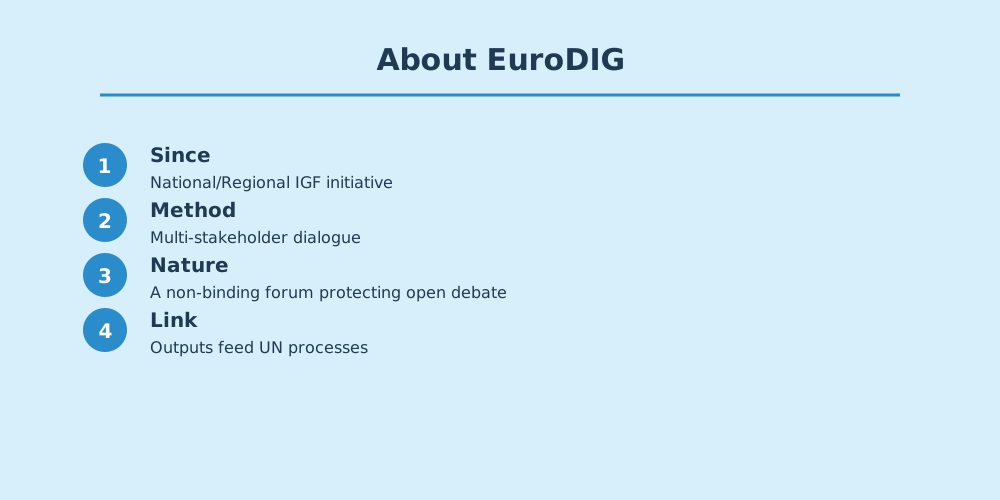
EuroDIG is a National or Regional IGF Initiative (NRI), aligning local internet governance discussion with global IGF principles.
Why It Matters to You
What was discussed here becomes the baseline for national digital policy, platform rules and AI regulation worldwide within a few years. The principles confirmed at the 2019 meeting are the foundation of the "next rules" for the phones, social platforms and AI services you use every day.
Sources & References
- Messages from The Hague (PDF) — EuroDIG Association (accessed 2026-07-10)
- EuroDIG 2019 — DiploFoundation (accessed 2026-07-10)
- EuroDIG 2019 — EuroDIG Wiki (accessed 2026-07-10)
- Keynote 01 2019(マリヤ・ガブリエル基調講演、書き起こし) — EuroDIG Wiki (accessed 2026-07-10)
- EuroDIG 2019 – Details — EuroDIG Wiki (accessed 2026-07-10)
- EuroDIG Archiv(歴代開催一覧) — EuroDIG Wiki (accessed 2026-07-10)
Quotes are translated or condensed from the records listed above. Bracketed numbers [n] refer to the source list.
Related links
- IGF official (NRI list): https://www.intgovforum.org/en/content/national-and-regional-igf-initiatives
- Japan IGF: https://japanigf.jp/
- Yuki Nakazawa's blog: https://nkzw.jp/category/igf/
Revision History
Rev. 1 — published 18 June 2019, 10:00 (Article published)
Rev. 2 — updated 10 July 2026, 23:16 (Fully revised into the in-depth edition: added the 3-line summary, minutes digest, short talk, source list and diagrams (all quotes verified against the listed sources))
— 中澤祐樹

