


The 3-Line Summary
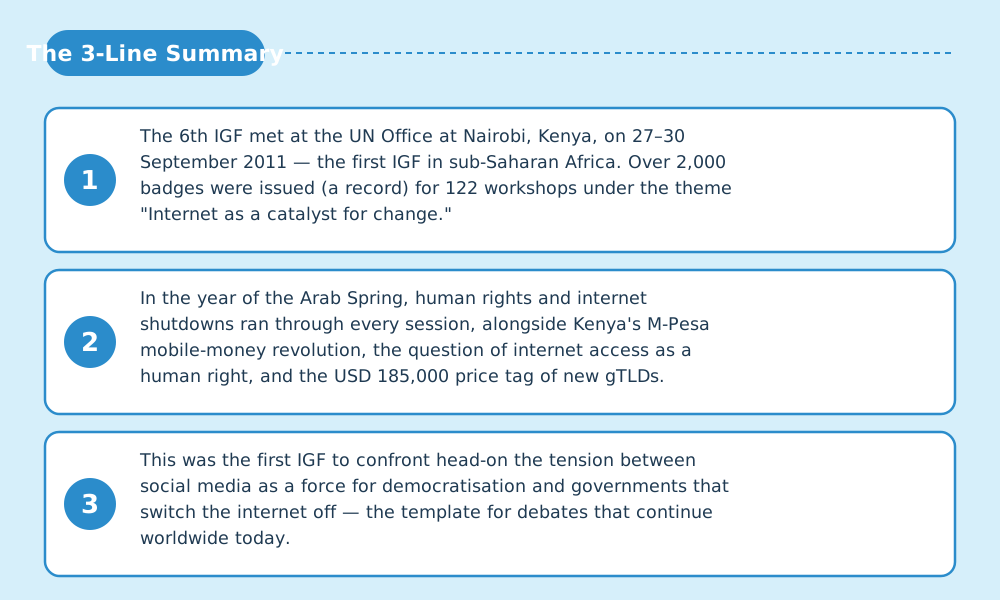
- The 6th IGF met at the UN Office at Nairobi, Kenya, on 27–30 September 2011 — the first IGF in sub-Saharan Africa. Over 2,000 badges were issued (a record) for 122 workshops under the theme "Internet as a catalyst for change."
- In the year of the Arab Spring, human rights and internet shutdowns ran through every session, alongside Kenya's M-Pesa mobile-money revolution, the question of internet access as a human right, and the USD 185,000 price tag of new gTLDs.
- This was the first IGF to confront head-on the tension between social media as a force for democratisation and governments that switch the internet off — the template for debates that continue worldwide today.
Welcome — this is the Japan IGF Support Organization. This in-depth report on Global IGF 2011 in Nairobi draws on official outputs, session records and on-site reporting. In a hurry? The three lines above and the diagrams carry the gist.
Conference at a Glance (from official records)
| Item | Detail |
|---|---|
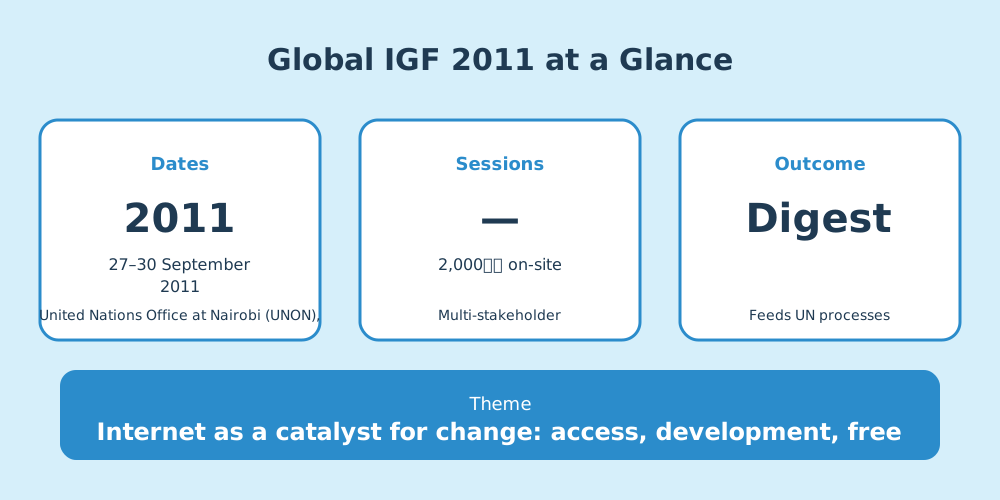
| Dates | 27–30 September 2011 |
| Venue | United Nations Office at Nairobi (UNON), Nairobi, Kenya |
| Theme | Internet as a catalyst for change: access, development, freedoms and innovation |
| Participants | More than 2,000 badges issued — the highest IGF attendance to date |
| Governments | 125 |
| Accredited media | 68 |
| Workshops | 122 |
| Remote participants | More than 823 remote participants; ~2,500 connections from 89 countries; 38 joined as remote panellists |
| Remote hubs | 47 |
| Regional distribution | African 53%, WEOG 29%, Asian 11%, GRULAC 4%, Eastern Europe 3% |
| Host | Government of Kenya (Ministry of Information and Communications) and the United Nations; chaired by Alice Munyua, Kenya Internet Governance Steering Committee |
| Milestone | First IGF ever held in sub-Saharan Africa (6th meeting) |
| Next hosts | At the closing ceremony Azerbaijan reiterated its invitation to host IGF 2012 and Indonesia offered to host the 2013 meeting |
(See the source list at the end of this article.)
Discussion Digest — from the Session Records
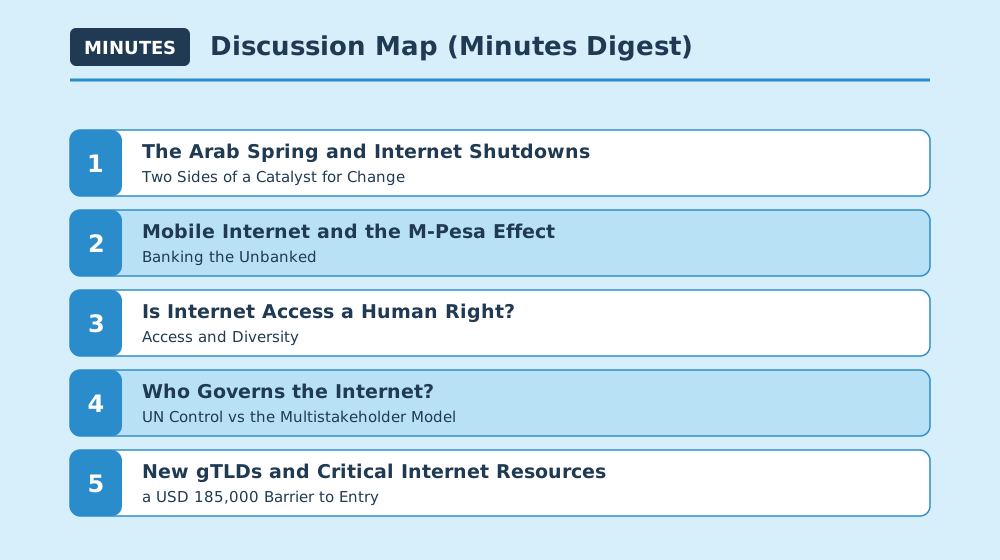
Key exchanges extracted from session records and transcripts.
1. The Arab Spring and Internet Shutdowns — Two Sides of a Catalyst for Change
Sessions: Main Session "Security, Openness and Privacy" (chaired by Michael Katundu, CCK; panellists included Frank La Rue, UN Special Rapporteur on Freedom of Expression)
"Certainly the so-called Arab spring has driven a number of actions by governments across the world and they are taking a much deeper look at the Internet"
— Lynn St. Amour (President and CEO, Internet Society) [1][3]
- The Chair's Summary lists internet cut-offs for individuals, groups and entire countries during the Arab Spring — alongside the WikiLeaks controversy — as defining events of the year [1][3]
- Participants agreed there was no silver bullet: states must protect citizens while guaranteeing freedom of expression, with human rights and the rule of law stressed again and again [1][3]
- The closing session even proposed making human rights the core theme of the next IGF [1][3]
2. Mobile Internet and the M-Pesa Effect — Banking the Unbanked
Sessions: Main Session "Emerging Issues" — "Is governance different for the mobile Internet from the wired Internet?" (chaired by Lillian Nalwoga, CIPESA)
- The chair noted that in Kenya mobile services had put sophisticated financial services into the hands of the previously "unbanked" — the host country's own story anchored the debate [1]
- An industry survey cited in the session projected 3.8 billion mobile-broadband subscriptions — about half the world's population — by 2015; mobile was called possibly the fastest-growing technology in history [1]
- In the opening ceremony, Permanent Secretary Bitange Ndemo described how new fibre-optic cables and innovations such as mobile money had put Kenya on the global map of innovative economies, with over 12 million Kenyans online [1]
3. Is Internet Access a Human Right? — Access and Diversity
Sessions: Main Session "Access and Diversity" (chaired by Dr. Bitange Ndemo, Permanent Secretary, Kenya)
- The UN Special Rapporteur's recent call to treat internet access as a human right framed the session; the rights to development and to the internet were described as conjoined [1]
- For the world's more than one billion people with disabilities, access without accessibility is meaningless — the Chair's Summary records a delegate with disabilities saying there can "be nothing about us without us" [1]
- Chairing the session, Ndemo recalled past pressure to shut down the internet in Kenya — the argument for free flow of information won, propelling Kenya toward more open governance and leadership across Africa [1]
4. Who Governs the Internet? — UN Control vs the Multistakeholder Model
Sessions: A cross-cutting debate, from the workshop on social media and news to the Critical Internet Resources session
"Many say it's a weakness of the IGF that it does not have any decisions or outcomes. However, others argue that is precisely its strength because there is no pressure to negotiate anything"
— Markus Kummer (VP for Public Policy, Internet Society; IGF co-founder) [3][1][6]
"It's not good enough for us to do things the way we've done in the past by the United Nations setting up an agency to run the Internet, a sort of top-down bureaucratic approach"
— Alun Michael (former UK minister; chair of the all-party parliamentary group on internet governance) [3][1][6]
- Egyptian activist Wael Khalil and Daily News Egypt deputy editor Sarah El Sirgany testified in a workshop on how social media was transforming news; UK minister Ed Vaizey called self-regulation by big platforms versus government regulation the essential dilemma [3][1][6]
- Several developing-country governments voiced concern that their voices were not being heard in internet policy-making, yet a strong consensus backed letting existing institutions continue to evolve [3][1][6]
- Vint Cerf expressed discomfort with any attempt to produce a consensus document, defending the IGF as a place for substantive debate rather than negotiation [3][1][6]
5. New gTLDs and Critical Internet Resources — a USD 185,000 Barrier to Entry
Sessions: Main Session "Managing Critical Internet Resources" (chaired by John Walubengo, Multimedia University College of Kenya)
- New gTLD applications — opening right after the IGF — required USD 185,000 plus an escrow deposit of several years' operating costs; a reduced fee of USD 47,000 for emerging markets had been proposed but not yet decided [1]
- The IANA contract re-bid was in focus, and speakers noted that transparency alone is not enough: the real barrier is the ability to digest the enormous volume of material — "information does not equal knowledge" [1]
- Governments' role through ICANN's Governmental Advisory Committee had become significantly more effective over the past year, shaping the final gTLD applicant process [1]
Three-Minute Short Talk — Your Questions Answered
Q. So what did the conference actually decide?
A. The IGF doesn't decide anything — and in 2011, months after the Arab Spring, simply getting governments, companies and civil society around one UN table to discuss internet shutdowns and surveillance was the achievement. The discussions were captured in the Chair's Summary.
Q. What was the most contentious topic?
A. Whether the UN should set up a new agency to run the internet. Developing-country governments said their voices weren't being heard; the technical community and Western governments defended the bottom-up multistakeholder model. The IGF's own no-decision format was itself on trial.
Q. Why should I care?
A. Kenya's M-Pesa story — banking the unbanked by phone — previewed today's mobile-payment world. And the question raised here, whether cutting off the internet violates human rights, is still being fought over 15 years later.
What Is Global IGF? (for first-time readers)
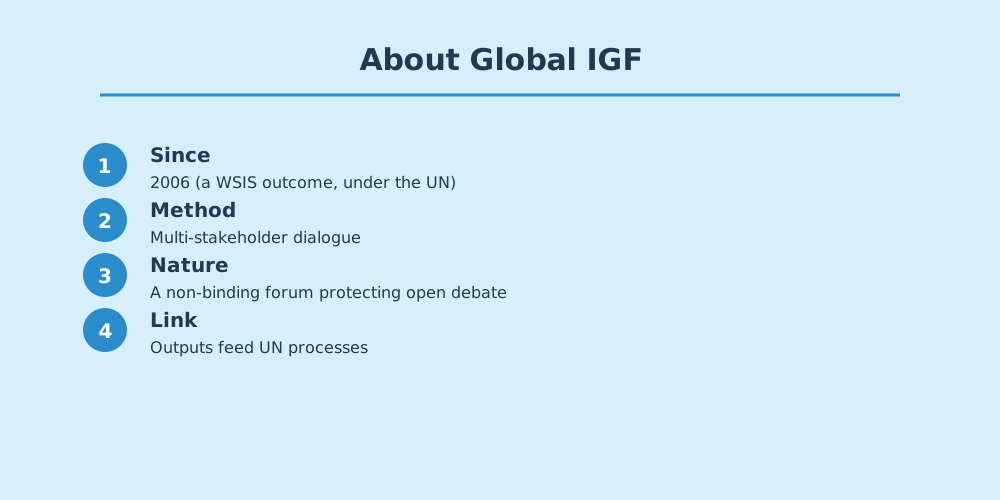
Global IGF has met annually under UN auspices since 2006 — the one global conference where governments, business, civil society, the technical community and youth debate internet governance as equals (the multistakeholder model).
Why It Matters to You
What was discussed here becomes the baseline for national digital policy, platform rules and AI regulation worldwide within a few years. The principles confirmed at the 2011 meeting are the foundation of the "next rules" for the phones, social platforms and AI services you use every day.
Sources & References
- Sixth Meeting of the Internet Governance Forum (IGF), Nairobi, Kenya, 27-30 September 2011 — Chair's Summary (PDF) — UN IGF Secretariat, wgig.org アーカイブ (accessed 2026-07-10)
- Internet Governance Forum Concludes in Nairobi, with Officials Describing 2011 Event as 'Biggest and Liveliest' Since Inception (PI/2011) — UN Meetings Coverage and Press Releases (accessed 2026-07-10)
- Who Owns the Internet? A report from the Internet Governance Forum — The Next Web (accessed 2026-07-10)
- Internet Governance Forum — IGF VI, Nairobi, Kenya 2011 — 英語版 (accessed 2026-07-10)
- IGF 2011 (archived official page) — intgovforum.org (accessed 2026-07-10)
- Thoughts on IGF Nairobi by Raf Fatani — UK Internet Governance Forum (accessed 2026-07-10)
Quotes are translated or condensed from the records listed above. Bracketed numbers [n] refer to the source list.
Related links
- IGF official (NRI list): https://www.intgovforum.org/en/content/national-and-regional-igf-initiatives
- Japan IGF: https://japanigf.jp/
- Yuki Nakazawa's blog: https://nkzw.jp/category/igf/
Revision History
Rev. 1 — published 27 September 2011, 15:00 (Article published)
Rev. 2 — updated 10 July 2026, 14:28 (Fully revised into the in-depth edition: added the 3-line summary, minutes digest, short talk, source list and diagrams (all quotes verified against the listed sources))
— 中澤祐樹

