


The 3-Line Summary
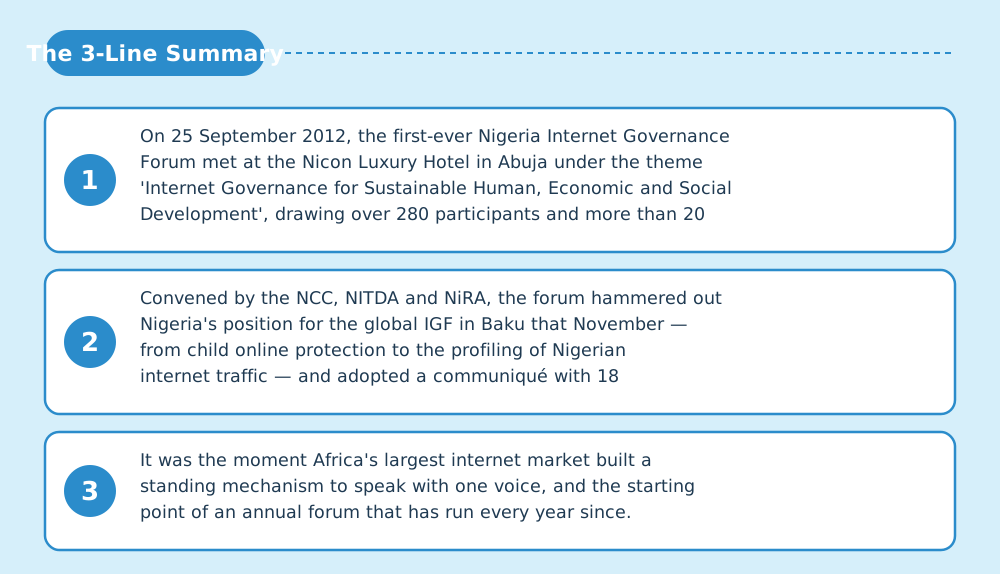
- On 25 September 2012, the first-ever Nigeria Internet Governance Forum met at the Nicon Luxury Hotel in Abuja under the theme 'Internet Governance for Sustainable Human, Economic and Social Development', drawing over 280 participants and more than 20 speakers.
- Convened by the NCC, NITDA and NiRA, the forum hammered out Nigeria's position for the global IGF in Baku that November — from child online protection to the profiling of Nigerian internet traffic — and adopted a communiqué with 18 recommendations.
- It was the moment Africa's largest internet market built a standing mechanism to speak with one voice, and the starting point of an annual forum that has run every year since.
Welcome — this is the Japan IGF Support Organization. This in-depth report on 1st Nigeria Internet Governance Forum (NIGF 2012) draws on official outputs, session records and on-site reporting. In a hurry? The three lines above and the diagrams carry the gist.
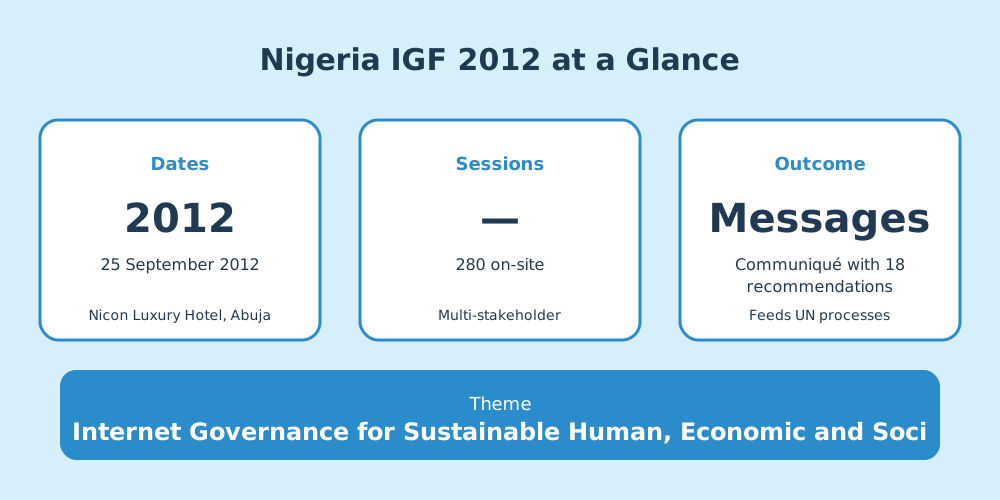
Conference at a Glance (from official records)
| Item | Detail |
|---|---|
| Official name | 1st Nigeria Internet Governance Forum (NIGF 2012) |
| Dates | 25 September 2012 |
| Venue | Nicon Luxury Hotel, Abuja |
| Theme | Internet Governance for Sustainable Human, Economic and Social Development |
| Participants | 280 |
| Speakers | 20 |
| Host | Jointly organised by the NCC, NITDA and NiRA in collaboration with the Federal Ministry of Communication Technology; planning committee chaired by NiRA president Mary Uduma |
| Outcome | Communiqué with 18 recommendations |
(See the source list at the end of this article.)
Discussion Digest — from the Session Records
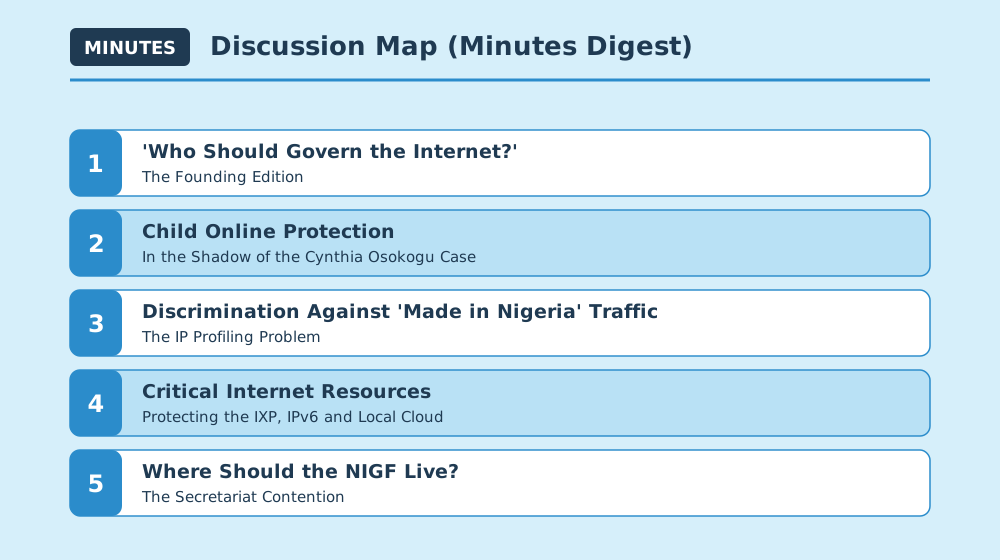
Key exchanges extracted from session records and transcripts.
1. 'Who Should Govern the Internet?' — The Founding Edition
Sessions: Opening session (welcome by Mary Uduma; keynote by Omobola Johnson, Minister of Communication Technology)
- Planning-committee chair Mary Uduma (NiRA president) told delegates the open nature of the internet was non-negotiable, putting the global 'who governs the internet' question on Nigeria's domestic agenda [1][4]
- In her keynote, Minister Omobola Johnson noted that an estimated 45 million Nigerians had used the internet by end-2011, up from 200,000 in 2000, and argued international internet management must be multilateral, transparent and democratic [1][4]
- An earlier local IGF attempt by the then Ministry of Information and Communication (2008) had fizzled; this relaunch was the first with a standing inter-agency, multistakeholder structure [1][4]
2. Child Online Protection — In the Shadow of the Cynthia Osokogu Case
Sessions: Agenda 2: Security, Openness and Privacy (SOP)
"Technologies must not be blamed for users' moral challenges. Moral standards must be strengthened rather than tighten security (official report)"
— Hakeem Ajijola (CEO, Consultancy Support Services) [1]
- With the murder of student Cynthia Osokogu — killed by men she met on social media — fresh in delegates' minds, child online protection dominated the security session [1]
- Speakers proposed adopting the NCC-facilitated child online protection policy guidelines (cop.gov.ng, drafted from 2011) as the national position, plus a coordinated incident-response system for reporting cybercrime [1]
- The communiqué demanded fast-tracking of the pending Cybercrime Bill — a law that would finally pass in 2015 [1]
3. Discrimination Against 'Made in Nigeria' Traffic — The IP Profiling Problem
Sessions: Stocktaking session and communiqué (recommendation 3)
- Delegates flagged as a major concern the profiling and blocking of internet transactions originating from Nigeria, which shut legitimate e-commerce players out of global markets [1]
- The communiqué recommended formally demanding a reversal of such discriminatory treatment at the African and global IGFs [1]
- Speakers including Paradigm Initiative's Gbenga Sesan argued Nigeria should build its own capacity to measure domestic internet usage rather than rely on foreign statistics [1]
4. Critical Internet Resources — Protecting the IXP, IPv6 and Local Cloud
Sessions: Agenda 3: Managing Critical Internet Resources; Agenda 5: Emerging Issues
- Muhammad Rudman, CEO of the Internet Exchange Point of Nigeria, argued for hosting cloud services and content locally to cut costs and reduce the vulnerabilities of offshore data hosting [1]
- NiRA vice-president Sunday Folayan proposed designating the IXP a protected critical national resource, a federal IPv6 task force, and a fund to send some 20 Nigerians regularly to ICANN, IETF and IGF meetings [1]
- Delegates even proposed that road designs include ducts for pulling fibre — a concrete plea for internet-aware public works [1]
5. Where Should the NIGF Live? — The Secretariat Contention
Sessions: Agenda 6: Taking Stock and Way Forward (plenary)
- Where to house the new NIGF secretariat proved contentious; stakeholders agreed it should sit with a neutral, independent body — NiRA, the .ng registry — rather than a government agency [1][3]
- The communiqué called for sustained government backing of the annual multistakeholder dialogue and an IGF fund to sponsor Nigerian delegates abroad [1][3]
- Delegates set the ambitious goals of hosting the African IGF within a year and bidding for the global IGF by 2014 — the former came true when Abuja hosted the 3rd AfIGF in July 2014 [1][3]
Three-Minute Short Talk — Your Questions Answered
Q. What did this meeting decide?
A. A communiqué with 18 recommendations — fast-track the cybercrime bill, protect the internet exchange point as critical infrastructure, keep the forum annual — which became Nigeria's position at the global IGF in Baku that November.
Q. What was the most contentious point?
A. Where to put the new NIGF secretariat. Stakeholders chose the neutral .ng registry NiRA over any government agency, stamping the forum as multistakeholder rather than state-run from day one.
Q. Why should I care?
A. The 'IP profiling' debate — legitimate Nigerian transactions being blocked wholesale abroad — is a universal story about trust and inclusion online, relevant to anyone doing business with African markets.
What Is Nigeria IGF? (for first-time readers)
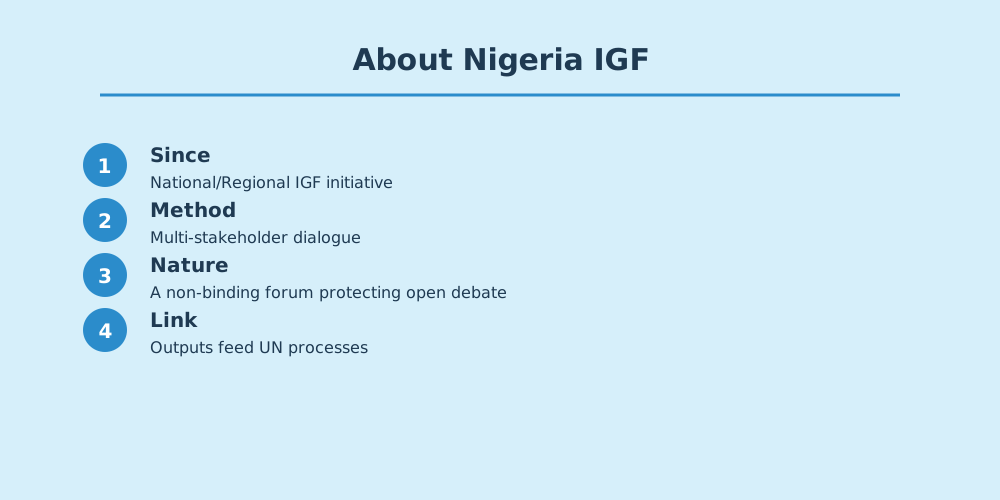
Nigeria IGF is a National or Regional IGF Initiative (NRI), aligning local internet governance discussion with global IGF principles.
Why It Matters to You
What was discussed here becomes the baseline for national digital policy, platform rules and AI regulation worldwide within a few years. The principles confirmed at the 2012 meeting are the foundation of the "next rules" for the phones, social platforms and AI services you use every day.
Sources & References
- NIGF 2012 Final Report — NIGF事務局(NCC公式サイト掲載) (accessed 2026-07-11)
- Digital Inclusion and Public Access Policy Issues(NIGF 2012発表資料) — Jimson Olufuye / Africa ICT Alliance(NCC公式サイト掲載) (accessed 2026-07-11)
- Nigeria — GISWatch 2017 country report — Global Information Society Watch (APC) / CITAD (accessed 2026-07-11)
- Nigeria IGF — GISWatch special report on national IGF initiatives — APC (accessed 2026-07-11)
- NIGF REPORTS(年次報告書アーカイブ) — NiRA(ナイジェリア・インターネット登録協会) (accessed 2026-07-11)
Quotes are translated or condensed from the records listed above. Bracketed numbers [n] refer to the source list.
Related links
- IGF official (NRI list): https://www.intgovforum.org/en/content/national-and-regional-igf-initiatives
- Japan IGF: https://japanigf.jp/
- Yuki Nakazawa's blog: https://nkzw.jp/category/igf/
Revision History
Rev. 1 — published 15 September 2012, 11:00 (Article published)
Rev. 2 — updated 17 July 2026, 12:32 (Fully revised into the in-depth edition: added the 3-line summary, minutes digest, short talk, source list and diagrams (all quotes verified against the listed sources))
— 中澤祐樹

