


The 3-Line Summary
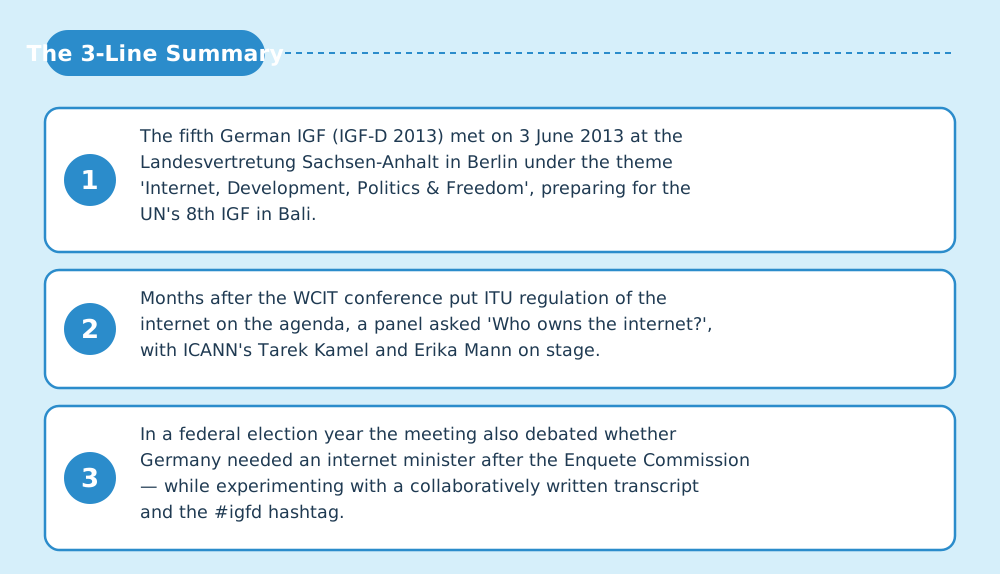
- The fifth German IGF (IGF-D 2013) met on 3 June 2013 at the Landesvertretung Sachsen-Anhalt in Berlin under the theme 'Internet, Development, Politics & Freedom', preparing for the UN's 8th IGF in Bali.
- Months after the WCIT conference put ITU regulation of the internet on the agenda, a panel asked 'Who owns the internet?', with ICANN's Tarek Kamel and Erika Mann on stage.
- In a federal election year the meeting also debated whether Germany needed an internet minister after the Enquete Commission — while experimenting with a collaboratively written transcript and the #igfd hashtag.
Welcome — this is the Japan IGF Support Organization. This in-depth report on V. Internet Governance Forum Deutschland (IGF-D 2013) draws on official outputs, session records and on-site reporting. In a hurry? The three lines above and the diagrams carry the gist.
Conference at a Glance (from official records)
| Item | Detail |
|---|---|
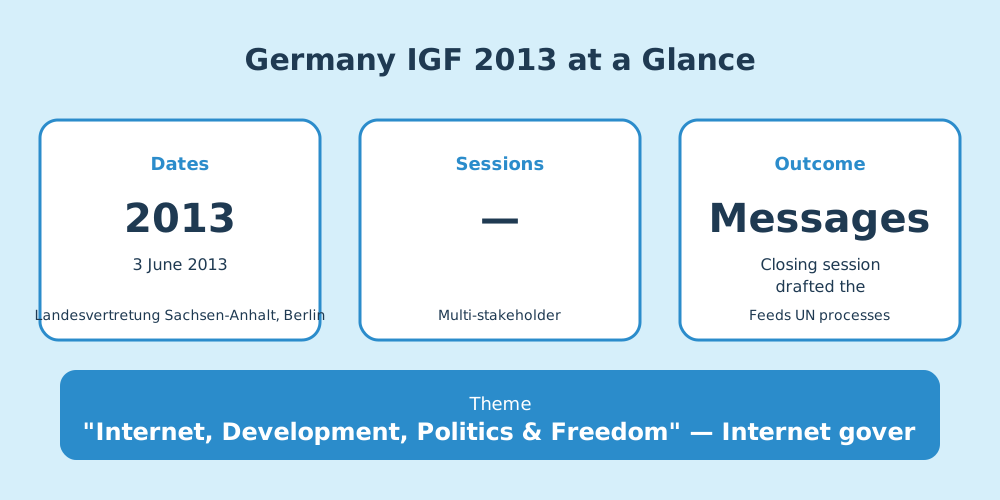
| Official name | V. Internet Governance Forum Deutschland (IGF-D 2013) |
| Dates | 3 June 2013 |
| Venue | Landesvertretung Sachsen-Anhalt, Berlin |
| Theme | "Internet, Development, Politics & Freedom" — Internet governance: unity out of many, or fragmented landscapes? |
| Purpose | Germany's contribution to the 8th UN IGF in Bali, Indonesia (October 2013) |
| Host | DGVN (German UN Association), eco, Humanistische Union and ISOC.DE |
| Outcome | Closing session drafted the "Messages from Berlin" (as set out in the official programme) |
(See the source list at the end of this article.)
Discussion Digest — from the Session Records
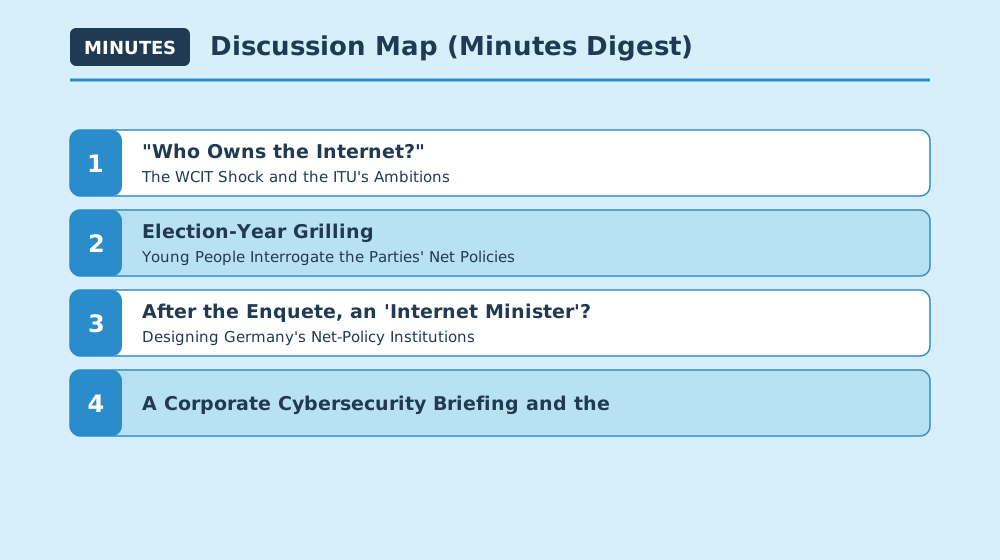
Key exchanges extracted from session records and transcripts.
1. "Who Owns the Internet?" — The WCIT Shock and the ITU's Ambitions
Sessions: Keynote by Tarek Kamel (9:35) and panel "Who Owns the Internet? — ITU, WCIT, WTPF & Co" (10:15–11:00, moderated by Falk Steiner)
- After several states used the December 2012 WCIT in Dubai to push for extending ITU authority over the internet, the official programme spelled out fears of growing state control and surveillance and of a 'two-class internet' open only to financially strong companies and users [1][3]
- Tarek Kamel — former Egyptian communications minister, then ICANN senior advisor — keynoted on the multistakeholder approach in global perspective; ICANN's Erika Mann, the economics ministry's Hubert Schöttner and eco's Oliver Süme parsed the dynamics after the May 2013 WTPF [1][3]
- The panel framed these skirmishes as the run-up to the ITU's 2014 Plenipotentiary — making the state-centric-versus-multistakeholder contest the year's central axis [1][3]
2. Election-Year Grilling — Young People Interrogate the Parties' Net Policies
Sessions: Panel "Net-Policy Agendas in Plain Language" (11:15–12:45, moderated by Lorena Jaume-Palasi & Nadine Karbach)
- Ahead of the September 2013 federal election, young people directly questioned politicians from government, opposition and extra-parliamentary opposition — Malte Spitz (Greens), Anke Domscheit-Berg (Pirate Party) and Thomas Jarzombek (CDU) — on their parties' net-policy platforms [1][2][3]
- The youth-IGF track matured, gaining its own page on the official site [1][2][3]
- EuroDIG's Sandra Hoferichter served as rapporteur, institutionalising the pipeline from panel debate to the closing Messages from Berlin [1][2][3]
3. After the Enquete, an 'Internet Minister'? — Designing Germany's Net-Policy Institutions
Sessions: Panel "From the Enquete to an Internet Minister?" (14:30–16:00, moderated by Prof. Wolfgang Kleinwächter)
- With the Bundestag's three-year Enquete Commission on the Internet and Digital Society just concluded (final report April 2013), the panel debated whether Germany should appoint an 'internet minister' to consolidate net policy [1][3]
- The line-up was unusually broad: netzpolitik.org's Markus Beckedahl, interior-ministry IT director Martin Schallbruch, foreign-office cyber coordinator Martin Fleischer, MP Jimmy Schulz (FDP), Afilias chairman Philipp Grabensee — and MDR broadcasting director Karola Wille [1][3]
- The question of who coordinates cross-ministerial net policy foreshadowed the post-election Digital Agenda (2014) and the Bundestag's new Digital Agenda committee [1][3]
4. A Corporate Cybersecurity Briefing and the Open-Transcript Experiment
Sessions: Lecture "Cybersecurity – Help to Protect" (13:30–14:15, Deutsche Telekom) and closing session "Messages from Berlin to the IGF" (16:00–16:30)
- Dr Markus Schmall, Deutsche Telekom's VP for IT security, delivered a briefing titled 'Cybersecurity – Help to Protect' with Q&A — the country's biggest carrier explaining its defences inside the national IGF [1][3][2]
- Every participant could edit a shared online transcript, finalised by session rapporteurs, and the #igfd hashtag ran officially — an early experiment in radically open documentation [1][3][2]
- In the closing session the rapporteurs (Gierow, Hoferichter, Ceulic, Haselbeck) pooled their findings and, under Prof. Kleinwächter's moderation, drafted the Messages from Berlin for the Bali IGF [1][3][2]
Three-Minute Short Talk — Your Questions Answered
Q. What kind of meeting was this?
A. Germany's fifth national IGF, held before the UN IGF in Bali, debating 'who owns the internet' — with a session where young people grilled politicians on their parties' net policies.
Q. What was the big controversy?
A. Whether the ITU should gain regulatory power over the internet. The 2012 WCIT had split the world into state-control and free-internet camps, and that fault line ran through this meeting.
Q. Why does it matter?
A. The WCIT fault line still shapes global digital politics, and the 'internet minister' debate — who coordinates digital policy across ministries — is the same question countries from Germany to Japan later answered with digital ministries and agencies.
What Is Germany IGF? (for first-time readers)
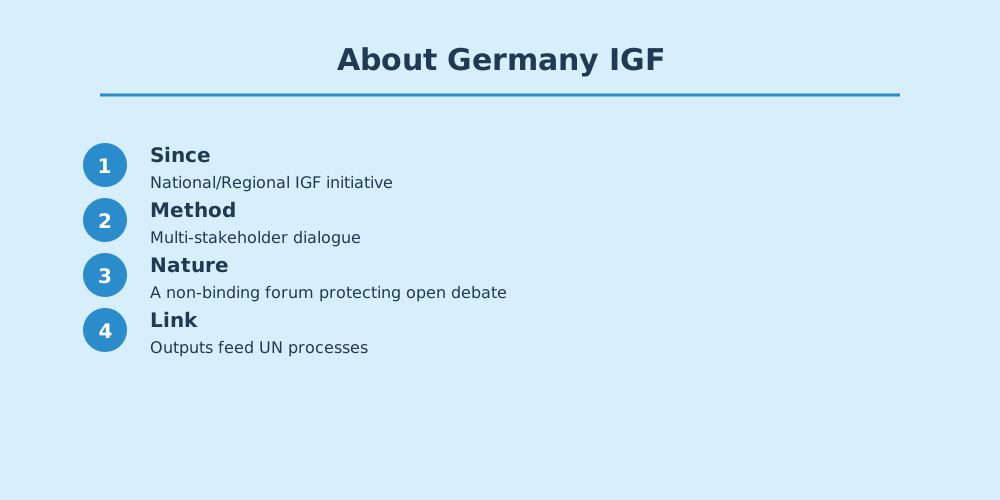
Germany IGF is a National or Regional IGF Initiative (NRI), aligning local internet governance discussion with global IGF principles.
Why It Matters to You
What was discussed here becomes the baseline for national digital policy, platform rules and AI regulation worldwide within a few years. The principles confirmed at the 2013 meeting are the foundation of the "next rules" for the phones, social platforms and AI services you use every day.
Sources & References
- Programm 2013 — 5. Internet Governance Forum Deutschland: Deutschlands Beitrag zum 8. Internet Governance Forum der Vereinten Nationen in Bali — IGF-D(旧公式サイト igf-d.de、Wayback Machine保存) (accessed 2026-07-11)
- SAVE THE DATE: 5. IGF-D am 3. Juni 2013 in Berlin(公式ニュース 2013-05-03、モットーとパネル予告) — IGF-D(旧公式サイト igf-d.de、Wayback Machine保存) (accessed 2026-07-11)
- IGF-D 2013 — V. Internet Governance Forum Deutschland(公式Historieページ、全アジェンダ・主催団体) — IGF-D e.V.(2020年版公式サイト、Wayback Machine保存) (accessed 2026-07-11)
- Internet Governance Forum Deutschland(IGF-D設立経緯・Messages from Berlinの仕組み) — DiploFoundation (accessed 2026-07-11)
Quotes are translated or condensed from the records listed above. Bracketed numbers [n] refer to the source list.
Related links
- IGF official (NRI list): https://www.intgovforum.org/en/content/national-and-regional-igf-initiatives
- Japan IGF: https://japanigf.jp/
- Yuki Nakazawa's blog: https://nkzw.jp/category/igf/
Revision History
Rev. 1 — published 20 June 2013, 09:00 (Article published)
Rev. 2 — updated 16 July 2026, 20:09 (Fully revised into the in-depth edition: added the 3-line summary, minutes digest, short talk, source list and diagrams (all quotes verified against the listed sources))
— 中澤祐樹

