

The 3-Line Summary
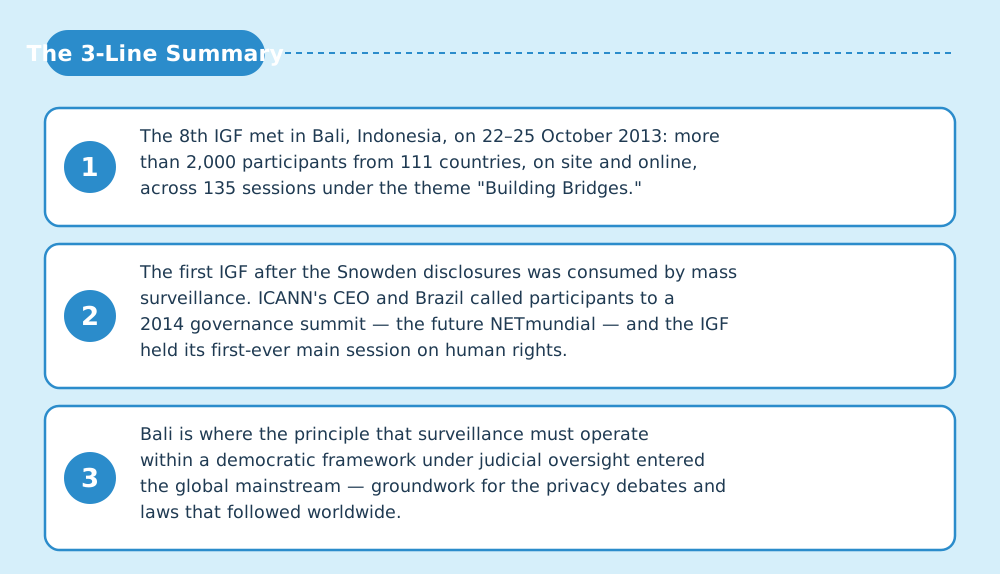
- The 8th IGF met in Bali, Indonesia, on 22–25 October 2013: more than 2,000 participants from 111 countries, on site and online, across 135 sessions under the theme "Building Bridges."
- The first IGF after the Snowden disclosures was consumed by mass surveillance. ICANN's CEO and Brazil called participants to a 2014 governance summit — the future NETmundial — and the IGF held its first-ever main session on human rights.
- Bali is where the principle that surveillance must operate within a democratic framework under judicial oversight entered the global mainstream — groundwork for the privacy debates and laws that followed worldwide.
Welcome — this is the Japan IGF Support Organization. This in-depth report on Global IGF 2013 in Bali draws on official outputs, session records and on-site reporting. In a hurry? The three lines above and the diagrams carry the gist.
Conference at a Glance (from official records)
| Item | Detail |
|---|---|
| Edition | 8th IGF |
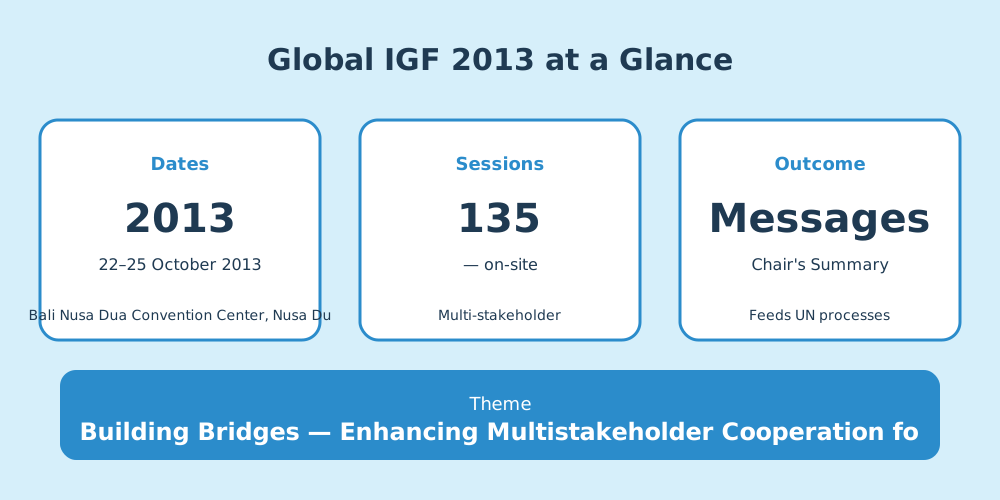
| Dates | 22–25 October 2013 |
| Venue | Bali Nusa Dua Convention Center, Nusa Dua, Bali, Indonesia |
| Theme | Building Bridges — Enhancing Multistakeholder Cooperation for Growth and Sustainable Development |
| Participants | Nearly 1,500 delegates on site from 111 countries; more than 2,000 including remote participants. Civil society was the largest stakeholder group |
| Sessions | 135 |
| Remote participation | About 1,704 remote connections from 83 countries, roughly 25 remote hubs, and 100+ remote presenters |
| Chair | Chaired by Tifatul Sembiring, Indonesia's Minister of Communication and Information Technology |
| Host | Government of Indonesia (Ministry of Communication and Information Technology) and the United Nations |
| Outcome | Chair's Summary |
| Context | The first global IGF after Edward Snowden's NSA mass-surveillance disclosures of June 2013 |
| Future hosts | At the closing, Turkey (2014), Brazil (2015) and Mexico (2016, contingent on renewal of the IGF mandate) announced their intent to host |
(See the source list at the end of this article.)
Discussion Digest — from the Session Records
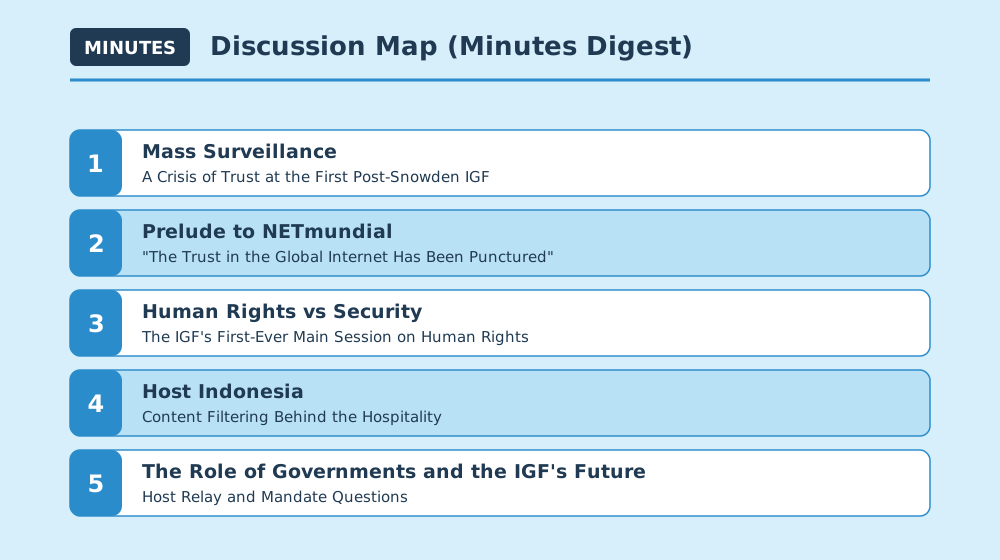
Key exchanges extracted from session records and transcripts.
1. Mass Surveillance — A Crisis of Trust at the First Post-Snowden IGF
Sessions: Across the whole meeting (multiple focus sessions and workshops, 22–25 October)
- Mass surveillance by the NSA and others was not the official headline agenda, yet it was debated in most of the 100-plus workshops in its legal, technical and social dimensions — it "permeated the entire event" (APC) [1][3][7][6]
- The Chair's Summary stated that security-driven surveillance should only happen "within a truly democratic framework, ensuring adequacy, proportionality, due process and judicial oversight," and that user trust had been seriously damaged [1][3][7][6]
- A planned marquee panel on surveillance collapsed after invited speakers — NSA Director Keith Alexander and German Justice Minister Sabine Leutheusser-Schnarrenberger — declined to appear [1][3][7][6]
2. Prelude to NETmundial — "The Trust in the Global Internet Has Been Punctured"
Sessions: ICANN's briefing and press conference on the "Brazil meeting" initiative (22–23 October)
"The trust in the global Internet has been punctured and now it's time to restore this trust through leadership"
— Fadi Chehadé (ICANN CEO) [5][1][4]
"If you want to go fast, go alone. If you want to go far, go together. So let's go together."
— Fadi Chehadé (ICANN CEO) [5][1][4]
- Brazil's representative invited IGF stakeholders to a "summit" on internet governance in the first half of 2014 — the initiative that became the NETmundial multistakeholder meeting [5][1][4]
- The move followed President Dilma Rousseff's forceful speech against US surveillance at the opening of the UN General Assembly in September 2013, amid distrust of US-centric governance [5][1][4]
3. Human Rights vs Security — The IGF's First-Ever Main Session on Human Rights
Sessions: Focus session on human rights, freedom of expression and the free flow of information — the IGF's first plenary dedicated to human rights
"There is no tradeoff between human rights and security… it is about securing the respect for human rights"
— Johan Hallenborg (Swedish Ministry of Foreign Affairs) [4][1]
- In its eighth year the IGF for the first time devoted a main session to human rights, tying it directly to the surveillance debate [4][1]
- Scott Busby of the US State Department framed security and rights as "a balancing act," while Sweden countered head-on that no tradeoff exists — a defining fault line of the week [4][1]
- Sweden presented seven principles for rights-respecting communications surveillance, including legality, legitimate aim, necessity and adequacy, proportionality and judicial oversight [4][1]
4. Host Indonesia — Content Filtering Behind the Hospitality
Sessions: Citizen Lab's monitoring research during the meeting and related workshops
- The communications ministry's "Trust+ Positif" filtering system listed over 745,000 domain names and 55,000 URLs for blocking; Citizen Lab investigated and published its workings around the meeting [8]
- Though nominally anti-pornography, blocking extended to local LGBT community sites and religious sites — a documented case of mission creep [8]
- At the same time, Indonesian civil society played an unprecedented organisational role in the host committee, earning credit as a multistakeholder practice by the host country [8]
5. The Role of Governments and the IGF's Future — Host Relay and Mandate Questions
Sessions: Focus session "Building Bridges — The Role of Governments in Multistakeholder Cooperation" (22 October morning) and the closing session
- The opening-day session, building on Brazil's "role of governments" opinion at the May 2013 WTPF, found broad support for the view that governments should support — not lead — multistakeholder processes [1][7]
- Brazil's representative stressed the proposal was not a power grab, pointing to Brazil's offer to host IGF 2015 as proof of its embrace of the multistakeholder model [1][7]
- Turkey (2014), Brazil (2015) and Mexico (2016, contingent on mandate renewal) announced hosting intentions at the closing, making the IGF's post-2015 survival a live issue [1][7]
Three-Minute Short Talk — Your Questions Answered
Q. So what did the conference actually decide?
A. The IGF doesn't 'decide' — it's the UN's forum where governments, companies and civil society talk as equals. But this year produced real movement: the Chair's Summary spelled out alarm over surveillance, Brazil invited everyone to a 2014 summit that became NETmundial, and Turkey, Brazil and Mexico lined up to host future IGFs.
Q. What was the most contentious topic?
A. US-led mass surveillance. At the first IGF after the Snowden leaks, the issue seeped into every session despite not being on the official agenda. The US spoke of 'balancing' security and rights; Sweden shot back that no tradeoff exists. The NSA director was invited but never showed.
Q. Why should I care?
A. This was the year the world learned its emails and messages could be watched across borders. The principle affirmed in Bali — surveillance only under legality, proportionality and judicial oversight — became the foundation for privacy laws and surveillance debates that followed worldwide.
What Is Global IGF? (for first-time readers)
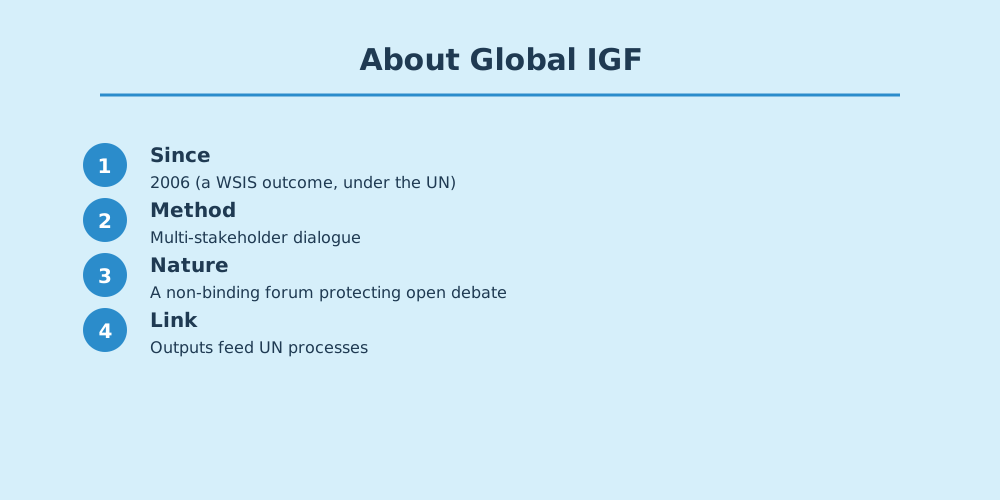
Global IGF has met annually under UN auspices since 2006 — the one global conference where governments, business, civil society, the technical community and youth debate internet governance as equals (the multistakeholder model).
Why It Matters to You
What was discussed here becomes the baseline for national digital policy, platform rules and AI regulation worldwide within a few years. The principles confirmed at the 2013 meeting are the foundation of the "next rules" for the phones, social platforms and AI services you use every day.
Sources & References
- Chair's Summary — 8th Meeting of the Internet Governance Forum, Bali (PDF) — UN IGF Secretariat / WGIG archive (accessed 2026-07-10)
- Internet Governance Forum — IGF VIII, Bali, Indonesia 2013 — en (accessed 2026-07-10)
- Surveillance a major concern at conclusion of UN-backed forum on internet governance — UN News (accessed 2026-07-10)
- 2013 Internet Governance Forum in Review — Access Now (accessed 2026-07-10)
- ICANN Explains "Brazil Meeting" Initiative — CircleID (accessed 2026-07-10)
- The Bali IGF: surveillance, surveillance, surveillance — Monika Ermert (accessed 2026-07-10)
- Reflections from APC on the IGF 2013 and recommendations for the IGF 2014 — APC (accessed 2026-07-10)
- IGF 2013: Analysis of the 2013 IGF and Future of Internet Governance in Indonesia — University of Toronto (accessed 2026-07-10)
Quotes are translated or condensed from the records listed above. Bracketed numbers [n] refer to the source list.
Related links
- IGF official (NRI list): https://www.intgovforum.org/en/content/national-and-regional-igf-initiatives
- Japan IGF: https://japanigf.jp/
- Yuki Nakazawa's blog: https://nkzw.jp/category/igf/
Revision History
Rev. 1 — published 22 October 2013, 10:00 (Article published)
Rev. 2 — updated 10 July 2026, 14:28 (Fully revised into the in-depth edition: added the 3-line summary, minutes digest, short talk, source list and diagrams (all quotes verified against the listed sources))
— 中澤祐樹

