

The 3-Line Summary
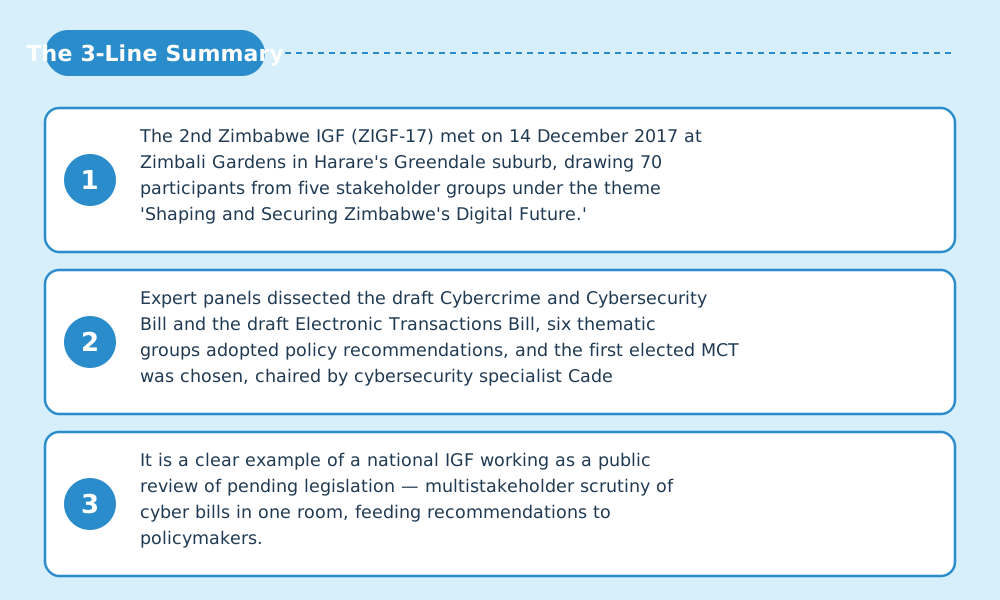
- The 2nd Zimbabwe IGF (ZIGF-17) met on 14 December 2017 at Zimbali Gardens in Harare's Greendale suburb, drawing 70 participants from five stakeholder groups under the theme 'Shaping and Securing Zimbabwe's Digital Future.'
- Expert panels dissected the draft Cybercrime and Cybersecurity Bill and the draft Electronic Transactions Bill, six thematic groups adopted policy recommendations, and the first elected MCT was chosen, chaired by cybersecurity specialist Cade Zvavanjanja.
- It is a clear example of a national IGF working as a public review of pending legislation — multistakeholder scrutiny of cyber bills in one room, feeding recommendations to policymakers.
Welcome — this is the Japan IGF Support Organization. This in-depth report on ZIGF 2017 (2nd Zimbabwe Internet Governance Forum) draws on official outputs, session records and on-site reporting. In a hurry? The three lines above and the diagrams carry the gist.
Conference at a Glance (from official records)
| Item | Detail |
|---|---|
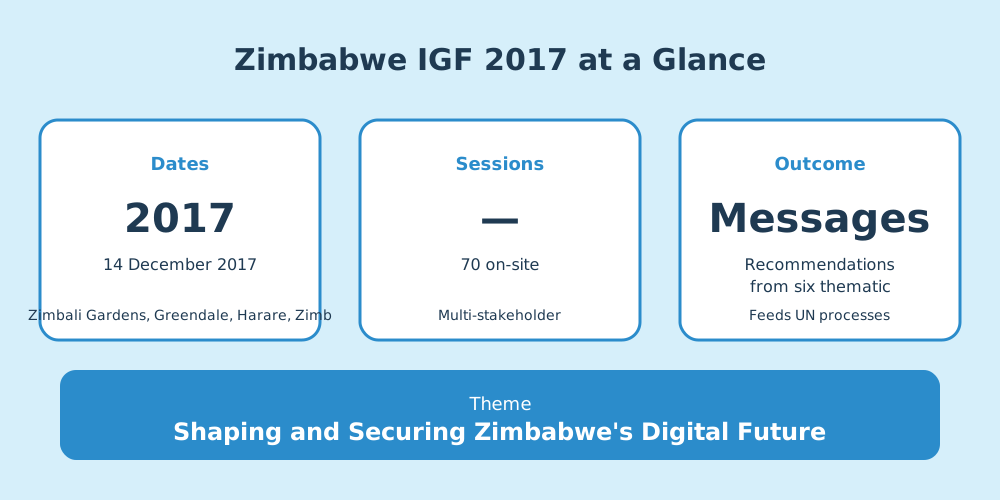
| Official name | ZIGF 2017 (2nd Zimbabwe Internet Governance Forum) |
| Edition | Second public meeting, officially the '2017 Public Meeting of the ZIGF' (ZIGF-17) |
| Dates | 14 December 2017 |
| Venue | Zimbali Gardens, Greendale, Harare, Zimbabwe |
| Theme | Shaping and Securing Zimbabwe's Digital Future |
| Participants | 70 (70 participants representing the technical, academic, civil-society, private-sector and government stakeholder groups (official report)) |
| Host | ZIGF interim Multi-stakeholder Coordinating Team (MCT); secretariat: POTRAZ |
| Outcome | Recommendations from six thematic working groups, and election of the first substantive MCT chaired by Cade Zvavanjanja |
(See the source list at the end of this article.)
Discussion Digest — from the Session Records
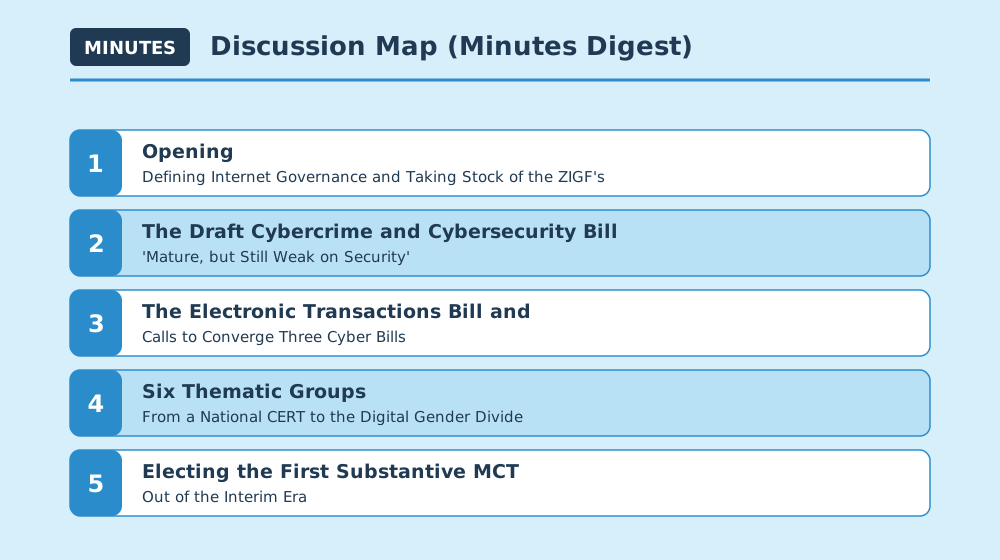
Key exchanges extracted from session records and transcripts.
1. Opening — Defining Internet Governance and Taking Stock of the ZIGF's First Two and a Half Years
Sessions: Official Opening Session, with interim MCT chair Dr Gilford Hapanyengwi and POTRAZ Deputy Director-General Alfred Marisa
"The way in which 'stakeholders' influence and foster the continued proper development and use of the Internet"
— Dr Gilford Hapanyengwi (outgoing chair, interim ZIGF MCT) [1]
- Outgoing interim chair Hapanyengwi reviewed 2015–2017: ToR adoption, registration with the global IGF, an independent website, and — despite no 2016 forum — submissions to IGF and ITU open consultations [1]
- POTRAZ Deputy Director-General Alfred Marisa set out the regulator's remit: DNS management, licensing of Internet access providers, universal access, consumer protection and technology advancement [1]
- Quoting Kofi Annan's line about passing the torch to the next generation, the chair framed the meeting as the handover from the interim team to an elected MCT [1]
2. The Draft Cybercrime and Cybersecurity Bill — 'Mature, but Still Weak on Security'
Sessions: Working Session: Panel on the Draft Cybercrime and Cybersecurity Bill, 2017 (moderator T. Mujuru; panellists Robert Shoniwa, Cade Zvavanjanja and Mr Mudiwa)
- Robert Shoniwa welcomed the draft's advances: it now covers individual privacy and security, child pornography, revenge pornography, xenophobia, extortion and ransomware [1]
- Cade Zvavanjanja judged the bill 'mature and human-rights centred' yet still weak on cybersecurity, calling for stronger international-cooperation clauses on extradition and references to the Budapest Convention, while crediting improvement over the SADC Model Law [1]
- Mr Mudiwa lamented that drafting had dragged into its fifth year since 2013; the floor proposed a resolution urging the ICT ministry to speed up gazetting of the bill stuck in the Attorney General's Office [1]
3. The Electronic Transactions Bill and Cryptocurrencies — Calls to Converge Three Cyber Bills
Sessions: Working Session: Panel on the Draft Electronic Transactions and Electronic Commerce Bill, 2017 (same panel)
"Where else in the world are crypto currencies regulated. Besides, our own Central Bank, the Reserve Bank of Zimbabwe, has no control over it"
— Mrs H. Mutseyekwa (participant) [1]
- Zvavanjanja observed that half the bill duplicates the Cybercrime Bill, urging the three cyber bills to converge rather than diverge, and flagged loopholes in the proposed 30-day cooling-off periods [1]
- While panellists stressed the need for a legal basis for e-transactions, others noted Zimbabweans were already transacting electronically, and that Sections 161 and 164 of the criminal code already criminalise some cyber offences [1]
- Cryptocurrency regulation crept in unplanned — the late-2017 global crypto boom reaching Zimbabwe's national IGF [1]
4. Six Thematic Groups — From a National CERT to the Digital Gender Divide
Sessions: Thematic break-away segment and plenary feedback
- Six working groups — Internet and human rights, data economy, social media, sustainable development, the digital gender divide, and cybersecurity/cybercrime — drafted recommendations read out by outgoing vice-chair Mavis Maunganidze [1]
- Headline asks included further telecom liberalisation and licence-fee reviews, a national CERT/CIRT, localised DNS management, and a gender focal person in the ICT ministry [1]
- The recommendations were published to 'inform and inspire those with policy-making power'; net neutrality also crept into the debate despite not being a selected theme [1]
5. Electing the First Substantive MCT — Out of the Interim Era
Sessions: Elections for the new MCT and the incoming chair's acceptance speech
- Elections across the five stakeholder groups produced the first substantive MCT, chaired by cybersecurity specialist Cade Zvavanjanja (Greeyps) with Koliwe Majama of media-freedom group MISA Zimbabwe as vice-chair [1][4]
- Only three interim members were re-elected; the refreshed 14-strong team spanned Econet Wireless, Liquid Telecom, ISOC Zimbabwe and the Harare Institute of Technology, while the government group withheld nominees pending consultation with principals [1][4]
- The incoming chair pledged to raise the ZIGF's profile and secure Zimbabwe's representation at the SAIGF, AfIGF and global IGF; the meeting closed at 16:28, with the third edition following in Harare in October 2018 [1][4]
Three-Minute Short Talk — Your Questions Answered
Q. What did the meeting actually do?
A. It put Zimbabwe's pending Cybercrime Bill and Electronic Transactions Bill through open multistakeholder review, adopted recommendations from six thematic groups, and elected the first substantive coordinating team, chaired by cybersecurity specialist Cade Zvavanjanja.
Q. What was most contentious?
A. The cyber bills. Panellists called the draft 'mature and human-rights centred' but weak on security, criticised duplication across three bills and five years of delay, and proposed a resolution urging government to gazette them quickly.
Q. Why should I care?
A. It shows a national IGF used as a public peer review of legislation before enactment — a transferable model. The bills debated here fed into Zimbabwe's later Data Protection Act, so this meeting documents where that law began.
What Is Zimbabwe IGF? (for first-time readers)
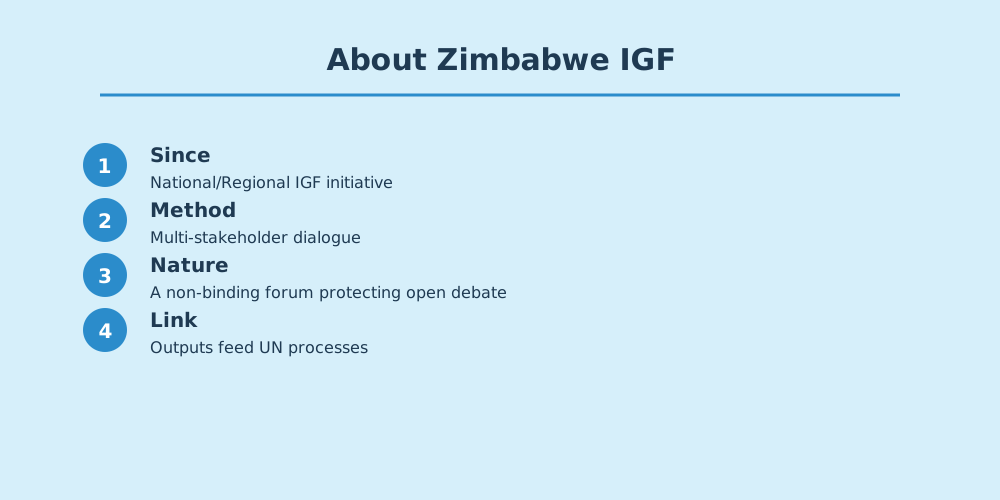
Zimbabwe IGF is a National or Regional IGF Initiative (NRI), aligning local internet governance discussion with global IGF principles.
Why It Matters to You
What was discussed here becomes the baseline for national digital policy, platform rules and AI regulation worldwide within a few years. The principles confirmed at the 2017 meeting are the foundation of the "next rules" for the phones, social platforms and AI services you use every day.
Sources & References
- Report of the 2017 Public Meeting of the Zimbabwe Internet Governance Forum (ZIGF)(公式報告書: 日付・会場・70名参加・全セッション・選挙結果) — ZIGF(国連IGF filedepot経由) (accessed 2026-07-11)
- NRIs Annual Meetings 2017(事前掲載: Zimbabwe IGF 11 December, Harare) — 国連IGF事務局 (accessed 2026-07-11)
- ZIGF 2017 Live Streaming(旧公式サイトブログ、2017-12-31時点のWayback Machine保存: 12月14日ジンバリ・ガーデンズ開催とNewsDayによる中継を告知) — ZIGF(zigf.org.zw、Internet Archive経由) (accessed 2026-07-11)
- Zimbabwe IGF(NRI公式記録: 年次報告リンクは2017年版が最新) — 国連IGF事務局 (accessed 2026-07-11)
Quotes are translated or condensed from the records listed above. Bracketed numbers [n] refer to the source list.
Related links
- IGF official (NRI list): https://www.intgovforum.org/en/content/national-and-regional-igf-initiatives
- Japan IGF: https://japanigf.jp/
- Yuki Nakazawa's blog: https://nkzw.jp/category/igf/
更新履歴
第1稿投稿 2026年7月22日 12時29分(記事コンテンツアップ)
— 中澤祐樹