


The 3-Line Summary
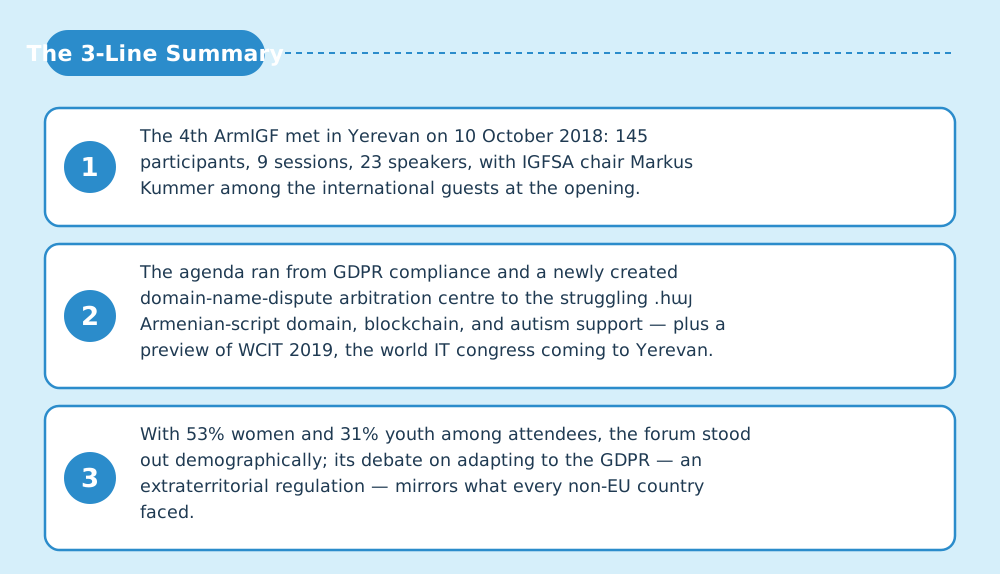
- The 4th ArmIGF met in Yerevan on 10 October 2018: 145 participants, 9 sessions, 23 speakers, with IGFSA chair Markus Kummer among the international guests at the opening.
- The agenda ran from GDPR compliance and a newly created domain-name-dispute arbitration centre to the struggling .հայ Armenian-script domain, blockchain, and autism support — plus a preview of WCIT 2019, the world IT congress coming to Yerevan.
- With 53% women and 31% youth among attendees, the forum stood out demographically; its debate on adapting to the GDPR — an extraterritorial regulation — mirrors what every non-EU country faced.
Welcome — this is the Japan IGF Support Organization. This in-depth report on The IV Armenian Internet Governance Forum (ArmIGF 2018) draws on official outputs, session records and on-site reporting. In a hurry? The three lines above and the diagrams carry the gist.
Conference at a Glance (from official records)
| Item | Detail |
|---|---|
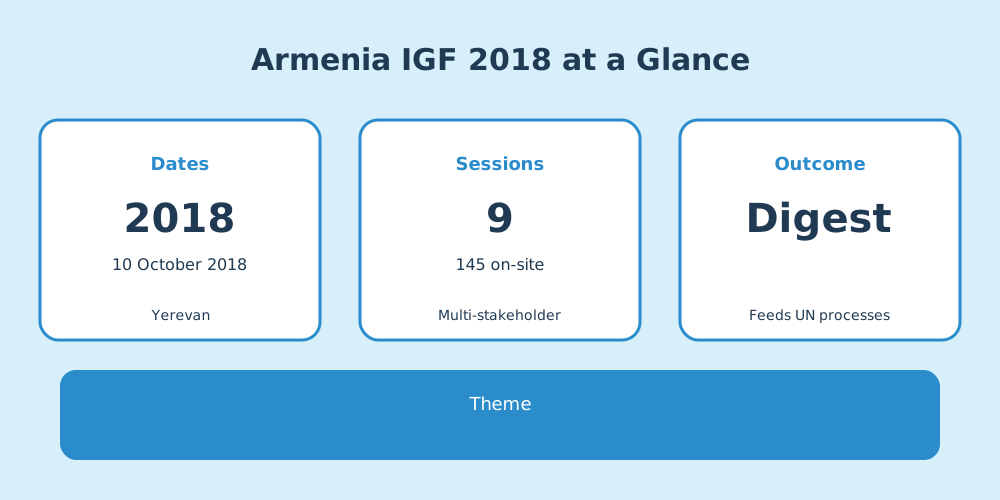
| Official name | The IV Armenian Internet Governance Forum (ArmIGF 2018) |
| Dates | 10 October 2018 |
| Venue | Yerevan |
| Theme | Regional governance themes |
| Participants | 145 |
| Sessions | 9 |
| Speakers | 23 |
| Opening | Opened by Minister Hakob Arshakyan, IGFSA chair Markus Kummer, ISOC's Frédéric Donck and RIPE NCC's Chris Buckridge, with certificates awarded to graduates of the 2nd Armenian School on Internet Governance (ArmSIG) |
| Host | Organised by the multistakeholder Internet Governance Council (IGC) with the support of the Ministry of Transport, Communication and Information Technologies and the Internet Society NGO |
(See the source list at the end of this article.)
Discussion Digest — from the Session Records
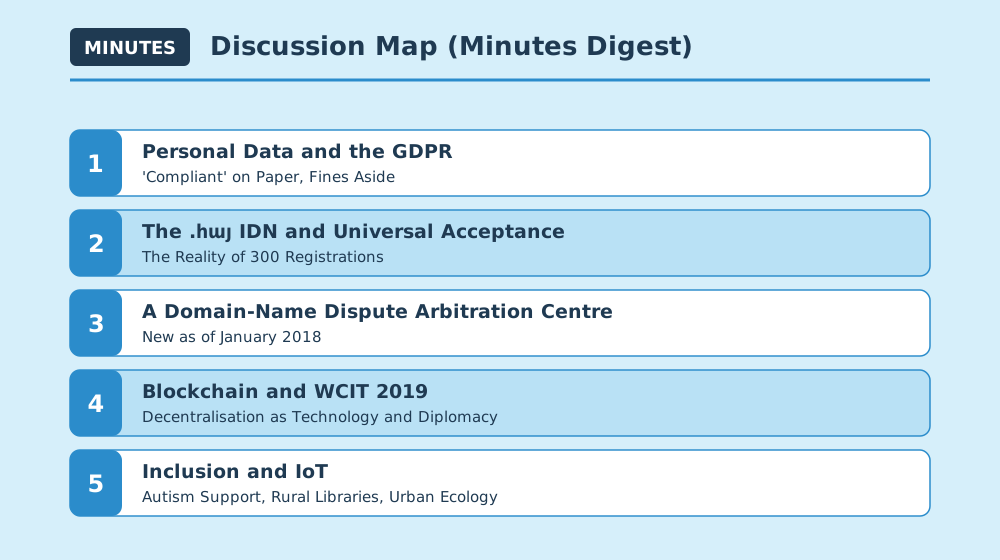
Key exchanges extracted from session records and transcripts.
1. Personal Data and the GDPR — 'Compliant' on Paper, Fines Aside
Sessions: Session 'Personal Data Protection: National Legislation Compliance to GDPR'
- Data Protection Agency head Gevorg Hayrapetyan said Armenia's 2015 law aligned with the GDPR — while the report notes it lacks GDPR-scale fines [2]
- The police cybercrime unit explained cross-border data requests via national focal points; ICANN's Alexandra Kulikova presented fixes for the GDPR-shaken WHOIS database [2]
- Participants agreed that non-conflicting data-protection rules would require studying the emerging practice across countries [2]
2. The .հայ IDN and Universal Acceptance — The Reality of 300 Registrations
Sessions: Session '".հայ" IDN and Universal Acceptance' (moderated by IGC chair Grigori Saghyan)
- Lianna Galstyan reported frankly that .հայ had only about 300 registrations, and outlined ISOC's promotion work [2]
- The state Language Committee's vice-chair pledged cooperation, framing .հայ adoption as part of enforcing Armenian-language policy — domain policy meeting language policy [2]
- UASG ambassador Dušan Stojičević argued government support is essential for a truly multilingual internet navigable entirely in local languages [2]
3. A Domain-Name Dispute Arbitration Centre — New as of January 2018
Sessions: Session 'Arbitration Centre of Settlement of Domain Name Disputes Foundation'
- Lawyer Ani Varderesyan traced alternative domain-dispute resolution back to WIPO's 1999 report, reporting that a new registration policy for .am and .հայ led to the arbitration centre's creation in January 2018 [2]
- Pitched as faster than courts and free of conflict-of-laws problems, it stands as a UDRP-style implementation in a small ccTLD [2]
4. Blockchain and WCIT 2019 — Decentralisation as Technology and Diplomacy
Sessions: 'Blockchain Talk' (Nooor Blockchain Association) and 'WCIT 2019: Update' (UATE)
- Nooor founder Vigen Arushanyan walked through decentralisation and distribution as blockchain's core features, ten years after Bitcoin's creation [2]
- UATE's Karen Vardanyan previewed WCIT 2019 in Yerevan — 'Fulfilling the Promise of the Digital Age: The Power of Decentralization', expecting 2,000+ delegates from 60 countries [2]
- Decentralisation thus linked the technical session and the country's flagship conference diplomacy [2]
5. Inclusion and IoT — Autism Support, Rural Libraries, Urban Ecology
Sessions: 'Disability Challenges: Autism and the Society', 'Online Educational Platforms in Armenian', 'Urban Ecology Monitoring System using IoT'
- The TMM centre showed video-modelling speech support for autistic children; Armenian-language e-learning was represented by the 3,000-student AGBU Virtual University and ISOC's project that has put 100+ computers into rural libraries over six years [2]
- Smaller technical-market topics — IoT urban-ecology monitoring, the economics of sub-regional ad geo-targeting that pits operators against advertisers — got their own slots [2]
Three-Minute Short Talk — Your Questions Answered
Q. What did this meeting decide?
A. Nothing binding, but the 145 participants worked through issues with direct practical consequences — GDPR adaptation, and the debut of a brand-new domain-dispute arbitration centre.
Q. The most striking number?
A. 300 — the total registrations in the much-heralded Armenian-script .հայ domain. The organisers admitted it openly and debated remedies head-on.
Q. Why should I care?
A. How non-EU countries absorb the GDPR was 2018's universal homework, and the .հայ adoption struggle echoes the fate of internationalised domain names everywhere.
What Is Armenia IGF? (for first-time readers)
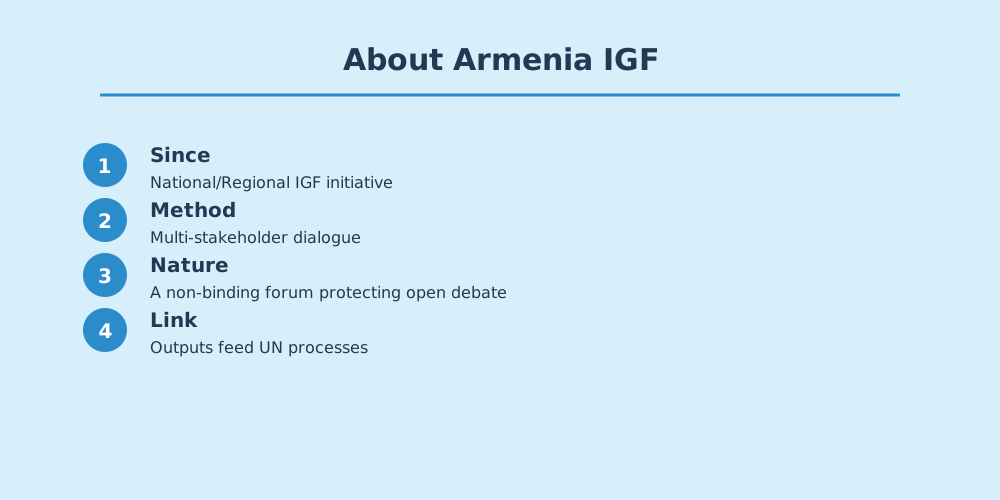
Armenia IGF is a National or Regional IGF Initiative (NRI), aligning local internet governance discussion with global IGF principles.
Why It Matters to You
What was discussed here becomes the baseline for national digital policy, platform rules and AI regulation worldwide within a few years. The principles confirmed at the 2018 meeting are the foundation of the "next rules" for the phones, social platforms and AI services you use every day.
Sources & References
- The IV Armenian Internet Governance Forum(公式英語ページ) — ArmIGF公式サイト (accessed 2026-07-11)
- ArmIGF 2018 Annual Report(公式報告書・英語) — ArmIGF公式サイト (accessed 2026-07-11)
- Armenian Internet Governance Forum (ArmIGF)(第4回・2018年10月10日の概要) — DiploFoundation (accessed 2026-07-11)
- Armenian Internet Governance Forum (ArmIGF)(系列概要) — Internet Society NGO(ISOC Armenia、.am/.հայレジストリ) (accessed 2026-07-11)
Quotes are translated or condensed from the records listed above. Bracketed numbers [n] refer to the source list.
Related links
- IGF official (NRI list): https://www.intgovforum.org/en/content/national-and-regional-igf-initiatives
- Japan IGF: https://japanigf.jp/
- Yuki Nakazawa's blog: https://nkzw.jp/category/igf/
Revision History
Rev. 1 — published 17 June 2018, 10:00 (Article published)
Rev. 2 — updated 17 July 2026, 12:32 (Fully revised into the in-depth edition: added the 3-line summary, minutes digest, short talk, source list and diagrams (all quotes verified against the listed sources))
— 中澤祐樹

