
The 3-Line Summary
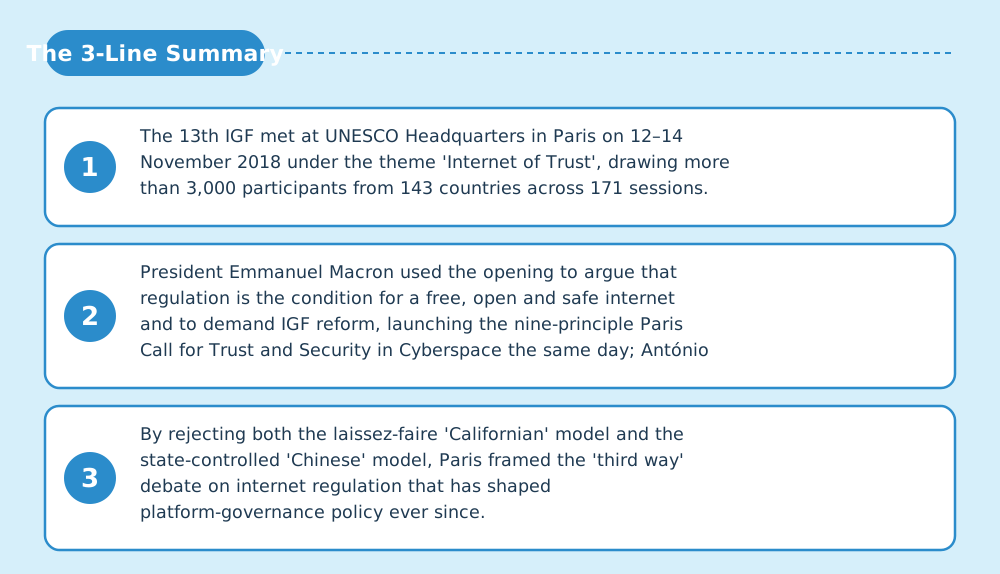
- The 13th IGF met at UNESCO Headquarters in Paris on 12–14 November 2018 under the theme 'Internet of Trust', drawing more than 3,000 participants from 143 countries across 171 sessions.
- President Emmanuel Macron used the opening to argue that regulation is the condition for a free, open and safe internet and to demand IGF reform, launching the nine-principle Paris Call for Trust and Security in Cyberspace the same day; António Guterres became the first UN Secretary-General to open an IGF in person.
- By rejecting both the laissez-faire 'Californian' model and the state-controlled 'Chinese' model, Paris framed the 'third way' debate on internet regulation that has shaped platform-governance policy ever since.
Welcome — this is the Japan IGF Support Organization. This in-depth report on Global IGF 2018 in Paris draws on official outputs, session records and on-site reporting. In a hurry? The three lines above and the diagrams carry the gist.
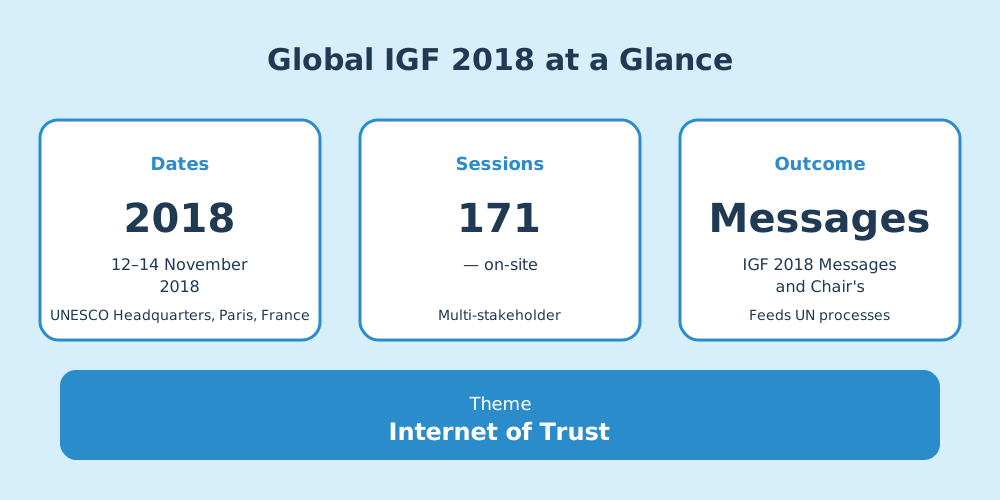
Conference at a Glance (from official records)
| Item | Detail |
|---|---|
| Edition | 13th annual meeting of the IGF |
| Dates | 12–14 November 2018 |
| Venue | UNESCO Headquarters, Paris, France |
| Theme | Internet of Trust |
| Participants | 3,000+ on-site delegates from 143 countries (62% first-time attendees, 43% women) |
| Online participants | About 1,400 online participants from 101 countries via 35 remote hubs |
| Sessions | 171 |
| Host | Government of France and the United Nations, hosted at UNESCO Headquarters |
| Outcome | IGF 2018 Messages and Chair's Summary; on day one President Macron launched the nine-principle Paris Call for Trust and Security in Cyberspace |
| Firsts | António Guterres became the first UN Secretary-General to open the IGF in person |
| Next host | Germany was announced as the 2019 host at the close |
(See the source list at the end of this article.)
Discussion Digest — from the Session Records
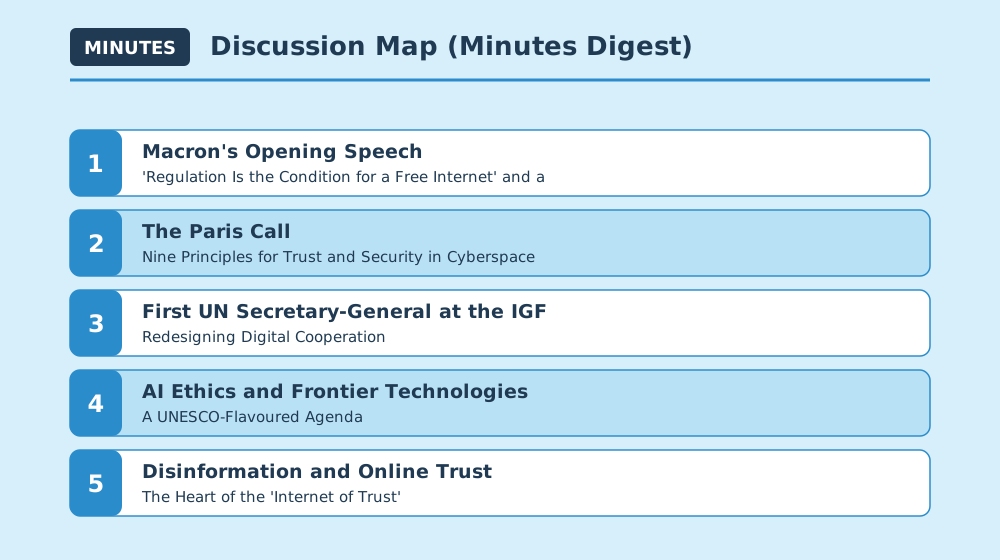
Key exchanges extracted from session records and transcripts.
1. Macron's Opening Speech — 'Regulation Is the Condition for a Free Internet' and a Challenge to the IGF
Sessions: Opening Ceremony (12 November, UNESCO Headquarters)
"I deeply believe regulation is needed. That is the condition for the success of a free, open and safe Internet"
— Emmanuel Macron (President of France) [2][3][4]
"Between leaving decisions up to the invisible hand of the market and mere state-directed development, the multi-stakeholder development of rules and regulation is the third and best way"
— Emmanuel Macron (President of France) [2][3][4]
- Macron rejected as a false alternative the choice between the self-regulating 'Californian' internet and the state-controlled 'Chinese' internet, casting cooperative rule-making as the 'third way' [2][3][4]
- He proposed that the IGF reform itself into 'a body producing tangible proposals' attached directly to the UN Secretary-General — a demand that ignited controversy over the future of the multistakeholder model [2][3][4]
- On intellectual property he defended regulation: 'Standing up for copyright does not mean strangling the internet. Quite the opposite.' [2][3][4]
2. The Paris Call — Nine Principles for Trust and Security in Cyberspace
Sessions: Announced by President Macron at the Opening Ceremony (12 November), in tandem with the Paris Peace Forum
- The Call set out nine principles, including protecting individuals and infrastructure, preventing damage to the general availability and integrity of the public core of the internet, defending electoral processes, and banning private-sector 'hack back' [4][7][8]
- It pioneered a format in which governments, companies and civil society endorse the same declaration — Microsoft and Google backed it, while the United States, China, Russia, Israel and Iran did not sign at launch [4][7][8]
- Support kept growing: by February 2021 it counted 79 states, 688 companies and 374 civil society organisations — over a thousand signatories, one of the largest multistakeholder cybersecurity declarations in the world [4][7][8]
3. First UN Secretary-General at the IGF — Redesigning Digital Cooperation
Sessions: Opening Ceremony (12 November) and closing sessions
"We cannot leave our fate in the digital age to the invisible hand of the market forces"
— António Guterres (UN Secretary-General) [3][5]
"When it comes to governance, we must be as creative and bold as those who first built the Internet"
— António Guterres (UN Secretary-General) [3][5]
- Guterres opened the IGF in person — a first for a UN Secretary-General — arguing that neither market forces alone nor classical forms of regulation are sufficient [3][5]
- He highlighted cooperation between the IGF and his High-level Panel on Digital Cooperation, launched that July — a thread that later led to the Global Digital Compact [3][5]
4. AI Ethics and Frontier Technologies — A UNESCO-Flavoured Agenda
Sessions: Opening remarks by Director-General Azoulay and AI / frontier-technology sessions
"(UNESCO will) launch a global dialogue on the ethical principles of artificial intelligence"
— Audrey Azoulay (Director-General of UNESCO) [6]
- The impact of AI and frontier technologies topped the agenda alongside the digital divide, gender equality, and countering hate speech and violent extremism [6]
- Host institution UNESCO championed an open, transparent and inclusive approach to internet governance and announced a global dialogue on AI ethics, putting the UN's education and culture agency at the centre of the AI governance debate [6]
5. Disinformation and Online Trust — The Heart of the 'Internet of Trust'
Sessions: Disinformation and trust sessions, and the closing session (14 November)
"Society, including a digital one, cannot function without trust"
— Fabrizio Hochschild (UN Assistant Secretary-General) [5]
"Inaction on the part of governments is not an option, given the challenges that our society face today"
— Mounir Mahjoubi (French Secretary of State for Digital Affairs) [5]
- Fake news and disinformation, data protection, cybersecurity and digital ethics ran through all three days, with consensus on the importance of the rule of law and global cooperation [5]
- Gender gaps and inclusion of under-represented stakeholders were also debated, with youth engagement stressed — over 71% of the world's young people were already online [5]
- Germany was announced as the 2019 host, carrying the 'regulation and trust' debate on to Berlin [5]
Three-Minute Short Talk — Your Questions Answered
Q. So what did the conference actually decide?
A. The IGF itself doesn't 'decide' anything — but host France used the stage to launch the Paris Call for Trust and Security in Cyberspace, nine principles endorsed not just by governments but by companies and NGOs alike, a new kind of international commitment.
Q. What was the most contentious moment?
A. President Macron's opening speech. He demanded the IGF reform itself into a body that produces tangible proposals and made an unapologetic case for regulation — prompting a fierce debate over whether this would weaken the multistakeholder model of internet governance.
Q. Why should I care?
A. The Paris Call principles on protecting elections from disinformation and citizens from cyberattacks became the foundation for platform regulation and cybersecurity policy worldwide. Today's debates on disinformation and AI rules trace straight back to the 'third way' framed in Paris.
What Is Global IGF? (for first-time readers)
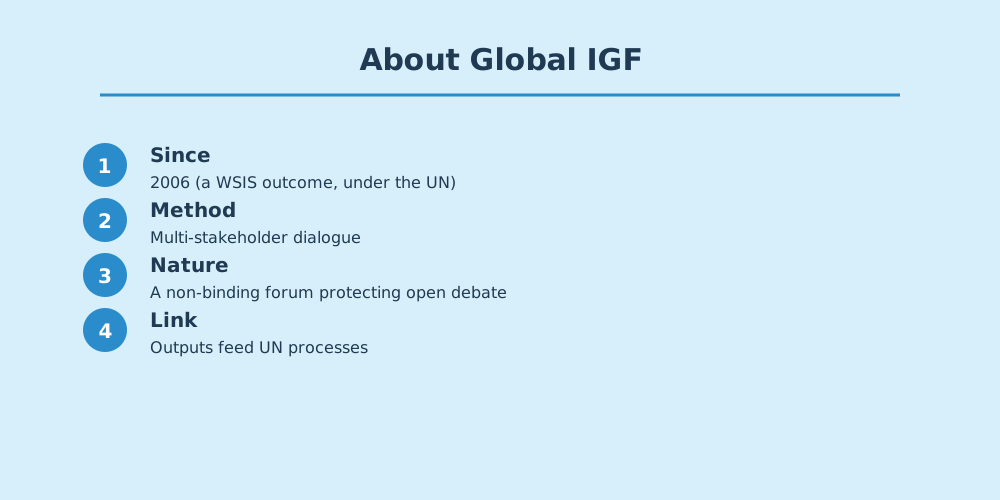
Global IGF has met annually under UN auspices since 2006 — the one global conference where governments, business, civil society, the technical community and youth debate internet governance as equals (the multistakeholder model).
Why It Matters to You
What was discussed here becomes the baseline for national digital policy, platform rules and AI regulation worldwide within a few years. The principles confirmed at the 2018 meeting are the foundation of the "next rules" for the phones, social platforms and AI services you use every day.
Sources & References
- IGF 2018 Attendance & Programme Statistics — UN IGF Secretariat (accessed 2026-07-10)
- IGF 2018 Speech by French President Emmanuel Macron(公式記録) — UN IGF Secretariat (accessed 2026-07-10)
- IGF Needs Bold Reform, Internet Needs More Regulation, Says President Macron — Intellectual Property Watch (accessed 2026-07-10)
- IGF 2018 Opening Plenary: French President Emmanuel Macron Urges More Regulation, Digital Cooperation, IGF Outputs — Elon University, Imagining the Internet (accessed 2026-07-10)
- Global cooperation and regulation key in addressing multilayered threats posed by new technology (IGF 2018 closes) — UN DESA (accessed 2026-07-10)
- Calling for an 'Internet of Trust', Internet Governance Forum opens annual meeting at UNESCO — UNESCO (accessed 2026-07-10)
- Cybersecurity: Paris Call for Trust and Security in Cyberspace — Permanent Mission of France to the UN (accessed 2026-07-10)
- The Paris Call and Activating Global Cyber Norms — German Marshall Fund of the United States (accessed 2026-07-10)
Quotes are translated or condensed from the records listed above. Bracketed numbers [n] refer to the source list.
Related links
- IGF official (NRI list): https://www.intgovforum.org/en/content/national-and-regional-igf-initiatives
- Japan IGF: https://japanigf.jp/
- Yuki Nakazawa's blog: https://nkzw.jp/category/igf/
Revision History
Rev. 1 — published 12 November 2018, 17:00 (Article published)
Rev. 2 — updated 10 July 2026, 14:28 (Fully revised into the in-depth edition: added the 3-line summary, minutes digest, short talk, source list and diagrams (all quotes verified against the listed sources))
— 中澤祐樹