

The 3-Line Summary
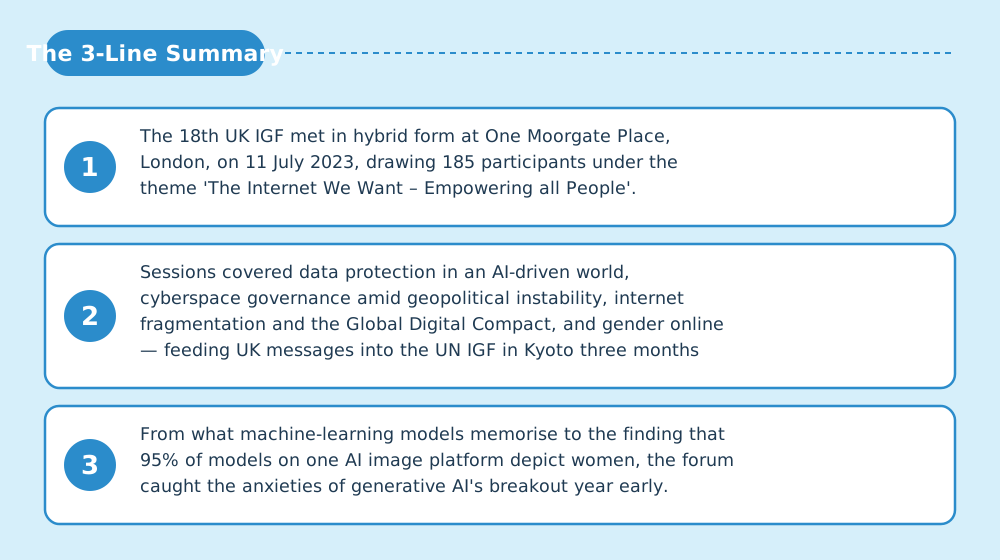
- The 18th UK IGF met in hybrid form at One Moorgate Place, London, on 11 July 2023, drawing 185 participants under the theme 'The Internet We Want – Empowering all People'.
- Sessions covered data protection in an AI-driven world, cyberspace governance amid geopolitical instability, internet fragmentation and the Global Digital Compact, and gender online — feeding UK messages into the UN IGF in Kyoto three months later.
- From what machine-learning models memorise to the finding that 95% of models on one AI image platform depict women, the forum caught the anxieties of generative AI's breakout year early.
Welcome — this is the Japan IGF Support Organization. This in-depth report on UK IGF 2023 draws on official outputs, session records and on-site reporting. In a hurry? The three lines above and the diagrams carry the gist.
Conference at a Glance (from official records)
| Item | Detail |
|---|---|
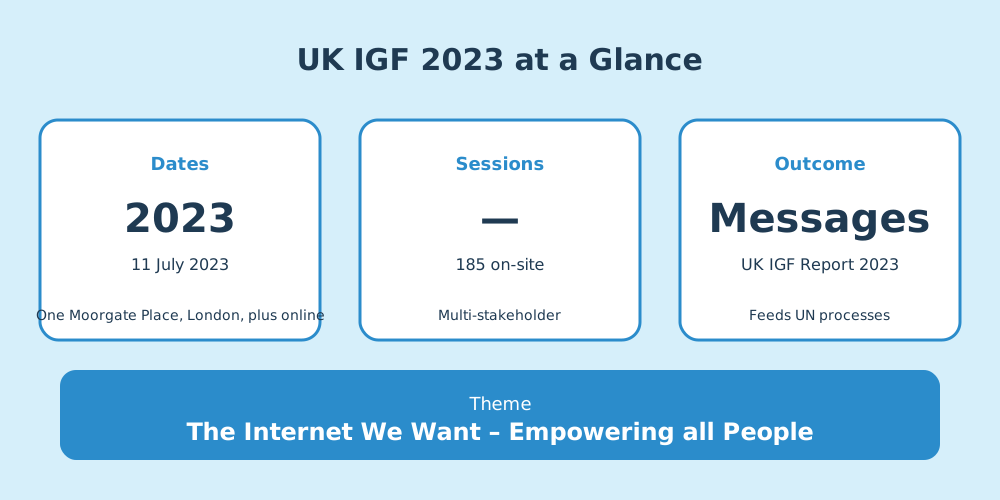
| Official name | UK IGF 2023 |
| Edition | 18th UK IGF (the official report describes the opening as 'the eighteenth UK Internet Governance Forum') |
| Dates | 11 July 2023 |
| Venue | One Moorgate Place, London, plus online (hybrid) |
| Theme | The Internet We Want – Empowering all People |
| Participants | 185 (185 representatives from government, civil society, industry, the technical community and academia; 50% first-time registrants and record youth attendance with over a third under 34) |
| Host | UK IGF Steering Committee (secretariat: Nominet); sponsored in 2023 by Nominet and ICANN |
| Outcome | UK IGF Report 2023, providing key messages for the UN IGF meeting in Kyoto, Japan (8–12 October 2023) |
(See the source list at the end of this article.)
Discussion Digest — from the Session Records
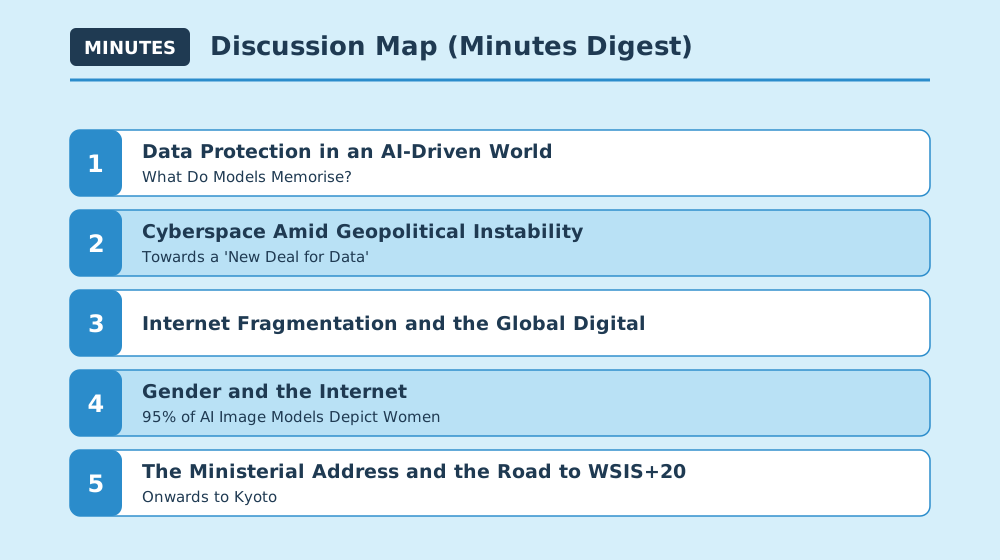
Key exchanges extracted from session records and transcripts.
1. Data Protection in an AI-Driven World — What Do Models Memorise?
Sessions: Panel 'Data Protection in an AI-Driven World' (10:05–11:05, chaired by Lord Allan)
- Dr Ana-Maria Cretu (Imperial College) explained ML models can memorise personal data, presenting post-hoc inference attacks that test whether sensitive attributes can be extracted — generative AI can also leak private records depending on training-data sources [1][3]
- Abigail Burke (Open Rights Group) warned algorithms can replicate and exacerbate discrimination from poor-quality data, and that the Data Protection and Digital Information Bill could weaken current law by making it easier for companies to deny data access [1][3]
- Georgia Osborn flagged an emerging clash between UK data protection law and the EU AI Act, which permits processing special category data to monitor and correct bias in high-risk AI systems [1][3]
2. Cyberspace Amid Geopolitical Instability — Towards a 'New Deal for Data'
Sessions: Panel 'Governance of Cyberspace During Times of Geopolitical Instability' (11:20–12:20, chaired by David Carroll)
- James Shires (Chatham House) mapped five geopolitical shifts affecting cyber governance, from renewed superpower conflict — the Russian invasion of Ukraine — to the blurring of economic and national security [1][3]
- The panel concluded that governance of cyberspace is central to keeping countries out of conflict and enabling individuals to access their rights and freedoms in full [1][3]
- Bojana Bellamy advocated international multilateral cooperation to forge a 'new deal for data' guaranteeing fair and justifiable access, against the backdrop of Russia's proposed UN information-security convention and the Cybercrime Convention negotiations [1][3]
3. Internet Fragmentation and the Global Digital Compact
Sessions: Panel 'Avoiding Internet Fragmentation and Creating a Shared Digital Future' (13:40–14:40, chaired by Casey Calista)
- Till Sommer (ISPA UK) argued there has never been a truly universal internet — a US-centric build-out simply met friction with other norms and values, making fractures visible [1][3]
- Izaan Khan located fragmentation at the technical, user-experience and governance layers, calling technical fragmentation the most damaging; he backed an 'IGF Plus' model and warned the proposed UN Digital Cooperation Forum could fragment governance further [1][3]
- A headline message of the forum: stakeholders must defend the multistakeholder model through the Global Digital Compact, the Summit of the Future and the WSIS+20 review [1][3]
4. Gender and the Internet — 95% of AI Image Models Depict Women
Sessions: Panel 'Gender and the Internet: A Source of Division or Community?' (14:45–15:45, chaired by Professor Katharine Millar)
- Dr Bernie Hogan (Oxford Internet Institute) reported that 95% of models on Civitai, one of the largest image-generation platforms, are of women — synthetic images are being used to objectify and terrorise women, with a global regulatory gap [1][3]
- Seyi Akiwowo (founder of Glitch) argued the internet can be made safe by centring minorities in its design and governance, and called for mandatory transparency reports from tech companies [1][3]
- Mallory Moore (Trans Safety Network) described how doxing feeds trolling and hate crime, urging that regulation should not assume the goodwill of governments or platform owners and technologies must defend users' rights by default [1][3]
5. The Ministerial Address and the Road to WSIS+20 — Onwards to Kyoto
Sessions: Ministerial address (Paul Scully MP, Minister for Tech and the Digital Economy, 17:00–17:45) + opening from Ellie Bradley (Nominet)
"…bringing 'prosperity, security and opportunity to communities in every corner of the globe'."
— Paul Scully MP (Minister for Tech and the Digital Economy) [1][3]
- Minister Scully reaffirmed the UK's commitment to a free, open and secure internet with day-to-day management led by the private sector and technical community, against Russian proposals for more multilateral governance [1][3]
- He traced the IGF's growth from its first session in Athens in 2006 to over 150 regional, national and youth forums, looking ahead to the UN IGF in Kyoto that October [1][3]
- Opening the forum, Ellie Bradley (Nominet) warned the WSIS+20 review in 2025 could mark a change in how the internet is governed, urging national IGFs to be active participants in the debate [1][3]
Three-Minute Short Talk — Your Questions Answered
Q. What was discussed?
A. The UK's national IGF in generative AI's breakout year: AI and data protection, cyberspace in wartime, internet fragmentation and gender online — all distilled into UK messages for the UN IGF in Kyoto that October.
Q. What was the most striking finding?
A. That 95% of models on one of the largest AI image-generation platforms depict women — while almost no jurisdiction regulates the distribution of synthetic images of real people.
Q. Why should I care?
A. The forum fed directly into the Kyoto UN IGF, and its debates on model memorisation and synthetic-image abuse are the same battles now playing out in AI regulation worldwide.
What Is UK IGF? (for first-time readers)
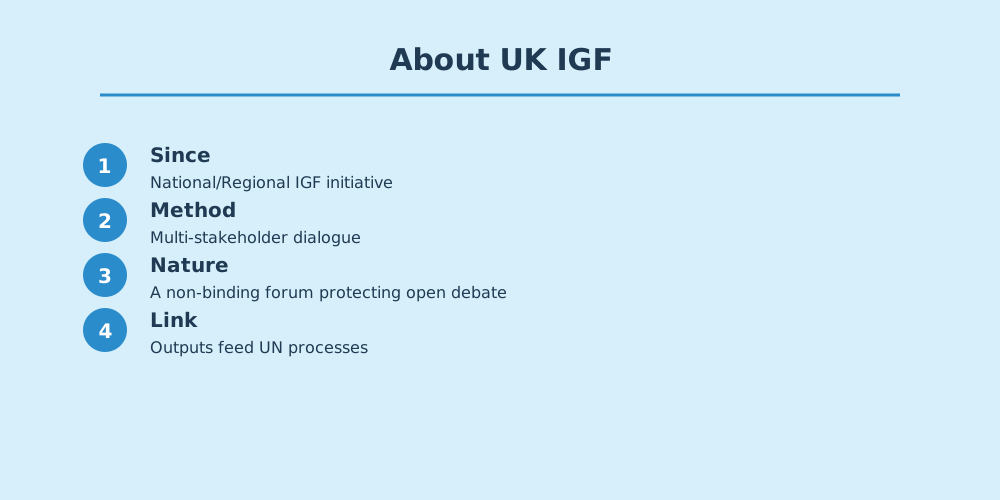
UK IGF is a National or Regional IGF Initiative (NRI), aligning local internet governance discussion with global IGF principles.
Why It Matters to You
What was discussed here becomes the baseline for national digital policy, platform rules and AI regulation worldwide within a few years. The principles confirmed at the 2023 meeting are the foundation of the "next rules" for the phones, social platforms and AI services you use every day.
Sources & References
- UK Internet Governance Forum Report 2023 (PDF) — UK IGF(事務局: Nominet) (accessed 2026-07-11)
- UK IGF 2023(公式イベントページ) — UK IGF (accessed 2026-07-11)
- 2023 Agenda — UK IGF (accessed 2026-07-11)
- 2023 Speakers — UK IGF (accessed 2026-07-11)
Quotes are translated or condensed from the records listed above. Bracketed numbers [n] refer to the source list.
Related links
- IGF official (NRI list): https://www.intgovforum.org/en/content/national-and-regional-igf-initiatives
- Japan IGF: https://japanigf.jp/
- Yuki Nakazawa's blog: https://nkzw.jp/category/igf/
Revision History
Rev. 1 — published 5 June 2023, 11:00 (Article published)
Rev. 2 — updated 16 July 2026, 20:09 (Fully revised into the in-depth edition: added the 3-line summary, minutes digest, short talk, source list and diagrams (all quotes verified against the listed sources))
— 中澤祐樹