


The 3-Line Summary
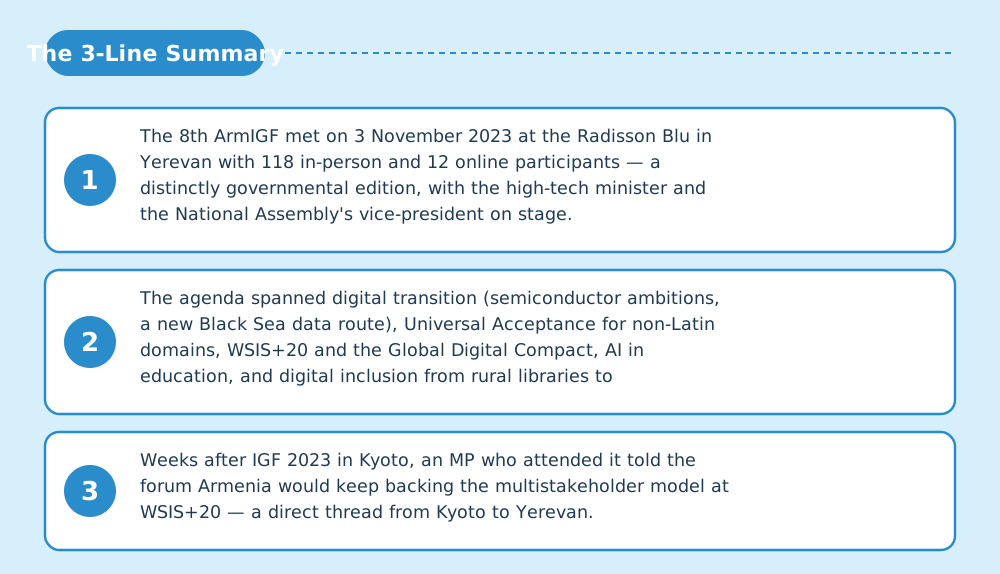
- The 8th ArmIGF met on 3 November 2023 at the Radisson Blu in Yerevan with 118 in-person and 12 online participants — a distinctly governmental edition, with the high-tech minister and the National Assembly's vice-president on stage.
- The agenda spanned digital transition (semiconductor ambitions, a new Black Sea data route), Universal Acceptance for non-Latin domains, WSIS+20 and the Global Digital Compact, AI in education, and digital inclusion from rural libraries to 'Anahit', an Armenian-language voice assistant.
- Weeks after IGF 2023 in Kyoto, an MP who attended it told the forum Armenia would keep backing the multistakeholder model at WSIS+20 — a direct thread from Kyoto to Yerevan.
Welcome — this is the Japan IGF Support Organization. This in-depth report on 8th Armenian Internet Governance Forum (ArmIGF 2023) draws on official outputs, session records and on-site reporting. In a hurry? The three lines above and the diagrams carry the gist.
Conference at a Glance (from official records)
| Item | Detail |
|---|---|
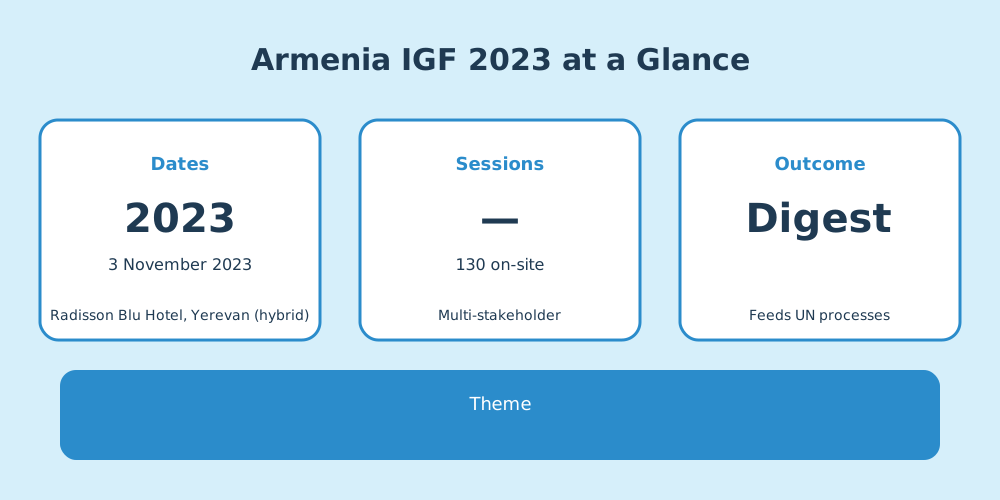
| Official name | 8th Armenian Internet Governance Forum (ArmIGF 2023) |
| Dates | 3 November 2023 |
| Venue | Radisson Blu Hotel, Yerevan (hybrid) |
| Theme | Regional governance themes |
| Participants | 130 |
| Host | The Ministry of High-Tech Industry, the Internet Governance Council (IGC), the Internet Society NGO and the ISOC Armenia Chapter |
(See the source list at the end of this article.)
Discussion Digest — from the Session Records
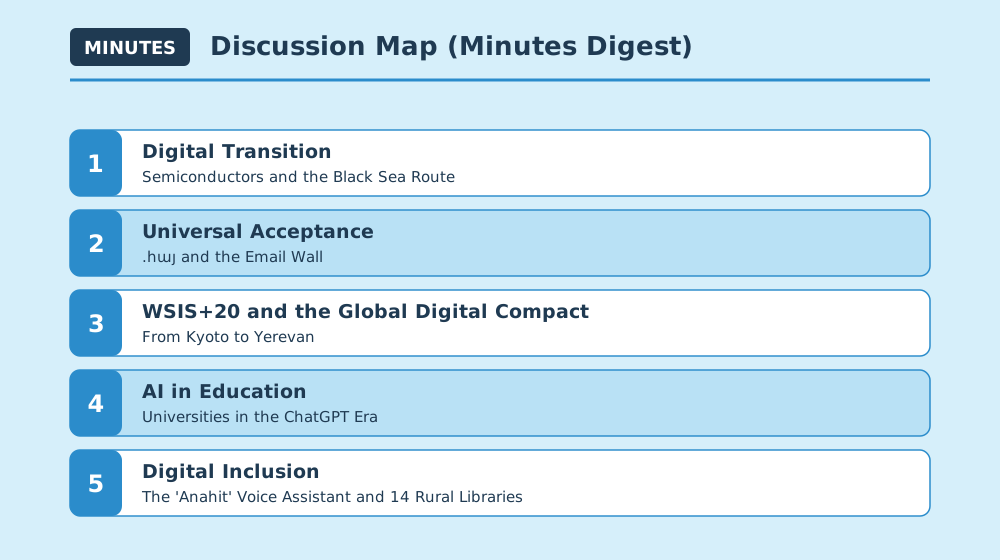
Key exchanges extracted from session records and transcripts.
1. Digital Transition — Semiconductors and the Black Sea Route
Sessions: Panel 'Digital challenges: solutions for society, government and the economy's digital transition' (10:30–12:00, moderated by Vahan Hovsepyan)
- Minister Robert Khachatryan outlined the five-year plan — modern identification, digitised public services — argued semiconductors could be a priority industry given Armenia's human capital, and named a new Europe–Black Sea–Armenia communications route as the ministry's top goal, positioning Armenia as a data-transit hub [1]
- Nerses Yeritsyan of the Information Systems Agency presented a four-layer national digital architecture (identity, delivery, integration, infrastructure) and the 'Yes Em' mobile/app ID [1]
- NA Vice-President Hakob Arshakyan announced a Science and Technology Development advisory council under the prime minister — while panellists vented openly about the slow pace of delivery [1]
2. Universal Acceptance — .հայ and the Email Wall
Sessions: Session 'Universal Acceptance as a part of the Internet we want' (12:00–13:00, moderated by Grigori Saghyan)
- Saghyan traced multilingual-internet commitments to the 2003 WSIS Geneva action plan and noted Armenian-script email fails wherever mail servers lack EAI support; training engineers and using government procurement as leverage were floated [1][2]
- Maria Kolesnikova of Russia's Coordination Center reported the identical problem for the Cyrillic .рф — proposing wide RFC notification, state-order leverage and coordination with major software developers [1][2]
- Registry board member Aram Verdyan reported successful Armenian-script email tests via UTF-8-ready providers such as Google, urging government involvement; a binding UN/ITU convention was raised as an option worth studying [1][2]
3. WSIS+20 and the Global Digital Compact — From Kyoto to Yerevan
Sessions: Session 'What is WSIS+20, its importance in the digital age, Global Digital Compact' (14:00–15:00, moderated by ICANN's Mikhail Anisimov)
"For countries that are landlocked, the Internet is a sea (official report)"
— Vahan Hovsepyan (RIPE NCC external relations officer, in the opening ceremony) [1][2]
"I'm happy to learn that Armenia has applied to host the ICANN policy forum in June 2025 (official report)"
— Mikhail Anisimov (ICANN Head of Global Stakeholder Engagement for Eastern Europe and Central Asia, in the opening ceremony) [1][2]
- Chris Buckridge of the IGF MAG walked through WSIS's Geneva–Tunis history, the IGF mandate renewals and the WSIS+20 Forum scheduled for May 2024 [1][2]
- MP and IGC member Aleksey Sandikov, fresh from the global IGF in Kyoto, said Armenia would keep supporting the current unified multistakeholder model of internet governance and take that position into WSIS+20 [1][2]
- Desiree Miloshevic of the RIPE Cooperation WG warned that the Global Digital Compact would be negotiated at the UN General Assembly — where the technical community, academia and civil society cannot negotiate — so those communities must lobby governments now with the Tunis Agenda's commitments [1][2]
4. AI in Education — Universities in the ChatGPT Era
Sessions: Panel 'Artificial Intelligence in studying and academic process' (15:00–16:00, moderated by Samvel Martirosyan, with faculty from six universities and institutes)
- 'Integrate, don't ban' set the tone: RAU's Sevak Sargsyan argued AI should be built into the educational system from the start, its potential harnessed rather than feared [1]
- Prof. Suren Edilyan threw down the gauntlet: Google and AI distribute knowledge better than lecturers, so teachers must instead cultivate questioning students who solve real community problems [1]
- Speakers described an 'asynchronous adaptation' gap between staff and students accelerated by COVID and ChatGPT — while an IT-department instructor noted AI-written submissions are actually easy to spot [1]
5. Digital Inclusion — The 'Anahit' Voice Assistant and 14 Rural Libraries
Sessions: Session 'Digital Inclusion (ISOC Armenia chapter's activities)' (16:20–17:20, moderated by chapter chair Vesmira Harutyunyan)
- The Lori-region project equipping rural libraries with broadband, Wi-Fi and videoconferencing hit its goal: about 14 libraries now operate as community internet centres [1]
- An IoT course for 80+ teenagers, run with UNICEF across five cities, produced 'Anahit' — a voice assistant that understands Armenian dialects, destined for the House of Culture for the Blind's smart room [1]
- The chapter set these local wins against ISOC's global picture: roughly half the world's population still offline, most of them low-income households [1]
Three-Minute Short Talk — Your Questions Answered
Q. What did this meeting decide?
A. Nothing binding — but the minister presented the digital five-year plan, and Armenia's position for WSIS+20 (backing the multistakeholder model) was stated publicly on the record.
Q. What stood out?
A. The Kyoto connection: an MP who had just attended the global IGF in Kyoto reported back and framed Armenia's stance for the UN's internet-governance review — a national IGF working exactly as designed.
Q. Why should I care?
A. Armenian-script email failing in global systems is the same Universal Acceptance problem facing every non-Latin language, and the ChatGPT-in-universities debate is playing out in every country's classrooms.
What Is Armenia IGF? (for first-time readers)
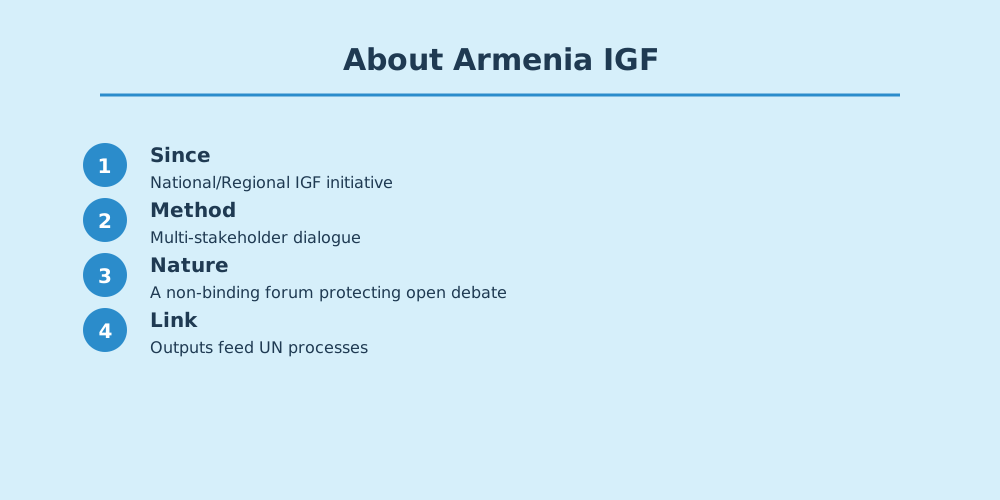
Armenia IGF is a National or Regional IGF Initiative (NRI), aligning local internet governance discussion with global IGF principles.
Why It Matters to You
What was discussed here becomes the baseline for national digital policy, platform rules and AI regulation worldwide within a few years. The principles confirmed at the 2023 meeting are the foundation of the "next rules" for the phones, social platforms and AI services you use every day.
Sources & References
- Armenian Internet Governance Forum Report 2023(公式報告書・英語・65ページ) — ISOC Armenia Chapter(chronicleアーカイブ) (accessed 2026-07-11)
- Armenian Internet Governance Forum 2023(参加報告) — ロシアTLD調整センター(Coordination Center for TLD .RU/.РФ) (accessed 2026-07-11)
- Armenian Internet Governance Forum – ArmIGF 8(助成記録) — Internet Society Foundation (accessed 2026-07-11)
- Armenia IGF(NRI登録ページ。直接取得は403のため検索スニペットで「The 8th meeting of the Armenia IGF was held in hybrid format on 3 November 2023」を確認) — 国連IGF事務局(intgovforum.org) (accessed 2026-07-11)
Quotes are translated or condensed from the records listed above. Bracketed numbers [n] refer to the source list.
Related links
- IGF official (NRI list): https://www.intgovforum.org/en/content/national-and-regional-igf-initiatives
- Japan IGF: https://japanigf.jp/
- Yuki Nakazawa's blog: https://nkzw.jp/category/igf/
Revision History
Rev. 1 — published 19 June 2023, 09:00 (Article published)
Rev. 2 — updated 17 July 2026, 12:32 (Fully revised into the in-depth edition: added the 3-line summary, minutes digest, short talk, source list and diagrams (all quotes verified against the listed sources))
— 中澤祐樹

