

The 3-Line Summary
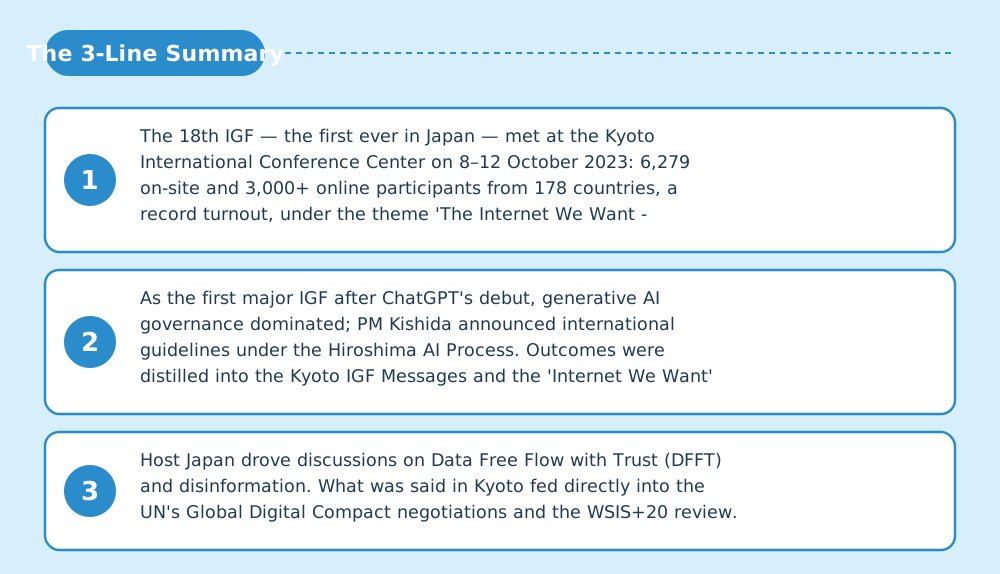
- The 18th IGF — the first ever in Japan — met at the Kyoto International Conference Center on 8–12 October 2023: 6,279 on-site and 3,000+ online participants from 178 countries, a record turnout, under the theme 'The Internet We Want – Empowering All People.'
- As the first major IGF after ChatGPT's debut, generative AI governance dominated; PM Kishida announced international guidelines under the Hiroshima AI Process. Outcomes were distilled into the Kyoto IGF Messages and the 'Internet We Want' vision paper.
- Host Japan drove discussions on Data Free Flow with Trust (DFFT) and disinformation. What was said in Kyoto fed directly into the UN's Global Digital Compact negotiations and the WSIS+20 review.
Welcome — this is the Japan IGF Support Organization. This in-depth report on Global IGF 2023 in Kyoto draws on official outputs, session records and on-site reporting. In a hurry? The three lines above and the diagrams carry the gist.
Conference at a Glance (from official records)
| Item | Detail |
|---|---|
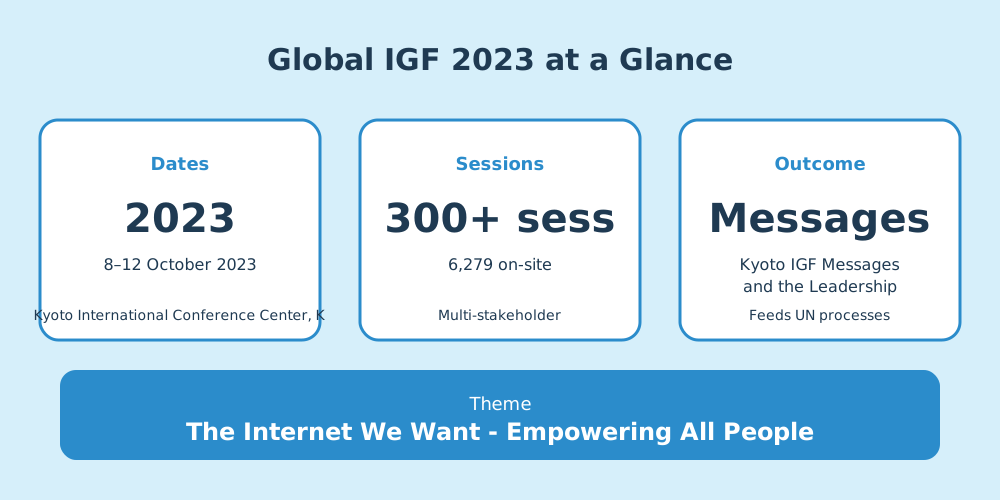
| Edition | 18th annual IGF; the first ever held in Japan |
| Dates | 8–12 October 2023 |
| Venue | Kyoto International Conference Center, Kyoto, Japan |
| Theme | The Internet We Want – Empowering All People |
| On-site participants | 6,279 |
| Online participants | 3,000+ online (per MIC Japan: 9,279+ total onsite and online) |
| Countries | 178 |
| Sessions | 300+ sessions (dig.watch tally: 300 sessions, 1,240 speakers) |
| Sub-themes | 8 |
| Host | Government of Japan (Ministry of Internal Affairs and Communications) and the United Nations |
| Outcome | Kyoto IGF Messages and the Leadership Panel's 'The Internet We Want' vision paper |
| Record | Highest-ever on-site IGF attendance at the time |
(See the source list at the end of this article.)
Discussion Digest — from the Session Records
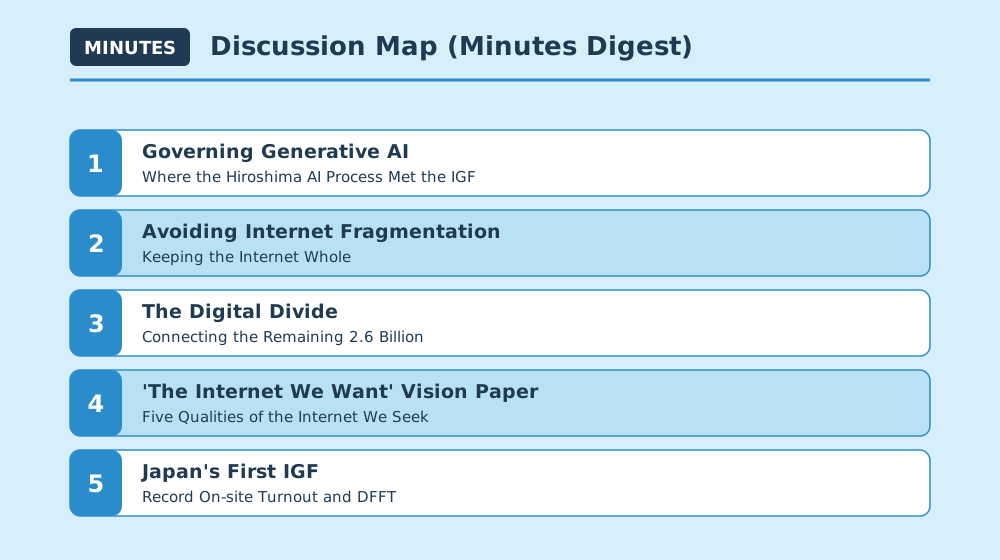
Key exchanges extracted from session records and transcripts.
1. Governing Generative AI — Where the Hiroshima AI Process Met the IGF
Sessions: Opening ceremony and AI special session (9 October), plus numerous AI-related sessions
"Generative AI is expected to accelerate innovation in a wide range of fields and bring dramatic change to the world"
— Kishida Fumio (Prime Minister of Japan) [3][4][8]
- AI was the most-discussed topic of the whole forum: in dig.watch's analysis of 3.2 million spoken words, 'AI' topped the list of most-mentioned terms [3][4][8]
- PM Kishida announced that under the G7 Hiroshima AI Process, international guidelines and a code of conduct for generative-AI developers would be drawn up within the year, and called on a broad range of actors to address fake images and disinformation [3][4][8]
- Debates centred on balancing regulation with technical standards — 'a balanced mix of voluntary standards and legal frameworks' — and on AI governance inclusive of the Global South [3][4][8]
2. Avoiding Internet Fragmentation — Keeping the Internet Whole
Sessions: Sessions under the 'Avoiding Internet Fragmentation' sub-theme; opening ceremony (9 October)
"The Internet must remain open, free, global, interoperable, secure, and trustworthy"
— Kishida Fumio (Prime Minister of Japan) [4][5][7]
- Participants shared alarm that geopolitical tensions, digital protectionism and censorship threaten the internet's open nature; 'international norms are critical to reducing the risk of fragmentation' [4][5][7]
- 'Avoiding Internet Fragmentation' was one of the eight sub-themes, covering both technical-layer fragmentation (state-ordered shutdowns) and regulatory fragmentation [4][5][7]
3. The Digital Divide — Connecting the Remaining 2.6 Billion
Sessions: Opening ceremony (video message by UN Secretary-General Guterres) and inclusion/connectivity sessions
"We must work together to close the connectivity gap and bring the remaining 2.6 billion people online"
— António Guterres (UN Secretary-General, video message) [4][5][6]
"We must not forget the 2 billion people who remain completely excluded from internet-governance discussions"
— Terezinha Alves Brito (CGI.br youth programme fellow) [4][5][6]
- Discussions moved beyond connectivity itself to 'meaningful access' — device affordability and digital-skills training [4][5][6]
- Digital technologies were noted to account for 1–5% of greenhouse-gas emissions; sustainability and the environment, including AI's carbon footprint, formed one of the sub-themes [4][5][6]
4. 'The Internet We Want' Vision Paper — Five Qualities of the Internet We Seek
Sessions: Launch and press briefing by the IGF Leadership Panel (9 October)
"Unless we figure out how to achieve 'the Internet we want,' we will not get it"
— Vint Cerf (Chair, IGF Leadership Panel) [3][6][7]
- The Leadership Panel of Chair Vint Cerf and Vice-Chair Maria Ressa set out five qualities of the internet we want: whole and open; universal and inclusive; free-flowing and trustworthy; safe and secure; and rights-respecting [3][6][7]
- The paper framed digital governance as 'critical for economic, social and environmental development, and a crucial enabler of sustainable development,' feeding into the Global Digital Compact negotiations [3][6][7]
- Over 7,000 entities were reported to have provided input to the GDC consultation phase; the WSIS+20 review of 2025 and the IGF's future were debated alongside [3][6][7]
5. Japan's First IGF — Record On-site Turnout and DFFT
Sessions: High-level sessions (DFFT, disinformation, WSIS+20, SDGs) and the IGF Village exhibition
"The internet is not only indispensable to daily life and socio-economic activity — it is critically important as the foundation of a democratic society"
— Kishida Fumio (Prime Minister of Japan) [1][2][5][7]
- 6,279 on-site and 3,000+ online participants — 9,279+ in total from 178 countries — made this the largest on-site IGF ever at the time [1][2][5][7]
- Japan-championed DFFT (Data Free Flow with Trust) and countering disinformation headlined the high-level sessions; Japan's MIC hosted 10 sessions and 72 companies and organisations from around the world exhibited at the IGF Village [1][2][5][7]
- Keio University's Jun Murai recalled how the 1995 Great Hanshin-Awaji Earthquake taught him the importance of the internet and international cooperation, voicing hope that Japan would be a starting point for the ethical use of the internet [1][2][5][7]
Three-Minute Short Talk — Your Questions Answered
Q. So what did the conference actually decide?
A. The IGF doesn't 'decide' — it's the UN forum where governments, companies and civil society talk as equals. But the Kyoto discussions were distilled into the Kyoto IGF Messages, which fed straight into the UN's Global Digital Compact negotiations and the WSIS+20 review.
Q. What was the biggest topic?
A. Generative AI. This was the first major IGF after ChatGPT's debut, and 'AI' became the most-spoken word of the forum. PM Kishida announced that the G7 Hiroshima AI Process would produce international guidelines for generative-AI developers.
Q. Why did hosting it in Japan matter?
A. On-site attendance hit a record 6,279, Japan's own policy concept DFFT (Data Free Flow with Trust) headlined the high-level sessions, and a generation of Japanese students and engineers got direct exposure to global internet-governance debates.
What Is Global IGF? (for first-time readers)
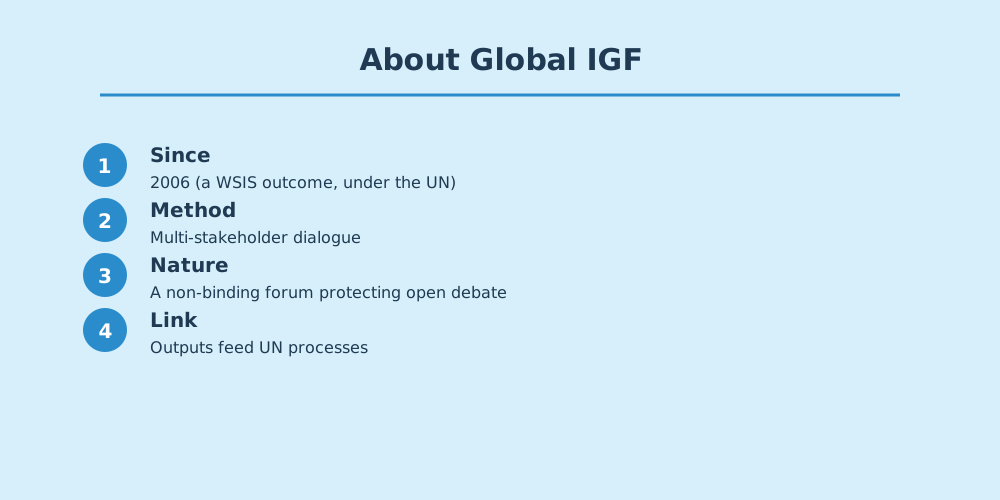
Global IGF has met annually under UN auspices since 2006 — the one global conference where governments, business, civil society, the technical community and youth debate internet governance as equals (the multistakeholder model).
Why It Matters to You
What was discussed here becomes the baseline for national digital policy, platform rules and AI regulation worldwide within a few years. The principles confirmed at the 2023 meeting are the foundation of the "next rules" for the phones, social platforms and AI services you use every day.
Sources & References
- IGF(インターネット・ガバナンス・フォーラム)— IGF京都2023の開催結果 — 総務省 (accessed 2026-07-10)
- Results of the Internet Governance Forum Kyoto 2023 (Press Release) — Ministry of Internal Affairs and Communications (accessed 2026-07-10)
- UN calls for urgent action to enable opportunities, mitigate risks for information and digital technology — closing press release (accessed 2026-07-10)
- IGF 2023 – Final Report — DiploFoundation (accessed 2026-07-10)
- Opening Ceremony | IGF 2023 (session report) — DiploFoundation (accessed 2026-07-10)
- JPNIC News & Views vol.2037【臨時号】IGF 2023(第18回インターネットガバナンスフォーラム)報告 [後編] — JPNIC(日本ネットワークインフォメーションセンター) (accessed 2026-07-10)
- 【IGF 2023レポート1】中澤の望むインターネットを実現するために——開会式ハイライト — D for Good! by Impress Sustainable Lab. (accessed 2026-07-10)
- 岸田文雄首相「経済対策でAIの開発・導入促進」国連会議で — 日本経済新聞 (accessed 2026-07-10)
Quotes are translated or condensed from the records listed above. Bracketed numbers [n] refer to the source list.
Related links
- IGF official (NRI list): https://www.intgovforum.org/en/content/national-and-regional-igf-initiatives
- Japan IGF: https://japanigf.jp/
- Yuki Nakazawa's blog: https://nkzw.jp/category/igf/
Revision History
Rev. 1 — published 8 October 2023, 09:00 (Article published)
Rev. 2 — updated 10 July 2026, 14:28 (Fully revised into the in-depth edition: added the 3-line summary, minutes digest, short talk, source list and diagrams (all quotes verified against the listed sources))
— 中澤祐樹

